
Chicken Stock
Bones, mirepoix, water, three hours of low simmer. The recipe that turns the abstract glossary words — stock, broth, fond — into a thing in a jar.
Contents (6 sections)▾
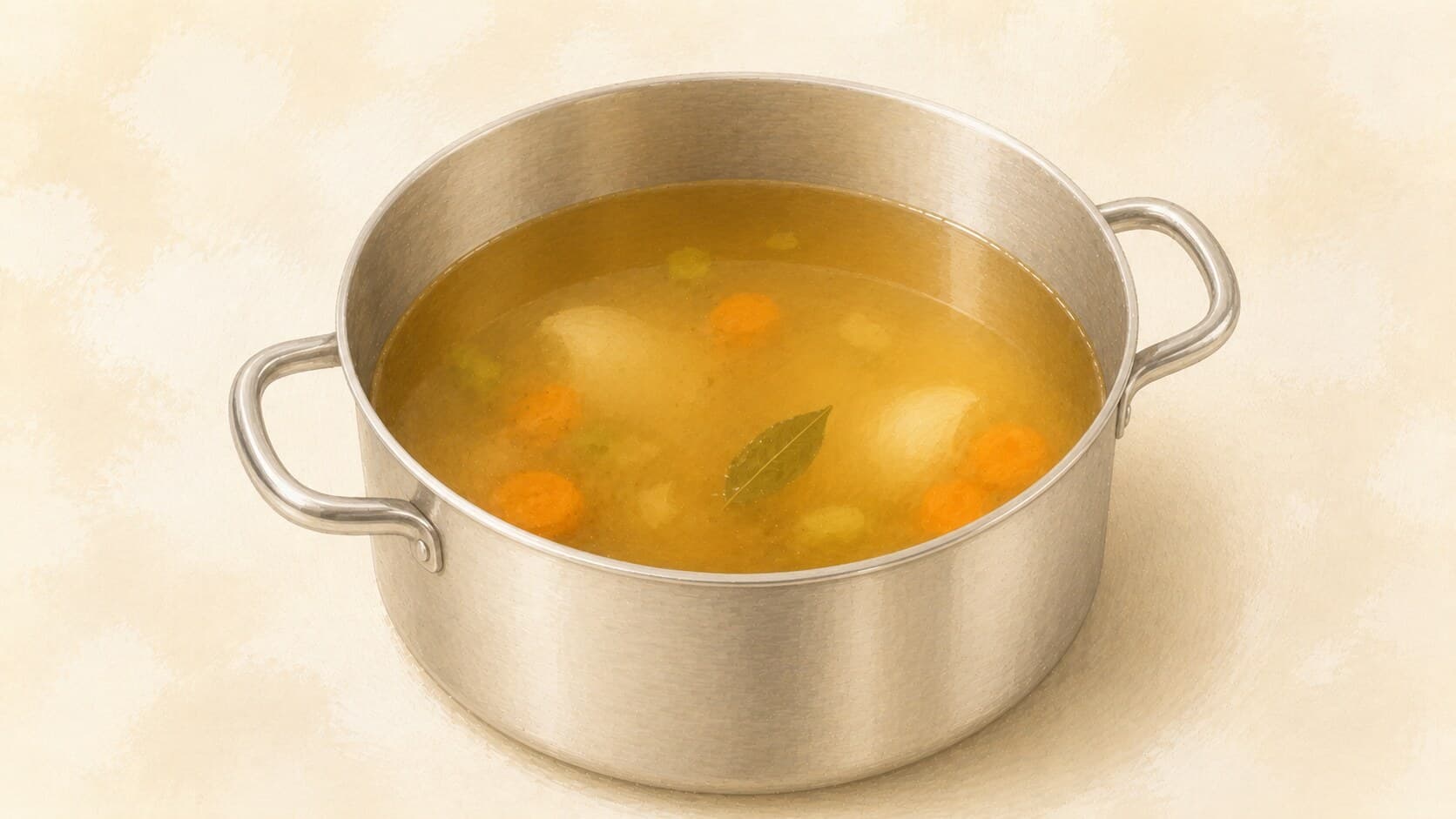
Ingredients
- 1.5 kg chicken bones — backs, wings, necks, or a carcass left over from a roast
- 1 large onion, halved (skin on for color, optional)
- 1 medium carrot, cut into 3 pieces
- 1 stalk celery, cut into 3 pieces
- 1 bay leaf
- 5 g whole black peppercorns
- 2–3 sprigs fresh thyme or parsley stems
- Cold water — about 3 L, enough to cover the bones by 5 cm
- (No salt — stock is unsalted; seasoning happens in the dish it builds)
Steps
If you want a white stock — pale, clean, multi-purpose — place the bones in a stockpot, cover with cold water by 5 cm, and bring to a simmer over medium heat. As scum rises in the first 10 minutes, skim it off with a ladle. (Cold-water start matters: it gradually draws proteins out of the bones into the water, where they coagulate as foam at the surface and can be removed. Hot-water start traps those proteins inside the bones, leaving a less clean stock.)
For a brown stock — deeper, more savory — roast the bones first at 220°C for 30–40 minutes, until deep golden, then proceed with cold water as above. The roasted bones contribute Maillard depth and the stock takes on a darker amber color. Both methods are correct; the choice depends on the dishes the stock will support.
Once the scum has been skimmed and the water is clear, add the mirepoix (onion, carrot, celery), bay leaf, peppercorns, and herbs. Reduce heat to the lowest possible simmer — surface barely dimpling, never a rolling boil. A hard boil emulsifies fat into the liquid and clouds the finished stock.
Cook 3 hours, occasionally skimming any new scum. Do not stir vigorously — stirring breaks down the bones and vegetables and clouds the stock. The pot wants to be left alone.
Strain through a fine-mesh strainer into a clean pot. For a clearer stock, line the strainer with a piece of muslin or a clean kitchen towel. Cool it quickly — decant into shallow containers (a deep pot can sit for hours in the 4–60°C danger zone) and refrigerate within 2 hours, rather than leaving it out until it reaches room temperature. The fat will rise to the surface and solidify within a few hours; lift it off cleanly with a spoon. The stock keeps in the fridge for 4–5 days, or freeze in portions for 3 months.
Tools you'll want
- · Tri-ply stainless saucepan (1.5–2 qt / 18cm)
- · Sauce strainer (chinois, perforated, or fine-mesh, 19–25cm)
- · Digital kitchen scale (gram precision)
Why this works
A chicken stock is the recipe that turns the abstract glossary entries — stock, broth, fond, mirepoix — into a thing in a jar. Without ever making it, those words remain reading material. After one batch, they become tools.
The structure is simple: collagen-rich bones, slow heat, water, time. Three things happen in parallel over the long simmer.
Collagen converts to gelatin. Bones and connective tissue contain collagen, a structural protein. At a sustained low temperature (above roughly 65–70°C, well below a boil), collagen unwinds and dissolves into the water as gelatin. This is what gives a properly made stock its body — when it cools, it will set to a soft jelly. A stock that doesn't gel a little has either been cooked too short or too gently.
Aromatic compounds transfer. The mirepoix's onion-carrot-celery flavor migrates into the water over the cook. So do the bay leaf, peppercorns, and herbs. The stock that comes out smells distinctly of mirepoix even though the vegetables are no longer present — they have left their character behind.
Water leaves. Not as much as in a sauce reduction, but enough that the stock concentrates somewhat as it simmers. Three liters in becomes about two liters out. This concentration is part of the body, alongside the gelatin.
The "white vs. brown" choice is the editorial moment. A white stock starts with raw bones — the result is pale, clean, neutral, and works under almost any sauce, soup, or braise. A brown stock starts with roasted bones — the Maillard reaction (the browning chemistry between heat, protein, and sugar that builds deep roasted flavor) on the roasted bones contributes a darker color, a deeper aroma, and a slightly thicker mouthfeel. Brown stock makes better demi-glace and deeper pan sauces; white stock makes better risotto and lighter soups. Most home cooks reach for white as their default — it's the more universal of the two.
The mirepoix here is doing the same work it does in a potage, but stretched across a longer timeline. Onion supplies sweetness and depth; carrot contributes a small amount of natural sugar; celery brings a slight bitterness that frames the other two. The 2:1:1 ratio is the French standard; pushing toward more carrot makes the stock sweeter, pushing toward more celery makes it more savory.
There are several views on whether to add chicken feet. Feet are extremely collagen-rich and produce a more dramatically gelling stock — useful for sauces destined to be reduced into glazes (demi-glace), less critical for general-purpose use. My view: include feet when you have them, omit when you don't; the difference is real but not always necessary.
The "no salt" rule is structural. Stock is raw material, not a finished dish. Salting it locks the seasoning before you know what the stock will be used for — too much for a delicate risotto, too little for a long-simmered braise. Salt the dish, not the stock.
Common mistakes
Boiling instead of simmering.
Target: Surface barely dimpling — small slow bubbles, never a rolling boil. Temperature about 85-90°C.
Why it matters: A hard boil emulsifies fat into water (blends them into one cloudy mixture instead of letting the fat sit on top) = cloudy stock. It also breaks down vegetables and bones aggressively, releasing impurities faster than skimming can keep up with. Once cloudy, the stock can't be re-clarified easily.
What to do: Bring to a simmer over medium heat, drop to lowest setting as soon as the first bubbles appear. Adjust if needed — too quiet, raise slightly; too vigorous, lower.
Workarounds:
- Stove can't go low enough? Diffuser plate under the pot — or use the oven at 90°C for hands-off control.
Hot-water start.
Target: Cold water over raw bones — bring up to simmer slowly.
Why it matters: Hot water traps proteins inside the bones; they leach out gradually as cloudy strands instead of rising as clean foam. The cold-water start is the key to clarity.
What to do: Cover bones with cold tap water, set to medium heat. Skim foam as it rises (first 10 minutes).
Workarounds:
- Already poured hot water? Add ice cubes to drop temperature and restart slowly — partial recovery only.
Stirring.
Target: Don't stir. Skim only.
Why it matters: Stirring breaks down vegetables and bones into the liquid, clouding the stock. The pot self-clarifies if left alone — convection currents do the gentle mixing.
What to do: Touch the pot only to skim. Ladle out foam at the surface, set down.
Workarounds:
- Worried about uneven heating? Use a heavy-bottomed pot — distributes heat without needing stirring.
Skipping the skim.
Target: Skim every 2-3 minutes (lift the foam off the surface with a ladle) during the first 10 minutes. Gray/pink foam rises early.
Why it matters: That foam is coagulated blood proteins and impurities. Cooked back into the liquid, it produces a cloudy, off-flavored stock. The window is the first 10 minutes when proteins denature (unfold and firm up with heat, rising as foam) most actively.
What to do: Ladle the foam into a small bowl beside the stove. Continue until the foam stops rising and the surface looks clear.
Workarounds:
- Forgot to skim early? Skim what you can later; strain through a cloth at the end to catch as much as possible.
Adding salt.
Target: Zero salt in the stock itself. Season the dish that uses it.
Why it matters: Stock is raw material. Salting locks the seasoning before you know what dish will use it — too much for delicate risotto, too little for long braises. Unsalted stock is universally adaptable.
What to do: Leave salt out entirely. Taste tests should expect a flat-tasting stock — that's correct.
Workarounds:
- For a finished broth-as-dish (not raw material), add salt to the bowl, not the pot.
Cooking too long.
Target: 3 hours for chicken stock. Stop there — don't extend.
Why it matters: Past 4 hours, bones have given everything; vegetables start breaking down into bitterness. The stock acquires off-flavors. The 3-hour window captures peak gelatin extraction without negative compounds.
What to do: Set a timer. Strain at 3 hours, even if "it looks like it could go more."
Workarounds:
- Beef/veal stock with larger bones → 6-8 hours is correct (different bones, different timeline).
What to look for
- The first 10 minutes: grey or pink foam rising to the surface, skimmed off with a ladle. When the foam stops rising and the surface looks clear, the skim is done.
- The simmer: surface barely dimpling. If you hear active bubbling or see splashing, the pot is too hot.
- The color at one hour: pale gold for white stock, deeper amber for brown. The color stabilizes around the one-hour mark and deepens only slightly thereafter.
- The aroma at two hours: kitchen smells of roast chicken, mirepoix, and a savory background. If there's any acrid or burnt note, the pot is too hot.
- The finished stock after chilling: a soft jelly when refrigerated, a thin layer of solid fat on top. The jelly is gelatin from the collagen; the fat lifts off cleanly with a spoon.
Chef's view
There are several views on whether to use whole carcasses or specifically bones. A carcass from a roast chicken is a free start — the bones already have some Maillard depth from the roast and the meat scraps add savor. Specifically butchered bones (backs, wings, necks) give a cleaner, more controllable stock. My view: use the roast carcass when you have one, supplement with a packet of butchered bones when you want a deeper batch.
The other quiet decision is whether to add wine. A splash of white wine added in the first 30 minutes gives the stock a slightly acidic, slightly brighter register — useful when the stock will go into sauces with rich proteins. Most classical chicken stocks omit it; many modern French kitchens include it. Both are correct; my default is no wine for a multi-purpose stock, yes wine when I know the stock is destined for fish-poaching or a lighter sauce.
A note on salt: as above, stocks are not seasoned. If you taste a finished stock and it tastes flat, it isn't — it's tasting "unsalted." When it goes into a dish, the salt arrives there. A flat stock is a normal stock.
This is the recipe that, once you have it as a habit, changes the entire register of your home cooking. A pan sauce becomes free. A risotto becomes serious. A potage becomes restaurant-grade. The investment is three hours of mostly-idle attention, returned across weeks of better dishes.
Related glossary terms
<!-- beginner-glossed v1 -->Get the essays in your inbox — free
Weekly notes on flavor, fermentation, and food history — the writing behind the Atlas of Flavor. No spam; unsubscribe anytime.