
Basic Dashi
Kombu, katsuobushi, water. Forty-five mostly idle minutes that produce the Japanese parallel to French stock — same role in a kitchen, different physics behind it.
Contents (11 sections)▾
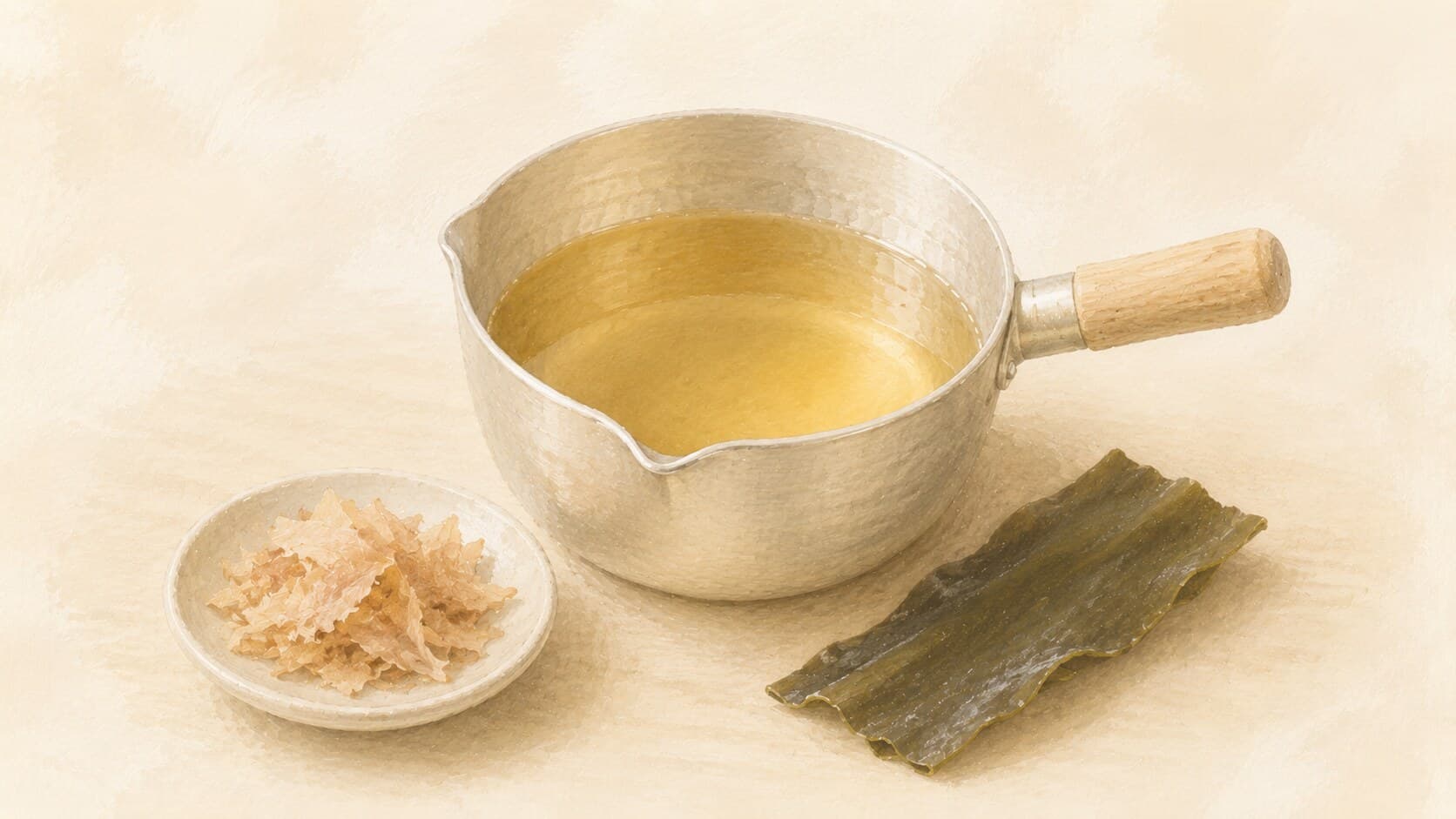
Ingredients
- 1 L cold water
- 10 g dried kombu kelp (a piece roughly 10 × 10 cm)
- 20 g katsuobushi (dried bonito flakes — the thin shavings, not the harder block)
Steps
Wipe the kombu lightly with a slightly damp cloth — not washed, just brushed clean. The white powder on the surface is not dirt; it contains some of the kombu's flavor compounds, so leave it on. Place the kombu in the cold water and let it soak for at least 30 minutes (overnight in the fridge is also fine, and gives a richer dashi). This cold-soak step extracts kombu's umami without any heat.
Place the pan over medium-low heat. The target is to bring the water to just below a simmer — typically the low 80s°C is a useful target, though the sense of "small bubbles starting to rise from the bottom of the pan, no rolling boil" is more reliable than the number. Just before it actively boils, remove the kombu with tongs. If the kombu boils, it releases compounds that make the finished dashi taste slightly bitter and slick.
Bring the water to a brief boil, then immediately pull off the heat. Add all the katsuobushi at once. Do not stir — the flakes need a moment to sink on their own, which they do within about 30 seconds. Steep for 1–2 minutes, no longer. Long steeping makes the dashi murky and slightly fishy.
Strain through a fine-mesh strainer (or a dashi strainer, the traditional Japanese fine-mesh tool). Do not press the katsuobushi — let it drain on its own. Pressing extracts bitterness. The finished dashi is pale amber, clear, and tastes savory without being heavy. Use within 2 days; dashi loses character quickly.
Tools you'll want
- · Fine-mesh dashi strainer
- · Tri-ply stainless saucepan (1.5–2 qt / 18cm)
- · Instant-read digital thermometer
Why this works
Dashi (Japanese kelp-and-bonito stock) is the Japanese parallel to French stock — the same role in a kitchen (the savory liquid underneath sauces, soups, and braises) approached through completely different physics. A French stock is a long collagen extraction; a dashi is a brief, careful pull of umami compounds from two ingredients that already contain them in concentrated form. Where a chicken stock takes three hours, a dashi takes ten minutes of active attention.
The chemistry is the headline. Kombu (dried kelp, a sea vegetable) is one of the world's densest natural sources of glutamic acid — the amino acid that drives the umami taste. Katsuobushi (dried bonito) is correspondingly rich in inosinic acid, a nucleotide with its own savory note. When these two are combined, the umami doesn't just add — it multiplies. The synergistic relationship between glutamate and inosinate is one of the best-studied effects in flavor science; the combination tastes significantly more savory than either ingredient alone would predict.
The temperature management is the technique. Kombu releases its glutamate slowly into cool water (the 30-minute cold soak) and faster into warm water. But if the kombu actually boils, it also releases alginates and other compounds that make the broth taste bitter and slightly slick. The classical rule is "remove the kombu just before the water boils" — somewhere in the low 80s°C as a rough target, though the visual cue (small bubbles climbing the pan walls, no rolling boil) is what most cooks actually use.
Katsuobushi is the opposite case. Adding the flakes to water that has just come off a boil — around 90–95°C — releases inosinate quickly while the high heat prevents fishiness. Letting them steep too long, or at too low a temperature, releases longer-chain proteins that cloud the broth and add an off-flavor. One to two minutes only, then strain.
The whole recipe takes 45 minutes if you count the kombu soak, but the active cooking time is about ten minutes. Most of the dashi work happens by sitting still — same as a French stock, but a fraction of the duration.
What dashi makes possible is enormous. Miso soup runs on dashi. Most simmered Japanese dishes (nimono, oden) start from dashi. Dashimaki tamago — the Japanese omelette — is half dashi by weight. Chawanmushi (savory steamed custard) is mostly dashi. Even Japanese sauces, like the dipping sauce for soba, are dashi diluted with soy and mirin. Without dashi, an entire cuisine doesn't quite function; with it, that cuisine becomes possible in a home kitchen in under an hour.
The first time you make a dashi from scratch, you understand why Japan's flavor architecture is so different from France's. The French build savor through Maillard reactions (the browning of food that develops deep, roasted flavor) and slow extraction over hours; Japan builds it through brief, careful pulls of pre-concentrated natural umami. Both arrive at "deep savor in a clear broth," through entirely different physics.
Common mistakes
Boiling the kombu.
Target: Pull kombu just before boil — small bubbles climbing the pan walls, ~80°C.
Why it matters: Boiled kombu releases alginates and other compounds — dashi becomes slick, bitter, slightly cloudy. The whole "clear, clean umami" goal collapses past this temperature.
What to do: Watch the bubbles. Small bubbles climbing walls = pull NOW. A thermometer reads 80-82°C — visual is more reliable.
Workarounds:
- Forgot? Pull as soon as you notice — partial recovery; subsequent kombu-cold-soak batches will be cleaner.
Pressing the katsuobushi during straining.
Target: Gravity drain only. Let flakes drain naturally without pressure.
Why it matters: Pressing extracts cellular bitterness and tannic compounds from the bonito muscle — dashi takes on a metallic, slightly bitter edge that doesn't go away. The umami you'd gain is offset by the off-flavor you introduce.
What to do: Pour through strainer, walk away for 5 minutes. Lift strainer, discard flakes.
Workarounds:
- Need more yield → use a larger surface-area strainer for faster gravity drain.
Long katsuobushi steep.
Target: 1-2 minutes, no longer. Flakes sink within 30 seconds — start timing then.
Why it matters: Past 2 minutes, longer-chain proteins start dissolving — dashi clouds and develops fishiness. The high-temperature extraction is "all the IMP in the first minute, off-flavors after that."
What to do: Set a timer. Strain at 2 minutes regardless of how it looks.
Workarounds:
- Want stronger katsuobushi note → use more flakes (30 g) for the same 1-2 min, not longer steeping.
Skipping the cold soak.
Target: 30 minutes minimum cold soak before heating. Overnight in fridge for deeper version.
Why it matters: Cold soak extracts glutamate gently without breaking down kombu cell walls. Skip it = less glutamate, flatter dashi. This is the lowest-effort, highest-return step in the whole recipe.
What to do: Set up first thing, before other prep. Use chilled water for slowest extraction.
Workarounds:
- Time-short → minimum 20 minutes is acceptable; lukewarm water (40°C) can accelerate to 15 min as a compromise.
Washing the kombu.
Target: Wipe with damp cloth only — never rinse under tap.
Why it matters: The white powder (mannitol) on kombu surface contributes umami and gentle sweetness. Washing removes a meaningful fraction of what you're extracting. The "cleaning" instinct is wrong here.
What to do: Slightly damp cloth → wipe gently → into water.
Workarounds:
- Visibly gritty → wipe more carefully, never rinse.
Storing too long.
Target: Use within 2-3 days refrigerated. Freeze in portions for longer storage.
Why it matters: Finished dashi loses aromatic compounds quickly even cold. After 3 days, character is noticeably diminished — what was bright and complex becomes flat and salty.
What to do: Plan dashi production for the day of use. Freeze leftovers in ice cube trays or 200 ml portions.
Workarounds:
- Freezer storage → 1 month with minimal aroma loss.
What to look for
- The kombu before heat: fully rehydrated, softened, sitting on the bottom of the pan. Thirty minutes minimum, more if you can.
- The water just before kombu removal: small bubbles climbing the inside of the pan, surface not yet broken by a rolling boil. This is the window — typically in the low 80s°C as a rough target.
- The katsuobushi at addition: flakes floating on the surface, sinking on their own within 30 seconds. Don't stir.
- The dashi at strain: pale amber, clear, smells distinctly of sea and dried fish in a clean, restrained way. If it smells fishy or murky, the steep was too long.
- The taste: savory, slightly salty (from the kombu's natural minerals), not "fishy." A flat dashi has been over-strained or the ingredients were too sparse.
Substitutions
- Katsuobushi → niboshi (small dried anchovies). A different dashi (niboshi-dashi), more savory, traditional for miso soup in northern Japan. Soak overnight cold, remove heads and guts before brewing.
- Katsuobushi → dried shiitake. Vegetarian shiitake-dashi. Soak overnight in cold water; use the soaking liquid plus kombu. Different umami compound (guanylate vs. inosinate) but real.
- Rausu / Ma kombu → Hidaka kombu. Hidaka extracts faster and tastes more mineral. Cut the soak time to 20 minutes if substituting.
- No quick swaps for "dashi powder" here. Powdered dashi (dashi-no-moto) works but tastes flatly salty — different food. If using, halve the salt elsewhere in the dish.
Make-ahead and storage
- Refrigerate within 30 minutes of straining. Keeps 2–3 days; character degrades fast after day 1. The Japanese kitchen treats dashi as a same-day-or-next-day liquid.
- Freeze leftovers in 200 ml portions or ice-cube trays. Up to 1 month with minimal aroma loss. Drop frozen cubes straight into a hot pan — they thaw in seconds.
- Spent kombu and katsuobushi can become niban-dashi. Re-simmer once in fresh water for 5 minutes; strain. Weaker, but exactly right for nimono and rice-cooking liquid.
- Don't boil to extend shelf life. Boiling concentrates salt and destroys aroma. Refrigerate at full strength instead.
Chef's view
There are several views on the kombu-to-katsuobushi ratio. The classical Japanese ratio I've used here (10 g kombu, 20 g katsuobushi per liter) produces a balanced, all-purpose dashi — what the Japanese kitchen calls ichiban-dashi ("first dashi"). Some traditions weight more heavily toward kombu (for a more vegetal note), others toward katsuobushi (for a smokier, fishier register). My view: the 10:20 ratio is the default; adjust toward more kombu when the dashi is going into vegetable-forward dishes, more katsuobushi when it's going under fish or red meat.
There is also a long Japanese tradition of niban-dashi ("second dashi") — re-using the spent kombu and katsuobushi for a weaker second extraction, used for simmered dishes where strong dashi character is not needed. My view: niban-dashi is a useful frugality move; the first dashi is for soups and dipping sauces, the second dashi is for cooking vegetables.
This is the recipe that, once it's in regular rotation, opens up the entire Japanese cuisine for cooking at home. A French chicken stock supports French cooking; a Japanese dashi supports Japanese cooking. There is no real substitute and no shortcut that produces the same result.
Chef Test Notes
I tested kombu extraction three ways with the same 10 g piece per liter:
- 30-minute cold soak, then heat to just under a simmer (the recipe above)
- Overnight cold extraction in the fridge, no heating step before adding katsuobushi
- No soak — kombu added straight to 60°C water and held there for 20 minutes
The overnight cold version was the most clearly umami-forward but slightly flatter on top notes — it works best for dashi destined for clear soups where restraint is wanted. The standard cold-soak-plus-gentle-heat method (1) gave the most balanced result and is the one I keep returning to. The direct 60°C method (3) was the weakest of the three — the warmth helps, but skipping the soak measurably costs glutamate.
A note on history
Dashi as we know it today crystallized in the Edo period (1603-1868). The kombu trade had been moving south from Hokkaido — the kitamae-bune shipping route brought it to Osaka, where Edo-period merchants developed the techniques for drying, aging, and grading the kelp. Katsuobushi (dried bonito) followed a parallel development arc in the same era, with the harder kare-bushi form (mold-cured, sun-aged) refined in the 17th century. By the late Edo period, the kombu-and-katsuobushi pairing was the standard kitchen broth across professional and home cooking. Western contact and modern science came later.
The dish's intellectual history changed in 1908. Kikunae Ikeda (1864-1936), a chemist at Tokyo Imperial University, was eating his wife's yudofu (kombu-stocked tofu) one evening and noticed that the broth had a savory taste distinct from sweet, sour, salty, and bitter. He took kombu to his lab and isolated glutamic acid as the source of that taste, naming it umami ("essence of deliciousness"). The discovery was published the next year. Saburosuke Suzuki picked up the science and commercialized it as monosodium glutamate under the brand Ajinomoto in 1909. Today, umami is recognized internationally as the fifth basic taste — and dashi, the everyday broth that Japanese home cooks had been making for three hundred years, was the substrate that made the discovery possible. The recipe above is unchanged from what Ikeda's wife was likely cooking that evening. The science around it changed; the technique did not.
Related glossary terms
- Umami — the chemical center of the dashi, glutamate plus inosinate multiplied together
- Stock — the French parallel that does the same kitchen job through different physics
- Broth — the closer cousin once the dashi is salted and eaten as itself (e.g., a clear soup)
Take it further
If this technique was useful:
- Book section: Part 3: Stocks, Dashi, and Foundations — the recipe sits inside this chapter of the book.
- What you're learning: Learn how kombu, katsuobushi, and timing build clean umami — without the heaviness that boiling introduces.
Get the essays in your inbox — free
Weekly notes on flavor, fermentation, and food history — the writing behind the Atlas of Flavor. No spam; unsubscribe anytime.