
Dashimaki Tamago
Eggs, dashi, soy, sugar, salt — rolled in many thin layers in a small pan. The Japanese counterpart to the French omelette, governed by the same physics through an entirely different tradition.
Contents (7 sections)▾
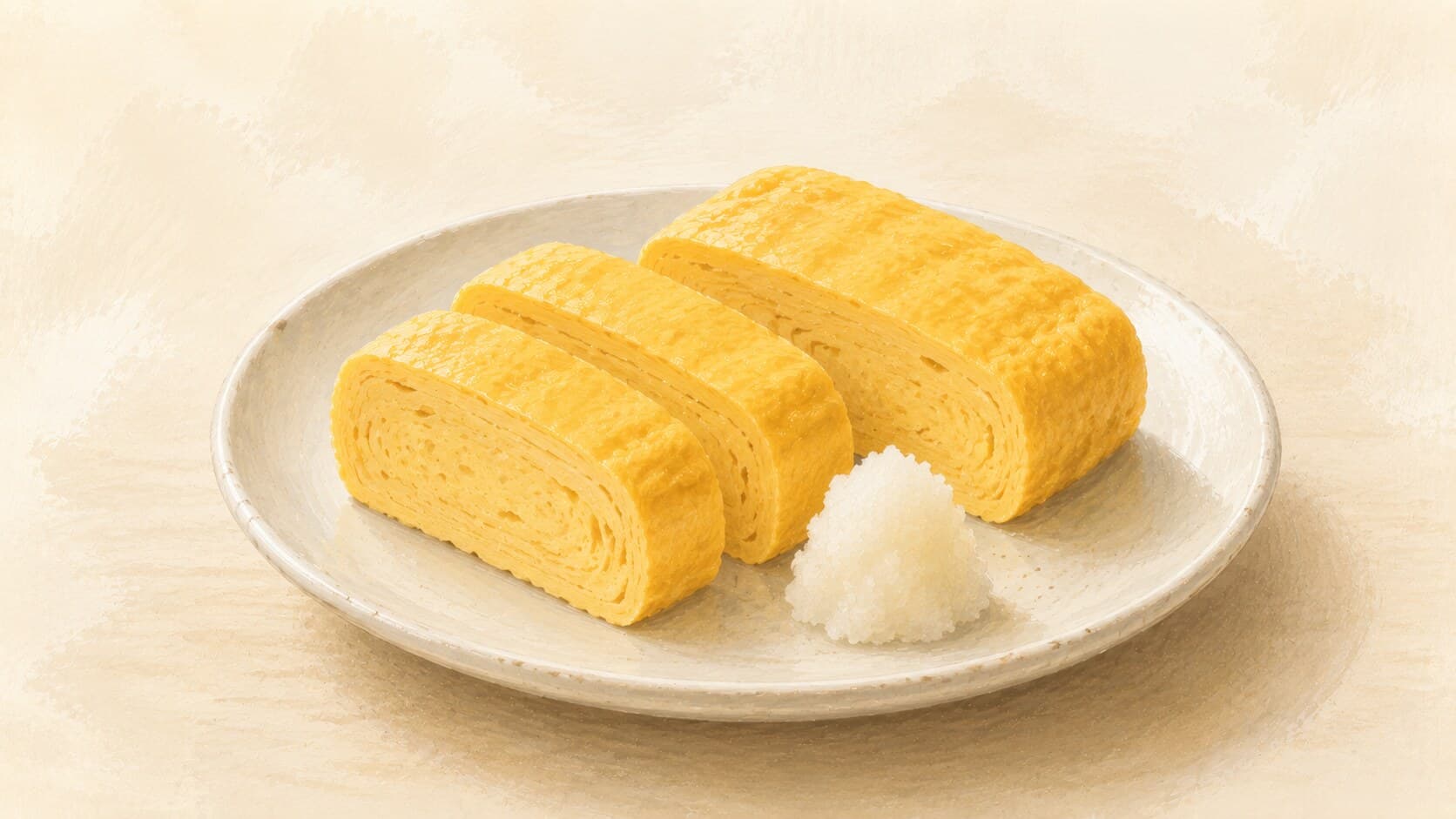
Ingredients
- 3 large eggs (about 180 g)
- 30 g cooled dashi (see the Basic Dashi recipe)
- 3 g light soy sauce (about 1/2 teaspoon)
- 2 g sugar
- 1 g fine sea salt
- Neutral oil for the pan, as needed (5–10 g)
- To serve: a small mound of grated daikon, a few drops soy sauce, a sprig of mitsuba (optional)
Steps
Whisk the eggs, dashi, soy, sugar, and salt in a bowl until uniformly combined but not foamy — about 20 seconds of gentle whisking. The mixture should pour like a slow ribbon. Over-whisking introduces air and produces a spongy, rough-textured finished log; under-whisking leaves visible white streaks in the cross-section.
Heat a small non-stick pan (or a rectangular tamago pan if you have one) over medium-low heat. The traditional Japanese cookware is the tamagoyaki-ki — a square or rectangular pan that produces uniform layers — but a small 18–20 cm round non-stick pan also works. Add a thin film of oil and wipe most of it out with a paper towel. The pan wants to be warm enough to set the egg but not so hot that the egg browns.
Pour about a third of the egg mixture into the pan and tilt to coat the bottom in a thin layer. As soon as the surface is just-set (the top still slightly wet, no liquid sliding), use chopsticks or a thin spatula to roll the layer toward one edge of the pan. Slide the rolled log back to the other edge.
Lightly oil the now-exposed pan bottom. Pour in another third of the egg mixture, tilt to coat — including under the rolled log so the next layer adheres. When the new layer is just-set, roll the log back over it. Repeat with the final third of the egg mixture.
Slide the finished log onto a sushi mat (makisu) or a piece of cling film. Wrap and let rest for 1 minute so the shape settles. Cook each layer through as you roll; for a softer interior use eggs pasteurized in the shell — residual heat is not a safety step. Slice into 4–6 cross-sections. Serve with a small mound of grated daikon, a few drops of soy, and a sprig of mitsuba if you have one.
Tools you'll want
- · Balloon whisk (24cm / 11-inch)
- · Instant-read digital thermometer
Why this works
Dashimaki tamago is the Japanese counterpart to the Basic French Omelette — same physics (egg cooking gently in fat) applied through an entirely different tradition. Where the French omelette is one folded sheet, dashimaki is many thin layers rolled into a log. Where the French omelette is essentially yolk and butter, dashimaki is yolk and dashi (a light savory Japanese broth made from kelp and dried fish flakes), with soy and sugar pulling it toward a savory-sweet register that the French version doesn't have.
The dashi is what makes the dish work. Eggs and dashi, whisked together in roughly 6:1 ratio (eggs to dashi by weight), form a delicate emulsion — the egg proteins suspend the dashi as a water phase, and the cooked result is significantly more tender than eggs alone would be at the same temperature. This is the reason a well-made dashimaki tastes "wetter" than a regular omelette without actually being undercooked: there is real water in there, held by the protein matrix.
The umami center is the dashi itself. The glutamate-inosinate combination that gives dashi its savory depth carries directly into the cooked egg. A dashimaki is not so much an omelette flavored with dashi as a dashi delivery system that happens to be made of eggs.
Heat management is the second variable. Dashimaki sits at the very low end of sauté heat — the pan is warm enough to set the egg but never hot enough to color it. A properly made dashimaki has no brown spots and no crust; the surface is the same pale yellow throughout. This requires medium-low heat and patience.
Carryover cooking does meaningful work at the end. After the final roll, the log is wrapped (traditionally in a makisu, a sushi mat; cling film also works) and rested for a minute. The rest lets the shape settle into a clean rectangle; each layer is cooked through as you roll, so this rest is for shape, not to finish an undercooked centre. Slicing immediately after the final roll gives a looser, less-set interior; the rest is the difference between "fine" and "right."
The recipe is mechanically harder than it looks. The first one or two attempts at home almost always come out uneven — the first layer too thick, the second too thin, the rolling motion not yet practiced. By the fifth or sixth attempt, the wrist has the motion. Dashimaki is one of the recipes that rewards repetition more directly than most.
Common mistakes
Heat too high.
Target: Medium-low heat. Each layer should set within 30 seconds of pouring without showing any color.
Why it matters: The whole aesthetic of dashimaki is pale yellow — colored egg reads as a failure of restraint, breaking the visual register that distinguishes Japanese rolled egg from a Western omelette. Also, browning forms a tough crust between layers, breaking the spiral pattern.
What to do: Test with a small drop — if it sizzles or browns, pull off heat for 10 seconds, retry. The pan can sit at the edge of the burner between layers to maintain temperature.
Workarounds:
- Pan keeps over-heating? Lift it off-heat for 5 seconds between layers — restores temperature without changing burner setting.
Over-whisking the egg-dashi mixture.
Target: 20 seconds of gentle whisking — chopsticks or a fork, not a balloon whisk. The mixture should flow as a slow ribbon.
Why it matters: Aeration produces a spongy, foamy texture in the finished log — and air pockets in cooked egg look like blowouts in the cross-section. The signature dashimaki texture is dense-but-tender, not airy.
What to do: Use chopsticks side-to-side (Japanese method) — moves liquid without trapping air. Stop when uniform.
Workarounds:
- For even finer texture → strain through a fine-mesh sieve before pouring — removes chalazae and any small clumps.
Layers too thick.
Target: Each layer 30-40 ml — thin enough to set in 30 seconds.
Why it matters: Thick layers take too long to set, then stick during rolling, producing a coarse cross-section instead of the fine concentric spiral that defines a good dashimaki. The visual signature is layer count and uniformity.
What to do: Use a small ladle for consistent portions. 3 eggs = 3 layers for a thick log; 4 layers for finer spiral.
Workarounds:
- Small pan (round 18 cm) → 3 layers; rectangular tamagoyaki pan → 4-5 thinner layers possible.
Not oiling between layers.
Target: Thin film of oil before every new layer — wipe excess with a folded paper towel.
Why it matters: Without re-oiling, the new layer sticks to the pan bottom instead of bonding to the previous roll. When you try to roll, the log tears or unravels.
What to do: Keep an oil-soaked paper towel beside the stove; wipe the pan between layers. Lift the existing log slightly to let oil pass underneath.
Workarounds:
- Modern nonstick pan → minimal oil needed, but still wipe a thin film for safety.
Skipping the rest in the mat.
Target: 1 minute rest in makisu (sushi mat) or cling film after final roll.
Why it matters: This separates "competent" from "right." The rest settles the shape into a clean rectangle and lets the dashi inside the protein matrix redistribute. Sliced immediately, dashimaki tastes fine but the interior is loose and the shape uneven.
What to do: Wrap, gently press into shape, rest 1 minute, then slice.
Workarounds:
- No makisu → fold a tea towel around the log instead. Same shape-setting effect.
Trying to roll too early.
Target: Roll when surface is just-set — no liquid slides when you tilt the pan; surface feels slightly tacky.
Why it matters: Wet surface = inside doesn't seal, layer slides during rolling, log unravels. Properly set surface bonds to the previous roll on contact.
What to do: Tilt test — if any liquid slides, wait. If the surface is matte and tilt-stable, roll now.
Workarounds:
- Slightly over-set? Still rollable; just expect a less seamless seam between layers.
What to look for
- The pan before the first layer: thin film of oil, no smoke, the surface warm enough that a drop of egg sets within 3 seconds but doesn't sizzle. If the test drop sizzles, lower the heat.
- Each layer at the rolling moment: surface just-set, slightly tacky to the touch, no visible liquid. Roll now, not later.
- The interior cross-section: fine concentric layers, soft yellow, no white streaks or dark spots. If you see white streaks, the egg was under-whisked.
- The finished log in the mat: a clean rectangle, slight wobble when shaken — soft but not liquid. The wobble is the dashi held by the protein matrix; this is the signature texture.
- At the slice: the spiral pattern visible, the cut clean, no liquid running out. If liquid escapes, the rest was too short.
Chef's view
There are several views on the sweetness of dashimaki. Tokyo-style is moderately sweet (the version above, with 2 g sugar per 3 eggs). Kansai-style is less sweet, sometimes salt-only. The sushi-restaurant version is significantly sweeter than either, sometimes more cake-like than omelette. My view: the Tokyo middle-ground is the most useful default for a home cook. Adjust the sugar up for a more luxurious register, down for a savory accompaniment.
The other quiet decision is the pan. A traditional rectangular tamagoyaki-ki produces a more uniform log with a true rectangular cross-section, and it is genuinely the right tool for the job. A round small non-stick pan works almost as well — the log comes out slightly oval rather than rectangular, but the technique and the texture are unchanged. If you make dashimaki more than once a month, the dedicated pan is worth it; if you make it occasionally, the round non-stick is fine.
This is the recipe that, paired with the Basic French Omelette, makes a powerful editorial point: two cuisines, half a world apart, arriving at "the gently cooked egg" through completely different routes. France folds; Japan rolls. France finishes with butter; Japan extends with dashi. Both produce, in skilled hands, one of the most beautiful expressions of egg as a cooked food.
Related glossary terms
- Carryover cooking — the rest in the mat that finishes the inside and sets the shape
- Umami — the dashi's chemical center, transferred whole into the egg
- Emulsion — the delicate egg-and-dashi suspension that gives the dashimaki its wet interior
- Sauté — the low end of the sauté range, where the egg sets without browning
Safety — the egg
Softly-set, runny or barely-cooked egg carries a Salmonella risk that freshness, a trusted or premium source, a clean shell, a hot pan and residual (carryover) heat do not remove. To keep the egg soft, use eggs pasteurized in the shell (heat-treated through to the contents) or a pasteurized egg product; otherwise cook the egg through until set. For children, pregnant people, older adults and anyone immunocompromised, use pasteurized egg or cook it fully.
<!-- beginner-glossed v1 -->Get the essays in your inbox — free
Weekly notes on flavor, fermentation, and food history — the writing behind the Atlas of Flavor. No spam; unsubscribe anytime.