
Basic French Omelette
Three eggs, low heat, butter, and one minute of patience — the smallest test case in classical cooking, and the recipe that quietly teaches every other French technique.
Contents (9 sections)▾
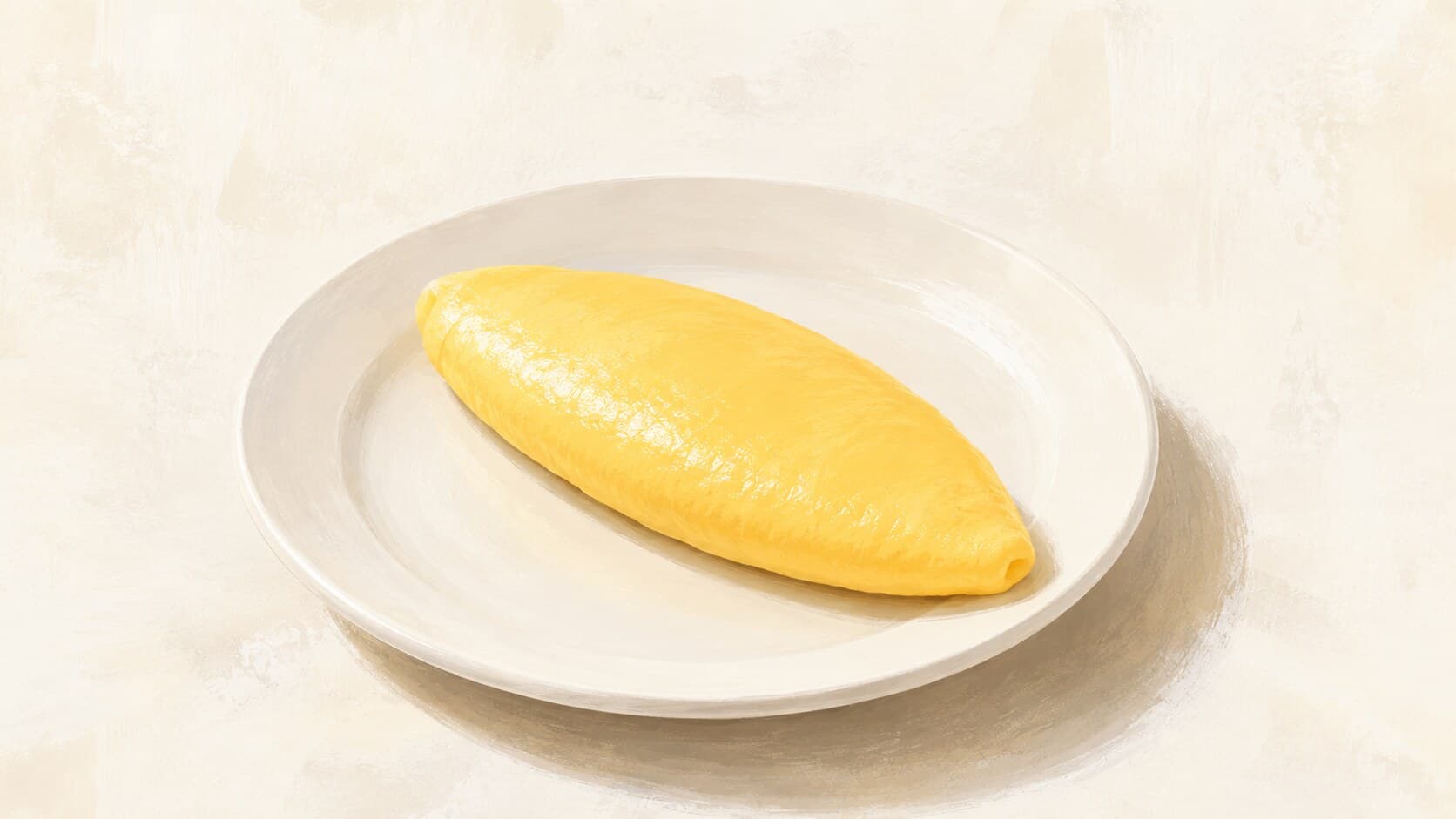
Ingredients
- 3 large eggs (about 180 g total)
- 15 g unsalted butter, divided (10 g + 5 g)
- 1 small pinch fine sea salt
- A few drops cold water (optional — helps the curd stay soft)
Steps
Crack the eggs into a bowl. Add the salt and the optional water. Whisk gently until the yolks and whites disappear into each other — about 20 seconds — and stop. Over-whisking aerates the eggs and makes the finished omelette rubbery.
Set a 20–22 cm non-stick or well-seasoned carbon-steel pan over medium-low heat. Wait 60 seconds, then drop in 10 g of the butter. It should foam quietly and stay pale. If it starts to brown, the pan is too hot — pull it off the heat for 10 seconds and try again.
Pour the eggs in. They should set lazily, not sizzle. With a heat-safe spatula, push curds from the edge gently toward the center while tilting the pan so the still-liquid egg flows into the gaps. Continue 30–40 seconds, until the surface is just-set but still glossy.
Take the pan off the heat. The eggs keep cooking — this is carryover. Tilt the pan and fold the omelette in thirds (or roll it) onto a warm plate. Rub the top with the remaining 5 g of butter for shine and a final aromatic finish. Because this omelette is served soft (baveuse), use eggs pasteurized in the shell — treated through to the contents — or a pasteurized egg product; residual/carryover heat sets the texture, it is not a Salmonella control. Otherwise cook the egg fully set.
Tools you'll want
- · Balloon whisk (24cm / 11-inch)
- · Tri-ply stainless saucepan (1.5–2 qt / 18cm)
- · Instant-read digital thermometer
Why this works
A French omelette is the smallest test case in classical cooking. Three ingredients, three minutes — and almost every variable a saucier later spends a career on shows up here at full size: heat control, emulsion, carryover, and the moment to stop.
The technique is built around a counter-intuitive truth: the omelette is mostly cooked off the heat. A few seconds too long in the pan and what was tender becomes rubber. Pulling it early — when the surface still looks faintly undercooked — sounds wrong, but five seconds of carryover cooking on the plate is exactly what brings the texture home.
The butter is doing real work, not flavoring. The first 10 g lubricates the pan and prevents the protein from grabbing. The final 5 g is rubbed across the top off the heat — closer to a beurre noisette gesture than a finishing seasoning. It adds shine and a thin film of fat that carries the aroma to the nose before the fork.
Common mistakes
Heat too high.
Target: Medium-low heat. Butter foams silently when it lands — no hiss, no browning.
Why it matters: This is the single mistake that defines French-omelette failure. Hot pan = browned bottom, seized protein, dry rubbery curd full of holes. The whole pale-yellow ideal collapses with a single excess of heat.
What to do: Preheat for 60 seconds at medium-low. Sound test: if butter hisses on contact, pull off heat 10 seconds and retry.
Workarounds:
- Stove runs hot? Drop to low, accept slightly longer cook (90 sec instead of 60).
- Heavy carbon-steel pan? Preheat shorter (30 sec) — it holds heat longer than nonstick.
Over-whisking.
Target: 20 seconds, gentle. Yolks just disappear; the liquid should flow as a slow stream, not foam.
Why it matters: Long whisking aerates the eggs and breaks protein structure — air pockets bake into rubber, and the final texture is tougher with visible bubbles. The French ideal is "silken custard," not "fluffy scramble."
What to do: Fork or chopsticks, not a balloon whisk. Mix until uniform, stop.
Workarounds:
- For an even smoother curd → strain the eggs through a fine mesh after mixing — removes chalazae and unbroken whites.
Salting the surface at the end.
Target: Salt into the egg mixture before pouring — never on the finished surface.
Why it matters: Salt on cooked egg sits as crystals on top, tasting sharp and uneven. Salt mixed into raw egg distributes molecularly and seasons from inside; it also slightly weakens protein bonds, contributing to a more tender curd.
What to do: Pinch of salt with the eggs in the bowl. Mix it in.
Workarounds:
- Want extra finishing flavor → fleur de sel sparingly on top is acceptable (large flakes give crunch, not sharp saltiness).
Cooking past the just-glossy moment.
Target: Pull when surface is still glossy — not wet, not dry. Total time: about 60 seconds.
Why it matters: When the surface stops looking wet, the omelette is already done. Carryover on the plate finishes it. Ten extra seconds in the pan → rubber. There is no recovering from over-cooked omelette.
What to do: Watch the surface sheen. Pull at glossy. Fold immediately onto warm plate.
Workarounds:
- Slightly under your liking → rest plated for 30 seconds longer — carryover continues to set.
- Want firmer interior (baveuse — the soft, slightly runny center — not desired) → take to almost-dry surface, but no further.
What to look for
- The pan: butter foams, never browns. If you hear a hiss when butter hits, the pan is too hot.
- The curd: edges set, center still moves. Use the spatula to fold the edges in; let the loose center flow underneath.
- The surface: just-glossy — not wet, not dry. Glossy means there is still moisture; this is when to pull.
- The fold: soft, not crisp. A French omelette has no brown color and no crust.
A probe thermometer is not much help here, by the way — this is one of the rare cooking tasks where sound and shimmer beat numbers. (For sauté work generally, the probe is back in its rightful place.)
Substitutions
- 3 large eggs → 4 small or 2 large + 1 yolk. The 2+yolk version is silkier; the 4-small version is more standard restaurant style.
- Butter → clarified butter or ghee. Doesn't brown, so you can hold higher heat for longer without coloring the omelette. The classic French technique uses regular butter and finesse with the heat instead.
- Plain → fines herbes (chive + parsley + tarragon + chervil) at 1 tsp total. Add at the same moment as the salt; never to a still-pourable mix.
- Filling: a tablespoon of soft cheese (boursin, fresh goat) folded in at the last minute. Don't load the pan — anything more than a tablespoon thickens the omelette and you lose the rolled silhouette.
Make-ahead and storage
- A French omelette is a 90-second dish. It does not survive holding, reheating, or refrigeration in any state that resembles the original.
- Eggs themselves keep 3 weeks refrigerated in the shell. Use the freshest available — older eggs cook fine but the curd is looser.
- If a finished omelette is left over, chop it cold into a sandwich filling or a salad topping. Don't try to reheat it whole.
- A note on fresh eggs. Crack each egg into a small bowl first; a bad egg costs you the whole omelette if it goes straight into the mixing bowl.
Chef's view
There are several views on the right pan temperature for a French omelette. Jacques Pépin's classic version runs hotter than what I describe here and uses constant motion to keep the eggs in fine curds. Joël Robuchon's version is gentler, almost a slow custard. My view sits between them — medium-low heat, with about half the motion Pépin uses — because it forgives small lapses in attention. The Pépin omelette is faster but punishes hesitation; the Robuchon omelette is gentler but harder to fold cleanly.
Either way, the work is the same: read the heat, watch the surface, stop early.
This is the recipe I cook on a slow morning to remember how to cook. When this is good, the rest of the kitchen tends to be good too.
Related glossary terms
- Emulsion — what the butter and the egg are quietly doing as they meet
- Carryover cooking — the five seconds on the plate that finish the omelette
- Beurre noisette — the next-step gesture if you want a more aromatic finish
- Sauté — the cousin technique once the heat goes back up
Safety — the egg
Softly-set, runny or barely-cooked egg carries a Salmonella risk that freshness, a trusted or premium source, a clean shell, a hot pan and residual (carryover) heat do not remove. To keep the egg soft, use eggs pasteurized in the shell (heat-treated through to the contents) or a pasteurized egg product; otherwise cook the egg through until set. For children, pregnant people, older adults and anyone immunocompromised, use pasteurized egg or cook it fully.
<!-- beginner-glossed v1 -->Get the essays in your inbox — free
Weekly notes on flavor, fermentation, and food history — the writing behind the Atlas of Flavor. No spam; unsubscribe anytime.