
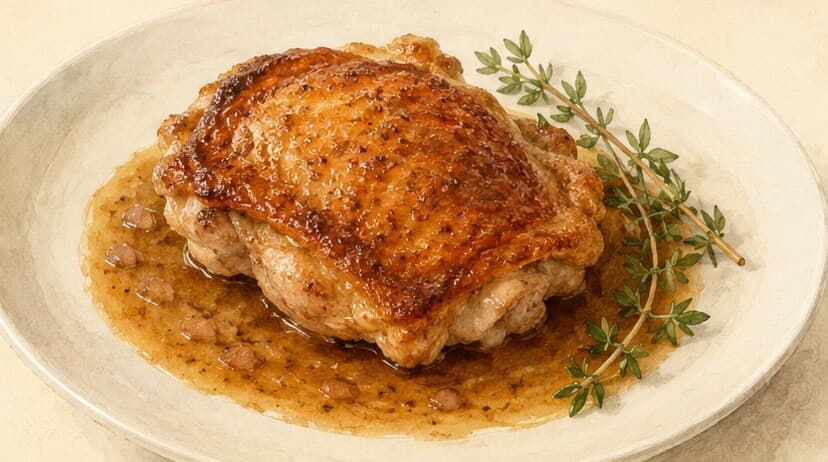
Pan-Roasted Chicken Thigh
Bone-in, skin-on, a heavy pan, twenty minutes. The recipe that brings together Maillard, carryover, and a finishing pan sauce — almost every technique on this site, working in one dish.
Contents (6 sections)▾
Ingredients
- 2 bone-in, skin-on chicken thighs (about 250 g each)
- 4 g fine sea salt (about 1/2 tsp), for the chicken
- 1 g freshly cracked black pepper
- 5 g neutral oil with a high smoke point (grapeseed, sunflower)
- For the pan sauce:
- 1 small shallot, finely minced (about 20 g)
- 100 g dry white wine (or 80 g wine + 20 g chicken stock)
- 30 g cold unsalted butter, cut into 4–5 cubes
- Optional: 2 sprigs fresh thyme, a small squeeze of lemon
Steps
Pat the thighs completely dry with paper towels. Wet skin will steam in the pan instead of browning. Season generously on both sides with salt and pepper. If you have an hour, salt the chicken in advance and leave it uncovered in the fridge — the dry-brining cycle pulls out surface moisture and gives you a crisper skin. Twenty minutes ahead is good; one hour is better. Same-time seasoning still works.
Heat a heavy skillet (cast-iron or carbon-steel preferred — they hold their temperature when cold meat hits) over medium heat. Add the oil. When the oil shimmers and a drop of water flicked in evaporates instantly, place the thighs skin-side down. The pan should hiss steadily — a busy, sustained sound, not a violent crackle.
Don't move them. The skin needs 6–8 minutes to render its fat and build a deep, evenly Maillard-browned crust. Resist the urge to peek for the first 5 minutes. If you hear the sizzle drop off, the moisture is gone and the browning is starting — that's the right sound.
Flip. Cook on the flesh side for another 5–7 minutes, until an instant-read thermometer in the thickest part (away from the bone) reads 74°C / 165°F — the USDA safe endpoint for poultry. Transfer to a warm plate and rest for 5–7 minutes; carryover may nudge it a degree or two higher, so pull right at 74°C rather than stopping short and counting on the rest to get there.
While the chicken rests, build the pan sauce. Pour off all but about 1 tablespoon of fat from the skillet. Reduce heat to medium-low. Add the shallot and stir 30 seconds — just long enough to soften it. Pour in the wine, scrape the brown stuck-on bits (the fond) up from the bottom with a wooden spoon, and add the thyme if using. Reduce until about 2 tablespoons of liquid remain — roughly 2 minutes.
Pull the pan off the heat. Swirl in the cold butter cubes one at a time, waiting for each to melt to a glossy emulsion before the next. Taste, season with a pinch of salt. A small squeeze of lemon brightens the sauce if it tastes flat. Spoon the sauce over the rested thighs and serve immediately.
Tools you'll want
- · Instant-read digital thermometer
- · Balloon whisk (24cm / 11-inch)
Why this works
This recipe brings together almost every technique on the site, working in one dish. The skin builds a Maillard reaction crust; the interior climbs to a safe temperature with the help of carryover cooking during the rest; the brown stuck-on bits in the pan become a sauce through deglazing; and the finishing butter is mounted into the reduced wine like a small beurre monté. If you can cook this one well, you have most of French dinner cooking in your hands.
The choice of bone-in, skin-on matters. Bone-in protein cooks more evenly because the bone conducts heat slowly and keeps the meat near it from overshooting; the skin renders into a crisp shell while protecting the flesh below. Boneless skinless thighs are faster, but they give up half the textural reward of the dish. If you're going to cook a thigh, cook the whole thigh.
The pan choice is doing real work. A heavy skillet — cast-iron or carbon-steel — holds its temperature when cold meat lands in it; a thin pan would drop in heat instantly and steam the chicken instead of searing it. A thin sizzle from the start is the audible signal that the pan was deep enough in heat to receive the meat.
Then comes the temperature target. The USDA consumer baseline for poultry is an internal temperature of 74°C / 165°F, measured with a thermometer in the thickest part (USDA FoodSafety.gov). Cook the thigh until it reads 74°C there, then pull — do not stop short at, say, 71–73°C and count on carryover during the rest to reach safety, because carryover is real but too variable to use as a safety margin. Its usefulness here is the opposite: because the number keeps drifting up a little after you pull, take the thigh off the heat as soon as it hits 74°C rather than pushing it well past and drying it out.
The pan sauce is the dish's quiet payoff. The fond — those dark stuck-on bits — carries the concentrated flavor of everything that just happened in the pan. Deglazing pulls it up into the wine; reduction concentrates the result; cold butter swirled off the heat gives the sauce body and shine. The whole pan-sauce process takes about three minutes, and it transforms a plate of chicken into a course.
Common mistakes
Moving the thigh while searing.
Target: Set skin-down, don't touch for 6-8 minutes, until crust is dark gold and releases naturally.
Why it matters: Continuous skin-to-pan contact = consistent crust. Lifting resets the browning clock; you end up with patchy color.
What to do: Set timer, walk away. Resist the urge to peek.
Workarounds:
- Crust developing unevenly → press gently with spatula at 4 min mark; otherwise leave alone.
Salting wet thigh right before cooking.
Target: Salt 20+ min ahead (allows moisture to redistribute), OR pat dry thoroughly right before pan.
Why it matters: Late salt on wet skin pulls moisture out — pan now has water to evaporate before browning. Skin steams instead of crisps.
What to do: Plan ahead: dry-brine (salt the chicken in advance and leave it uncovered in the fridge so the surface dries out) on a rack in the fridge for 1+ hour. Or pat dry meticulously just before the pan.
Workarounds:
- Quick option → pat dry with paper towels, salt, pat dry again before going in.
Pulling too early.
Target: Internal 74°C / 165°F at the thickest part, measured — the safe endpoint. Pull as soon as it reads there.
Why it matters: Below 74°C the center may be undercooked. Carryover (the way meat keeps cooking a few more degrees off the heat from stored warmth) is real but limited and variable — you cannot pull below 74°C and rely on the rest to reach safety. Its value is that the number keeps climbing a touch after you pull, so measure at 74°C and take the thigh off rather than overshooting into dry.
What to do: Instant-read thermometer. Test at the thickest joint, not the surface.
Workarounds:
- No thermometer → colour and clear juices are not a reliable safety test for poultry (the USDA advises a thermometer), so err well past visibly done at the joint — juices fully clear, no pink — and get a thermometer for next time.
Pulling too late.
Target: Pull at 74°C / 165°F — much past that and the meat dries fast.
Why it matters: Poultry's window from done to dry is narrower than red meat. 5 minutes too long = noticeably drier result.
What to do: Check temperature early, often. Pull as soon as the thickest part reads 74°C / 165°F.
Workarounds:
- Slightly overshot → rest on warm plate; carryover settles and it cools off its peak.
Skipping the rest.
Target: 5-7 minutes rest on a warm plate, loosely covered with foil.
Why it matters: Cut immediately = more juice spills onto the board. A short rest lets it cool off its peak, so less runs out when you cut.
What to do: Plan the rest into your timing. Use the time to make the pan sauce.
Workarounds:
- Need to serve hot → rest only 3 min; warm plate compensates partially.
Cold butter into hot pan sauce.
Target: Pull pan off heat first, then swirl in cold butter.
Why it matters: Bubbling pan melts butter to oil instead of emulsifying it — sauce breaks, no gloss.
What to do: Off heat completely, wait 5 sec, then add cold butter cubes one at a time.
Workarounds:
- Broke → whisk in 1 tbsp warm stock off-heat; sometimes restores.
What to look for
- The pan before the chicken goes in: oil shimmers, a water droplet evaporates instantly. If the droplet sits and steams, the pan is too cool.
- First minutes of the sear: a steady, busy hiss that doesn't quiet. Silence too early means the pan is losing heat.
- The skin: deep golden brown across the surface, no pale spots. Even color means even contact, which means even heat.
- Internal temperature: 74°C / 165°F in the thickest part of the flesh, not touching the bone. This is your safe pull target.
- The rested chicken: clear juices when pressed, not red. Pink near the bone of a thigh is normal and not a doneness problem; raw-looking liquid is.
- The sauce: glossy, coats the back of a spoon, holds for at least 30 seconds before breaking.
Chef's view
There are several views on whether to start the pan hot or cold. The modern school (often associated with Modernist Cuisine and several restaurant kitchens) starts skin-side down in a cold pan and brings the heat up gradually — the slow render produces an extraordinarily crisp skin. The classical French approach is a hot pan from the start, accepting a slightly less rendered fat layer for the sake of speed and the depth of flavor that assertive Maillard browning gives.
My view: medium heat from the start, not cold and not screaming hot. The cold-pan method works, but it locks the cook into the recipe for an extra 5–8 minutes of careful attention. The hot-pan method is faster, but slightly less forgiving. Medium gives you the best of both — a fast enough sear that the kitchen still smells like cooking, a slow enough render that the skin is crisp without being lacquered.
The other quiet judgment call is wine choice for the pan sauce. A dry white (the same kind you'd drink with the chicken) is the safe answer. A splash of dry vermouth is the upmarket French move — more aromatic, slightly more bitter, holds up well to butter. Sherry vinegar plus a little stock is the "if you don't have wine" answer that loses nothing. The reduction is doing most of the work; the wine is supplying aroma, not the structural component.
This recipe is the test case for whether the rest of the site has stuck. Heat control, Maillard, carryover, pan sauce, butter mount — all of it lives inside this one twenty-minute dish. When this is good, the rest of dinner tends to be good too.
Related glossary terms
- Maillard reaction — the chemistry of the crust on the skin
- Carryover cooking — the rest that brings the chicken to its final temperature
- Deglazing — how the brown stuck-on bits become a sauce
- Fond — what those brown stuck-on bits actually are, and why they matter
Get the essays in your inbox — free
Weekly notes on flavor, fermentation, and food history — the writing behind the Atlas of Flavor. No spam; unsubscribe anytime.