
Sole Meunière
A flour-dusted white-flesh fish, browned butter, lemon, parsley. Two parallel Maillard reactions in one pan, finishing in the most ancient French sauce of all.
Contents (7 sections)▾
Ingredients
- 2 sole fillets (about 150 g each — flounder, plaice, or any tender white-flesh fish works)
- 20 g all-purpose flour, for dusting
- 3 g fine sea salt
- 1 g freshly cracked black pepper
- 30 g unsalted butter, divided (10 g for the sear, 20 g for the brown-butter finish)
- 5 g neutral oil with a high smoke point (grapeseed, sunflower)
- Half a lemon
- A small handful flat-leaf parsley, finely chopped
Steps
Pat the fillets completely dry with paper towels — wet fish steams in the pan instead of browning. Season both sides with salt and pepper. Spread the flour on a small plate, lay each fillet in it, and turn once to coat lightly. Shake off any excess; a heavy flour coat will burn before the fish is done.
Heat a heavy skillet over medium-high heat. Add the neutral oil and the first 10 g of butter. When the butter foams and the foam just begins to subside, you are at the right moment. If the butter smokes, the pan is too hot — pull it off for 15 seconds before continuing.
Lay the fillets in the pan, presentation-side down. Don't move them. After about 2 minutes, the underside should be deep golden — Maillard, not yet brown butter. Flip carefully with a thin spatula. Cook another 1–2 minutes on the second side, depending on thickness.
Transfer the fillets to a warm plate. Wipe the pan briefly (you want a clean slate for the brown butter — flour residue would burn). Add the remaining 20 g of butter. Swirl over medium heat as it foams, then quietly browns, then smells of toasted hazelnut — this happens in about 30 seconds. Pull off the heat the moment the foam turns nutty-amber.
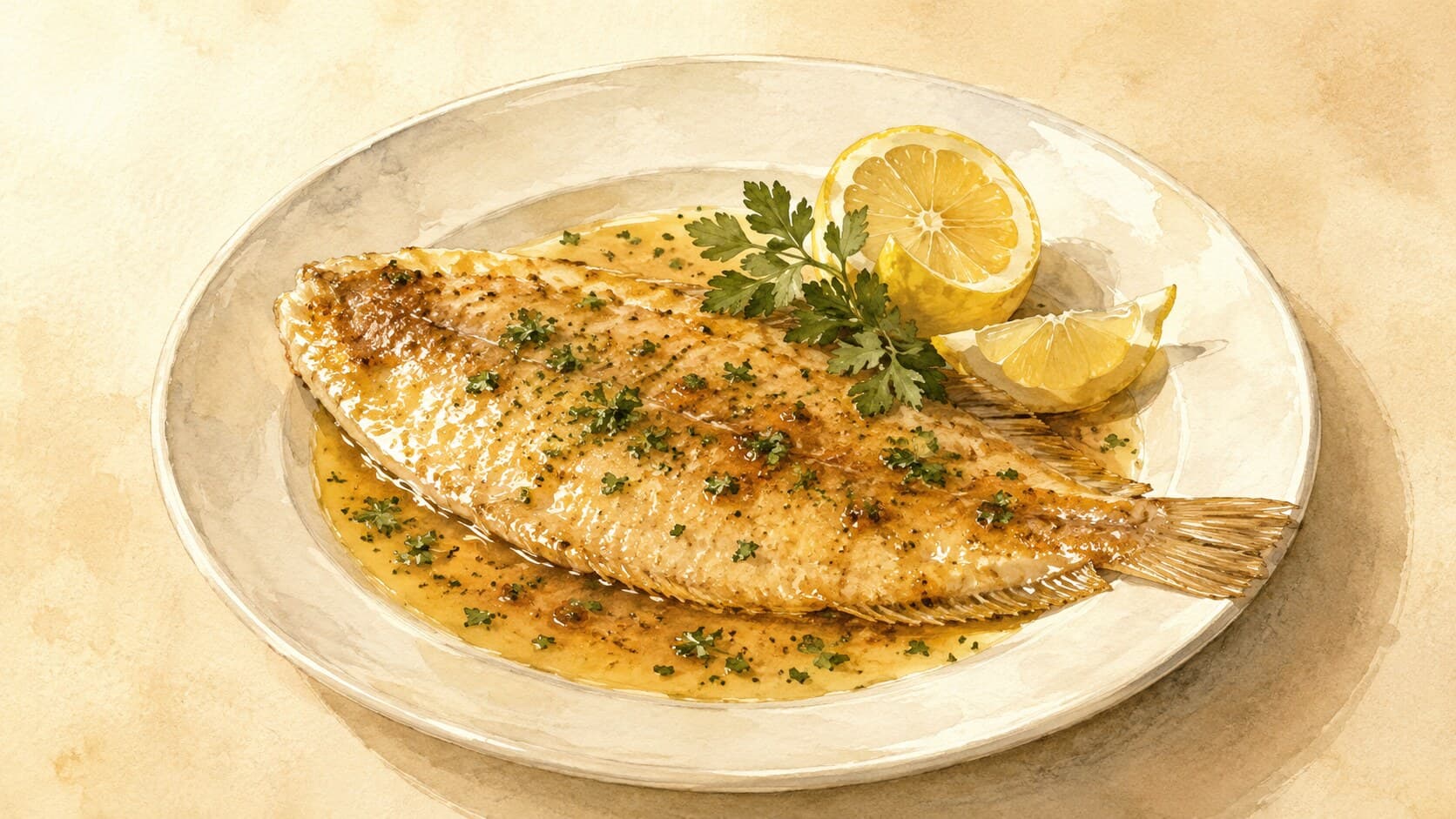
Squeeze the lemon directly into the hot butter — it will hiss and emulsify. Scatter the parsley over the fish, pour the brown butter across the plate, serve immediately. The sauce holds for less than a minute at its peak; meunière is one of the most time-sensitive dishes in the French repertoire.
Tools you'll want
- · Tri-ply stainless saucepan (1.5–2 qt / 18cm)
- · Instant-read digital thermometer
- · Balloon whisk (24cm / 11-inch)
Why this works
Sole meunière is, at its surface, a recipe with four ingredients. Underneath, it is a study in two parallel browning reactions running through the same pan within the same minute.
The first browning is on the fish itself. The light flour coating gives the fillet's exterior a slightly more uniform protein-and-starch surface than bare flesh would offer — the Maillard reaction runs more reliably across that surface, and the fillet comes out the color of pale gold rather than the pale grey you sometimes see in butter-poached fish. The flour is doing structural work, not seasoning.
The second browning happens after the fish has left the pan. The remaining butter is heated past melted, past foamed, into beurre noisette — milk solids Maillard-browning inside the residual fat. This takes about thirty seconds and has its own window: pull too early and you have melted butter; pull too late and you have black butter, which is a different and not always wanted sauce.
The whole dish is a sequence of timed pulls. The fish comes off when the second side is just done; the butter comes off when the foam turns the color of toasted hazelnut; the lemon goes in the moment after that. Three pulls, three windows, no second chances. This is why classical kitchens place the cook for fish meunière next to a clock and a clean spatula.
There are several views on how dark to take the brown butter. The Pépin school keeps it on the lighter end of beurre noisette for maximum sweetness and clarity. Other lineages push further — beurre noir territory — for a deeper, slightly bitter note. My view: stay in the noisette window for sole, the most delicate of the white fish. Save the darker butter for sturdier flesh.
The fish also wants more careful heat than most proteins. White flesh denatures fast, and it goes from "just done" to "dry" in about thirty seconds. For food safety, the USDA consumer baseline is to cook fish to 63°C / 145°F, or until the flesh is opaque and flakes easily with a fork (USDA FoodSafety.gov); some chefs pull sole a touch earlier for a more delicate texture, but that is a culinary preference below the safe endpoint, not the same thing, and carryover cooking — small and variable — should not be the way you reach it. (And on the smoke point side — a half-butter-half-neutral-oil pan is the right call here, because the neutral oil keeps the butter solids from burning at the temperatures the Maillard reaction needs.)
Common mistakes
Wet fish.
Target: Fish surface completely dry — a clean paper towel touched to the fillet should come back unchanged.
Why it matters: This is THE single most common failure. Moisture turns the first minute in the pan into steaming, not browning. The fillet ends up pale, the flour goes gummy, and the Maillard window passes before you noticed it opened.
What to do: Pat dry with paper towels. Wait 2 minutes. Pat dry again. THEN flour.
Workarounds:
- For very wet fish (frozen, thawed), salt lightly and rest on a rack for 10 minutes — pulls moisture, then pat dry.
- A small fan blowing across the fillet for 5 minutes works wonders.
Heavy flour coat.
Target: Light dusting — flour barely visible on the surface, no white powder pockets.
Why it matters: Excess flour absorbs butter, burns, and tastes like burnt flour. Light dusting browns evenly and adds a delicate crust.
What to do: Turn the fillet once in flour, then shake hard to remove excess. The fish should look almost bare.
Workarounds:
- For gluten-free, rice flour or cornstarch works equally well — even crispier.
- For thicker fish, double-flour: dust → rest 30 seconds → dust again, shake. Builds a barely-thicker crust.
Moving the fish too early.
Target: Leave undisturbed for 2 minutes minimum after placing in the pan.
Why it matters: The flour crust needs continuous contact with the pan to build. Lifting resets the clock — and disturbed fish loses the structural moment when the crust forms.
What to do: Place the fillet flesh-side down. Hands off. Check at 2 minutes by tilting the pan and looking — the crust should look dry and pulling away.
Workarounds:
- If you have to peek, lift just one corner with a spatula — don't drag.
Brown butter (butter cooked until the milk solids toast to amber) pushed too far.
Target: Pull from heat at noisette (the "hazelnut" stage of browned butter, just past golden) — foam JUST turning nut-colored, butter smells like toasted hazelnuts.
Why it matters: Past the noisette window, butter goes from sweet to acrid bitter in 10 seconds. Burnt brown butter cannot be rescued — the bitter compounds taint the entire sauce.
What to do: Watch and listen — when the popping/foaming subsides and the foam turns golden, immediately remove from heat. The pan's residual heat continues the cook gently.
Workarounds:
- Burnt it? Pour out, wipe the pan, start over with fresh butter. Cheap insurance against ruining the dish.
- For more margin, add the butter to a stainless pan (not cast iron) — better visual cue of the color.
Lemon squeezed away from the pan.
Target: Squeeze lemon directly into the hot pan with the brown butter — it should hiss.
Why it matters: The acid stabilizes the brown-butter emulsion. Squeezed onto the fish on the plate, the butter and lemon stay separate (puddles). Squeezed into the hot pan, they fuse into the lively, slightly emulsified sauce that defines meunière.
What to do: Have lemon halved and ready. Squeeze into the pan immediately after pulling brown butter off heat. Tilt and swirl. Pour over fish.
Workarounds:
- For maximum sauce yield, add 1 tbsp white wine to the pan along with the lemon — extra emulsifier.
Wrong fish.
Target: True Dover sole (Solea solea — a small flatfish prized in classical French cooking), if you can find it. Petrale sole, flounder, or other thin white fish acceptable.
Why it matters: Sole's delicate texture and clean flavor pair perfectly with brown butter — anything thicker or richer dominates the simple sauce. Salmon, tuna, or any oily fish is wrong here.
What to do: Ask the fishmonger; if no sole, request a similar thin white fillet (under 1.5 cm thick).
Workarounds:
- Common substitutes: plaice, fluke, or any small flatfish work beautifully.
- For a deeper-flavored variant, trout almondine uses the same brown-butter technique.
What to look for
- The fish before the pan: bone dry on the surface, flour barely visible. If your hand comes back from a touch and looks the slightest bit damp, dry the fillet again.
- The pan with the first butter: foam settling to a thin layer, no smoke. The window where butter foams quietly without browning is your start signal.
- The crust on the first side: deep golden, even color across the fillet. Lift one edge with a thin spatula at the 2-minute mark to check.
- The brown butter: amber color, smells of toasted hazelnut, foam barely active. You have about 10 seconds inside this window before it turns.
- The plate at service: fish glossy, butter pooling beside it, parsley still bright green. Brown parsley means you waited too long between pouring the sauce and serving.
Chef's view
There are several views on which fish to use. The classical name comes from sole — Dover or Channel sole — but those are expensive and sometimes hard to source. Flounder, plaice, lemon sole, and small petrale sole all behave identically in the pan. My view: the technique matters more than the species. A perfectly cooked flounder meunière is a better dish than an over-cooked Dover sole meunière, and at roughly one-tenth the price.
The other quiet decision is whether to capture the brown butter as a true sauce or just pour it. The classical service is "just pour" — a small lively pool beside the fish. The slightly upmarket move is to whisk a few drops of cold water or lemon juice into the hot butter just before serving, which gives it a beat more body and a slightly cream-finished sheen. Either is correct.
This is the recipe I cook when I want to remember how thin the margin is between elegant and ordinary in French cooking. The ingredients are almost nothing; the timing is almost everything.
A note on history
The name itself tells you what the dish is. Meunière (the French term for fish lightly floured and pan-fried in butter) means "miller's wife" in French — the woman who would have had the freshest flour in the village, and who is imagined dusting the fish with it before frying. The dish is one of the simplest preparations in the classical French repertoire, and one of the oldest in continuous use. It appears in Auguste Escoffier's 1903 Le Guide Culinaire as a base preparation — meaning Escoffier already considered it a foundation that other dishes (sole à la grenobloise, sole aux amandes, etc.) were built on top of.
The recipe acquired a second life in 1948, when an American woman named Julia Child ate it at La Couronne in Rouen — her first meal in France, two days after arriving with her husband Paul. She wrote later in My Life in France (2006) that the sole meunière of that day was "an absolute revelation… the most exciting meal of my life." The pan-browned butter, the fillet still trembling from the heat, the small lemon — she described the moment as the one that launched her cooking career. The book that career produced, Mastering the Art of French Cooking (1961, co-authored with Simone Beck and Louisette Bertholle), opened French technique to a generation of American home cooks who otherwise might never have touched a sauté pan. A single sole at La Couronne, on a single day in 1948, is one of the documented hinges between French restaurant cuisine and American home cooking. The recipe above is the same one Julia ate.
Related glossary terms
- Maillard reaction — the browning that runs through the floured fish surface
- Beurre noisette — the finishing sauce, in its own thirty-second window
- Carryover cooking — the half-degree the fish climbs after it leaves the pan
- Smoke point — why the pan starts with a butter-and-oil mix, not butter alone
Get the essays in your inbox — free
Weekly notes on flavor, fermentation, and food history — the writing behind the Atlas of Flavor. No spam; unsubscribe anytime.