
Beurre Blanc
White wine, vinegar, shallot, cold butter — a sauce held together by temperature and acid rather than starch. The recipe that teaches what a working emulsion really is.
Contents (8 sections)▾
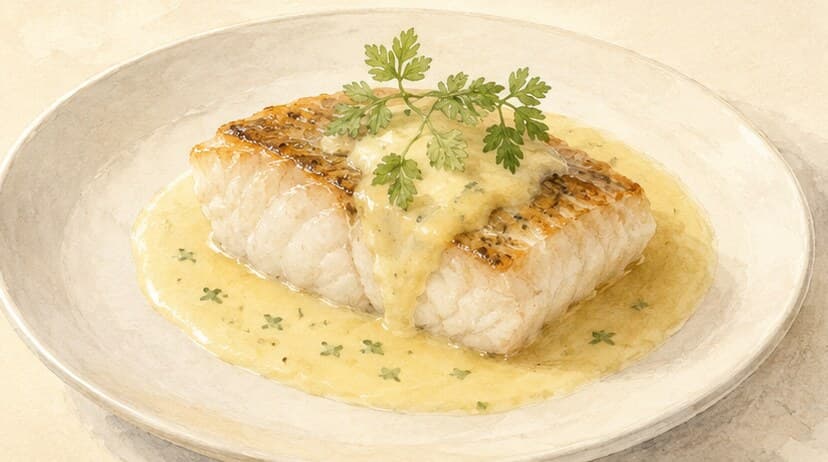
Ingredients
- 200 g dry white wine (Muscadet, Sauvignon Blanc, or similar)
- 50 g white wine vinegar
- 50 g shallot, finely minced (about 2 small)
- 200 g cold unsalted butter, cut into 16–20 cubes
- 2–3 g fine sea salt, to taste
- 1 small pinch white pepper (optional)
Steps
In a small heavy-bottomed saucepan, combine the wine, vinegar, and shallot. Bring to a simmer over medium heat and reduce until only about 2 generous tablespoons (~30–40 ml) of liquid remain — the shallots will move from 'sitting in liquid' to 'wearing a glaze.' This step concentrates the acid that will hold the emulsion together later.
Lower the heat as far as the burner will go. The sauce will be built well below a simmer — somewhere around the low-to-mid 50s°C as a rough target. If the pan feels hot to a hand held near it (rather than just warm), pull off the heat for 20 seconds before continuing.
Drop in two cubes of cold butter and whisk constantly until they melt into a glossy, slightly cloudy liquid — not pooling on top, not separating to oil. That cloudiness is the emulsion forming. Continue adding cubes 2–3 at a time, whisking each one to full incorporation before the next. The sauce will visibly thicken as you go.
Once all the butter is in, pull off the heat. Taste, season with the salt and optional white pepper. For a refined plate, strain through a fine-mesh strainer to remove the shallot. For a more rustic plate, leave the shallots in for body and bite. Serve within 10–20 minutes — beurre blanc holds in a warm spot, but does not survive reheating.
Tools you'll want
- · Tri-ply stainless saucepan (1.5–2 qt / 18cm)
- · Balloon whisk (24cm / 11-inch)
- · Sauce strainer (chinois, perforated, or fine-mesh, 19–25cm)
- · Instant-read digital thermometer
Why this works
A beurre blanc is the first sauce in the French repertoire that asks you to hold a working emulsion (a smooth, stable mix of fat and water-based liquid that would normally separate) at temperature for several minutes — not stir it together once and walk away, but keep it alive while you build. Every detail in the technique exists to make that possible.
The first step is a reduction. Two hundred grams of wine and 50 g of vinegar boil down to about 30 ml of syrup, which looks like a story about removing water — but the real work is concentration. Acid stabilizes butter emulsions; the more concentrated acid you carry into the base, the more forgiving the rest of the build becomes. A watery reduction can't hold a butter emulsion at all.
Then comes the temperature. Cold butter is itself an emulsion — roughly 80% fat, 16% water, and 4% milk proteins, all held in suspension. Whisked into a warm acid base, each cube releases its water slowly into the liquid phase, while the milk proteins quietly do the stabilizing work. The window for this is narrow. Below about 45°C, the butter doesn't melt evenly. Above the low 60s°C, the milk proteins start to denature and the fat releases as oil — at which point the sauce breaks. The whole sauce wants to live somewhere around the low-to-mid 50s°C, which is well below a simmer.
This is one of the few sauces where a probe thermometer earns its place in your hand. Even so, "the pan feels warm but not hot to a hand held near it" is usually a better instrument than a number.
The shallot does two jobs. The minced flesh adds savor; the aromatic compounds released during reduction bind into the acid base. Classically, the shallot is strained out at the end — a beurre blanc on a fine plate is a clean glossy sauce. In Brittany, where the dish comes from, the shallots are often left in for body. Neither is wrong.
Common mistakes
Heat too high.
Target: Sauce temperature 60–75 °C. Watch the surface — should NEVER bubble or simmer.
Why it matters: The SINGLE most common failure. Above 80 °C the butter's water-fat emulsion breaks, producing thin oily liquid with shallot floating in it. Below 50 °C the butter solidifies and the sauce won't form.
What to do: Keep the pan on the lowest heat setting; use a heat diffuser if needed. Lift the pan off the burner periodically if the sauce gets too warm.
Workarounds:
- Broken sauce? Pull off heat, whisk in another cold cube — sometimes the temperature drop recovers it.
- Truly broken? Strain, return reduction to pan, start the butter incorporation again.
Adding too many cubes at once.
Target: 2–3 small cubes of cold butter at a time, fully incorporated before adding more.
Why it matters: Butter added faster than the emulsion absorbs floats as melted fat. Once you see melted butter on the surface, the sauce is broken.
What to do: Cut butter into 1 cm cubes ahead. Whisk in 2–3 at a time. Watch the sauce thicken before adding the next batch.
Workarounds:
- For maximum reliability, use very cold butter cubes straight from the fridge.
Stopping the whisk.
Target: Continuous whisking from the moment the first butter cube enters until the sauce is plated.
Why it matters: Fat droplets begin coalescing within seconds of stopping motion. The emulsion is fragile and active.
What to do: Have everything ready before starting. If you need to step away, pull the pan off the heat first.
Workarounds:
- For multitasking, prep the reduction ahead and reheat it gently before the butter step — minimizes time the sauce is "live."
Reducing too little.
Target: Wine + shallot reduced to about 50 ml — syrupy consistency.
Why it matters: A watery base can't carry the emulsion. Insufficient reduction means the sauce stays thin no matter how much butter you whisk in.
What to do: Reduce uncovered until you can see the bottom of the pan when you tilt it. About 4 minutes of vigorous boiling.
Workarounds:
- Don't over-trust visual estimation — actually measure with a ladle if unsure. 50 ml exactly.
Reducing too far.
Target: Stop reduction at 50 ml — past 25 ml the sauce becomes aggressively acidic and faintly bitter.
Why it matters: Past the right point, the sauce is over-acidic. A beurre blanc should taste lively and bright, not sour.
What to do: Watch the volume. When in doubt, stop reducing earlier.
Workarounds:
- Over-reduced? Add a splash of white wine or water to dilute before adding butter.
Reheating.
Target: Serve within 20 minutes of completion. Never reheat over active heat.
Why it matters: Beurre blanc cannot survive a return to active heat — the emulsion breaks irreversibly.
What to do: Time the sauce to coincide with the dish. Hold in a warm spot (50–60 °C) at most.
Workarounds:
- For dinner-party staging, use lecithin (1/4 tsp per cup) as a stabilizer — sauce holds longer, slightly less classic.
What to look for
- The reduction: ~2 generous tablespoons of slick syrup; shallots no longer in liquid but wearing a glaze.
- The pan after the heat drops: warm to a hand held near it, not hot. If it feels hot, pull off for 20 seconds.
- First butter cubes: glossy, slightly cloudy liquid — no oil layer on top. That cloudiness is the emulsion forming.
- Mid-build: the sauce thickens visibly with each addition. By halfway through the butter, it should coat the back of a spoon.
- Done: glossy, pale, holds soft body on the spoon. If you've gone too far and it's stiff, a teaspoon of warm water whisked in will loosen it.
A beurre blanc is closely related to a beurre monté — both are warm butter emulsions held below the breaking point. The difference is the base: beurre monté starts from a small amount of water; beurre blanc starts from a reduced wine. The technique is the same; the flavor lives in the reduction.
Substitutions
- Shallot → small white onion (half the volume). Less pronounced sweet-acid background, still works.
- White wine → dry vermouth or 50/50 wine + water. Vermouth shifts toward herbal; the diluted wine version is cleaner.
- White wine vinegar → tarragon or sherry vinegar. Tarragon vinegar deepens the herb register; sherry adds a savory edge that suits red-meat plates.
- Cold cubed butter — non-negotiable. Room-temperature butter melts too quickly and the emulsion thins instead of building.
Make-ahead and storage
- Beurre blanc does not hold well. The butter emulsion sets on cooling and re-warming usually breaks it. Treat as a 30-minute sauce.
- Hold warm (50–55 °C) in a thermos or over barely-warm water for up to 30 minutes. Stir gently before serving.
- Reduction can be made ahead. Reduce the shallot + wine + vinegar to the syrup stage, refrigerate up to 3 days, and finish the butter at service time.
- Do not refrigerate finished sauce. Recovery is unreliable and the result is grainy at best.
Chef's view
There are several views on whether to add cream to beurre blanc. The modern restaurant kitchen often whisks 30–50 g of cream into the reduction before the butter goes in — the milk fat widens the temperature window and gives the cook more forgiveness. The classical Loire-Valley original uses no cream; the only fats are butter.
My view: no cream, and call it what it is. If you want a more forgiving sauce, that's beurre blanc à la crème — a different dish. The reason classical beurre blanc tastes like beurre blanc is that nothing else is competing with the butter for the surface of your tongue. A cream-stabilized version is easier to make, but loses the very thing the dish is famous for.
The other quiet decision is whether to strain. For fish on a clean plate, strain — a glossy, perfectly clear pale-yellow pool is part of the visual register. For a more rustic plate, or for fish with a strong character of its own, leave the shallots in. The texture of small shallot bits is not a flaw in the home kitchen; it's a sign of where the sauce comes from.
This recipe is the test case for whether you have internalized what an emulsion really is. If a beurre blanc still feels like a coin flip after twenty attempts, the diagnosis is almost always one of two things — heat too high, or whisking too hesitant. Both are fixable.
Related glossary terms
- Beurre blanc — the family this recipe sits inside
- Emulsion — what the whisk is actually building, droplet by droplet
- Reduction — the concentrated-acid base that lets the emulsion hold
- Beurre monté — the closely related technique built on a water base instead of a wine reduction
Get the essays in your inbox — free
Weekly notes on flavor, fermentation, and food history — the writing behind the Atlas of Flavor. No spam; unsubscribe anytime.