
Basic Pan Sauce
After the protein leaves the pan, a small sauce builds itself in about five minutes. Deglaze, reduce, mount with cold butter. The recipe that retroactively explains what every searing technique was for.
Contents (6 sections)▾
Ingredients
- 1 small shallot, finely minced (about 20 g)
- 100 g dry white wine (or red, for darker proteins)
- 50 g stock (chicken, vegetable, or whatever fits the protein)
- 30 g cold unsalted butter, cut into 4–5 cubes
- 1 small pinch fine sea salt
- Optional: 1 sprig thyme, a few drops sherry vinegar or lemon
Steps
Start with the pan still hot from a sear, the protein already resting on a warm plate. Pour off all but about 1 tablespoon of fat, leaving the dark stuck-on bits (the fond) on the bottom. Reduce heat to medium-low.
Add the shallot and stir 30 seconds — just long enough to soften, not to brown. The residual pan heat does most of the cooking; you are coating the shallot in the existing fat and softening its edge.
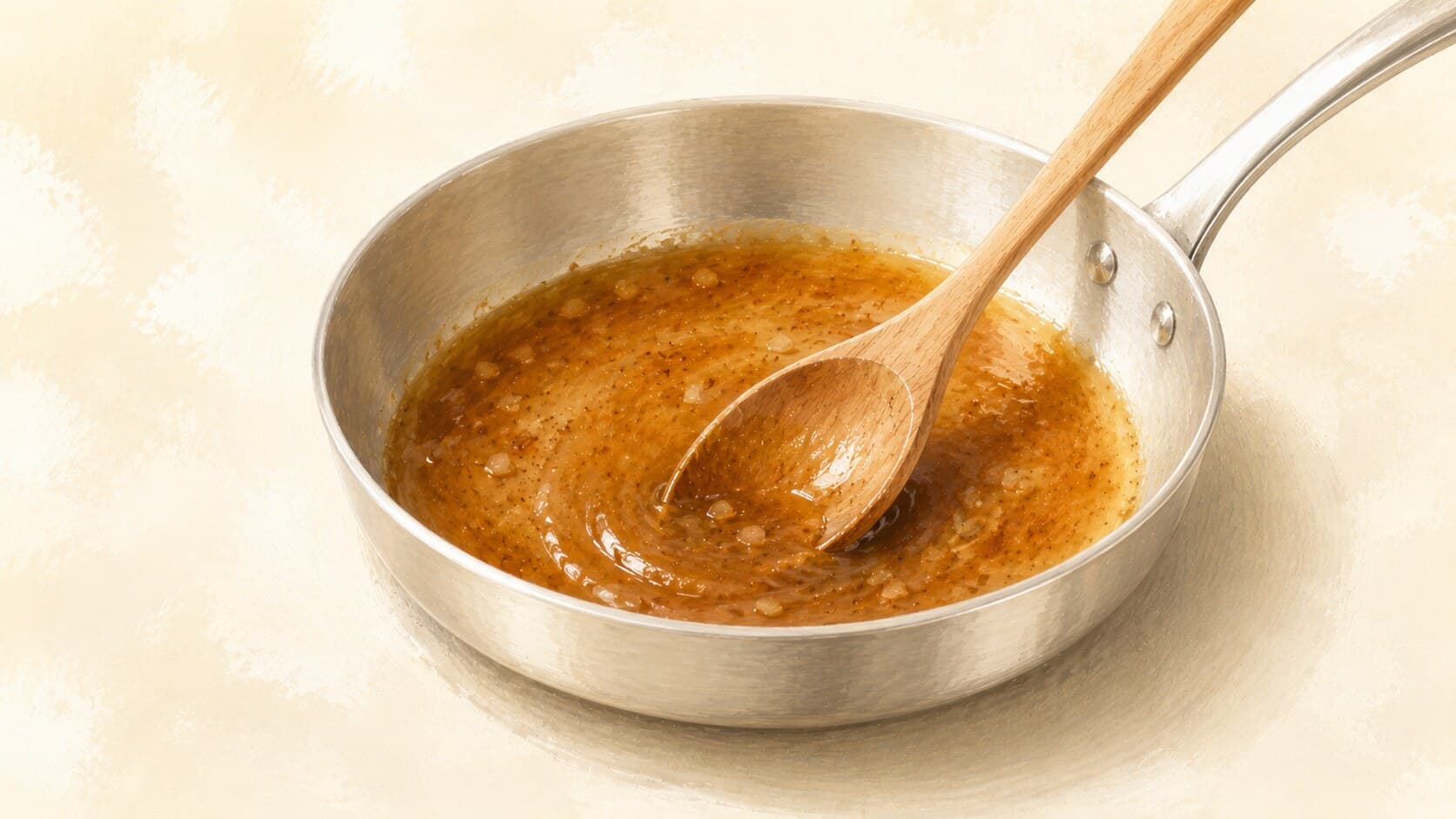
Pour in the wine. Scrape the fond up from the bottom with a wooden spoon as it bubbles. Add the stock and the optional thyme. Reduce until about 2 generous tablespoons of liquid remain — roughly 2 minutes. The sauce will look thin until the final few seconds, when it begins to coat the spoon.
Pull the pan off the heat. Swirl in the cold butter cubes one at a time, waiting for each to melt into a glossy emulsion before the next. Taste, season with salt. A few drops of sherry vinegar or lemon brighten the sauce if it tastes flat. Pour over the rested protein and serve immediately.
Tools you'll want
- · Tri-ply stainless saucepan (1.5–2 qt / 18cm)
- · Balloon whisk (24cm / 11-inch)
Why this works
A pan sauce is a recipe that retroactively explains every searing technique you have ever used. The brown stuck-on bits in the pan — what the French call fond, foundation — are concentrated savor, the residue of every Maillard reaction (the browning that gives seared food its savory, roasted flavor) that ran on the protein's surface. Wasted, they go down the sink with the rinse water. Captured, they become a sauce in five minutes.
The capture happens through deglazing. Liquid — wine, stock, water, vinegar, anything — added to a hot pan dissolves the fond off the bottom and lifts it into solution. The wooden spoon, dragged across the pan as it bubbles, is doing real mechanical work; what was stuck becomes suspended. This is the moment that separates a meal from a course.
Then comes reduction. The deglazed liquid is, at first, watery — too thin to coat anything. Boiling it down concentrates the dissolved solids while evaporating the water; the same physics that runs through a beurre blanc reduction or a tomato sauce reduction runs here, in miniature. Two minutes of attention reduces 150 g of liquid to about 30 ml of syrup, and the sauce now has body.
The final move is a small beurre monté — cold butter swirled into the off-heat pan in cubes. Each cube emulsifies (blends fat and liquid into one smooth, glossy mixture that won't separate) into the warm acid base, the same way a beurre blanc is built, just at a smaller scale. The butter gives the sauce shine, body, and a fat layer that carries the aroma of everything that just happened in the pan up to your nose.
A pan sauce is the recipe-that-isn't. There is no list of mandatory ingredients beyond fond + liquid + butter. Every plate of seared protein can carry its own pan sauce, made from whatever you have to hand, in less time than it takes to plate.
Common mistakes
Pouring off all the fat.
Target: Leave 1 tablespoon of rendered fat in the pan. The rest pours off into a bowl.
Why it matters: The fat carries aroma compounds from the protein and helps the sauce hold its body. Bare metal = thinner, less interesting sauce. The retained spoonful is the flavor bridge between protein and sauce.
What to do: Tilt the pan, pour off excess into a heatproof bowl, stop when a thin film remains.
Workarounds:
- Want a leaner sauce? Pour off more, but compensate with 1 extra tbsp butter at the mount.
Wiping the fond out by accident.
Target: Never wipe the pan bottom — the brown stuck-on bits are the sauce.
Why it matters: The fond is the entire point of pan sauce. A cleanup-reflex paper-towel wipe = sauce thrown away before you started. Maillard residue from the protein cannot be recreated.
What to do: Look at the pan before deciding to wipe. Brown sticky bits = keep. Burnt black = scrape with wooden spoon, the sauce will still work.
Workarounds:
- Burnt black fond → still salvageable. Deglaze, taste; if bitter, start fresh sauce with just butter and shallot.
High heat throughout.
Target: Medium-low heat after the initial deglaze splash. Steady simmer, not rolling boil.
Why it matters: Hard boiling over-reduces in seconds — you go from "almost ready" to "salty bitter syrup" in 20 seconds. Heat control is everything for a 5-minute sauce.
What to do: Drop heat immediately after the wine is added and the initial sizzle subsides. Steady controlled bubbles.
Workarounds:
- Pan is too hot → add a splash of cold stock to drop temperature without diluting flavor much.
Reducing past the syrup point.
Target: Sauce coats back of wooden spoon. Line drawn with finger holds for 1 second.
Why it matters: Over-reduced = salty, bitter, gluey. The window from "perfect" to "ruined" is about 20 seconds at the end. Watch closely.
What to do: Test with the wooden spoon test starting at the 90-second mark. Pull at "just coats the spoon" — don't wait for visible "thick."
Workarounds:
- Reduced too far → whisk in 1 tbsp warm stock to thin and rebalance. Still serve.
Adding cold butter to a still-bubbling pan.
Target: Off the heat first. Pan warm enough to melt butter slowly, not so hot that it breaks into oil.
Why it matters: Cold butter into bubbling pan = butter melts and instantly breaks into greasy slick rather than emulsifying. The mount only works in the temperature window where butter softens but doesn't break.
What to do: Lift pan off burner. Wait 5 seconds. Then add first butter cube, swirl until incorporated. Continue with remaining cubes one at a time.
Workarounds:
- Pan too hot? Move it to a cool burner; wait 10 seconds before adding butter.
Trying to scale a pan sauce up.
Target: Pan sauce for 1-2 portions of protein per pan. Two batches for 4+ servings.
Why it matters: A pan sauce depends on fond-to-liquid ratio. Scaling up = same fond, more liquid = diluted character. Better two perfect small sauces than one over-stretched.
What to do: Plan for separate pans if cooking for a larger group. Or split protein across two seared batches in the same pan.
Workarounds:
- Forced to scale → reduce more liquid (use less wine, more stock) and finish with a bit more butter to compensate for body loss.
What to look for
- The pan after pouring off fat: brown bits visible across the bottom, about a tablespoon of fat remaining. This is your base; don't touch it further.
- The shallot: softened, translucent, no color. If it browns, the pan is too hot.
- The deglaze: the bubbling liquid lifts the fond visibly into solution. The pan bottom should go from brown to bare metal within 30 seconds.
- The reduction: the back of a wooden spoon shows a clean trail when you draw a finger across. That line holding for a second is your done signal.
- The butter mount: each cube melts into a glossy slightly-cloudy liquid, not oil on top. The cloudiness is the emulsion forming.
Chef's view
There are several views on how big a role wine should play. A "classical French" pan sauce is mostly wine, slightly tempered with stock. A more modern restaurant move skews further toward stock — sometimes very lightly reduced demi-glace — for a deeper, less acidic register. My view: half-and-half by weight, plus or minus, with the option to push toward more wine for fish or poultry and more stock for red meat.
The other quiet decision is whether to strain. For a fine-plate service, yes — the shallot bits are texture you don't want next to a delicate fish or a seared scallop. For everyday cooking, no — the shallots are part of the sauce's character, and the cleanup is faster.
This recipe is the companion to Pan-Roasted Chicken Thigh, but it lives independently because almost every plate of seared protein can carry its own pan sauce. The thigh recipe taught the technique inside one dish; this one extracts the technique so you can apply it to anything.
Related glossary terms
- Deglazing — the act that turns fond into liquid
- Fond — the brown stuck-on residue that is the sauce's flavor concentrate
- Reduction — what concentrates the deglazed liquid into a sauce
- Beurre monté — the finishing emulsion that gives the sauce its shine and body
Get the essays in your inbox — free
Weekly notes on flavor, fermentation, and food history — the writing behind the Atlas of Flavor. No spam; unsubscribe anytime.