
Hollandaise Sauce
Egg yolks, melted butter, an acid reduction, ten minutes of careful temperature management. The mother sauce that teaches what a held emulsion really demands.
Contents (9 sections)▾
Ingredients
- For the acid reduction:
- 60 g white wine vinegar
- 30 g water
- 2 g whole black peppercorns, lightly crushed
- 1 small shallot, finely minced (about 15 g)
- —
- 3 large egg yolks (about 60 g) — pasteurized, or from shell eggs treated to destroy Salmonella (see the safety note)
- 180 g unsalted butter, melted gently and kept warm (clarified is traditional; whole melted butter also works)
- 2 g fine sea salt, to taste
- A few drops fresh lemon juice, to brighten
- Optional: 1 small pinch cayenne, classical addition
Steps
Make the reduction first. Combine vinegar, water, crushed peppercorns, and shallot in a small saucepan. Simmer over medium heat until reduced to about 2 tablespoons (~30 ml). Strain through a fine-mesh sieve, pressing the shallot, and reserve the liquid. The reduction concentrates the acid that will hold the emulsion together.
Set up a bain-marie: a heavy saucepan of water at a quiet simmer (small bubbles only — not rolling), with a heat-safe bowl that fits in the rim of the pan but doesn't touch the water. (If you prefer direct heat, work over the very lowest flame and pull on and off as needed.) The temperature target is somewhere around 60–70°C; well below a simmer.
In the bowl, whisk the egg yolks with about 2 tablespoons of the cooled reduction. Place over the bain-marie. Whisk constantly. Within 2–3 minutes the yolks will lighten in color, increase in volume, and start to look like loose ribbons — this is the sabayon stage. You'll see whisk-tracks holding for about a second on the surface. Do not let the bowl get hotter than warm to the touch on the outside; if it does, lift off the pan for 10–15 seconds.
Once the sabayon is at ribbon stage, begin streaming in the warm melted butter — very slowly at first, just a thin drizzle, while whisking constantly. The yolks emulsify the butter into droplets. Continue adding the butter gradually; the sauce thickens visibly as you go. By the end you have a glossy, pale-yellow sauce roughly the texture of soft mayonnaise.
Off the heat, whisk in salt, a few drops of lemon, and the optional pinch of cayenne. Taste. If the sauce is too thick, a teaspoon of warm water whisked in will loosen it. Serve immediately or hold in a warm (not hot) place for up to 30 minutes; hollandaise does not survive reheating.
Tools you'll want
- · Balloon whisk (24cm / 11-inch)
- · Tri-ply stainless saucepan (1.5–2 qt / 18cm)
- · Sauce strainer (chinois, perforated, or fine-mesh, 19–25cm)
- · Instant-read digital thermometer
Why this works
Hollandaise is the recipe that demands more sustained temperature attention than almost any other in the French repertoire. It is also the recipe where, once you understand the temperature window, the rest of the technique becomes mostly mechanical.
The starting point is a reduction — the same acid-concentration step that opens a beurre blanc. Vinegar, water, peppercorns, and shallot boil down to a few tablespoons of concentrated, aromatic liquid. The acid is what stabilizes the emulsion that will come; the more concentrated it is going into the build, the more forgiving the rest of the process.
Then the egg yolks. Whisked with the cooled reduction over gentle heat, the yolk proteins partially unfold and trap air, lightening the color and increasing the volume. This is the sabayon stage — the same physics that builds a zabaglione, just savory rather than sweet. The yolks at this point are at maybe 60°C; warm, foamy, holding whisk-tracks on the surface.
The critical move is the butter stream. Warm melted butter — itself an emulsion of fat, water, and milk solids — gets emulsified into the warm yolks, just as oil emulsifies into a mayonnaise. The yolks supply the lecithin (the natural emulsifier), the warm acid base supplies the stability, and the whisk supplies the mechanical energy that breaks the butter into small enough droplets to stay suspended.
The temperature window is narrow. Below about 55°C, the butter doesn't fully emulsify and the sauce stays runny. Above about 75°C, the egg proteins denature too much and the sauce curdles or breaks. The whole build wants to sit somewhere around 60–70°C, give or take — well below a simmer, warm to the back of your hand near the bowl but not hot. This is one of the few recipes where a probe thermometer is genuinely useful, and even then, the back-of-hand sensory cue is often more reliable than a number that lags the actual surface temperature.
A hollandaise is closely related to a beurre monté — both are warm butter emulsions held below the breaking point. The difference is the emulsifier: a beurre monté relies on milk proteins alone; a hollandaise has egg yolk lecithin doing the heavy lifting. The egg yolk is what makes hollandaise so much more stable than its relatives — but also what makes it vulnerable to over-heating.
Safety — the egg yolks. The sabayon warms the yolks into the emulsion, but this 60–70 °C window is a texture target, not a validated pasteurization step: a bath temperature without a controlled, measured hold is not a home Salmonella kill guarantee, so don't treat "it got warm" as proof the egg is safe. For reliable safety — and especially for pregnant people, infants and young children, older adults, and anyone immunocompromised — use pasteurized egg yolks, or yolks from shell eggs pasteurized in the shell to destroy Salmonella (an ordinary "fresh" egg is not the same thing). This changes nothing about the technique below.
Common mistakes
Too much heat.
Target: Yolks held at 65–75 °C. Below that they won't thicken; above 80 °C they scramble.
Why it matters: This is the SINGLE most common failure. Over-heated yolks produce a broken sauce — either curdled (grainy) or split (butter pooling on thin liquid). The egg-protein coagulation window is narrow.
What to do: Use a double boiler with simmering (not boiling) water. The bowl should not touch the water. If you see steam rising aggressively, lower the heat.
Workarounds:
- Broken sauce? Whisk 1 tsp cold water vigorously into the curdled mixture — sometimes recovers it.
- Beyond recovery? Start with a fresh pasteurized yolk in a clean bowl, slowly whisk the broken sauce into the new yolk.
Adding butter too fast.
Target: Thin drizzle for the first 30 seconds, accelerating only after the sauce visibly thickens.
Why it matters: Butter added faster than the emulsion can absorb floats as fat instead of integrating. The result is a split sauce that can't be saved.
What to do: Drizzle in a slow trickle — about the rate of a leaky faucet. Once the sauce thickens noticeably, you can speed up but never to a pour.
Workarounds:
- For more forgiveness, use clarified butter (no water content) — emulsifies more reliably.
Cold butter in warm yolks.
Target: Butter melted and warm — 55–60 °C — when it goes in.
Why it matters: Cold butter crashes the yolk temperature, the emulsion doesn't form, and the sauce stays liquid.
What to do: Melt butter in a separate pan, hold at warm. Pour in a thin stream.
Workarounds:
- For ultra-rich sauce, use brown butter (noisette) instead of plain melted butter.
Reduction not strained.
Target: Strain the wine + peppercorn + shallot reduction firmly through a fine sieve, pressing solids.
Why it matters: Whole peppercorns or shallot bits in the finished sauce ruin the silken texture. Strain to remove every solid.
What to do: Use a fine sieve, push down with the back of a spoon to extract liquid.
Workarounds:
- For deeper flavor, use the reduction without straining INTO the sauce, but strain through the final sauce before serving.
Stopping whisking.
Target: Continuous whisking from the moment yolks hit the heat until the sauce is plated.
Why it matters: Even brief breaks let the yolks coagulate on the bowl surface, and let butter separate. Hollandaise is a 10-minute focused task with no breaks.
What to do: Have everything ready before you start. Get help to pour the butter if needed.
Workarounds:
- Blender hollandaise: simpler one-button method — yolks + lemon in blender, drizzle warm butter through the lid hole. Slightly different texture but reliable for beginners.
Trying to reheat.
Target: Make hollandaise as close to service as possible. NEVER reheat — only HOLD warm.
Why it matters: Reheating breaks the emulsion. The proteins can't be re-suspended once the structure has set.
What to do: Time the hollandaise to coincide with the dish. Hold in a warm spot (thermos, low double boiler) for up to 30 minutes if needed.
Workarounds:
- For dinner-party staging, make as a "sabayon" first (yolks + reduction), then whip in warm butter at the last second.
What to look for
- The reduction: about 2 tablespoons of liquid, shallot soft and aromatic. Strain firmly.
- The bowl temperature: warm to the back of a hand held near it, not hot. If hot, pull off the heat for 10–15 seconds.
- The sabayon: yolks light in color, voluminous, holding ribbon tracks for about a second. This is the platform the butter goes into.
- First butter stream: thin drizzle, sauce thickens visibly. If butter pools on top, you are adding too fast.
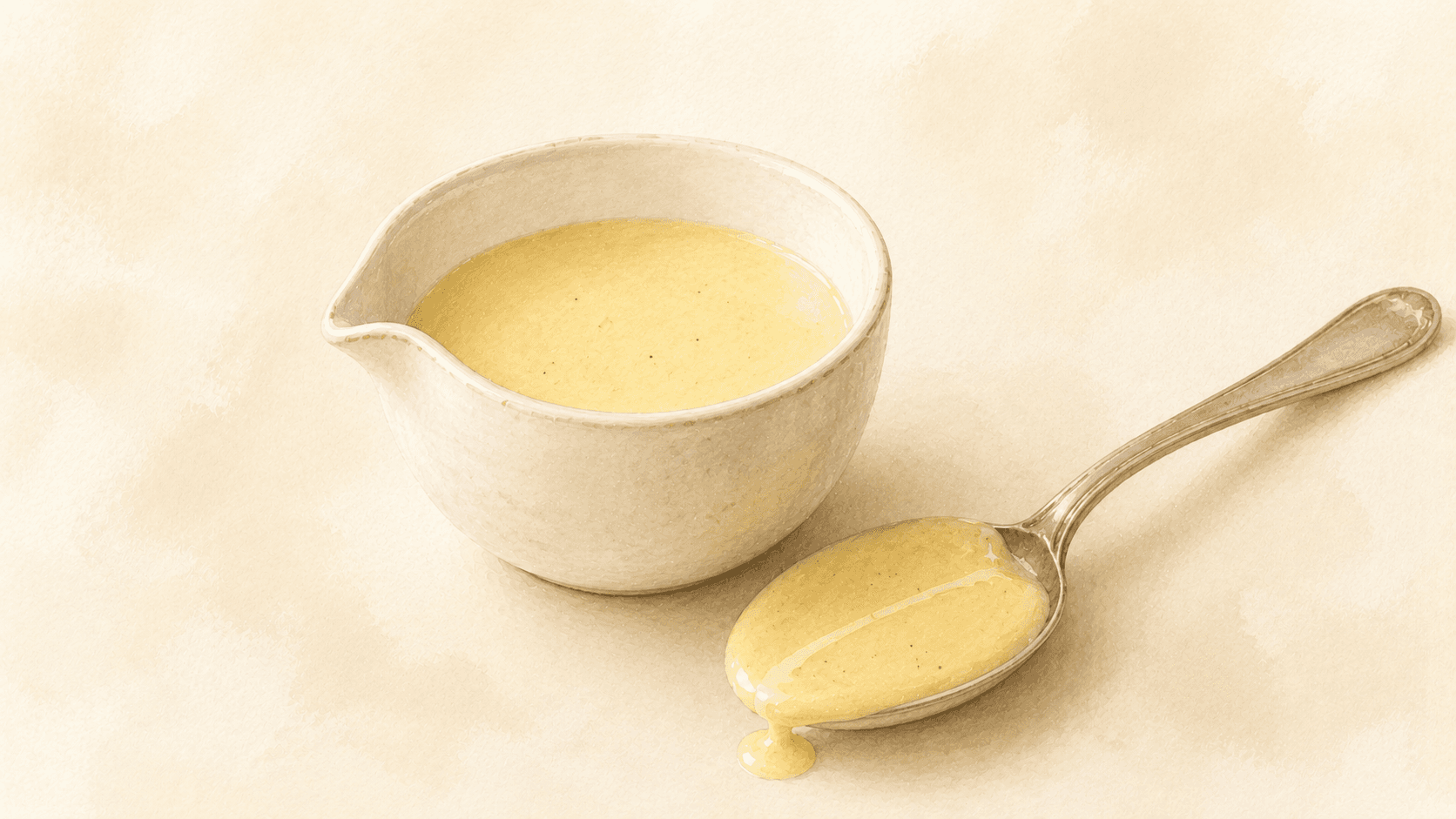
- Done: glossy, pale yellow, the texture of soft mayonnaise. A spoon dragged across leaves a clean line for several seconds.
Substitutions
- Lemon juice → white wine vinegar (~75% by volume). Sharper but cleaner. Sherry vinegar shifts toward a more savory register.
- Clarified butter → ghee. Identical for the emulsion; the toasted note of ghee suits poached eggs over hash, less suits asparagus.
- Whole butter (not clarified) — possible but trickier. Milk solids increase break risk. Hold the temperature 2 °C lower throughout.
- 3 yolks → 2 yolks + 1 tbsp warm water. Lighter sauce, less yellow, slightly less stable. Useful on weeknights.
Make-ahead and storage
- Hollandaise does not refrigerate well. The emulsion firms on cooling and is very hard to bring back smoothly. Treat it as a 30–60 minute sauce, not a make-ahead.
- Hold warm up to an hour in a thermos with the lid loose, or in a warmed bowl over (not in) gently warm water — never simmering.
- Re-warming is possible but risky. Start the cold sauce in a bowl over barely-warm water; whisk constantly; expect to lose some volume.
- If it breaks, don't discard. Whisk a teaspoon of warm water into a clean bowl and drizzle the broken sauce in slowly while whisking — the emulsion rebuilds.
Chef's view
There are several views on the heat source. The bain-marie (water bath) is the traditional safe choice — the water never exceeds 100°C, so the bowl above it stays in the safe temperature range almost by default. The direct-pan method (heat on lowest, pulling on and off) is faster and what most restaurant kitchens actually use. It requires more attention but produces an indistinguishable sauce. My view: the bain-marie is the right starting point until the temperature feel is internalized. After about ten successful sabayons, the direct method becomes the obvious workflow.
The other quiet decision is whether to clarify the butter. Classical French training calls for clarified butter — milk solids removed, just the pure fat — for a cleaner emulsion. Whole melted butter works almost as well and is faster; the milk solids contribute a slight cloudiness and a fuller flavor. My view: whole butter at home, clarified for service. The difference is real but small.
This is the recipe that tests whether the lessons of vinaigrette, mayonnaise, and beurre blanc have actually stuck. It uses every one of them — acid stabilization (vinaigrette), yolk-as-emulsifier (mayonnaise), warm butter emulsion at a narrow temperature window (beurre blanc) — assembled into a single high-attention 10 minutes. When this sauce is good, it is the test that the rest of your French sauce work is also good.
Chef Test Notes
I tested this sauce at three bowl temperatures during the butter stream:
- Held around 60°C — sauce stayed slightly loose, took longer to thicken, very forgiving
- Held around 70°C — built into ribbon stage quickly, the cleanest emulsion of the three
- Held around 75°C — twice out of three attempts the sauce edged toward graininess at the bottom of the bowl
70°C was the most reliable target with a probe thermometer in the bowl. Without a thermometer, the more honest cue is the back of the hand near (not on) the bowl — warm enough to register clearly, not hot enough to want to pull away. The 75°C tests were a useful reminder that the upper edge of the window is closer than it feels.
Related glossary terms
- Emulsion — what the whisk is building, with egg yolk lecithin as the emulsifier
- Beurre monté — the closely related warm butter emulsion, simpler base
- Reduction — the acid-concentration step that stabilizes everything that follows
- Beurre blanc — the sibling sauce with butter alone instead of yolk-supported emulsion
Get the essays in your inbox — free
Weekly notes on flavor, fermentation, and food history — the writing behind the Atlas of Flavor. No spam; unsubscribe anytime.