
Classic Vinaigrette
Three parts oil, one part vinegar, salt, mustard, a whisk. The simplest French sauce — and the one that teaches you what an emulsion really is.
Contents (8 sections)▾
Ingredients
- 60 g vinegar (sherry, red wine, or white wine)
- 180 g extra-virgin olive oil (or a 50/50 blend with neutral oil for a milder finish)
- 5 g Dijon mustard (acts as emulsifier; small spoon)
- 4 g fine sea salt (about 1/2 tsp)
- 1 g freshly cracked black pepper
- 1 small shallot, finely minced (optional, ~15 g)
Steps
Mince the shallot, if using, and let it sit in the vinegar for 2–3 minutes. This softens its bite and starts to pickle it slightly.
Add the salt and Dijon mustard to the vinegar. Whisk for 10 seconds — until the salt has fully dissolved and the mustard is uniformly suspended. This step is what makes the next one work.
Drizzle the oil in slowly while whisking constantly. Start with single drops, then a thin steady stream. Whisk for another 20 seconds after all the oil is in. The mixture should look pale, slightly cloudy, and hold together rather than separating instantly. That is the emulsion.
Taste with a small piece of lettuce or bread (not from the spoon — fat coats the tongue and reads sweeter neat than it does on a leaf). Adjust salt or acid if needed. Add black pepper last.
Tools you'll want
- · Balloon whisk (24cm / 11-inch)
- · Digital kitchen scale (gram precision)
Why this works
A vinaigrette is the easiest French sauce to make and one of the hardest to make well. The recipe is mostly a ratio — three parts oil to one part vinegar, plus salt — and almost every variable that affects taste is hidden inside the technique, not the list.
The technique builds an emulsion. Oil and vinegar do not naturally mix; left alone, they will separate within minutes. What holds them together long enough to coat a leaf is a combination of three things: salt dissolved in the vinegar (lowers the surface tension), Dijon mustard (whose proteins act as an emulsifier, gripping both fat and water), and the mechanical energy of the whisk (which shatters the oil into droplets fine enough to stay suspended).
The three-to-one ratio is itself an old French heuristic, not a law. With a sharp vinegar (sherry, red wine), three-to-one keeps the acid pleasant but present. With a softer vinegar (cider, rice), you can push to two-to-one. With a fierce one (balsamic, citrus), you sometimes want four-to-one. Treat the ratio as a starting point and the pH of your specific vinegar as the real variable.
Salt does double duty here. It seasons the dressing, but more importantly, it dissolves into the vinegar before the oil arrives. Salt that gets added at the end sits on top of the oil and tastes harsh. Salt that dissolves into the vinegar early ends up inside the emulsion, distributed evenly across every drop.
Common mistakes
Dumping the oil in all at once.
Target: Oil drizzled drop-by-drop initially, building to a thin stream as the emulsion sets. Continuous whisking throughout.
Why it matters: Bulk oil doesn't get broken into small enough droplets — mustard proteins can't grip them, dressing separates immediately. The slow drizzle is the only way to build a stable emulsion by hand.
What to do: Pour from a squeeze bottle or measuring cup with a thin spout. Drop, drop, drop → thin stream as you see emulsion building (cloudy, thickening).
Workarounds:
- Broke? Start over in a clean bowl with fresh mustard + vinegar, drizzle the broken vinaigrette in slowly as your "oil."
Skipping the mustard.
Target: 5 g Dijon mustard per 240 ml dressing — even a tiny amount stabilizes.
Why it matters: Mustard proteins are the emulsifier — without them, vinaigrette separates within 1 minute. The amount can be small (no mustard flavor) but the protein is essential for any holding.
What to do: Whisk mustard into vinegar before oil. Even ¼ tsp does the job invisibly.
Workarounds:
- Allergic to mustard → a small amount of egg yolk is the next-best emulsifier; raw garlic paste also has some emulsifying ability. Because this dressing is never cooked, use a pasteurised egg (pasteurised in the shell, or a pasteurised yolk product) for that yolk — an ordinary raw yolk carries a Salmonella risk that freshness does not remove; high-risk diners should avoid raw yolk entirely.
Salt added after the oil.
Target: Salt dissolved in vinegar before any oil touches.
Why it matters: Salt only dissolves in water-based liquids, not oil. After oil is in, salt crystals float and refuse to incorporate — you taste them as grit and the dressing tastes flat. Pre-dissolution = even distribution.
What to do: Vinegar in bowl → salt → whisk 10 seconds → mustard → oil last.
Workarounds:
- Forgot? Dissolve salt in 1 tsp warm water, whisk into dressing. Slightly dilutes but fixes the grit.
Tasting straight from the spoon.
Target: Taste on a leaf or piece of bread, never directly off the spoon.
Why it matters: Fat coats your tongue without anything to lift it — neat vinaigrette tastes sweeter and heavier than it does on food. You'll over-balance toward acid based on spoon-tasting, then it'll taste sharp on the salad.
What to do: Dip a single leaf, taste. Adjust based on that.
Workarounds:
- No leaves available → a small piece of plain bread is acceptable proxy.
Over-dressing the salad.
Target: Thin coating on leaves — about 1 tbsp per cup of greens.
Why it matters: Over-dressed greens wilt within minutes. The vinaigrette is concentrated; a little goes far. Better to start light and add than to recover wilted lettuce.
What to do: Pour, toss thoroughly with hands or salad servers, taste, add more if needed.
Workarounds:
- Already over-dressed → add fresh dry leaves to absorb excess; toss again.
What to look for
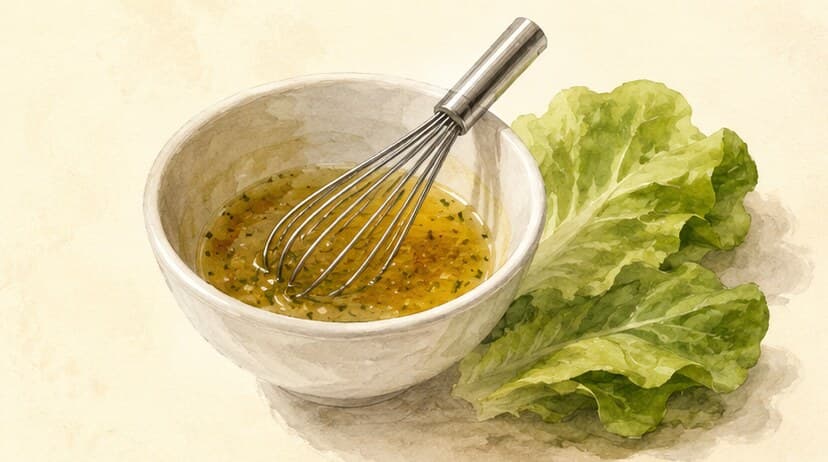
- Cloudy, pale gold. A successfully emulsified vinaigrette looks slightly opaque — like very thin honey. Translucent, water-thin liquid means it hasn't emulsified yet.
- A faint ribbon when you lift the whisk. Briefly. It will fall back into the bowl in seconds, but during the lift you should see a thread.
- No oil layer floating on top. If oil pools on the surface within 30 seconds, the emulsion is broken. Whisk again.
- A clinging coat on a leaf. Dip one leaf, lift it. The dressing should leave a thin, even film, not pool at the rib.
If you build a salad with umami-rich elements (parmesan, anchovy, soy, miso, mushroom), a slightly less acidic vinaigrette will serve better — the savory amino acids already supply some of the structural job that acid does on its own. Drop to a 4:1 ratio.
Substitutions
- Dijon → whole-grain mustard or a tiny pinch of honey. Whole-grain keeps the structure; honey skips the emulsifier but adds a softening sweetness for fruit-forward salads.
- Red wine vinegar → sherry, balsamic, or lemon juice. Each shifts the personality (sharper, sweeter, brighter) without breaking the 3:1 oil:acid ratio.
- Neutral oil → extra-virgin olive oil at 100%. Bigger flavor; pair only with assertive ingredients (anchovy, garlic, blue cheese) that can hold their own.
- Shallot → garlic clove crushed to a paste with salt. Sharper, more rustic. Skip if the salad already has raw onion.
Make-ahead and storage
- Vinaigrette holds well. Refrigerate in a sealed jar for up to 1 week. Bring to room temperature and re-shake before serving — the oil firms cold and pours unevenly.
- Mustard-based vinaigrettes hold the emulsion best. Versions without mustard separate within minutes; re-whisk or shake at plating time.
- Don't add fresh herbs until service. Chopped herbs in the jar discolor and turn bitter overnight.
- Garlic-forward vinaigrettes lose their edge after 48 hours. Make those fresh; keep the plain version on hand for daily use.
Chef's view
There are several views on how a vinaigrette should be made. The classical French school whisks in a bowl. A faster school shakes in a jar. A third — Jacques Pépin's preferred technique — drizzles oil into a blender while it runs. They all produce emulsions; they produce different emulsions.
My view: whisk for the small-batch dressing you're going to use in the next ten minutes. The fine bubbles broken in by hand give it a lighter mouthfeel. Shake in a jar for batches that need to live in the fridge for a week — the larger droplets the shake produces hold up better through cold storage. Blender only for thick "creamy" vinaigrettes that need a tight emulsion (caesar, green goddess).
The thing that matters most is not the equipment. It is the order. Salt into vinegar first, mustard second, oil slowly third. Everything else is preference.
Related glossary terms
- Vinaigrette — the family this recipe sits inside
- Emulsion — what the whisk is actually building
- pH — why different vinegars want different ratios
- Umami — the lever that lets you use less acid without losing brightness
Get the essays in your inbox — free
Weekly notes on flavor, fermentation, and food history — the writing behind the Atlas of Flavor. No spam; unsubscribe anytime.