
Mayonnaise
One yolk, a teaspoon of mustard, a few drops of vinegar, oil drizzled in slowly. Five minutes of whisking that, once you understand them, explain almost every emulsion in cooking.
Contents (9 sections)▾
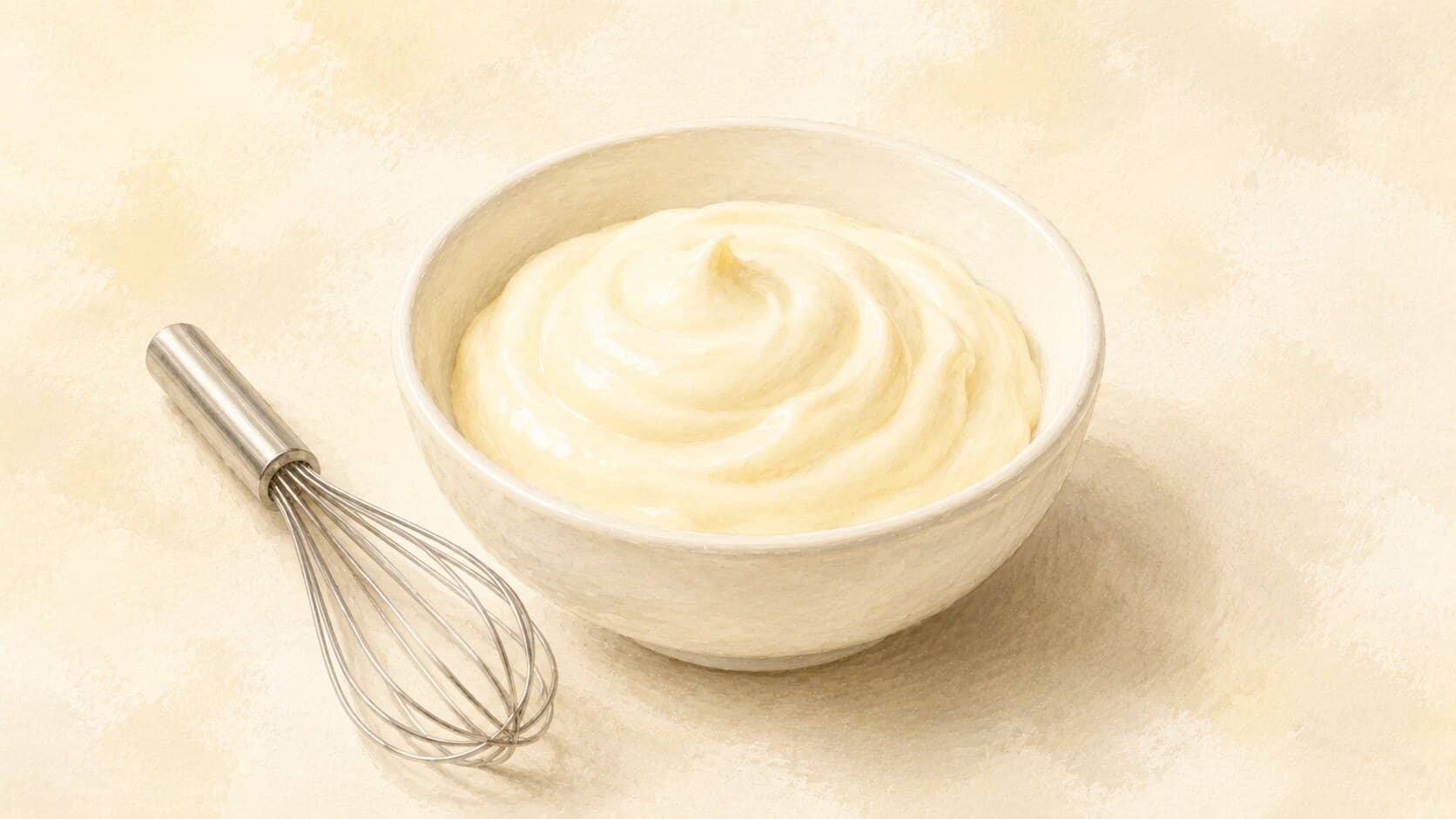
Ingredients
- 1 large egg yolk (about 20 g), at room temperature — pasteurized, or from a shell egg treated to destroy Salmonella (this sauce is uncooked; see the safety note)
- 5 g Dijon mustard (about 1 small teaspoon)
- 3 g white wine vinegar or fresh lemon juice (about 1/2 teaspoon), plus more to taste
- 200 g neutral oil (grapeseed, sunflower) — or 150 g neutral + 50 g olive oil for a milder olive note
- 2 g fine sea salt, plus more to taste
- 1 small pinch white pepper (optional)
Steps
In a medium bowl, whisk the yolk with the mustard, vinegar, and salt for about 20 seconds, until the mustard is uniformly suspended and the salt has dissolved. The yolk should look slightly lighter in color — proteins beginning to unfold. This is the platform the oil will emulsify into.
Begin streaming in the oil. The first 30 seconds are the most important: drop by drop, then a thin trickle, while whisking constantly. The sauce will thicken visibly within 10–15 seconds — that's the emulsion forming. If you can see oil pooling on top, you are adding faster than the yolk can take it; slow down and whisk through what's there before adding more.
Once the first 50 g of oil is incorporated and the sauce is visibly thick, the rate can pick up — a thin steady stream rather than drops. Continue whisking constantly. By the end you have a glossy, pale, mayonnaise-thick sauce holding a clear peak when the whisk is lifted.
Taste. Adjust salt, vinegar, or mustard. A thicker mayonnaise can be loosened with a teaspoon of warm water whisked in. A too-thin one usually needs more oil. Refrigerate in a clean jar; use within 3–4 days.
Tools you'll want
- · Balloon whisk (24cm / 11-inch)
- · Digital kitchen scale (gram precision)
Why this works
A mayonnaise is the emulsion teaching recipe — the dish where every variable that matters in every other emulsion is visible at once and on a slow enough timeline to watch.
Egg yolk is the engine. It contains lecithin, a phospholipid that has a water-loving end and a fat-loving end. Whisked into a small amount of water-based liquid (the vinegar, mustard, and salt), the lecithin orients itself around oil droplets as the oil arrives — the water-loving end pointing outward into the water phase, the fat-loving end embedded in the droplet. That orientation is what keeps the droplets suspended instead of merging back into a single oil layer. One yolk can stabilize a remarkable amount of oil — typically 150–200 g, sometimes more.
The water phase is the second variable. Vinegar gives acidity, which helps stability; mustard adds its own emulsifying compounds (mucilage, protein); salt dissolves into the water and lowers surface tension. The order matters: salt has to dissolve into water-based liquid before the oil arrives, because salt does not dissolve in oil. This is also why a vinaigrette salts the vinegar before the oil — same physics, smaller scale.
The mechanical energy of the whisk is the third variable. The whisk shatters incoming oil into droplets small enough to stay suspended. Slow streaming gives the yolk time to coat each droplet with lecithin before the next arrives; fast pouring overwhelms the system, the lecithin can't keep up, and the sauce breaks — droplets merge, oil pools, the emulsion is gone.
Once you have made a mayonnaise twice from scratch, the vinaigrette recipe stops looking like a different dish. They are cousins. The vinaigrette uses mustard alone for emulsification (no yolk), so it has less holding power. The mayonnaise uses the yolk's lecithin and is consequently far more stable. The technique — salt into vinegar first, mustard next, oil slowly third — is identical. What changes is the emulsifier.
A small optional move: a few drops of concentrated reduction (vinegar boiled down to a syrup, or a tablespoon of a sherry reduction) added to the water phase before the oil. This is a small reduction step that gives the finished mayonnaise more depth than vinegar alone provides — useful for an aioli-adjacent register or a mayonnaise destined for fish.
The umami note is quietly real. Egg yolks themselves contribute free glutamate, and good Dijon mustard adds more. A mayonnaise that tastes "rich" is partly tasting fat, partly tasting savory amino acids — not just the oil.
Common mistakes
Oil too fast.
Target: First 30 seconds drop-by-drop, then thin steady stream. Continuous whisking.
Why it matters: The #1 failure mode — fast pouring overwhelms the lecithin, droplets coalesce, sauce breaks. Once you see oil pooling above egg water rather than glossy cream, you went too fast.
What to do: Squeeze bottle or measuring cup with fine spout. Drop, drop, drop until visibly thick (about 50 g oil in), then stream slowly.
Workarounds:
- Broke? Rescue method: a fresh pasteurized yolk in a clean bowl, drizzle broken sauce in slowly as if it were oil. The new lecithin reserve fixes it.
Cold egg yolk straight from the fridge.
Target: Yolk at room temperature (20°C) before whisking.
Why it matters: Cold lecithin is sluggish — emulsion takes 2x longer to build and more likely to break. Room-temp yolks emulsify cleanly.
What to do: Pull egg from fridge 15 minutes before. Or float the yolk briefly in warm water.
Workarounds:
- Forgot to temper → place yolk in bowl over warm water (off-heat) for 1 minute before starting.
Adding mustard at the end.
Target: Mustard whisked into yolk base with vinegar and salt — before any oil.
Why it matters: Mustard added late sits on top, tastes harsh, doesn't contribute its emulsifying proteins to the build. Early mustard reinforces the lecithin's work.
What to do: Yolk + mustard + vinegar + salt whisked together. Oil last.
Workarounds:
- Mustard-allergic → omit, but use slightly less oil (180 g) since lecithin alone has less holding power.
Salt only at the end.
Target: Salt dissolved in vinegar/yolk base before oil.
Why it matters: Salt doesn't dissolve in oil — late salt crystals float and taste gritty. Same physics as vinaigrette: pre-dissolution = even distribution.
What to do: Salt into the water-based mixture; whisk until dissolved before oil.
Workarounds:
- Need to add more salt later → dissolve in 1 tsp warm water first, then whisk in.
Trying to use pure olive oil.
Target: Neutral oil base, finish with a small splash of olive at end (50 g neutral + 50 g olive max ratio for aioli register).
Why it matters: Strong extra-virgin olive oil makes mayonnaise heavy and sometimes bitter (especially with stick blender — the fragmenting brings out polyphenol bitterness). Neutral oil emulsifies cleanly.
What to do: Build emulsion with neutral oil first; whisk olive oil in last for aroma without bitterness.
Workarounds:
- Want olive-forward (aioli) → use mild olive oil (not strong EVOO) for the whole thing.
Reusing a broken sauce as is.
Target: Don't use broken mayo — rebuild it properly.
Why it matters: Broken mayonnaise tastes greasy, watery, harsh. The texture and emulsion that define mayonnaise are absent. Don't try to mask it.
What to do: Rescue with a fresh pasteurized yolk: clean bowl, whisk the new pasteurized yolk briefly, drizzle broken sauce into it drop-by-drop. Same physics as initial build.
Workarounds:
- Time-short → use the broken mayo as dressing for cooked vegetables where the texture matters less; make fresh for sandwich/dip applications.
What to look for
- The yolk base: salt visibly dissolved, mustard uniformly distributed, color slightly lighter than the raw yolk. This is the platform.
- First 30 seconds of oil: drop by drop, sauce thickens visibly with each whisk pass. If you don't see thickening, stop adding and whisk what's there.
- Mid-build: the sauce is glossy and visibly thicker, oil streams in at the rate of a slow drizzle.
- Done: glossy, pale, holds a soft peak when the whisk is lifted. The whisk should drag clean tracks across the surface.
- A clinging coat on a spoon: the back of a spoon dipped in and lifted out comes up coated in a layer that doesn't drip. This is mayonnaise-thick.
Substitutions
- Whole egg → yolk only (about 1.5 yolks). Slightly thicker, richer; less stable on the spoon. Whole egg gives a lighter, more spreadable mayo.
- Dijon mustard → English (Colman's) or whole-grain. English mustard adds heat; whole-grain shifts the texture but stays neutral on flavor.
- Neutral oil → 50/50 with olive oil for aioli notes. Pure olive oil mayo turns bitter and unstable from agitating polyphenols — stick to a blend.
- Lemon juice → 1 tsp water + 1 tsp vinegar. A cleaner, more neutral acidity with a similar tang — a flavour choice, not a change to safety or keeping quality.
Make-ahead and storage
- Refrigerate immediately in a clean, sealed jar — never leave at room temperature longer than the time it takes to plate the meal.
- Keeps 3–4 days refrigerated. After that, oil-bloom and off-aromas start. Discard at any sign of separation, off smell, or color change.
- Do not freeze. The emulsion breaks irreversibly on thawing — the result is grainy and watery.
- A note on raw egg yolks. This mayonnaise is uncooked, so the yolk is raw — freshness does not make a raw egg safe from Salmonella. Use a pasteurized egg (pasteurized in the shell, or a pasteurized egg product), still refrigerate the mayo within an hour, and use within 3–4 days. Pregnant people, infants and young children, older adults, and anyone immunocompromised should use pasteurized egg or commercial mayo.
Chef's view
There are several views on which acid to use. Lemon juice gives a brighter, more aromatic mayonnaise — good for fish, vegetables, anything Mediterranean. White wine vinegar gives a more neutral, classical French register. Sherry vinegar or aged red-wine vinegar gives more depth, slightly toastier. My view: lemon for fresh applications, white wine vinegar as the default, sherry when the mayonnaise is going onto something that itself has Maillard depth (a sandwich, a sear).
The other quiet decision is whether to use a stick blender. A small mayonnaise (one yolk, 200 g oil) is essentially the same time whisked by hand or blitzed in a tall narrow jar with a stick blender. The stick blender produces a slightly tighter, slightly more aerated emulsion, and it's foolproof. The hand-whisked version has a slightly looser, more luxurious texture and rewards attention. Both are correct. Restaurant lines use blenders for everything; the home kitchen has time for either.
A note on raw egg yolk: this mayonnaise is uncooked, so use an egg whose label or treatment confirms it is pasteurized — a shell egg pasteurized through to the contents, or a pasteurized egg product. Availability varies by market, and freshness, a "raw-eating" (生食用) label, or shell washing/disinfection are not the same as content pasteurization. Refrigerate the finished mayonnaise and use within a few days; when in doubt, consult a trusted food-safety reference.
This is the recipe that taught me to whisk. After about thirty mayonnaises, the wrist learns the rhythm and the recipe becomes one of the fastest "from scratch" sauces in the kitchen — under five minutes, no special equipment, no waste.
A note on history
The origin story of mayonnaise is a siege. In 1756, French forces under the Duc de Richelieu captured the port of Mahón on the island of Menorca from the British. The popular legend says Richelieu's chef, lacking cream for a victory sauce, improvised with egg yolks and oil — and the dish was named Mahonnaise in honor of the captured city, eventually softened to mayonnaise. The story is probably apocryphal (no contemporary documentation survives), but it captured the French imagination and the name stuck. Other theories trace the name to manier ("to handle"), or to moyennaise (linked to Bayonne) — but the Menorca story is the one the world remembers.
What's documented is that by the early 19th century, mayonnaise had entered the French classical repertoire. Antonin Carême described it in his L'Art de la cuisine française au XIXe siècle (1833-1835), and it has been there ever since. Industrial production began in the early 20th century — Hellmann's (1905, Manhattan) and Best Foods (1912, California) turned mayonnaise from a daily-made restaurant sauce into a shelf product, and that shelf product is now the version most of the world recognizes. Kewpie (created by Toichiro Nakashima in 1925) added rice vinegar and used only egg yolks, producing the richer, more umami-leaning Japanese version. So a sauce supposedly invented during a battle for a small Mediterranean island now exists in three globally-distinct industrial forms (American, European, Japanese), each subtly tuned to its market. The recipe above is the unindustrialized version — closer to what Richelieu's chef might have actually made, if the legend is true.
Related glossary terms
- Emulsion — what the whisk is building, droplet by droplet
- Vinaigrette — the cousin recipe that uses the same technique with a different emulsifier
- Umami — the quietly real savory note in yolk + mustard
- Reduction — the optional concentrated acid that deepens the finished sauce
Get the essays in your inbox — free
Weekly notes on flavor, fermentation, and food history — the writing behind the Atlas of Flavor. No spam; unsubscribe anytime.