
Basic Potage
Mirepoix, one dominant vegetable, stock, and a small mount of butter at the end. The recipe that turns soup-making from improvisation into a four-step template you can fill with anything.
Contents (6 sections)▾
Ingredients
- For the mirepoix:
- 1 medium onion, diced (about 100 g)
- 1 small carrot, diced (about 50 g)
- 1 stalk celery, diced (about 50 g)
- 20 g unsalted butter, for the sweat
- —
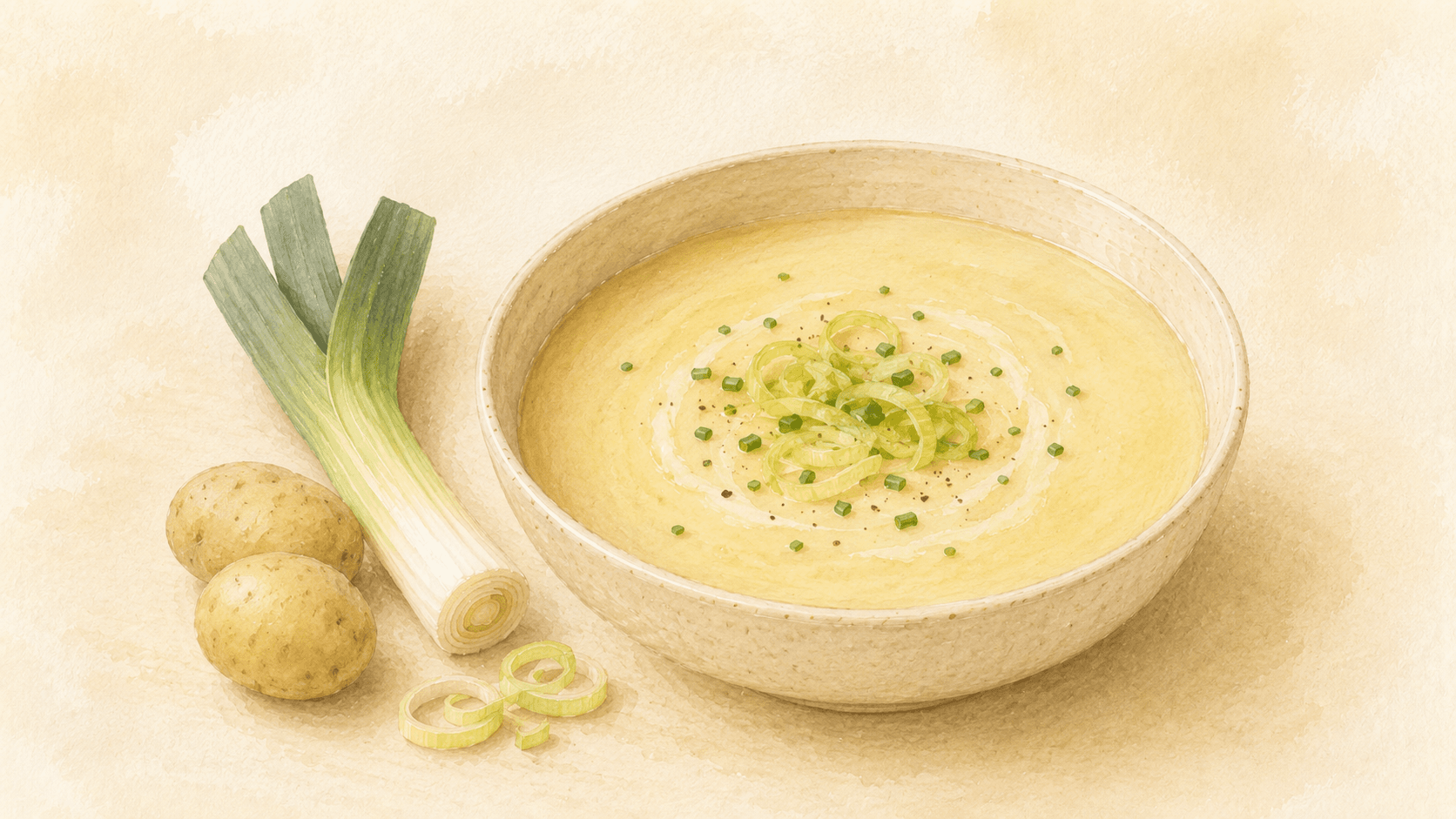
- 500 g dominant vegetable, peeled and chopped (potato + leek classic; cauliflower; pumpkin; broccoli; peas; etc.)
- 600 g chicken or vegetable stock (warm)
- 30 g cold unsalted butter, for the final mount
- 3 g fine sea salt, plus more to taste
- Optional: a swirl of cream, a few drops lemon, fresh herbs at service
Steps
Melt the 20 g of butter in a heavy saucepan over medium-low heat. Add the diced mirepoix — onion, carrot, celery — and a small pinch of salt. Cook gently for 8–10 minutes, stirring occasionally, until the vegetables are soft and the onion is translucent. Do not let them brown. The goal is to sweat the aromatics, not caramelize them; this preserves the pale color and clean flavor of the finished potage.
Add the dominant vegetable, chopped roughly. Stir it through the mirepoix for 1 minute to coat in the fat. Pour in the warm stock — enough to cover the vegetables by about 1 cm. (Warm stock keeps the cook moving; cold stock would drop the pan temperature for several minutes.) Bring to a simmer.
Cook at a low simmer for 15–20 minutes, until the dominant vegetable is fully tender. The exact time depends on what it is — potato 18 minutes, cauliflower 12, peas 4. Test with the tip of a knife: it should slide through with no resistance.
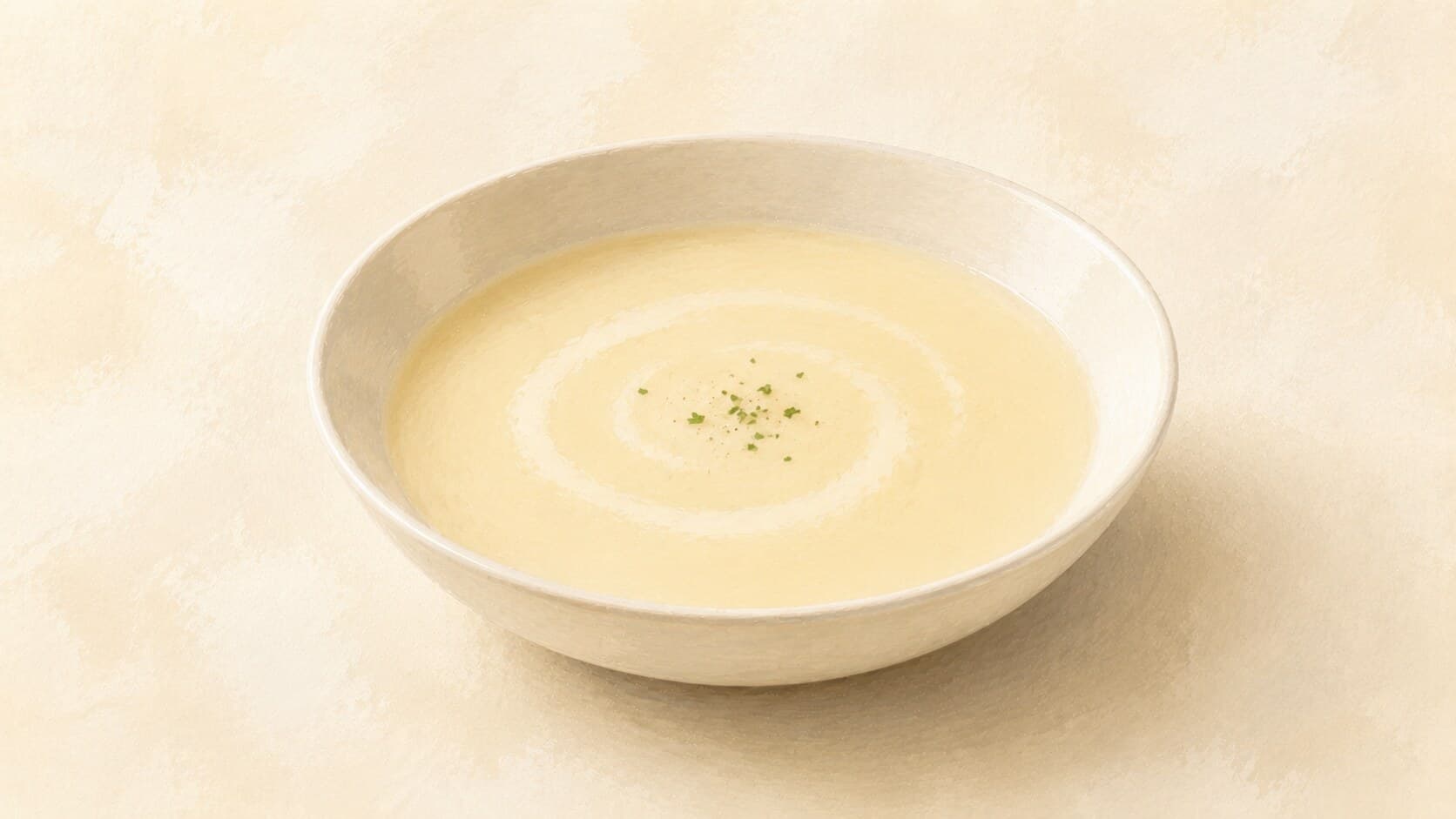
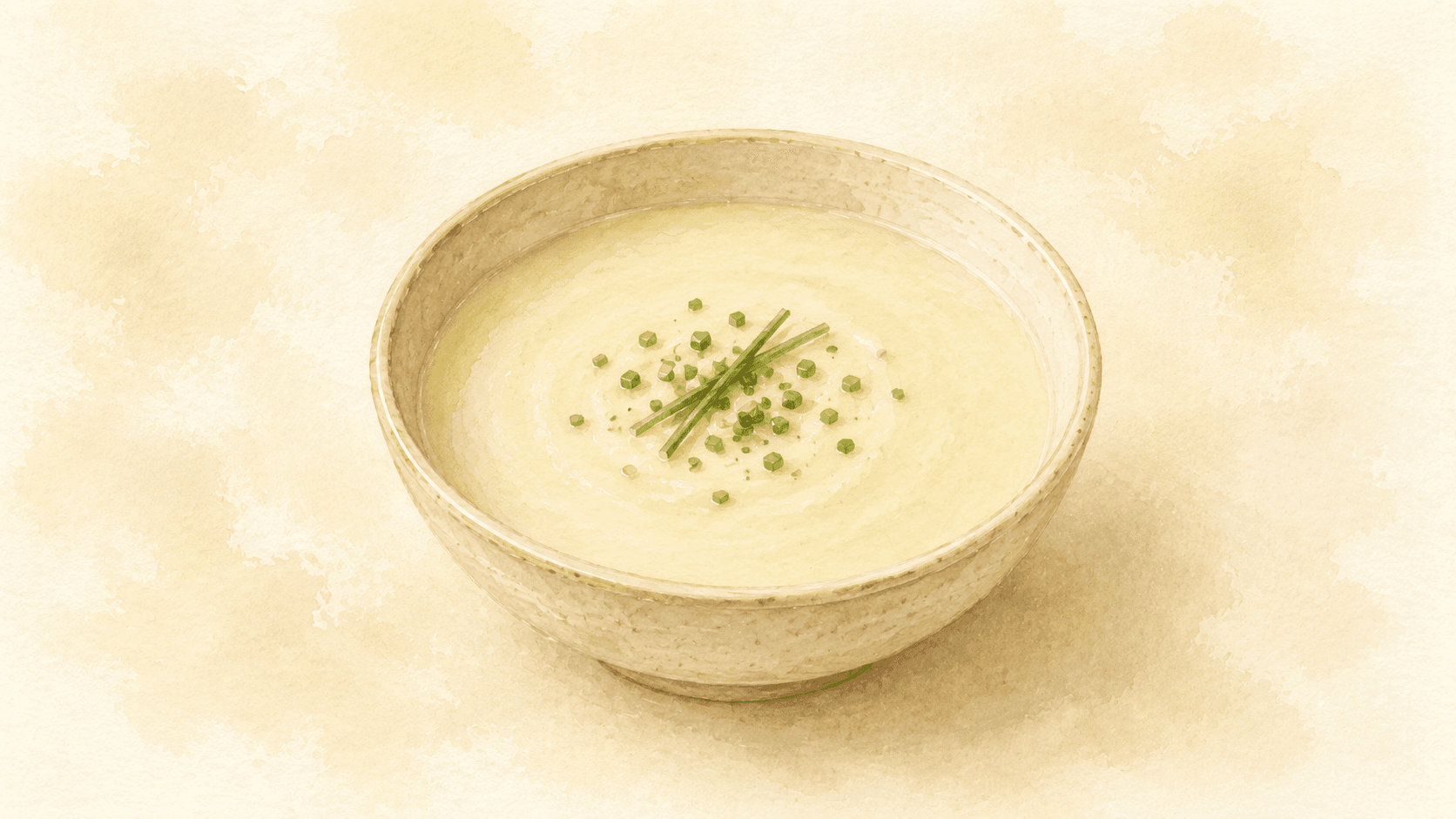
Pull off the heat. Blend smooth — with a stick blender directly in the pot, or in batches in a stand blender. For a silkier texture, pass through a fine-mesh strainer. Return to low heat. Off the heat, swirl in the cold butter cubes one at a time until the soup looks glossy and slightly thicker. Taste, adjust salt. Serve into warm bowls with a swirl of cream, a few drops of lemon, or a sprinkle of fresh herbs.
Tools you'll want
- · Tri-ply stainless saucepan (1.5–2 qt / 18cm)
- · Sauce strainer (chinois, perforated, or fine-mesh, 19–25cm)
- · Balloon whisk (24cm / 11-inch)
Why this works
A potage is one of the most quietly important recipes in French cooking — not because it's hard, but because it is a template. Once you understand the four moves, you stop following potage recipes; you make potage out of whatever vegetable is in the fridge.
The four moves:
1. Mirepoix. Onion, carrot, celery in a 2:1:1 ratio, sweated gently in butter. This is the aromatic base — the depth that keeps every potage from tasting flat. Beginners sometimes skip the mirepoix and go straight to "vegetable + stock + blend." The result is technically soup. It is not potage.
2. The dominant vegetable. This is the soup's character — potato, leek, cauliflower, pumpkin, asparagus, peas, white beans, fennel. Whatever it is, it goes in after the mirepoix and gets a moment to absorb the fat before the stock arrives.
3. Stock and gentle simmer. Just enough liquid to cover the vegetables; a low simmer (not a hard boil); cook until tender. This step is mostly a reduction running quietly underneath — water doesn't dominate, flavor concentrates as the vegetables break down.
4. Blend, then mount with cold butter. This last step is where most home potages fall short. After blending smooth, a small amount of cold butter swirled into the warm soup off the heat creates a tiny emulsion — like a small beurre monté. The butter doesn't sit on top; it disperses through the soup as fat droplets, giving the surface its characteristic gloss and the mouthfeel its characteristic roundness.
That fourth move is the difference between "blended vegetable in liquid" and "a French potage." It takes about thirty seconds and it is what makes the dish taste finished.
Once you've made it three times with potato-and-leek, you start to see the template. Same four moves, swap the dominant vegetable. Cauliflower potage. Pumpkin potage. Pea potage. A whole season of soups from one recipe, because the recipe isn't really a recipe — it's a structure.
There are several views on whether to add cream. The classical French finish is butter alone (the technique above). A heavier, more modern restaurant version adds 30–50 g of cream during the final mount, giving extra body. My view: butter only for a clean, vegetable-forward soup; add cream when the dominant vegetable is itself lean (asparagus, peas) and could use the support.
Common mistakes
Browning the mirepoix.
Target: Onion glassy and translucent at 8-10 minutes. No color.
Why it matters: Color on the mirepoix darkens the potage and gives it a slightly burnt-edge flavor. Wrong register for a pale, clean potage. French onion soup is built on browned onion — that's a different dish.
What to do: Medium-low heat. Stir occasionally. If the pan gets too hot, pull off heat for 30 seconds. Look for glassy, not golden.
Workarounds:
- Pan too hot? Cover with parchment-cartouche to trap steam and slow browning while keeping the vegetables soft.
Too much liquid.
Target: Stock covers vegetables by about 1 cm — visible vegetable tops just submerged.
Why it matters: Too much liquid = thin weak soup, vegetables can't flavor it adequately. You can always thin later; you can't remove water without re-concentrating.
What to do: Use 600 ml per 500 g vegetable as starting ratio. Top up with warm stock at the end if needed.
Workarounds:
- Already too liquid → simmer uncovered for 5-10 min after blending to reduce volume.
Cold stock.
Target: Stock warm (40-60°C) when added — never straight from the fridge.
Why it matters: Cold stock crashes the pan temperature for 3-5 minutes, stretching the cook out and producing under-developed vegetable flavor. Warm stock keeps the simmer continuous.
What to do: Heat the stock in a kettle or small pot while the mirepoix sweats. Ready to add at the right moment.
Workarounds:
- Microwave 1 minute on high to warm cold stock.
Skipping the butter mount.
Target: 30 g cold butter swirled in off the heat after blending. Surface goes from matte to glossy.
Why it matters: The single biggest difference between "soup" and "potage." Cold butter into warm soup forms a micro-emulsion — fat disperses throughout, giving body and gloss. 30 seconds of work, dramatic quality jump.
What to do: Off heat, drop in cold butter cubes, swirl the pot until the surface gleams. Don't stir vigorously — let the residual heat melt it gradually.
Workarounds:
- Want extra body → add 1 tbsp heavy cream alongside butter for richer finish.
Salt only at the end.
Target: Salt twice — pinch with the mirepoix, more to taste at finish.
Why it matters: Early salt draws moisture from vegetables and concentrates the aromatic base. End salt only seasons the liquid surface. Two-stage salting builds deeper integration.
What to do: Small pinch (1 g) with mirepoix → final adjustment after blending.
Workarounds:
- Forgot early salt → dissolve final salt in 1 tbsp warm soup before stirring back in for better integration.
Over-blending.
Target: Blend to smooth, then stop — about 30-60 seconds depending on blender power.
Why it matters: Blending past smooth incorporates air, lightens the color, and creates a foamy bubbly texture. The desired finish is dense and velvety, not aerated.
What to do: Pulse-blend for control. When the texture is uniform smooth, stop. Don't keep going.
Workarounds:
- Slightly foamy? Let rest 5 minutes — surface bubbles dissipate naturally before service.
What to look for
- The mirepoix at minute 8: soft, translucent, no color. The onion should look glassy, not golden.
- The stock level: liquid covers the vegetables by about 1 cm at the start. If you can see the tops of vegetables poking out, add a splash more.
- The simmer: small, lazy bubbles at the surface — not a rolling boil. Hard boiling can break vegetables aggressively and clouds the finished texture.
- The texture before the strainer: smooth from the blender, no chunks. If the blender leaves bits, strain to catch them; if it's already silky, the strainer is optional.
- The butter mount: the soup goes from matte to glossy in about 20 seconds. That glossy surface is your finished signal.
Chef's view
There are several views on the role of the strainer. A restaurant kitchen will almost always pass the soup through a fine-mesh strainer (or a chinois) after blending — it removes any unblended fiber and produces a glass-smooth texture. A home kitchen can skip this with most ingredients (potato, pea, cauliflower blend perfectly smooth in a good blender) but should strain anything fibrous (asparagus, celery, fennel) — the strings are the part you don't want.
The other quiet decision is what garnish to use. The classical French restraint is a small swirl of cream, a few drops of olive oil, or a single sprig of fresh herb (chervil, chive, parsley). My view: the simpler, the better. A garnish should hint at one ingredient, not announce three.
This is the recipe I cook when I want to remember that French cooking is really mostly templates. Recipe books fill pages with "asparagus soup, pea soup, cauliflower soup" as if they were distinct lessons. They are one lesson. The four moves above are the lesson. Everything else is the vegetable changing.
Related glossary terms
- Mirepoix — the aromatic base that gives every potage its depth
- Reduction — the quiet concentration that happens during the simmer
- Emulsion — what the final butter mount actually builds
- Beurre monté — the closely related technique applied here in miniature
Get the essays in your inbox — free
Weekly notes on flavor, fermentation, and food history — the writing behind the Atlas of Flavor. No spam; unsubscribe anytime.