
Basic Miso Soup
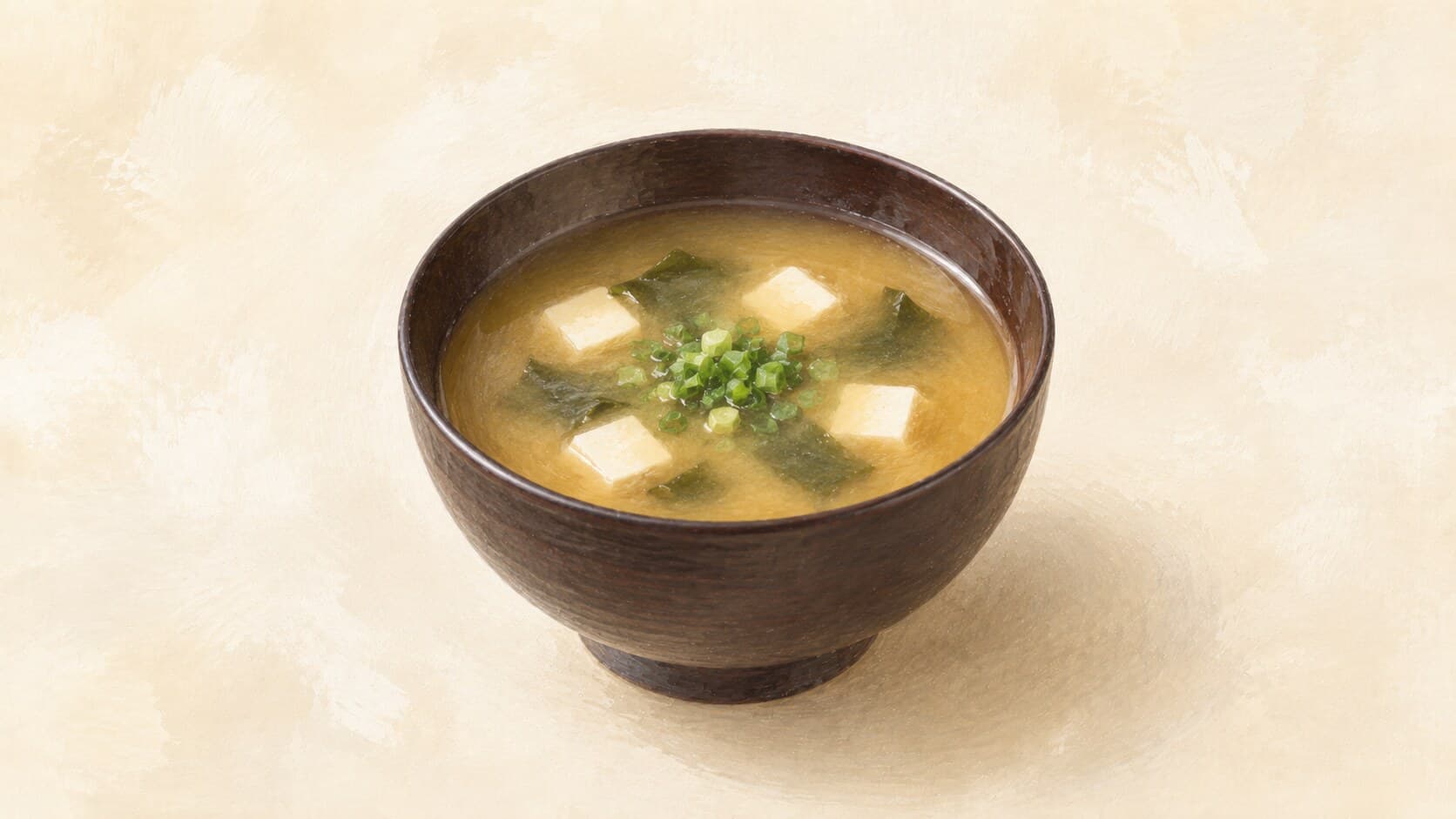
Dashi, miso, tofu, wakame, scallion. Five minutes of cooking governed by one rule: miso is dissolved off the heat, never boiled — because boiling kills the very aroma compounds that make miso miso.
Contents (9 sections)▾
Ingredients
- 400 g freshly made dashi (kombu or kombu-katsuobushi — see the dashi recipe)
- 30 g miso paste (white miso for a sweeter, milder soup; red miso for a deeper, saltier register; or 50/50 awase for the home default)
- 80 g silken tofu, cut into 1.5 cm cubes (firm tofu works but the texture is wrong)
- 2 g dried wakame seaweed (about 1 teaspoon — it will expand 5-7x in volume)
- 1 thin scallion, finely sliced into rings
Steps
Soak the dried wakame in cold water for 5 minutes while you prepare everything else. It will rehydrate and turn from a brittle dark green flake into soft tender ribbon. Drain and squeeze gently.
Warm the dashi in a small saucepan over medium-low heat. You're looking for around 80°C — wisps of steam, no rolling boil. Hard-boiling dashi muddies it; the same gentle warm hold applies here.
Add the tofu cubes and the rehydrated wakame to the warm dashi. Let them sit in the liquid for about 30 seconds — long enough to come up to temperature, not long enough for the tofu to seize.
Pull the pan off the heat. This is the critical moment. Spoon the miso into a small ladle, dip the ladle just below the surface, and dissolve the miso into the dashi by stirring with the back of the spoon or with chopsticks. Miso must dissolve cleanly — no chunks. Working off the heat keeps the aroma intact.
Taste. If it needs more depth, add another small spoon of miso. If it tastes muddy or over-salty, add a splash of plain warm water to back it off. Pour into bowls, scatter the scallion across the top, and serve at once. Miso soup does not improve by sitting — its aroma is at its peak in the first three minutes.
Tools you'll want
- · Fine-mesh dashi strainer
- · Tri-ply stainless saucepan (1.5–2 qt / 18cm)
- · Instant-read digital thermometer
Why this works
Miso is fermented soybean paste — the result of months or years of cultured proteins, sugars, and aroma compounds that develop together. Most of the character that makes a specific miso a specific miso lives in volatile aromatic molecules: the same kind of compounds that give coffee, wine, or aged cheese their distinct smell. These compounds are fragile. Above roughly 70°C they begin to evaporate fast. Above a rolling boil, they're gone in seconds.
This is why miso soup is governed by a single non-negotiable rule: miso is dissolved off the heat. The dashi is warmed first, the tofu and wakame are added to that warm dashi, the pan is pulled off the burner, and only then does the miso go in. Treating miso soup as "boil and add miso" is a common shortcut — and the cost is a soup that tastes flatter and saltier than it should, because heat has driven off the aroma and concentrated the salt.
The other ingredients have their own logic. Dashi (a light Japanese stock, here made from kelp and sometimes dried fish flakes) supplies the umami (the deep savory taste, the so-called fifth taste alongside sweet, salty, sour, and bitter) backbone — the glutamate (from kombu) and the inosinate (from katsuobushi, if used) that miso amplifies but cannot create on its own. Silken tofu is chosen because its texture is delicate enough to be a contrast against the broth, not a competitor with it. Wakame brings a quiet marine note, the second hint that this is a soup from the ocean's shadow. The scallion is added at the very end, raw, for the sharp aromatic top note that the soup itself can't produce.
Common mistakes
Boiling the miso.
Target: Miso added off the heat, dashi at 80°C (steaming but not bubbling).
Why it matters: The single most common error. Miso's aromatic compounds (esters, ketones from fermentation) are volatile — above 70°C they evaporate fast. Boiled miso = 30% aroma loss = flat salty soup.
What to do: Pan off burner FIRST. Dissolve miso into the warm (not boiling) dashi. Stove off, then miso.
Workarounds:
- Already boiled? You can't reverse it, but adding a tiny extra spoonful of fresh miso at the end can partially restore aroma.
Adding too much miso.
Target: Start with 15 g per 200 ml dashi — taste — add more only if needed.
Why it matters: Miso intensifies as it sits in the soup (continued enzymatic activity and salt diffusion). Too-salty miso soup can't be backed off without dilution; under-seasoned is easier to fix.
What to do: Start with 80% of what feels right. Stir, taste, add the rest only if needed.
Workarounds:
- Over-salted → add a splash of warm water or unsalted dashi to dilute. Re-taste.
Dropping the miso paste directly into the broth.
Target: Dissolve through a ladle dipped just below the surface, or pre-dissolve in a small bowl with 2 tbsp warm dashi.
Why it matters: Miso paste lumps don't fully dissolve in hot liquid — you get clumps on the bottom, weak broth on top. The ladle technique gives the miso a small contained pool to disperse into evenly.
What to do: Spoon miso into ladle → submerge ladle below surface → stir with chopsticks until paste passes through ladle into broth.
Workarounds:
- No ladle? Small bowl method: 2 tbsp dashi + miso, whisk until smooth, then pour into pot.
Letting the soup sit before serving.
Target: Serve within 3 minutes of finishing. Aroma is at its peak immediately.
Why it matters: Even 10 minutes on a warm stovetop costs noticeable aroma — volatiles continue to evaporate at any temperature above ~40°C. Miso soup is a "live" preparation that degrades fast.
What to do: Finish the soup last in meal sequence. Pour into bowls immediately. Pre-warm bowls if possible.
Workarounds:
- Make-ahead for breakfast → keep dashi separate from miso; reheat dashi gently, add miso off-heat at the moment of serving.
What to look for
- Color. A finished miso soup should be a uniform cloudy amber-brown — opaque, not transparent like dashi. The cloudiness comes from miso particles in suspension; that is the soup. If you can see the bottom of the bowl, the miso isn't fully dissolved or there isn't enough of it.
- Aroma at the rim. Lean over the bowl. A finished miso soup gives off a sweet-savory aroma that is unmistakably "miso" — slightly cheesy, slightly toasty, slightly oceanic. If the smell is faint or generic-salty, the soup was overheated.
- Tofu texture. The cubes should hold their cube shape but yield instantly to the back of a chopstick. Bouncy or rubbery tofu means it was boiled too long. Pieces falling apart means it was stirred too aggressively.
- The dissolve. Look at the surface as the miso goes in. You should see streaks of miso paste turning into uniform color within 10-15 seconds of stirring. Persistent visible chunks mean either too-cold dashi (the miso seized) or too-thick miso (needs to pre-dissolve in a small bowl).
Substitutions
- Awase (mixed) miso → white miso (shiro). Lighter, sweeter, less salty. Good with fish or vegetable-forward meals. Increase the volume slightly (about 20%) for the same total impact.
- Awase miso → red miso (aka). Saltier, deeper. Use 15–20% less and pair with simple ingredients (tofu and wakame) so the miso isn't fighting the bowl.
- Tofu → fried tofu (aburaage) or wakame alone. Aburaage adds savory depth and works especially well with white miso; wakame-only soup is the leanest possible miso bowl.
- Dashi → vegetable dashi (kombu + dried shiitake) for vegetarian. Drop the katsuobushi; soak shiitake overnight cold. Same building logic, different umami compound.
Make-ahead and storage
- Best made and served within 10 minutes. Miso aroma is the main thing the bowl is selling — it degrades quickly above 40 °C.
- For make-ahead, keep dashi and miso separate. Refrigerate the dashi (2–3 days); dissolve the miso into a single bowl at the moment of serving by ladling warm dashi over a small whisked portion.
- Refrigerate leftovers within 2 hours. Keeps 1–2 days. Reheat to drinking temperature only — never re-boil, for the same aroma reasons.
- Don't freeze a finished bowl. Tofu turns spongy and the miso flavor never recovers. Freeze plain dashi instead and assemble fresh.
Chef's view
There are several views on how much miso belongs in miso soup. The classic Japanese home convention is roughly one heaped tablespoon per cup of dashi — call it 15 g per 200 ml. The Tokyo professional kitchens I've worked in tend to be slightly more restrained, closer to 12 g per 200 ml, on the theory that the dashi should be doing more work than the miso. The Kansai register goes lighter still, especially with sweeter white miso.
My view: I use less miso than the convention suggests, and a slightly stronger dashi. The soup tastes more like dashi finished with miso than miso served in liquid. This is partly aesthetic and partly practical — a too-salty miso soup will dominate everything else on the table, while a slightly understated one supports the meal it sits next to. Japanese home cooking is meant to be eaten in combination, and the soup that wins at lunch alone often loses at dinner.
The other thing I'd argue gently: white miso is not "training wheels miso." It's a different miso with a different role. For a delicate fish course or a vegetable-forward meal, a white-only miso soup is the correct choice; saltier red miso would flatten everything. Pick the miso for the meal, not for the recipe.
A note on safety. Miso is a fermented food and stores well at refrigerator temperature for months — typical commercial miso has enough salt to suppress unwanted microbes for a long time. Once opened, keep it covered in the fridge. The finished miso soup, on the other hand, is a different animal: it's at high water content and once cooled it shouldn't be left at room temperature for more than two hours. Refrigerate any leftovers and reheat gently to drinking temperature only — never re-boil, for the same aroma reasons that governed the first heating.
Chef Test Notes
I tested the miso-adding step at three dashi temperatures with the same awase miso:
- Dashi at 95°C — stirred miso in while still on the heat
- Dashi pulled off heat at 80°C — miso added through a ladle
- Dashi pulled off heat and rested to 65°C — miso added through a ladle
The 95°C soup tasted noticeably flatter and saltier at the rim — the aroma had visibly thinned within thirty seconds. The 80°C soup (the recipe above) was the most clearly fragrant at the rim and held its character into the second bowl. The 65°C version was just as aromatic but felt slightly underwhelming on the first sip — it served better in cooler weather when the rim warmth wasn't carrying the smell. 80°C remains my default; in winter I edge toward the warmer end of that window, in summer toward 70°C.
Related glossary terms
<!-- beginner-glossed v1 -->Get the essays in your inbox — free
Weekly notes on flavor, fermentation, and food history — the writing behind the Atlas of Flavor. No spam; unsubscribe anytime.