
Veal Stock
Veal stock is made by simmering veal bones with vegetables and aromatics to extract flavor, then clarifying the fat for a concentrated base.
Contents (5 sections)▾
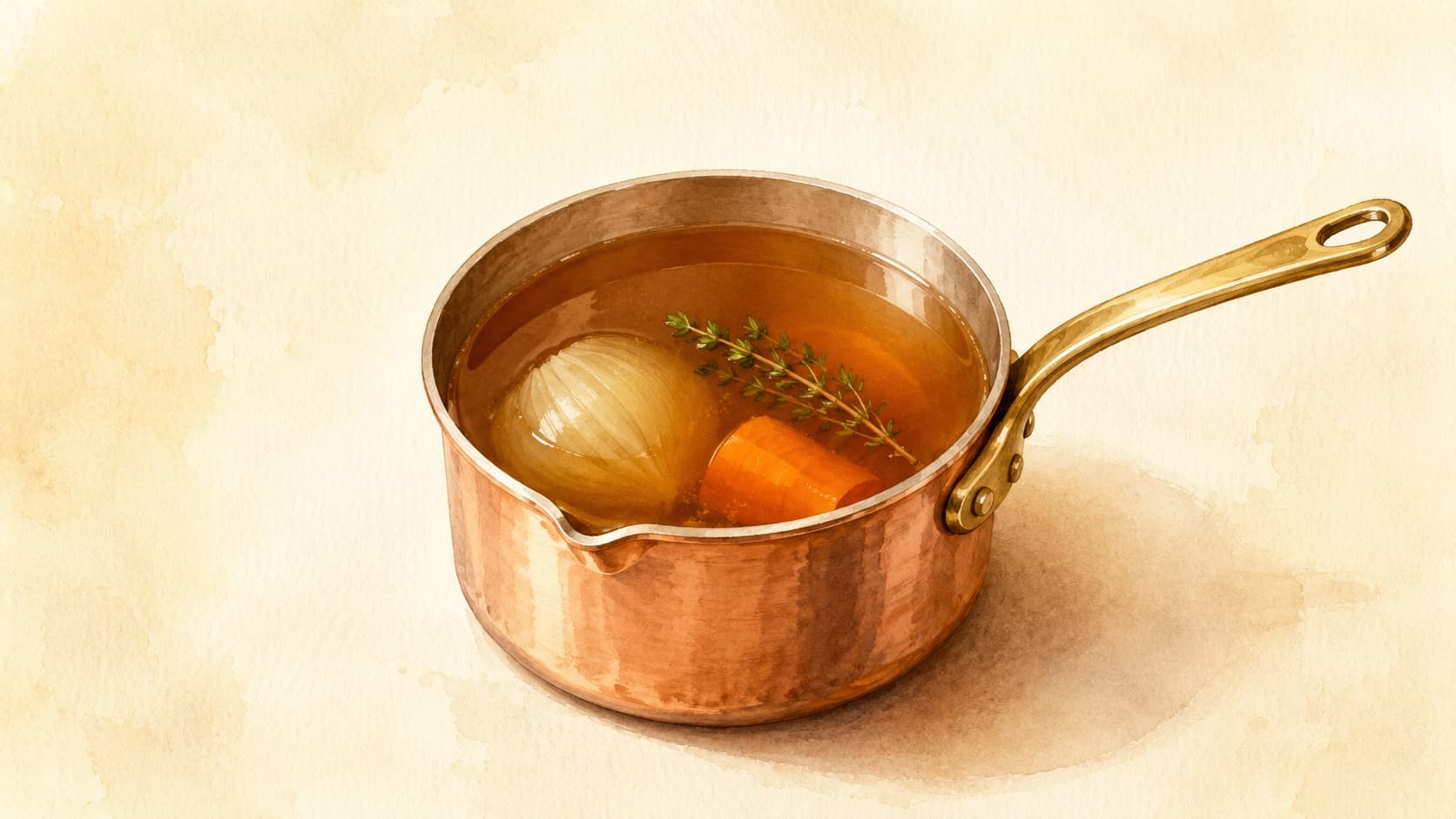
Ingredients
- 2 kg veal bones, chopped
- 1 onion, quartered
- 2 carrots, chopped
- 2 celery stalks, chopped
- 4 cloves garlic, smashed
- 1 bouquet garni (thyme, bay leaf, parsley stems)
- 1 tbsp tomato paste
- 3 liters cold water
- to taste salt
- to taste black peppercorns
Steps
Preheat your oven to 200°C (400°F). Roast the veal bones on a baking sheet for about 30-40 minutes until browned, which enhances the flavor through caramelization.
Transfer the roasted bones to a large stockpot. Add the onion, carrots, celery, garlic, and tomato paste. Stir to combine.
Pour 3 liters of cold water over the bones and vegetables, ensuring everything is submerged. Bring to a simmer over medium heat, skimming off any foam that rises to the surface.
Add the bouquet garni, salt, and black peppercorns. Reduce the heat to low, cover partially, and let simmer gently for 4 hours. This slow cooking extracts collagen and flavor.
After 4 hours, strain the stock through a fine-mesh sieve into a clean pot, discarding the solids. Let it cool, then refrigerate or freeze for later use.
Why this works
Veal stock is crafted from bones that are rich in collagen, which breaks down during the long simmering process to create a luxurious mouthfeel and deep flavor. The roasting of bones is crucial; it develops a rich, complex flavor that enhances the overall profile of the stock. The addition of mirepoix (onions, carrots, celery) and tomato paste adds depth and sweetness, while the bouquet garni infuses aromatic notes. If your stock seems too weak, continue simmering for an additional hour to concentrate the flavors. Conversely, if it reduces too much, add a bit of water to balance. Properly skim the surface during cooking; this removes impurities that can cloud the stock and affect its taste. A well-made veal stock can serve as the foundation for countless sauces and soups, adding a gourmet touch to your dishes.
Common mistakes
-
Hard-boiling instead of simmering. A rolling boil turns the stock cloudy and emulsifies fat back into the liquid.
- Target: A bare simmer — a single lazy bubble rising every second or two, never a roiling surface.
- Why it matters: At a hard boil, fat and impurities mix into the stock instead of rising. The result is a greasy, opaque liquid that won't reduce cleanly into sauce.
- What to do: Bring to a simmer, then drop the heat until the surface only just trembles. Crack the lid to let steam escape and the temperature self-regulate.
-
Skipping the bone roast. Raw bones make a pale, thin stock that lacks the brown notes a sauce wants.
- Target: Bones roasted at 200 °C for 30-40 minutes until deep golden — not just tan, but properly caramelised on the cut surfaces.
- Why it matters: Roasting drives Maillard reactions on the bone and any clinging meat, contributing the colour, aroma and depth that distinguish brown veal stock from white.
- What to do: Spread bones in a single layer with mirepoix, roast until the edges are dark and the pan is browned, then deglaze the roasting tray with a splash of water and pour everything into the pot.
-
Salting during the cook. Stock is a reducing ingredient — what tastes seasoned now will be overseasoned later.
- Target: No added salt during the simmer; season the finished sauce or soup downstream.
- Why it matters: A litre of stock might reduce to 250 ml in a sauce. Any salt now concentrates four times over, and there is no rescue.
- What to do: Leave salt out entirely. Test seasoning when the stock is being used, not when it's being made.
-
Skimming once and walking away. Impurities rise continuously for the first hour, especially with bones that weren't blanched.
- Target: Skim grey foam every 10-15 minutes during the first hour, then settle into hourly checks.
- Why it matters: The clarity, colour, and clean taste of a finished stock are decided in that first hour. Foam left in the pot dulls everything.
- What to do: Keep a small ladle and a bowl beside the stove. Lift foam at the surface only — leave the fat ring around the edge alone until the very end, when it strains off cleanly.
What to look for
- Roasted bones that smell deeply nutty and savoury as they come out of the oven — that's the Maillard layer (the browning reaction between proteins and sugars that builds roasted aroma) locked in.
- A simmer so gentle the surface only twitches, not bubbles — the texture of a clear stock starts here.
- A finished liquid that runs through the strainer as a clear, deep-amber line — no clouding, no greasy slick.
- Cold stock that sets to a soft jelly in the fridge — proof the collagen has fully dissolved into gelatin.
A note on history
Veal stock (a long-simmered liquid drawn from veal bones, used as the base for sauces and braises) is one of the foundations of the French classical kitchen. In Auguste Escoffier's "Le Guide Culinaire" of 1903, fond brun de veau (brown veal stock — bones roasted first, giving a deeper colour and flavour) and its lighter counterpart fond blanc de veau (white veal stock — bones blanched but not roasted, giving a pale, neutral base) appear at the very front of the book, treated as the base on which much of the rest is built — the espagnole, the demi-glace, and a wide range of sauces and braises. The bone-roast-and-long-simmer approach itself is older, drawing on the techniques of Carême and earlier nineteenth-century chefs whom Escoffier set out to codify and simplify.
Get the essays in your inbox — free
Weekly notes on flavor, fermentation, and food history — the writing behind the Atlas of Flavor. No spam; unsubscribe anytime.