
Chicken Soboro
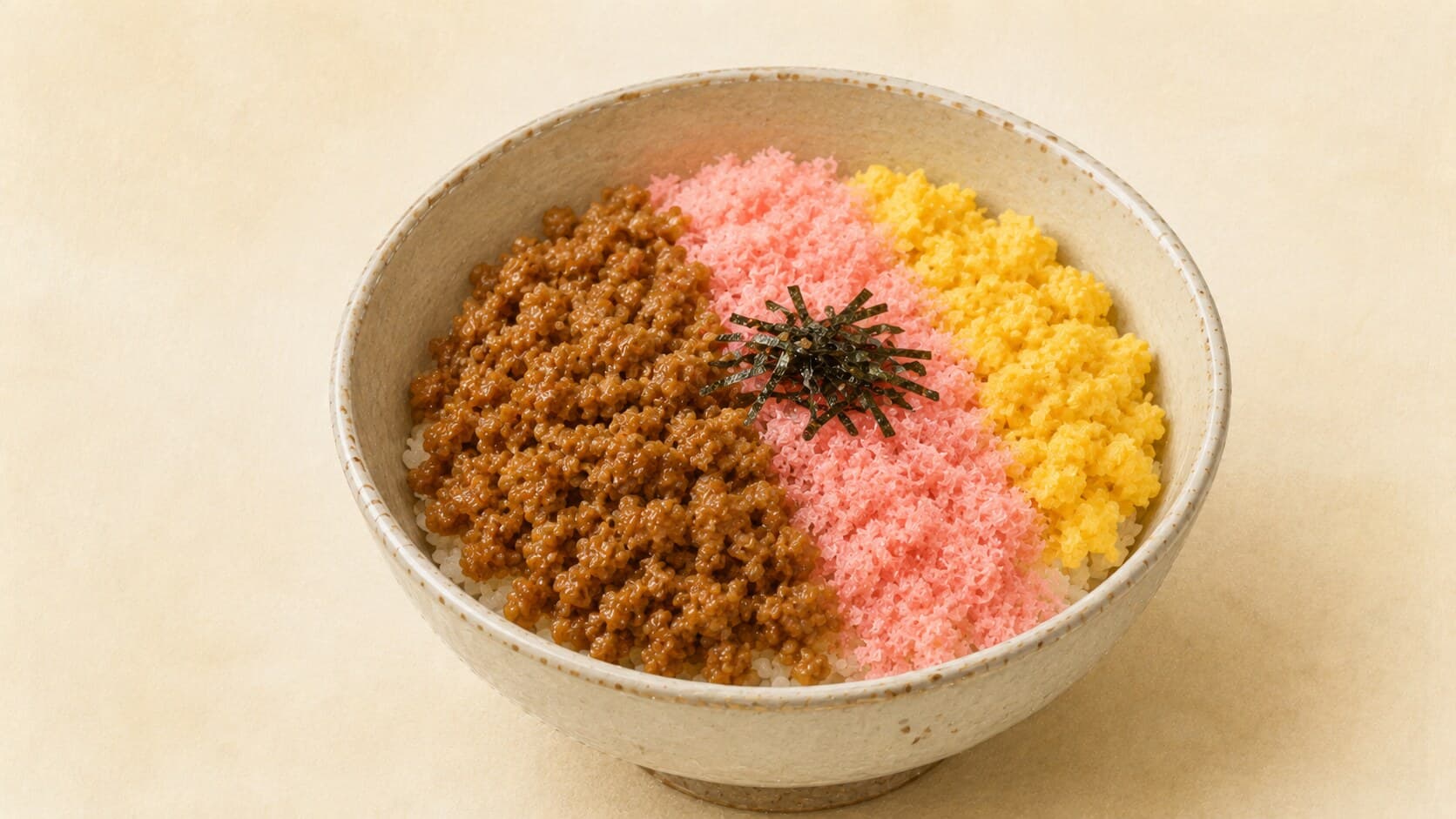
Ground chicken, soy sauce, mirin, sake, ginger, sugar — cooked dry over seven minutes until every clump separates and the seasonings cling like a glaze. The Japanese pantry preparation that teaches how to make ground meat behave.
Contents (7 sections)▾
Ingredients
- 250 g ground chicken (thigh meat is best; breast meat dries out)
- 20 g soy sauce (about 1 tablespoon)
- 15 g mirin (about 1 tablespoon)
- 15 g sake (about 1 tablespoon)
- 10 g sugar (about 2 teaspoons; brown sugar gives more depth)
- 5 g fresh ginger, finely grated
- 1 thin scallion, finely sliced (for serving)
- Toasted white sesame seeds (optional, for serving)
Steps
Combine the soy sauce, mirin, sake, sugar, and grated ginger in a small bowl. Whisk briefly so the sugar starts to dissolve. This is the entire seasoning — pre-mixing means it goes in evenly.
Heat a wide nonstick pan or carbon steel pan over medium-high. Do not add oil — ground chicken has enough fat. Add the chicken to the dry pan.
Immediately start breaking the meat apart with four chopsticks held together (the traditional Japanese method) or two wooden spoons. The goal is to separate the meat into the finest possible crumble as it cooks, before it clumps. Keep moving for about 2 minutes — the meat will go from pink to pale and finally to a uniform pale tan.
Pour in the seasoning mixture. The pan will sizzle hard. Continue stirring constantly. The liquid coats the meat and rapidly reduces. About 3-4 minutes.
The soboro is done when the pan is mostly dry, the meat crumbles are glossy with a thin glaze (not wet), and the color has deepened to a warm golden-brown. Ground chicken has its surface bacteria worked all the way through, so it must be cooked fully: check the thickest clump with an instant-read thermometer and confirm 74 °C / 165 °F. The dry, glossy crumble and colour are the texture cues; the measured temperature is the safety check. Taste a small piece — it should be balanced sweet-salty, not too sweet, with a clear note of ginger. Adjust if needed; another splash of soy if flat, a pinch more sugar if sharp. Pull off the heat and let it sit 1 minute. Serve warm or at room temperature over plain steamed rice, beside a soft-boiled egg, in onigiri, or as part of a sanshoku bento with scrambled egg soboro and a green vegetable. Refrigerate leftovers up to 3 days.
Tools you'll want
- · Tri-ply stainless saucepan (1.5–2 qt / 18cm)
- · Digital kitchen scale (gram precision)
Why this works
Soboro is the recipe that teaches how to make ground meat behave. Ground chicken (or pork, or any minced meat) has a strong tendency to clump up into pebble-sized lumps as it cooks. Once those lumps form, they don't separate again — and the texture is wrong. A clumped soboro tastes like small meatballs in a sweet sauce. A properly-made soboro is a fine, almost crumbly texture where every grain of meat is coated separately in the glaze. That difference is entirely about the first two minutes.
The Japanese technique for this uses four chopsticks held together as a single tool, gripped like a comb, and used to break the meat apart aggressively from the moment it hits the pan. Four chopsticks are better than two because they create more contact lines per stroke, and they work better than a spatula because they reach into clumps and pry them apart rather than just pressing the surface. Two wooden spoons working in opposition is a Western-kitchen substitute that works almost as well.
The other half of the technique is the dry pan. Ground chicken has enough fat (especially thigh meat, recommended) that no added oil is needed. Adding oil at the start creates a slurry that the meat sits in, which prevents the fine separation. Dry-pan cooking forces each grain of meat to either brown against the pan surface or steam off its own water — both of which keep it separate from its neighbors.
The seasoning structure — soy sauce, mirin, sake, sugar, ginger — is the classical Japanese "everyday savory" formula. Soy sauce provides salt and umami. Mirin contributes sweetness and a subtle alcohol-cooked depth. Sake adds aromatic and tenderizing alcohol. Sugar amplifies the savory by suppressing bitterness. Ginger cuts the richness of the chicken fat and brightens the entire dish. The proportions in this recipe are the home-everyday standard; restaurant versions sometimes add a small splash of dashi for extra umami, but it's not necessary.
The seasonings go in after the meat has separated, not before. Adding the sweet seasoning to wet pink meat creates a slurry; the meat steams in its sauce and never separates properly. Wait until the chicken is pale and separated, then add the seasoning, then reduce.
Common mistakes
Stirring slowly with one spoon.
Target: Four chopsticks held together as one tool (Japanese-kitchen technique for breaking ground meat into fine crumbs), or two wooden spoons working against each other — continuous aggressive motion for the first 90 seconds.
Why it matters: Single-spoon stirring can't break clumps fast enough — they form, then stay. Four chopsticks pry into clumps and separate them; the texture window is closed within 2 minutes.
What to do: Pre-position four chopsticks in your dominant hand. Hit the pan moving the moment meat goes in.
Workarounds:
- No chopsticks → two wooden spoons in opposition; not as fine-textured but acceptable.
Adding oil to the pan.
Target: Dry pan, no added oil. Ground chicken thigh has enough fat to render.
Why it matters: Oil at the start creates a slurry that the meat sits in — prevents the fine grain separation that defines soboro. Dry-pan cooking forces each grain to brown or steam separately.
What to do: Hot pan, meat directly in — no oil. The fat renders within 30 seconds.
Workarounds:
- Lean chicken or only breast meat → add 1 tsp neutral oil minimum (not more), but expect slightly looser texture.
Adding seasoning too early.
Target: Wait until chicken is uniformly pale beige and separated before adding the seasoning mixture. About 2 minutes.
Why it matters: Sweet-salty liquid on pink, still-coalescing meat = sticky slurry that locks the lumps in place. The seasoning needs to coat already-separated grains.
What to do: Watch color: pink → pale tan → uniform beige. Pour seasoning at uniform beige.
Workarounds:
- Added too early? Continue stirring aggressively — partially salvageable, but won't reach optimal texture.
Reducing too long after seasoning.
Target: 3-4 minutes after seasoning goes in, until pan is mostly dry and grains are glossy.
Why it matters: Past 4 minutes, the meat dries out and toughens; the sugar can also darken past gold into burnt. The window is narrow at the end.
What to do: Watch the sizzle: aggressive when seasoning hits, calms to quiet bubbling, then nearly silent — pull at the quiet stage.
Workarounds:
- Over-reduced/tough → splash 1 tsp warm water + 1 tsp soy sauce off-heat to re-moisten slightly.
Using only breast meat.
Target: Ground chicken thigh preferred (darker, richer leg meat — fattier than breast). Or 70% thigh + 30% breast for slightly leaner version.
Why it matters: Breast meat dries out and turns chalky in the short cook. Thigh's fat content keeps grains tender and helps with separation. The dish was developed with thigh in mind.
What to do: Ask the butcher to grind thigh specifically, or grind from boneless thighs at home.
Workarounds:
- Only breast available → mix in 1 tbsp neutral oil + 1 tbsp water to compensate for fat loss.
Cooking on heat too low.
Target: Medium-high heat — meat should sizzle aggressively from the moment it hits the pan.
Why it matters: Low heat means meat poaches in its own juices before separating — clumps form before you can break them apart. High heat = immediate sear, easier separation.
What to do: Pre-heat pan for 60 seconds before adding meat. The first contact should sizzle.
Workarounds:
- Worried about burning → high heat for 2 min, then drop to medium when seasoning goes in.
What to look for
- The first separation. Within 90 seconds of putting the meat in the pan, you should see the texture going from a pink blob to small distinct crumbles. If clumps are forming, you're not breaking them apart fast enough.
- The color shift. Pale pink → pale tan → uniform pale beige is the first stage. Once it's uniform beige, the seasoning goes in.
- The sizzle change. When you pour the seasoning into a hot dry pan, it sizzles aggressively. As it reduces, the sound calms down to a quiet bubble. When it sounds quiet and you can see the meat is glossy but not wet, you're done.
- The final color. Properly-finished soboro is a warm golden-brown, not pale and not dark. If it's still pale, reduce another 30 seconds. If it's darkening past gold toward mahogany, pull off the heat immediately — the sugar is starting to caramelize past the point you want.
Chef's view
There are several views on the seasoning balance. The traditional home version (above) is sweet-leaning — the version Japanese kids grow up eating in their bento boxes. Some adult versions, especially in izakaya or restaurant settings, dial back the sugar by half and add more ginger or a splash of dashi for a more savory adult register. My view: the home-sweet version is the right teaching baseline — it's what soboro is in Japanese cultural memory. From there, anyone can tune it drier for their own palate.
A note on the chopstick technique. If you've never broken meat apart with four chopsticks held together, it feels awkward for about a minute, and then it suddenly clicks and becomes obvious. The two-wooden-spoon Western substitute works fine, but the four-chopstick method is genuinely faster once practiced. It's worth ten minutes of practice on a dummy package of ground meat just to learn it.
A note on safety. Ground meat carries more bacterial surface area than whole cuts, and home-pasteurization guidance recommends cooking ground poultry to 74°C (165°F) internal temperature. In soboro, every fine crumble is small enough that uniform high heat reaches the center within seconds — proper pan technique cooks it through. The visual cue (no pink remaining, uniform color throughout) and the temperature target line up here. Store leftovers refrigerated, eat within 3 days, reheat to steaming before serving.
A note on history
The word soboro (Japanese ground meat or fish cooked dry into fine seasoned crumbs) is older than the dish in its current form. It comes from the Japanese verb soboro suru (おぼろにする) — "to make crumbly" — and was originally applied to dried-fish flakes (魚そぼろ, sakana soboro) that home cooks made with chopsticks in the Edo period (1603-1868), before refrigeration was common. The point was preservation: dried, finely-crumbled, sweet-salty fish kept for days at room temperature and could be sprinkled on plain rice when nothing else was available. Chicken soboro is the 20th-century evolution of this technique — refrigeration removed the preservation imperative, but the texture and sweet-salty seasoning profile carried over.
The fine-crumble result that defines modern soboro depends on the four-chopstick technique (四つ箸, yotsu-bashi), which is documented in pre-war professional Japanese kitchens. It's a tool for getting the texture you want when no Western utensil exists to give it to you — a recurring pattern in Japanese cuisine, where the right tool is often the one with no Western analog (yukihira-nabe, tamagoyaki-pan, oroshigane). Sanshoku donburi (三色丼), the three-color rice bowl with chicken soboro, scrambled-egg soboro, and a green vegetable, became iconic mid-20th century — partly through women's magazines that codified the home bento as a daily art form. Today soboro is the most common protein in a Japanese kid's bento box, the dish that "tastes like home" to a generation that grew up in the Showa era.
Related glossary terms
- Umami — the soy-mirin-sugar interaction is built on glutamate amplification
- Maillard reaction — the golden-brown color and depth of finished soboro
- Reduction — the post-seasoning stage is exactly this, on a small scale
Get the essays in your inbox — free
Weekly notes on flavor, fermentation, and food history — the writing behind the Atlas of Flavor. No spam; unsubscribe anytime.