
Quick Pickles
Vegetables, salt, vinegar, sugar, a clean jar, and one to twenty-four hours of rest in the fridge. A short-keeping condiment that teaches the salt-acid-sugar ratio — and quietly opens the door to fermentation.
Contents (8 sections)▾
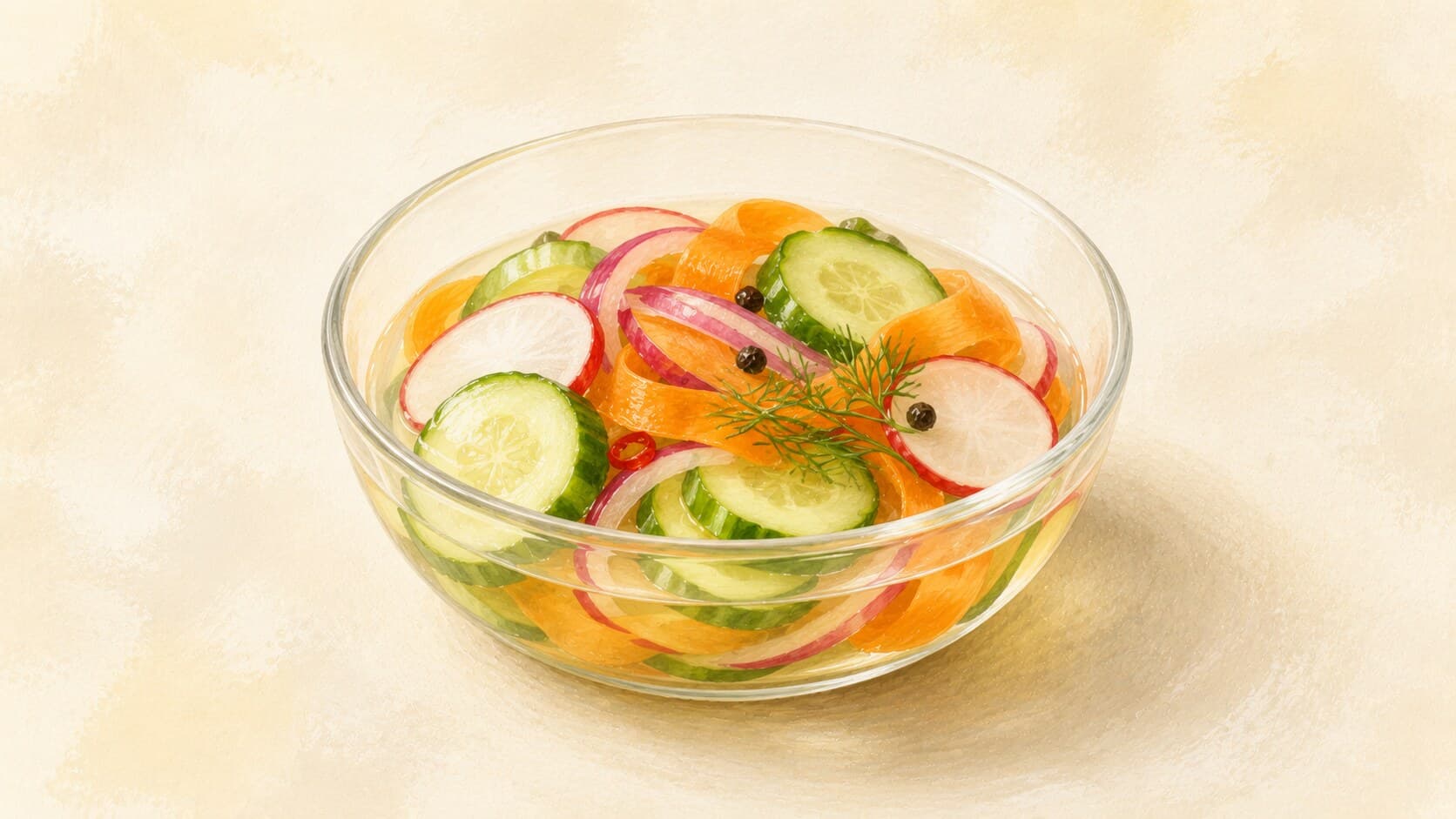
Ingredients
- 400 g vegetables — cucumber, carrot, red onion, daikon, radish (single or mixed; cut to even bite-sized pieces)
- For the brine:
- 200 g rice vinegar (or any mild vinegar; white wine vinegar works too)
- 200 g water
- 20 g sugar (a 5% sweetness ratio against the brine)
- 12 g fine sea salt (a 3% salinity ratio against the brine)
- Optional aromatics: 1 small clove garlic (lightly crushed), 5 g whole black peppercorns, 1 bay leaf, 2 g coriander seed, or a small piece of fresh ginger
Steps
Prepare a clean, dry 1 L jar with a tight-fitting lid. Wash the jar in hot soapy water, rinse, and let dry completely; moisture in the jar at the start dilutes the brine. Wash the vegetables, dry them, and cut into even pieces — cucumbers in slices or spears, carrots in batons, red onion in thin slivers.
Pack the vegetables into the jar — fairly tight but not crushed. If using aromatics, tuck them in among the vegetables. Leave about 1 cm of space at the top.
In a small saucepan, combine the rice vinegar, water, sugar, and salt. Warm over medium heat just enough to dissolve the sugar and salt completely — typically about a minute. The brine should not boil. Pull off the heat as soon as the salt and sugar are dissolved, and let the brine cool to lukewarm (about 5 minutes).
Pour the lukewarm brine over the vegetables, fully submerging them. If anything floats, weight it down with a small piece of plastic wrap pressed against the surface. Seal the jar. Let stand at room temperature for 15–30 minutes, then refrigerate.
The pickles are ready to eat within 1 hour, better after 4–6 hours, and at their best between 12 and 24 hours. These are short-keeping refrigerator pickles, not preserved-on-the-shelf canning. Keep refrigerated, use within 1 week, and don't try to keep them at room temperature.
Tools you'll want
- · Wide-mouth glass jar (1L)
- · Digital kitchen scale (gram precision)
- · pH test strips
Why this works
Quick pickles are an acid-and-salt cure, not a lactic-acid fermentation. The distinction matters. In a true fermentation, you wait for lactic-acid bacteria to lower the brine pH over days or weeks. In a quick pickle, vinegar provides the acidity immediately. The vegetables go from raw to acidified in minutes, not days — and the keeping window is correspondingly short. These are refrigerator-only, eat-within-a-week condiments.
This is worth being clear about, because the language around pickling often conflates the two. "Pickles you make in a jar" includes both shelf-stable fermented pickles (kimchi, sauerkraut, traditional Japanese nukazuke) and short-keeping quick pickles like these. They use overlapping equipment but follow different rules.
The salt-acid-sugar ratio is the technique. At about 3% salt and 5% sugar in the brine, with rice vinegar or another mild vinegar making up roughly half the liquid by weight, the pickle tastes balanced — neither aggressively sour nor sweet, with the salt resolved into the background. This is a tunable template: push the sugar up for a sweeter Japanese-style namasu, push the vinegar up for a sharper Western pickle, drop both for a milder cure.
Three other small physics:
Osmosis pulls water out of the vegetables. Salt in the brine creates a concentration gradient — water moves from the vegetables (low salt) toward the brine (high salt). The vegetables shrink slightly, the brine dilutes slightly, and the pieces take on a crisper texture. This is why cucumber quick pickles tighten visibly in the first hour: water is leaving.
Acid penetrates the vegetable cell walls. The lower pH of the vinegar slowly permeates the vegetable structure, both flavoring it and slowing the natural enzymatic processes that would otherwise soften the vegetable. This is what gives quick pickles their characteristic firm-but-yielding bite.
A small umami layer develops over time. Even in a refrigerator pickle, the slow breakdown of plant cell walls releases small amounts of free glutamate. A pickle eaten at hour one tastes mostly of brine; a pickle eaten at hour twelve tastes deeper, with an unmistakable but quiet umami underneath. This is part of why the 12–24 hour window is the sweet spot.
A pH strip is a useful but optional check. The finished brine sits well below pH 4 — closer to pH 3, given the vinegar concentration — which is into a range that many food-safety guidelines treat as sufficiently acidic for short refrigerator storage of vegetables. Specific safety thresholds vary by ingredient and method; when in doubt about a particular preparation, follow a trusted food-safety reference for your region. For shelf-stable canning, follow tested canning recipes specifically — quick pickles like these are not designed for shelf storage.
Common mistakes
Treating these as preserves.
Target: Refrigerator only, 1 week maximum. Never shelf-stable, never room-temperature long-term.
Why it matters: Quick pickles are short-keeping fridge condiments — they have not been canned, the seal is not sterile, the pH alone doesn't make them safe long-term. Confusing these with shelf-stable canning is a food safety issue.
What to do: Mark the jar with the date when made. Use within 7 days, refrigerated throughout.
Workarounds:
- Want shelf-stable → follow a tested canning recipe specifically; quick pickle ratios are not the same.
Boiling the brine.
Target: Lukewarm, just enough to dissolve salt and sugar — about 1 minute over medium heat.
Why it matters: Boiling brine cooks the brine itself (loss of vinegar's bright top notes) and partially cooks the vegetables on contact, making them mushy instead of crisp.
What to do: Pull off heat the moment salt and sugar are dissolved. Cool 5 min to lukewarm before pouring.
Workarounds:
- Cold-brine alternative → use the cold method (just whisk in cold liquid until dissolved); slightly more aroma loss but no heat at all.
Pouring hot brine onto vegetables.
Target: Cool brine to lukewarm (about 40°C) before pouring over vegetables.
Why it matters: Hot brine begins cooking vegetables on contact — cucumber goes from crisp to slightly soft within seconds. The signature crunch requires cool/cold contact.
What to do: Wait 5 min after dissolving salt+sugar before pouring. Test with a finger.
Workarounds:
- Want maximum crisp → make brine ahead, fully cool to fridge temperature before pouring; takes longer but locks in crispness.
Leaving raw garlic in too long.
Target: Garlic in for first 24 hours, then remove (or use sparingly from the start).
Why it matters: Garlic in acidic brine can turn blue-green over days (reaction with trace minerals — harmless but unattractive). Removing after 24 hours preserves the flavor without the color change.
What to do: Lightly crush to release flavor faster, pull out at 24 hours.
Workarounds:
- Don't mind the color → leave it; the pickle is still safe to eat.
Skipping the room-temperature rest.
Target: 15-30 minutes at room temp before refrigerating — speeds initial brine penetration.
Why it matters: Room-temp contact gives the brine an early start on penetrating the vegetables. Direct refrigeration slows everything down by half. Pickles still work, just take longer to peak.
What to do: After pouring brine, leave on counter 15-30 min, then transfer to fridge.
Workarounds:
- In a hurry → straight to fridge, expect peak flavor 4-6 hours later instead of 12.
Using a dirty or wet jar.
Target: Clean, fully dry glass jar before adding vegetables.
Why it matters: Residual water dilutes the brine's salt/acid concentration. Residual soap or food bits introduce contaminants. Both shorten the keeping window.
What to do: Hot soapy water wash → rinse → air dry completely. Vegetables dried after rinsing too.
Workarounds:
- Sterilize for extra safety → run jar through dishwasher hot cycle; not strictly necessary but eliminates concerns.
What to look for
- The brine after dissolving: salt and sugar completely dissolved, liquid clear, no granules at the bottom of the pan. If you see granules, warm slightly longer.
- The brine when you pour it: lukewarm to the touch, not hot. If you can comfortably hold a finger in it, you're at the right temperature.
- The pickles at 1 hour: vegetables have visibly tightened, brine looks slightly cloudier (vegetable starches diffusing). This is normal.
- The pickles at 12–24 hours: fully flavored, firm bite, brine bright and clear (after any initial cloudiness settles). This is the eating window.
- The pickles after a week: softer than at the start, brine more diffuse, flavor weaker. Use within the week; the longer they sit, the more they shift from "fresh quick pickle" to "tired pickle."
Substitutions
- Rice vinegar → apple cider, white wine, or champagne vinegar. All work; rice vinegar is the cleanest, cider the most assertive, champagne the most expensive.
- Sugar → honey or maple syrup at the same weight. Honey rounds the acid more, maple darkens the brine color and adds wood notes — pleasant under pork.
- Spice (mustard seed, dill, peppercorn) — pick one or two, not five. Quick pickles taste better with restraint; a single defining aroma reads more clearly than a chorus.
- Vegetables: cucumber, carrot, daikon, red onion, cauliflower, cabbage, radish all work. Soft vegetables in 1 hour, hard vegetables overnight.
Make-ahead and storage
- Quick pickles peak around 24–48 hours in the brine. Earlier than that, the brine hasn't penetrated; later than 5–7 days, the vegetable softens past the right point.
- Refrigerate immediately in a clean sealed jar. Quick pickles are not shelf-stable — they are not a true fermentation and do not have the salt level needed for room-temperature safety.
- Keeps 1–2 weeks refrigerated. Crispness goes first; flavor holds longer than texture.
- Discard if the brine becomes cloudy in a way that wasn't there at packaging, if you see fuzzy growth on the surface, or if the smell turns yeasty or sour-funky. A vinegar-clean smell is correct; anything biological is not.
- Brine can be reused once for a second batch of vegetables; after that the acid is too weak and the brine should be discarded.
Chef's view
There are several views on whether to call these "pickles" at all. The Japanese tradition has a clear distinction: nukazuke (vegetables fermented in a salted rice-bran bed) and tsukemono-mukōzuke are fermented pickles; what we are making here is closer to sunomono (vinegared vegetables) or namasu (lightly pickled vegetables in vinegar). The Western tradition is looser — "pickle" covers everything from a quick refrigerator cucumber to a long-fermented sauerkraut. My view: be clear in your own head about which you're making. The technique here is the short-cure version, not the fermentation version.
The other quiet decision is the vegetables. Almost anything raw and crisp works — cucumber, carrot, daikon, radish, red onion, cauliflower, bell pepper, fennel. The vegetables that don't work well are dense long-cooking ones (potato, hard squash) and very leafy greens (lettuce, spinach), which go limp rather than crisp. My view: cucumber + carrot is the safest first attempt; once you have the ratio in your wrist, branch out.
This recipe is the gateway to the Fermentation · Preservation · Acid side of the catalog without itself being a fermentation. It teaches the salt-acid-sugar ratio that everything else in that cluster builds on. A real lactic fermentation (where naturally present lactic-acid bacteria convert sugars into acid over days or weeks) — sauerkraut, naturally fermented kimchi — uses related but different physics, on a longer timeline, with different safety considerations.
For deeper reading on what fermentation actually is, see The Taste of Time.
Related glossary terms
- Lactic-acid fermentation — the longer-form cousin technique these quick pickles are not
- pH — why vinegar's acidity gives quick pickles their keeping (and why long-keeping needs a different approach)
- Umami — the quiet savory note that develops in the 12–24 hour window
Get the essays in your inbox — free
Weekly notes on flavor, fermentation, and food history — the writing behind the Atlas of Flavor. No spam; unsubscribe anytime.