
Ratatouille
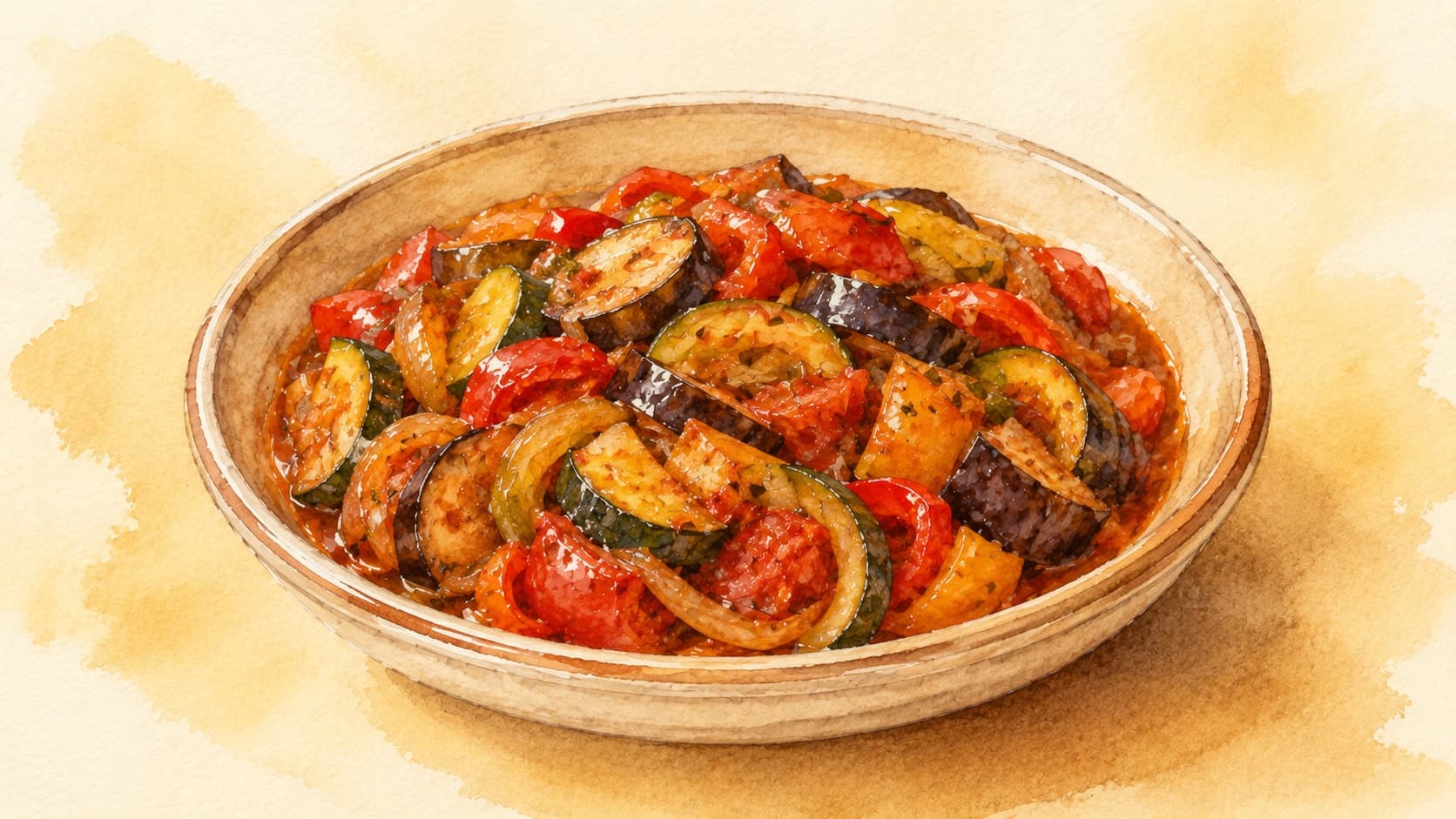
Eggplant, zucchini, bell pepper, tomato, garlic, olive oil — cooked separately first, then briefly together. The Provençal dish that teaches why vegetables steamed together always end up muddy, and what to do instead.
Contents (7 sections)▾
Ingredients
- 1 medium eggplant (about 300 g), cut into 2 cm cubes
- 2 medium zucchini (about 250 g), cut into 2 cm cubes
- 1 red bell pepper, seeded and cut into 2 cm pieces
- 400 g ripe tomatoes (or 1 can of whole peeled tomatoes), roughly chopped
- 1 medium onion, finely diced
- 3 cloves garlic, thinly sliced
- 60 ml extra-virgin olive oil, divided
- 1 small bunch fresh basil leaves, plus extra for serving
- 1 sprig fresh thyme
- Fine sea salt and freshly cracked black pepper, to taste
Steps
Salt the cubed eggplant lightly and let it sit on a plate or in a colander for 10 minutes. This draws out water that would otherwise dilute the dish. Pat dry with paper towel before cooking.
Cook each vegetable separately to start. Heat 15 ml olive oil in a wide pan over medium-high. Add the eggplant in a single layer, do not crowd, season with a pinch of salt. Cook 4-5 minutes until the cubes are golden and just tender. Transfer to a bowl. Repeat with the zucchini (15 ml oil, 3-4 minutes — they cook faster and should still hold their shape). Repeat with the bell pepper (10 ml oil, 4-5 minutes). This staggered cook is the secret — each vegetable hits the right doneness on its own.
In the same pan, add the remaining 20 ml of olive oil. Add the onion with a pinch of salt and cook over medium heat for 4-5 minutes until soft but not browned. Add the garlic and cook 30 seconds — it should perfume the pan, not color.
Add the chopped tomatoes and the thyme sprig. Bring to a simmer and cook 8-10 minutes, until the tomatoes have broken down into a loose sauce and most of the water has cooked off. Season with salt and pepper.
Return the cooked vegetables to the pan, fold gently to combine. Cook together for 3-5 more minutes — just long enough for the flavors to merge, not long enough for the vegetables to lose their shape. Tear in the basil leaves at the very end. Remove the thyme sprig. Taste and adjust. Serve warm or at room temperature; ratatouille is often better the next day, after the flavors have settled overnight.
Tools you'll want
- · Tri-ply stainless saucepan (1.5–2 qt / 18cm)
- · Digital kitchen scale (gram precision)
Why this works
Most home ratatouille recipes start with the entire pile of vegetables in one pot. The result is always the same: a muddy gray-brown stew where each vegetable tastes like all the others. This is not a flavor failure. It's a water management failure.
Each of the four headline vegetables in ratatouille — eggplant, zucchini, bell pepper, tomato — has a different water content, different cooking time, and a different doneness signature. Eggplant is dense and absorbs oil; zucchini is over 90% water and turns to mush quickly; bell pepper needs gentle sauté to bring out sweetness; tomato wants to break down into sauce. Put them in one pot together and they release all their water at once. Everything stews in that water. The eggplant overcooks before the pepper softens. The zucchini disintegrates before the tomato concentrates. The dish becomes a single muddy thing.
The classical Provençal technique (the cooking tradition of Provence, the sun-and-olive-oil region of southeast France) solves this by cooking each vegetable separately first. Eggplant in oil until golden. Zucchini briefly so it retains some bite. Bell pepper until just sweet. Tomato cooked down into a loose sauce with the onion and garlic. Then everything is combined briefly at the end — long enough for flavors to merge, not long enough for shapes to collapse. Each vegetable shows up to the final dish at its own peak doneness.
The eggplant salting step is part of this water management. Sprinkling salt on cubed eggplant and letting it sit for 10 minutes draws out a meaningful amount of cell water; without it, the eggplant releases that water into the pan and steams instead of browns. (Modern eggplant varieties have less bitterness than older varieties, but they still hold a lot of water.) The dry-the-cubes step before cooking is essential.
This is a reduction (cooking off liquid to concentrate flavor) staged across multiple pans. The tomato base concentrates first; the discrete vegetables stay distinct; everything meets at the end.
Common mistakes
Cooking everything together in one pot.
Target: Each vegetable (eggplant, zucchini, peppers, onion+garlic) cooked in its own batch before any combining.
Why it matters: Vegetables release water at different rates and reach their target browning at different temperatures. Thrown in together, the slowest-cooking ones (eggplant) sit in the water from the fastest (zucchini), and the result is a muddy stewed mush — the hallmark of bad ratatouille.
What to do: Sauté each vegetable separately in olive oil until lightly caramelized, then combine in the final stage.
Workarounds:
- Short on time? At minimum, separate eggplant from everything else — that's where the worst water-release happens.
- For the oven-roast approach (Confit Byaldi style), arrange thin slices in concentric rings and bake — no separate stovetop step needed.
Skipping the eggplant salt step.
Target: Salt diced eggplant generously, rest 30 minutes, blot dry.
Why it matters: Eggplants are 90 % water with a spongy cellular structure that absorbs oil aggressively. Salting draws out free water through osmosis and partially collapses the air pockets — the eggplant then absorbs less oil and holds shape better.
What to do: Toss with 1 tsp kosher salt per medium eggplant, rest on paper towels for 30 minutes, blot. Don't rinse.
Workarounds:
- No time to salt? Pre-cook eggplant separately in a hot pan with high heat — drives off water by evaporation instead.
- For a healthier version, microwave the diced eggplant for 4–5 minutes uncovered to dehydrate before pan-frying. Cuts oil absorption by half.
Crowding the pan.
Target: Vegetables in a single layer with at least 1 cm spacing.
Why it matters: A crowded pan steams instead of sautéing. Browning produces the caramelization compounds that distinguish ratatouille from "vegetable stew."
What to do: Work in batches. Use the widest pan you own.
Workarounds:
- Sheet-pan ratatouille: spread vegetables on a tray and roast at 220 °C for 25 minutes. Much faster, similar browning, less hands-on time.
- For deep flavor without browning (vegan or oil-light versions), pre-roast peppers under the broiler for char.
Combining for too long at the end.
Target: Final combined cook is 3–5 minutes, just to marry the flavors.
Why it matters: After separate cooking, the vegetables are already cooked through. Anything beyond a few minutes of combination time and they collapse into mush — undoing all the careful texture work.
What to do: Combine, season, stir gently, taste, serve.
Workarounds:
- For make-ahead: combine and cool quickly. Reheat gently right before service rather than holding warm.
- A finishing splash of red wine vinegar at this stage brightens everything without affecting texture.
Adding the basil at the start.
Target: Tear basil in within the last 30 seconds, off the heat ideally.
Why it matters: Basil's aroma compounds (estragole, linalool, eugenol) are volatile and heat-fragile. Sustained heat oxidizes them and gives basil a metallic, almost mint-toothpaste flavor.
What to do: Tear by hand (don't chop — the bruising oxidizes the leaves) at the very end.
Workarounds:
- No fresh basil? Use a teaspoon of dried herbes de Provence early in the cook — heat-stable.
- For a deeper finish, add basil + a drizzle of fresh olive oil at the table, not in the pan.
What to look for
- The eggplant. Cubes should be golden-brown on at least two sides, just tender to the point of a knife. Not gray, not collapsed.
- The zucchini. Should still hold a cube shape with a slight color shift to deeper green. If it's mushy at this stage, you've cooked it too long.
- The bell pepper. Should be softened but still have some pleasant resistance. The skin shouldn't be charred.
- The tomato base. When you add the cooked vegetables back, the tomato should be a loose sauce — wet but not watery. If there's a pool of liquid in the pan, simmer another minute uncovered to drive it off.
- The final dish. Each vegetable should be recognizable on sight. If you can't tell what's what, it's overcooked.
Chef's view
There are several views on whether to keep the vegetable cubes distinct (the version above) or to roast everything together at low temperature (a Thomas Keller-style oven method). The roast version produces a different dish — deeper, less bright, more savory. My view: the staged sauté is the right teaching version, because it makes the water-management lesson visible. Once you understand why each vegetable wants to be treated differently, the oven method becomes a stylistic choice rather than a workaround.
A note on ratatouille's evolution. The 2007 Pixar film popularized a fanned-out, geometrically-arranged version — "ratatouille confite" or "tian de légumes" (a shallow-baked Provençal vegetable casserole, named after the earthenware dish it cooks in) — which is genuinely beautiful and a legitimate dish, but it's a different recipe. What I'm teaching here is the older, peasant Provençal version: rustic, vegetable-forward, sometimes eaten cold the next day with bread, sometimes folded into eggs, sometimes spooned over polenta. The fanned tower is a French restaurant idea; the cubed stew is what Provençal grandmothers actually cook.
Ratatouille is one of those rare dishes that improves overnight. The flavors settle, the harshness of raw garlic fades, the basil aroma diffuses through. Make it the night before you need it if you can.
A note on history
The word "ratatouille" appears in 18th-century French as a coarse military stew — the verb touiller means "to stir," and the early dish was whatever vegetables a Provençal kitchen had to hand, simmered together. The version that anchors the modern recipe is younger than people assume: eggplant, tomato, and bell pepper are all New World vegetables, and they only became standard in Provençal cooking once they spread through Mediterranean Europe in the 17th-18th century. The dish as we know it today crystallized in the late 19th century in and around Nice — peasant cooking, not haute cuisine. Auguste Escoffier, born in nearby Villeneuve-Loubet, did not include it in his 1903 Guide Culinaire; it remained kitchen-table food.
The 20th century did something strange to it. Roger Vergé and Michel Guérard, leaders of cuisine du soleil in the 1970s, brought Provençal dishes onto Michelin-starred tables. Thomas Keller then pushed the form further with his confit byaldi around 2000 — eggplant, zucchini, tomato all sliced paper-thin and arranged in concentric circles, slow-roasted. The 2007 Pixar film borrowed that version, not the one above, and locked it into global memory. Today the two ratatouilles coexist: the rustic peasant cube-stew (what's in this recipe) and the geometric restaurant arrangement (Keller and the film). Both are legitimate. They are different dishes that happen to share a name.
Related glossary terms
- Reduction — the staged water-driving mechanism this dish is built on
- Maillard reaction — the brown color on the eggplant and bell pepper
- Mirepoix — the onion-garlic base that anchors the tomato sauce stage
Get the essays in your inbox — free
Weekly notes on flavor, fermentation, and food history — the writing behind the Atlas of Flavor. No spam; unsubscribe anytime.