
Basic Tomato Sauce
Tomatoes, salt, fat, time. The recipe that teaches what a reduction really is — and why patience is the only ingredient most home tomato sauces are missing.
Contents (7 sections)▾
Ingredients
- 800 g canned whole peeled tomatoes (San Marzano or similar — better tomatoes make a better sauce)
- 50 g unsalted butter, or 40 g olive oil
- 1 medium onion, peeled and halved (about 150 g)
- 4 g fine sea salt, plus more to taste
- Optional: 1 small clove garlic, lightly crushed; 1 small pinch sugar; 2–3 fresh basil leaves at the end
Steps
Open the can of tomatoes into a bowl. Crush them gently by hand or with a fork — you want pieces, not a purée. Some chefs strain out the seeds; most home sauces are better with the seeds in, for body.
In a heavy saucepan, combine the tomatoes, butter (or oil), onion halves, and salt. The onion stays whole — it flavors the sauce slowly during the cook and gets removed at the end. Bring to a gentle simmer over medium heat.
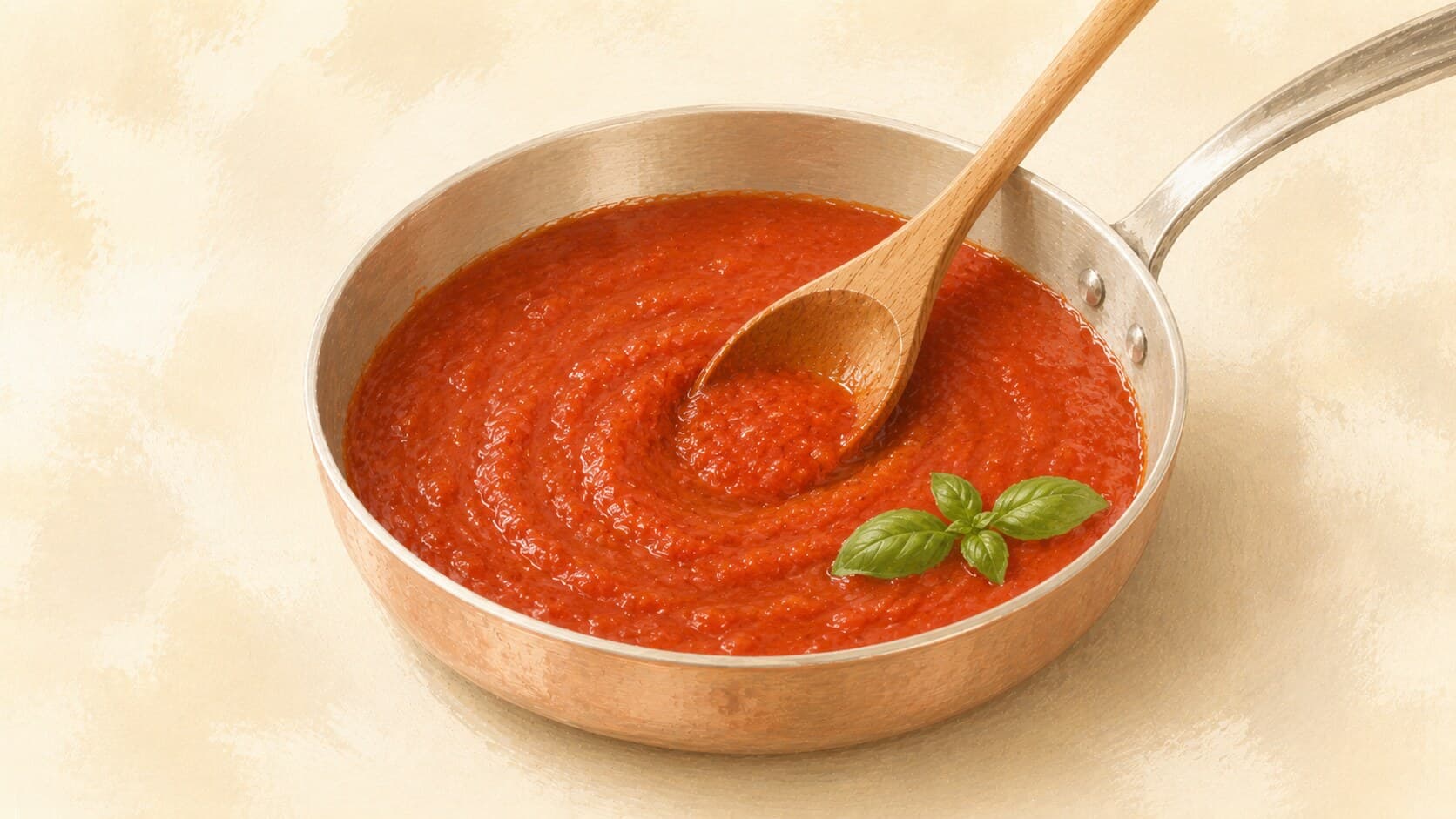
Reduce heat to low-medium. The sauce should bubble lazily — surface dimpling, never a rolling boil. Cook 30 minutes, stirring occasionally with a wooden spoon to lift anything that wants to catch on the bottom. The sauce thickens by visible degrees; the color deepens from bright red to deep brick.
After 30 minutes, taste. The sauce should taste round, not sharp. If it still reads as flat or acidic, give it another 5 minutes; if it's already perfect, stop now. Adjust salt. Remove the onion (and any garlic, if used). Tear in fresh basil if using. The sauce is done — pour over pasta, spoon onto chicken, or refrigerate up to 5 days.
Tools you'll want
- · Tri-ply stainless saucepan (1.5–2 qt / 18cm)
- · Sauce strainer (chinois, perforated, or fine-mesh, 19–25cm)
Why this works
A good tomato sauce has, at its core, almost nothing. Marcella Hazan's famous three-ingredient version is tomatoes, butter, onion, and salt. That sauce is more or less the gold standard, and the reason it works isn't the choice of ingredients — it's that the recipe sits patiently for 30 minutes and lets a reduction do its work.
Reduction here is gentle. Boiling tomatoes hard would over-evaporate and scorch the milk solids in the butter; a low simmer lets water leave slowly while flavor concentrates. The sauce thickens not by adding anything but by removing about a third of the original water. Same physics that runs through every French reduction, here applied across a longer, lazier timeline.
There are two interconnected chemistries running through that 30 minutes. The first is reduction proper — water leaves, flavor concentrates, body increases. The second is light caramelization at the bottom of the pan, where occasional contact between the sauce and the hot pan surface lets a little sugar in the tomato darken. Stirring lifts that browned residue back into the sauce — call it tomato's own tiny version of fond. The result is a sauce that's deeper than its ingredient list suggests it should be.
The whole onion is doing two jobs. Its mass slows the reduction (the sauce can't rip past 100°C while there's an evaporating onion in it) and it gives off aromatic compounds slowly without falling apart into the texture. Pulling it at the end gives you a smooth sauce with onion's complexity but none of its bite. (You can also leave it in if you like a coarser, more rustic feel; if you do, dice it small before adding so it disperses.)
For an editorial step beyond the Hazan base, the mirepoix-adjacent move is to chop a small onion fine, a small carrot fine, and (optionally) celery, sweat them in the butter for 5 minutes before the tomatoes go in. This builds an Italian-style soffritto base — a cousin of the Italian sofritto, with a slightly different ratio than the French mirepoix. A soffritto sauce is rounder, more complex, slightly closer to a Bolognese register without the meat.
The umami note here is quiet but real. Cooked tomato is one of the densest natural sources of free glutamate; the long simmer concentrates it. This is also why a small spoon of grated parmesan stirred in at the end disappears so completely — both are doing the same chemical work from different directions.
Common mistakes
Heat too high.
Target: Surface dimpling lazily — never a rolling boil. Bubbles rise softly across the surface, no splash onto the pan walls.
Why it matters: A rolling boil scorches the bottom (butter milk-solids burn first), splatters everywhere, and over-reduces in minutes — you end up with a darker, harsher sauce in less time. The slow simmer is doing two jobs at once: gentle reduction AND mild bottom caramelization. High heat skips both.
What to do: Low-medium heat after the initial bring-to-simmer. If splashing on the pan walls, the burner is too high.
Workarounds:
- Weak burner control? Use a flame tamer or diffuser under the pan.
Stirring too much.
Target: Stir every 5 minutes, just enough to lift anything starting to catch on the bottom.
Why it matters: Constant stirring breaks down tomato pieces faster than reduction builds body — the sauce becomes a thin purée rather than a body-rich sauce with chunk character.
What to do: Set a timer. Stir, walk away, repeat. Wooden spoon, drag the bottom briefly each time.
Workarounds:
- Smooth sauce preferred → blend at the end with an immersion blender instead of stirring more during the cook.
Salt too late.
Target: 4 g salt at the start of the simmer; final pinch only if needed after tasting at 25 minutes.
Why it matters: Salt added early dissolves into the cook and seasons the tomato flesh from inside. Salt added only at the end sits on the surface and tastes harsher — you can taste the grains.
What to do: Salt with the tomatoes, before bringing to simmer. Taste at 25 minutes for adjustment.
Workarounds:
- Forgot the start salt? Dissolve final salt in 1 tbsp warm sauce off-heat before stirring in — disperses better than dry salt on cool sauce.
Sugar to compensate for acid.
Target: Time first, sugar second. If sharp at 30 minutes, simmer another 10 minutes before reaching for sugar.
Why it matters: The cook's reflex with sharp tomatoes is sugar — but sugar just masks acidity, it doesn't round it. Time actually changes the acid profile: organic acids continue to break down during the long simmer, and the result is rounder than sweetened-sharp.
What to do: Taste at 25–30 min. If sharp, +10 minutes. If still sharp, then add a pinch of sugar (1–2 g).
Workarounds:
- Truly aggressive cheap tomatoes → 1 g baking soda neutralizes acid more directly than sugar (use sparingly — too much tastes soapy).
Adding fresh basil too early.
Target: Basil off the heat, torn by hand, just before serving.
Why it matters: Basil's aromatic compounds (linalool, eugenol) are heat-volatile — they evaporate within minutes of simmering. Cooked basil tastes like green nothing; the dish loses the bright top-note that signals "fresh tomato sauce."
What to do: Tear (don't cut — bruising oxidizes less than blade-cutting) into the finished sauce at the end.
Workarounds:
- Want deeper basil character → keep a basil stem in the sauce during the simmer (extracts a little flavor), discard at the end, then add torn fresh leaves.
Choosing the cheapest tomatoes.
Target: San Marzano DOP or premium whole-peeled brand. Look at the label — fewer ingredients = better (just tomatoes, juice, salt, maybe basil leaf).
Why it matters: This is one of few recipes where the ingredient outranks technique. Good canned tomatoes are 60–80% of the sauce's final character. Cheap tomatoes stay thin and sharp regardless of simmer time — you can't simmer character into them.
What to do: Spend the extra $2 on a good can. The whole pot benefits.
Workarounds:
- Stuck with mediocre tomatoes → add 1 tbsp tomato paste to deepen body and color; longer simmer (45 min) helps modestly.
What to look for
- The bubble pattern: slow surface dimpling, no splashing. If sauce hits the wall of the pan, you are too hot.
- The color: deepens from bright red to brick over 20 minutes. Brick = the sugars are starting to caramelize at the bottom.
- The body: the wooden spoon, drawn across the bottom, leaves a brief clear line. That line holding for half a second is your readiness signal.
- The taste at 25 minutes: round, not sharp; salted, not over-salted. If it's sharp, give it another 5–10 minutes before reaching for sugar.
- The onion at the end: soft but holding its shape. Remove with tongs; it can go straight into a soup or salad.
Chef's view
There are several views on butter vs. olive oil as the fat. Marcella Hazan's classic uses butter, full stop, and the result is roundly creamy. The Southern Italian tradition uses olive oil and lets the tomato's brightness speak. My view: butter for a sauce going on a delicate pasta (pappardelle, fresh fettuccine) or a poultry dish; olive oil for a punchier sauce, for pizza, or for anything Mediterranean-leaning. Half-and-half is also legitimate and not a copout.
The other quiet decision is whether to add garlic. Hazan didn't. Many home cooks default to garlic without thinking — and a lightly crushed clove, added with the onion and removed at the end, does add a useful aromatic layer. But raw garlic added in the middle of the cook can taste assertive, and minced garlic added at the start can burn. If you want garlic, treat it like the onion: in whole, out at the end.
This is the recipe that taught me that patience is an ingredient. Every time I rush a tomato sauce, the result is shallow; every time I leave it for the full 30, even slightly cheap tomatoes taste like something better. The pan does most of the work if you let it.
Related glossary terms
- Reduction — what the slow simmer is actually doing
- Caramelization — the small browning at the bottom of the pan that deepens the color
- Mirepoix — the cousin technique when you want a sofritto base instead of the Hazan minimum
- Umami — why cooked tomato tastes so savory, and why parmesan stirred in at the end disappears
Continue the lesson
After the audio walkthrough above:
- Take it further with the book: see Part 2: Sauces and Structure for the deeper treatment of reduction.
- Why this lesson sticks: Basic Tomato Sauce reveals reduction, seasoning balance, and flavor development.
Get the essays in your inbox — free
Weekly notes on flavor, fermentation, and food history — the writing behind the Atlas of Flavor. No spam; unsubscribe anytime.