
Phở Bò (Beef Pho)
Charred aromatics, blanched bones, hours of patient simmering. Phở is a long extraction that teaches you how to read a broth — clarity is not aesthetic, it is evidence of correct technique.
Contents (8 sections)▾
Ingredients
- 1.5 kg beef bones (knuckle + marrow mix)
- 300 g beef brisket or flank
- 1 large onion, halved
- 5 cm piece fresh ginger, halved lengthwise
- 2 star anise
- 1 cinnamon stick (5 cm)
- 3 cloves
- 1 tsp coriander seeds
- 1 tbsp fish sauce, plus more to taste
- 1 tsp sugar
- Salt to taste
- 200 g dried pho rice noodles (bánh phở), soaked
- 150 g beef sirloin or eye round, thinly sliced raw (for assembly)
- Bean sprouts, Thai basil, lime wedges, sliced chili (to serve)
Steps
Blanch the bones: place in cold water, bring to a boil, boil hard 5 minutes, drain and rinse under cold water. This removes blood and impurities — the step most home cooks skip, and the reason their phở is murky.
Char the aromatics: hold the onion halves and ginger cut-side down directly over a gas flame or under the broiler until darkened and fragrant, about 5 minutes. The char is not a mistake — it adds color, sweetness, and a smoky depth that raw aromatics cannot provide.
Toast the spices: dry-toast star anise, cinnamon, cloves, and coriander seeds in a dry pan over medium heat until fragrant, about 2 minutes. Don't scorch them.
Combine blanched bones, charred aromatics, and toasted spices in a large pot. Cover with 3 L cold water. Bring to a simmer (not a boil) and hold there. Skim every 15 minutes for the first hour — this is where the clarity is built.
After 1 hour, add the brisket to the broth. Continue simmering 1.5–2 hours until brisket is just tender. Remove brisket, cool, slice thinly.
Continue simmering the bone broth another 2 hours minimum (4 hours total from start). Season with fish sauce, sugar, and salt. Taste and adjust — the broth should be deeply fragrant, savory, and clean.
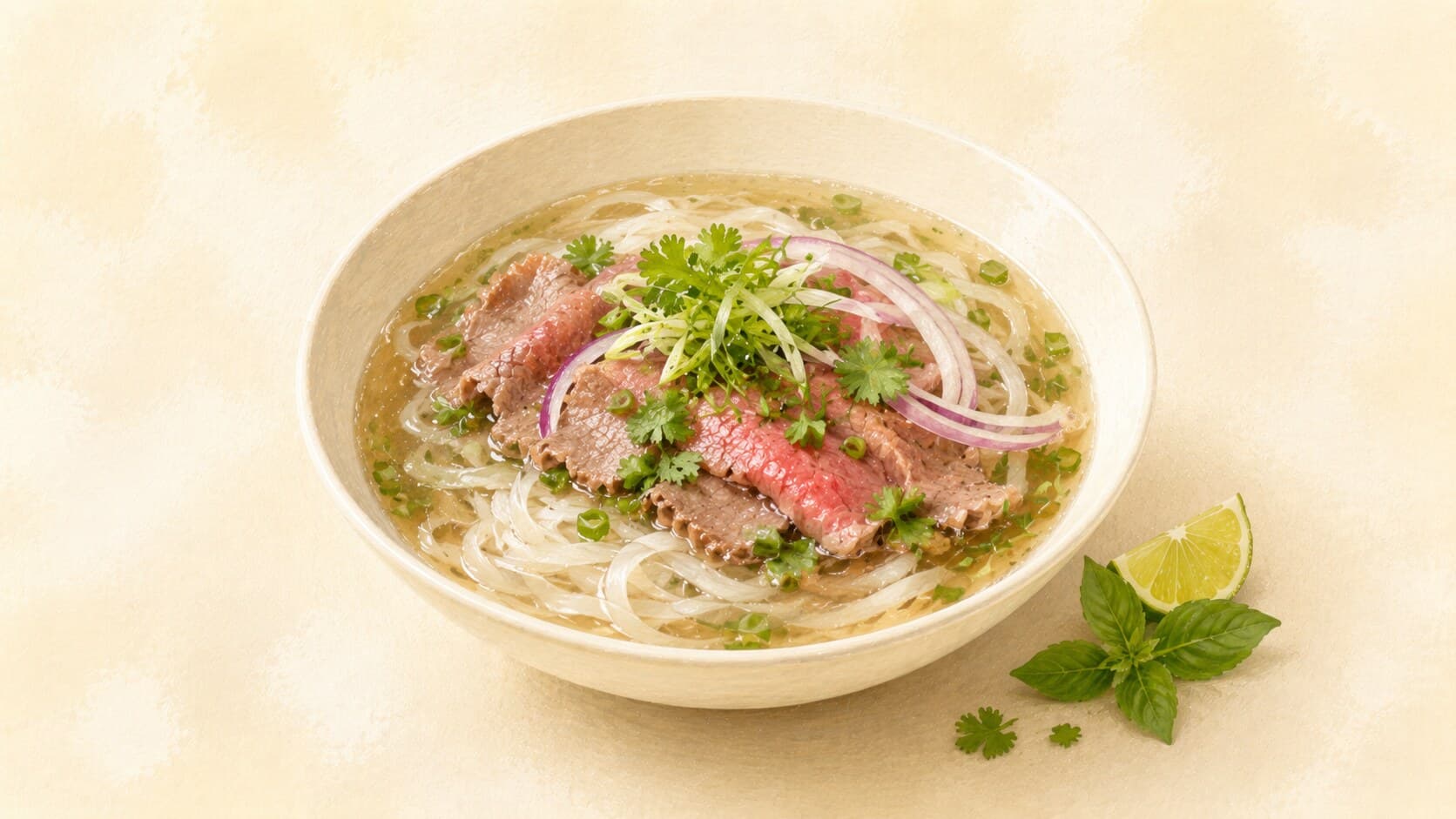
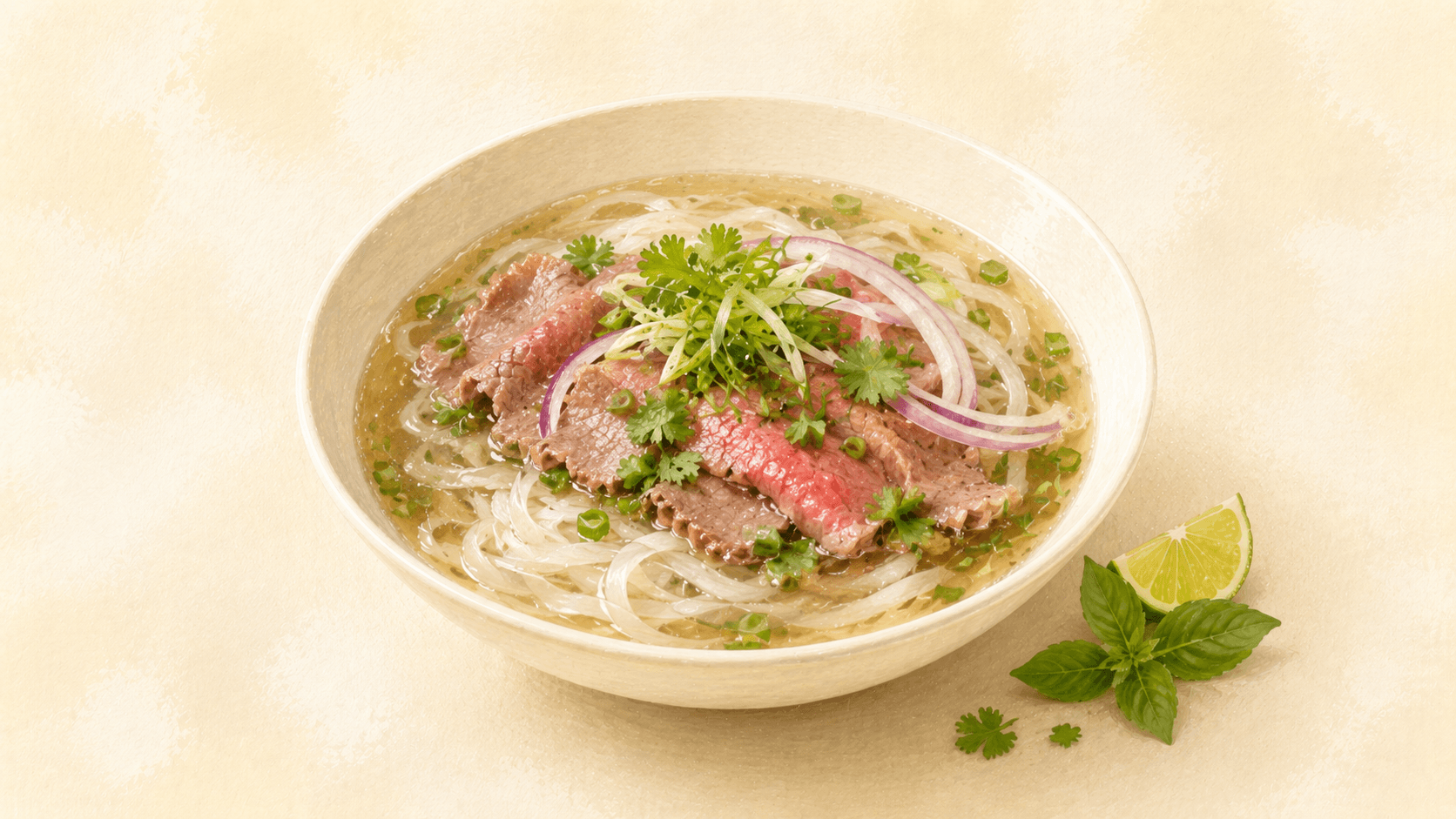
Strain through a fine-mesh strainer. The finished broth should be clear, pale amber, deeply fragrant. If it is cloudy, the heat was too high somewhere.
Cook soaked rice noodles briefly in boiling water, drain into deep bowls. Layer sliced cooked brisket and raw sirloin over noodles. Ladle boiling-hot broth over — the heat cooks the raw beef in the bowl. Serve with herbs, bean sprouts, and lime.
Tools you'll want
Why this works
Phở is a long extraction, and the first thing to understand is that the clarity of a finished bowl is not visual decoration — it is the direct evidence that the extraction happened at the right temperature. A properly made phở broth is pale amber and nearly transparent. A broth that is brown, grey, or murky tells you that somewhere, the pot rolled to a full boil, or the bones were not blanched, or the skim was skipped. The physics of why is straightforward: at a simmer (around 85–90°C), fat molecules and proteins coagulate into large particles that float to the surface and can be skimmed. At a full boil, those particles are mechanically emulsified into tiny droplets that suspend in the liquid permanently, producing cloudiness that cannot be reversed.
The blanching step — cold water to boil, five minutes, discard — removes myoglobin, coagulated blood proteins, and volatile off-compounds that accumulate during the slaughter and butchering of the animal. These are not flavor-neutral. They contribute a grey, slightly metallic register that you may have tasted in quick, unblanced stocks. The blanch removes them entirely. After blanching, the bones are rinsed and the pot is started fresh, which is why the initial water starts from a position of relative cleanliness.
The char on the aromatics is one of phở's defining techniques. Holding a halved onion and ginger cut-side-down over an open flame until blackened triggers Maillard reactions and partial caramelization simultaneously. The burnt edges add a smokiness that reads as complexity without adding any smokiness per se — it is the flavor of caramelized sugars and Maillard browning, not wood smoke. Raw onion and ginger boiled into the broth would produce a green, sharp aromatic quality; charred onion and ginger produce sweetness, depth, and color. The spices — star anise, cinnamon, cloves, coriander — are dry-toasted for the same reason: heat volatilizes the aromatic compounds, making them more available to the broth.
The bone geometry matters as well. Knuckle bones contain cartilage that converts to gelatin over four hours, giving the broth body without cloudiness. Marrow bones contribute fat and deep flavor. The brisket added at the one-hour mark is there for texture — it cooks to tenderness in 1.5–2 hours, and its removal before the four-hour mark prevents it from turning to mush. The remaining broth time after the brisket comes out is about the bones: collagen continuing to convert, aromatics deepening, the volatile spice notes mellowing into the background.
Common mistakes
Skipping the blanch.
Target: Cover bones with cold water, bring to a hard boil for 5–7 minutes, drain, rinse the bones thoroughly under cold water.
Why it matters: Bones release blood proteins, marrow particles, and other impurities into the water during the first few minutes of cooking. If you skip this step, those impurities dissolve into your stock and CAN'T be skimmed out — you'll have a murky, slightly funky broth no matter how long you simmer.
What to do: This 7-minute pre-step is non-negotiable. The single most common reason home phở tastes "almost right but not quite."
Workarounds:
- Short on time? Even a 3-minute blanch is better than nothing.
- For pre-blanched bones (available at some butchers), confirm they were properly handled — many "pre-blanched" bones are just rinsed.
Boiling instead of simmering.
Target: Bare simmer with occasional bubbles breaking the surface — about 90 °C.
Why it matters: A full rolling boil emulsifies fat and proteins permanently into the broth — once cloudy, it can't be reclaimed without classical raft clarification (egg whites + ground meat, which defeats the purpose). The clarity of phở broth is half its appeal.
What to do: Use the lowest possible burner setting after the initial heat-up. Tilt the lid slightly to prevent the temperature from rising.
Workarounds:
- If your stove can't go low enough, use a flame tamer or set the pot on a back burner with a heat diffuser.
- A 130 °C oven is even more stable for long, low simmers if you have a Dutch oven.
Not charring the aromatics enough.
Target: Onion and ginger blackened on cut surfaces — confident char, not "browned."
Why it matters: The char produces sulfur and Maillard compounds that give phở its signature aromatic depth. A light tan is not enough — the difference is dramatic.
What to do: Halve onion and ginger, place cut-side-down on an open gas flame or under a hot broiler until the surface is black, about 5–7 minutes. Slight singe on the outside is correct.
Workarounds:
- No gas flame or broiler? Use a dry cast-iron skillet over high heat. Slower (10 minutes) but works.
- For extra-deep flavor, char a stick of cinnamon and a few star anise the same way.
Skimming only at the beginning.
Target: Skim every 10–15 minutes for the first hour, then every 30 minutes for the remainder.
Why it matters: Fat continuously renders from marrow bones over the 3–4 hour simmer. Skimming only at the start leaves a layer of fat that re-emulsifies if the heat creeps up.
What to do: Keep a small bowl of cold water nearby — dip the skimmer in cold water between passes so impurities don't stick.
Workarounds:
- For hands-off skimming, chill the broth overnight after cooking — the fat solidifies on top and lifts off in one piece.
Under-seasoning at the end.
Target: Add fish sauce + sugar AFTER straining, not during the simmer.
Why it matters: Phở broth is a concentrated extraction; if you season early, the saltiness intensifies through evaporation and overshoots. The final balance is delicate — fish sauce for umami and salt, sugar for a barely perceptible roundness.
What to do: Strain first, taste, then adjust. Start with 2 tbsp fish sauce + 1 tbsp rock sugar per liter, taste, adjust.
Workarounds:
- If you over-seasoned, dilute with hot water — better than serving an over-salty broth.
- For deeper umami without more salt, add a small piece of dried squid or a chunk of yellow rock sugar.
Serving below boiling.
Target: Broth at a rolling boil (100 °C) ladled directly over the raw beef slices.
Why it matters: The raw sirloin in the bowl is cooked by the broth's heat. Broth below 90 °C won't cook the beef — it'll warm it to an unsafe temperature zone without cooking through. Beyond food safety, the contrast between hot broth and barely-cooked beef is the textural signature of phở.
What to do: Keep the finished broth at a boil right up to the moment of serving. Slice the beef paper-thin (use partially frozen meat for clean slices).
Workarounds:
- For dinner parties, set the pot on a portable burner at the table and ladle to order.
- Pre-warming the bowls with hot water helps maintain temperature on the way to the table.
What to look for
- The bones after blanching: white, clean, with no grey or pink residue in the surrounding water. The rinse water should run clear before you move on.
- The charred aromatics: cut surfaces are dark brown to black, not light tan. The outside may be slightly charred; the inside stays intact.
- The broth in the first hour: small bubbles rising, occasional fat globules on the surface that come off with a spoon. If it is rolling, lower the heat immediately.
- The broth at four hours: pale amber, clear enough to see the bottom of a white bowl. Opacity at this stage means the temperature was too high.
- The seasoning balance: savory and fragrant, with the spice notes present but not dominant. If cinnamon or star anise is all you taste, the spice quantity was too high or they were not toasted.
- The bowl after pouring: the raw sirloin slices should turn from red to grey-pink within 30 seconds. If they stay bright red, the broth was not hot enough.
Chef's view
Phở is one of the most technically demanding bowls of noodle soup in any cuisine, and it is demanding in a specific way: the work is not precision cutting or complex sauce construction — it is patience, attention, and the ability to read the broth. You learn phở by watching the pot, not by following steps. The recipe above will produce a technically correct broth. Whether it is a great broth depends on how closely you watched the heat, how thoroughly you skimmed, and how seriously you took the blanching (a brief hard boil to flush out impurities before the real simmer starts) step.
I have made phở in an apartment kitchen in HCMC (Ho Chi Minh City, Vietnam's largest metropolis) with a single burner and a stockpot that barely held the volume. The limitation taught me something: phở does not need special equipment. It needs time and the willingness to skim (lift off the foam and fat rising to the surface with a flat spoon). A four-hour broth on a low flame is not difficult — it is just long. The reward for that patience is a broth that tastes like it took four hours.
Chef Test Notes
I ran three bone-ratio tests with the same total weight (1.5 kg) and same everything else:
- All knuckle bones: Broth was the clearest of the three and had the most neutral base flavor — gelatinous body, clean. Missing some of the deep richness I associate with phở.
- All marrow bones: Broth had the most flavor depth and a slightly golden color from the marrow fat. Harder to skim clean; the broth was marginally cloudier even with careful simmering. More forgiving in taste, less forgiving technically.
- Knuckle + marrow mix (the recipe above): Best balance. The knuckle provides body and clarity; the marrow contributes depth. This is the combination that most phở vendors use.
I also tested charring level — light char vs. full black char on the onion:
- Light char (tan surfaces): Broth was sweeter but lacked depth. The aromatic contribution was closer to caramelized onion soup than phở.
- Full black char (the recipe): Broth had the characteristic smoky-sweet-savory register that makes phở smell immediately recognizable. This level of char felt like burning and was hard to commit to the first time I did it. It was correct.
A note from HCMC
The first bowl I had in District 1, at a streetside stall at 6am, came in a wide white bowl that was already warm from being rinsed in hot water before filling. The vendor skimmed the broth surface with the same focused, unhurried expression that someone uses when reading a difficult page. He did it without looking up, without pausing the conversation he was having — the skim was automatic, instinctual, two or three passes of a flat spoon, then set the spoon down. I watched it six or seven times before I understood that the skim was not maintenance. It was how he was reading the pot.
Related glossary terms
- Umami — the savory taste compound at the center of both phở broth and dashi; fish sauce and long bone extraction both contribute it.
- Extraction — the mechanism driving phở: temperature-controlled pull of flavor and collagen from solid ingredients into liquid.
- Stock — the structural parallel to phở in French cooking; same logic, different ingredients and physics.
Get the essays in your inbox — free
Weekly notes on flavor, fermentation, and food history — the writing behind the Atlas of Flavor. No spam; unsubscribe anytime.