
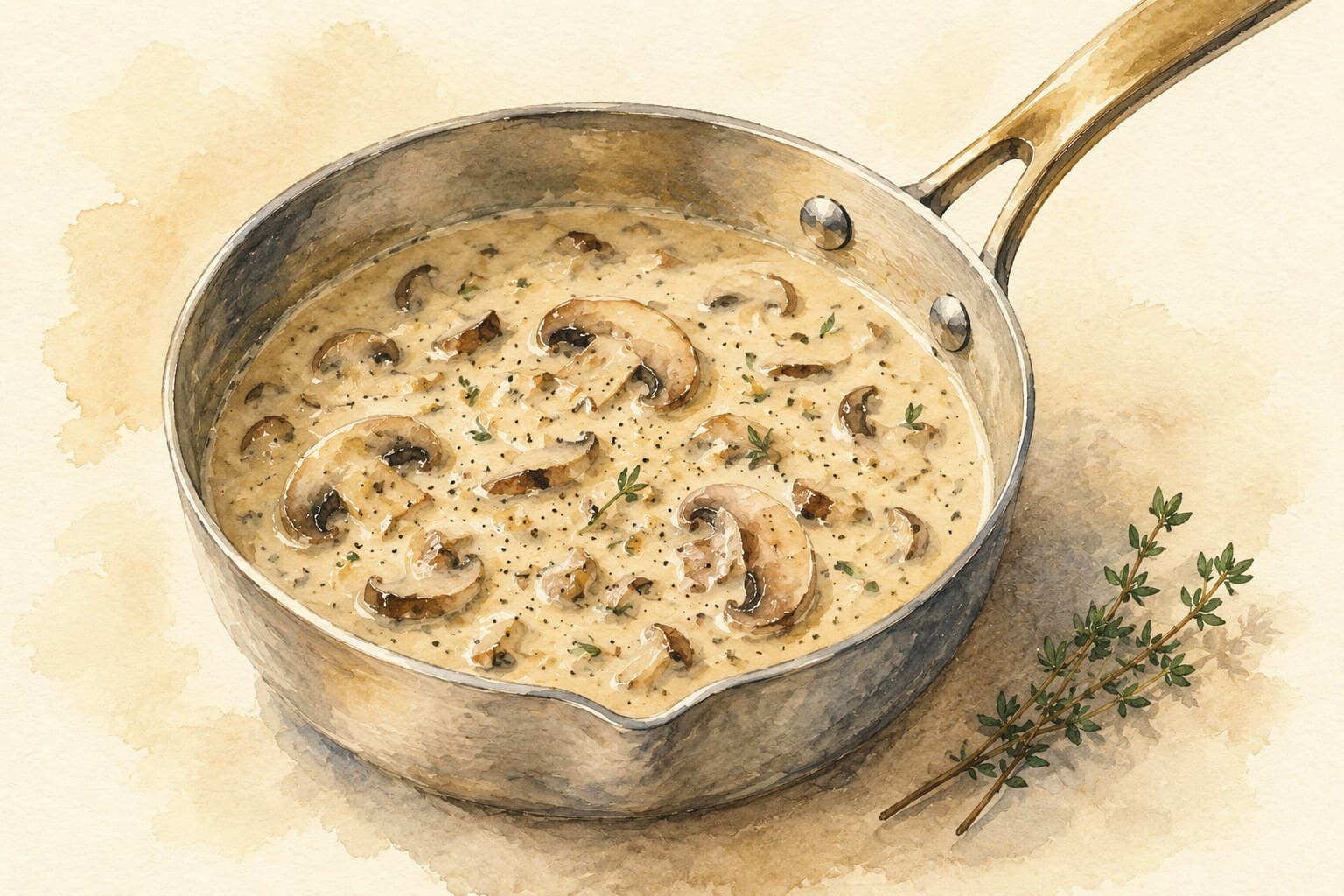
Mushroom Cream Sauce
Mushrooms, butter, a splash of wine, stock, cream — built in two stages over twenty minutes. The recipe that teaches why most home mushroom sauces are watery and gray, and exactly which step fixes that.
Contents (6 sections)▾
Ingredients
- 300 g mixed mushrooms (cremini + shiitake is the home default; add 30 g rehydrated dried porcini for depth if you have them)
- 20 g neutral oil (sunflower or grapeseed — keeps the dry-sauté at high heat without burning butter)
- 20 g unsalted butter (added at the end of the mushroom stage, not the beginning)
- 1 small shallot, finely minced (about 15 g)
- 1 small clove garlic, finely minced (optional)
- 30 ml dry white wine
- 100 ml vegetable or chicken stock
- 120 ml heavy cream (35% fat, ideally — lower fat creams break more easily)
- 3 g fine sea salt, divided
- Freshly cracked black pepper
- 1 small sprig fresh thyme (optional — strip the leaves)
Steps
Clean the mushrooms by brushing or wiping with a damp cloth — do not rinse under running water. Slice them about 5 mm thick. Mixed sizes are fine; a few smaller pieces add texture variety.
Heat the neutral oil in a wide heavy pan over medium-high until it shimmers. Add the mushrooms in a single layer with about 1 g of salt — do not crowd. If your pan won't fit them in one layer, work in two batches. The mushrooms will release water in the first 2-3 minutes. Do not stir. Let them sit until the water has evaporated and the bottoms start to brown.
Once the mushrooms are golden-brown on the underside (about 5 minutes), stir, add the butter, and let them finish browning in the fat for another 2-3 minutes. Add the shallot and garlic, stir for 30 seconds — they should soften, not brown. The mushrooms should now smell deeply savory and nutty.
Pour in the wine. It will sizzle hard. Scrape any fond from the bottom of the pan with a wooden spoon — this is the [reduction](/glossary/reduction) starting. Let the wine cook off almost completely, about 1 minute.
Add the stock. Bring to a steady simmer and reduce by about half — you'll see the level drop and the bubbles slow as the liquid thickens slightly. About 3-4 minutes.
Reduce the heat to medium-low and pour in the cream. Stir to combine. Simmer gently (not boiling — cream breaks above a hard simmer) until the sauce coats the back of a wooden spoon and a finger drawn across leaves a clean line that holds for a moment. About 3-5 minutes. Taste, adjust salt and pepper, scatter the thyme leaves if using, and pull off the heat. Serve at once over pasta, roasted chicken, a seared steak, or alongside potatoes.
Tools you'll want
- · Tri-ply stainless saucepan (1.5–2 qt / 18cm)
- · Balloon whisk (24cm / 11-inch)
- · Digital kitchen scale (gram precision)
Why this works
Mushrooms are mostly water — by weight, around 90% in fresh cremini, even more in some varieties. That water is the single biggest obstacle to a great mushroom cream sauce. If you add cream to wet, gray, unbrowned mushrooms, the result is exactly what most home mushroom sauces look like: a watery, faintly mushroomy beige liquid that never thickens properly and never tastes deeply of mushroom.
This is why the recipe has two distinct stages, and the order matters. Stage one is dry-sautéing (cooking in a small amount of fat over high heat without added liquid, so the food browns instead of stewing in its own water) the mushrooms over high heat in a hot pan with a small amount of oil. The salt added at this stage actually accelerates the process — it draws water out of the cells, which then evaporates rapidly. What you want is to push the mushrooms past "wet and gray" into "dry, glossy, browned on the cut faces." That browning is the Maillard reaction doing its work, and it is where most of the depth of flavor in the finished sauce comes from. The butter goes in at the end of stage one, not the beginning — butter at high heat browns and burns; better to use neutral oil for the heavy work and finish the mushrooms in the rich brown butter you create.
Stage two is the sauce itself. The wine deglazes (the act of pouring liquid into a hot pan to dissolve and lift the browned bits stuck to the bottom) the fond — those browned bits stuck to the pan, dense with the flavor compounds the Maillard reaction just built. The stock takes the place that water would otherwise: another layer of flavor instead of dilution. The cream goes in only at the end, when the stock has reduced and concentrated. Cream is fragile — it breaks above a hard simmer, splitting into curdled fat and watery liquid — so the heat comes down before the cream goes in, and the sauce finishes at a gentle simmer rather than a boil.
The mechanism is a reduction: you're not thickening with flour or starch (that would be a velouté, a classical French sauce thickened with a butter-and-flour paste called roux), you're concentrating by evaporation, then enriching with cream. The cream itself thickens slightly as it reduces (its proteins start to gel), but most of the body comes from the volume you've taken away. A reduced cream sauce coats a wooden spoon and holds a finger-drawn line. A cream sauce that hasn't reduced enough just runs off.
Common mistakes
Adding cream before the mushroom water is driven off.
Target: Pan visibly dry, mushrooms glossy + browned on cut faces, before any liquid touches.
Why it matters: This is the #1 failure mode. Mushrooms keep releasing water under the cream — you get a gray watery sauce no later reduction can fix. The dry-sauté is non-negotiable.
What to do: 5 minutes minimum of high-heat dry-sauté in single layer. Wait for the audible shift from "steady steam-hiss" to "sharp sizzle/crackle" — that signals water is out, browning is starting.
Workarounds:
- Tons of mushrooms? Do two batches; combine at the deglaze step. Quicker than fighting an overcrowded pan.
Crowding the pan.
Target: Mushrooms in a single layer with gaps. No piling.
Why it matters: Single layer = browns. Stacked = steams. The trapped moisture from below means the top layer never browns, and the dish loses the Maillard depth that defines a good mushroom sauce.
What to do: Eye the pan — if you can't see the bottom between pieces, split into two batches.
Workarounds:
- Time-constrained → use a larger pan (28-30 cm wide) so the full 300 g fits in one layer.
Adding the butter at the beginning.
Target: Butter goes in at the end of stage one — after mushrooms have browned in neutral oil.
Why it matters: Butter at the high heat needed for dry-sauté browns and then burns. Black butter solids = bitter aftertaste throughout the sauce. Neutral oil tolerates the heat; butter finishes for richness and brown-butter aroma.
What to do: Oil first (smoke-point 220°C+). Butter after mushrooms are golden (3-4 min into the cook).
Workarounds:
- Want pure butter flavor → use ghee or clarified butter instead of regular butter at the start (milk solids removed, tolerates higher heat).
Letting the cream boil hard.
Target: Gentle simmer after cream goes in. Small slow bubbles, no rolling boil.
Why it matters: Cream above a steady simmer breaks — proteins denature, fat separates into greasy globules in watery whey. Once broken, the sauce is permanently grainy.
What to do: Drop heat to medium-low before adding cream. If you see graininess: off heat immediately, whisk in 1 tbsp cold cream — sometimes rescues it.
Workarounds:
- Higher fat content (40% double cream) tolerates slightly more heat without breaking — useful if you need stronger reduction.
Skipping the reduction step.
Target: Nappe consistency — coats wooden spoon, finger-drawn line holds 1 second.
Why it matters: Under-reduced cream sauce is thin, watery, tastes diluted. Body comes from removing volume, not adding cream. Most home failures end here — the cook stops too early because "the sauce looks creamy."
What to do: Wooden spoon test before pulling off heat. If line fills immediately, +1 minute more simmer.
Workarounds:
- Reduced past the point of taste? Whisk in 1 tbsp extra cold cream to thin and re-balance.
What to look for
- The mushroom color. Stage one is done when the mushrooms are deep golden-brown on their cut faces, with visible Maillard color on the surface. Pale, gray, or shrunken mushrooms mean they haven't browned yet — keep going. The pan bottom should also show some fond (light brown sticky residue) — that's good, you'll deglaze it.
- The audible cue. When mushrooms are releasing water, the pan sound is a quiet steady steam-hiss. When the water is gone and the browning starts, the sound changes — sharper, more sizzling, almost crackling. Listen for the shift.
- The reduction stage. As the stock reduces, watch the bubble pattern. Big slow bubbles mean lots of liquid still. As the volume drops, the bubbles get smaller and faster, and the sauce starts to look glossy rather than thin. That's the moment to add the cream.
- The final coating test. The classic nappe test: dip a wooden spoon in the sauce, hold it horizontally, and draw a finger across the back. If the line stays clean for a second before the sauce flows back in, the consistency is right. If the line fills in immediately, simmer for another minute.
Chef's view
There are several views on whether to add stock at all. Some classical recipes go straight from deglazing with wine to adding cream — the sauce is then a pure mushroom-and-cream concentrate. Others build a deeper, more layered sauce by adding stock between the wine and the cream, treating the stock as a third flavor stage.
My view: the stock is worth the extra two minutes. A pure wine-and-cream sauce can taste a little flat — fine if you're serving it with a richly flavored protein that contributes its own juices, but on its own it lacks middle depth. The stock fills that gap. I use vegetable stock for vegetarian dishes and a light chicken stock when there's no diet constraint; the difference at this scale is subtle.
The other view I'd push back on gently is the "more cream is more luxurious" instinct. Most home recipes use too much cream and too little reduction, and the result is a heavy sauce that buries everything else on the plate. The point of the cream is to bind the flavors the mushrooms have already concentrated, not to be the flavor itself. A well-reduced sauce with 120 ml of cream feeding 2-3 portions is more luxurious than a thinner sauce with 200 ml.
On dried porcini: if you have them, the rehydrating liquid is liquid gold. Use it (strained, to remove grit) to replace part of the stock — the umami concentration is several times what fresh mushrooms can deliver. This is the one substitution that changes the character of the dish, and it changes it for the better.
Related glossary terms
- Maillard reaction — the browning chemistry that drives the mushroom-stage flavor
- Reduction — the mechanism for building body in this sauce without flour
- Fond — the browned residue you'll deglaze with wine
- Sauté — the dry-pan technique stage one depends on
Get the essays in your inbox — free
Weekly notes on flavor, fermentation, and food history — the writing behind the Atlas of Flavor. No spam; unsubscribe anytime.