
Velouté Sauce
A pale blond mother sauce — chicken, veal, or fish stock thickened with a blond roux. The sibling that shows what happens when you let the roux go one shade further.
Contents (8 sections)▾
Ingredients
- 500 g light chicken stock (or veal stock, or fish stock — skimmed, well-clarified)
- 30 g unsalted butter
- 30 g all-purpose flour
- 2 g fine sea salt (adjust to taste — stock salt levels vary)
- 1 small pinch white pepper
Steps
Bring the stock to a quiet simmer in a separate saucepan. It should be hot and fragrant when it meets the roux. Cold or lukewarm stock into hot roux is the direct cause of most lumps.
In a heavy-bottomed saucepan, melt the butter over medium-low heat. When the foam settles to a fine white froth and the butter is fully liquid, add the flour all at once.
Cook the roux, whisking constantly, for 2–3 minutes. Unlike the white roux for béchamel, a blond roux is taken one step further — past the raw-flour smell, to the edge of a light biscuit aroma. The color should be pale gold, not white, not amber. This is the moment the starch is partly dextrinized, giving the velouté its characteristic warmth of flavor.
Add about a quarter of the hot stock and whisk hard. The roux will seize into a smooth paste, then loosen. Whisk until uniform. Add the remaining stock in two or three additions, whisking smooth between each. The sauce will be thin after the last addition.
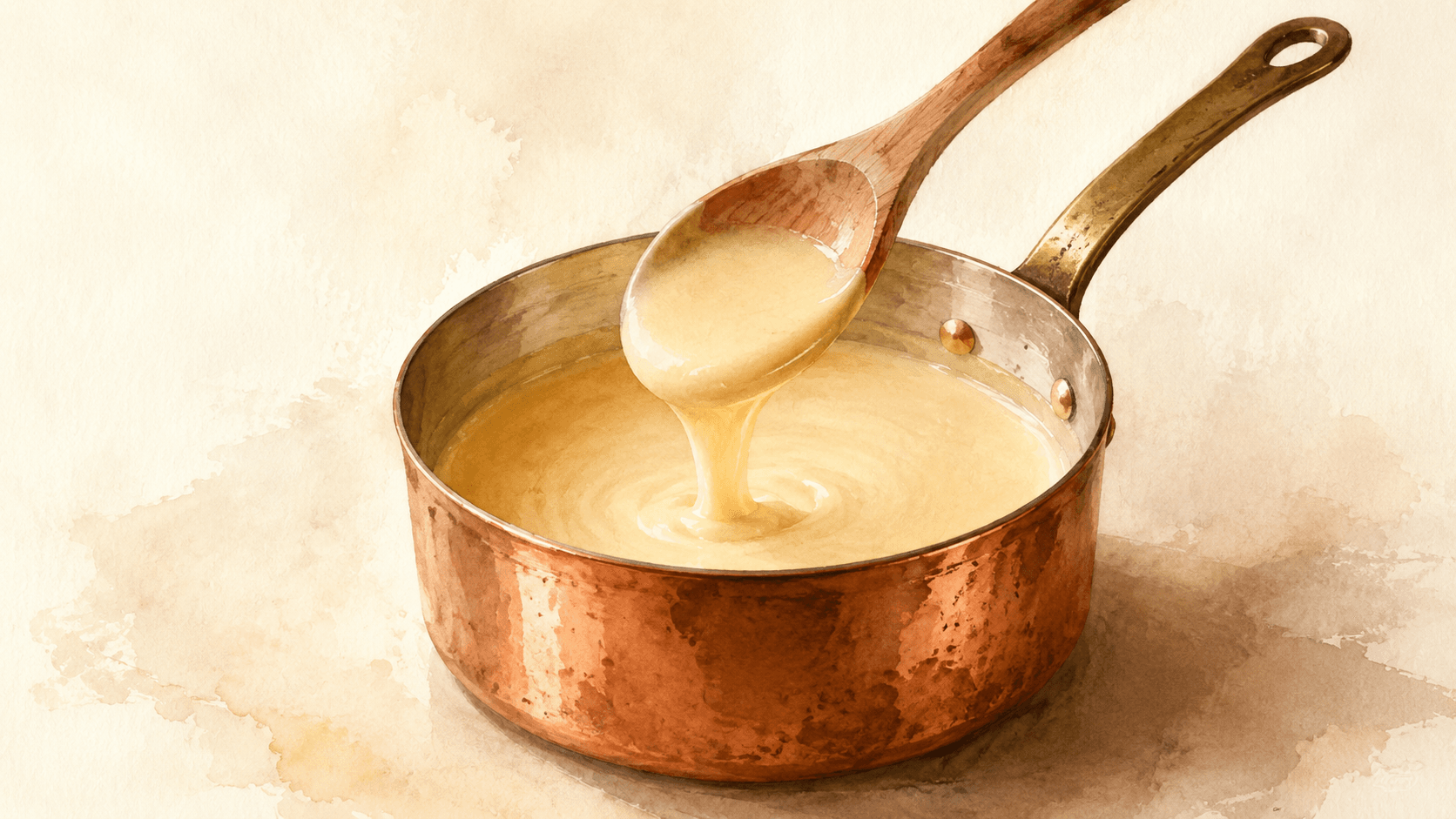
Simmer gently for 10–12 minutes, whisking frequently. The sauce will gradually thicken as gelatinization proceeds. When it coats the back of a spoon and a finger-drawn line holds clean for a second, taste and adjust salt and white pepper. For service, strain through a fine-mesh strainer or chinois. Use immediately or keep warm with a cartouche of parchment pressed to the surface to prevent a skin from forming.
Tools you'll want
- · Tri-ply stainless saucepan (1.5–2 qt / 18cm)
- · Balloon whisk (24cm / 11-inch)
- · Digital kitchen scale (gram precision)
- · Sauce strainer (chinois, perforated, or fine-mesh, 19–25cm)
Why this works
Velouté sits one step away from béchamel on the roux spectrum. Both use roux — butter and flour cooked together — to disperse starch without clumping. What separates them is the cooking time of the roux and the liquid used. Béchamel is built on milk with a white roux barely cooked past raw; velouté is built on stock with a blond roux taken to the edge of pale gold.
That extra minute on the roux is not cosmetic. Heat partially breaks down the long starch chains in the flour, converting some of them to shorter dextrins. Dextrins are less efficient at thickening than intact starch, which is why a blond-roux sauce often needs slightly more roux per liter of liquid than a white-roux sauce for the same final consistency. But the partial dextrinization brings a faint, toasty warmth of flavor that a white roux doesn't have — the flavor register that makes a velouté taste like a sauce and not a flavored paste.
The choice of stock dictates the final character of the sauce. Chicken velouté (the most common) has a mild, neutral-savory base ready to receive herbs, cream, mushrooms, or a liaison of egg yolks. Veal velouté is rounder and more gelatinous, its stock richer in collagen. Fish velouté (the most delicate) is built on a short-cooked, very light fish stock and is the foundation of classic Normandy-style cream sauces.
The name comes from velours — French for velvet — which is exactly what the sauce should feel like on the palate: smooth, flowing, with a quiet richness from the butter-fat matrix. If it feels pasty or gluey, the roux was under-cooked. If it feels watery, the sauce was under-simmered.
Common mistakes
Using poor-quality stock.
Target: Clear, well-skimmed homemade stock — chicken, veal, or fish depending on the velouté. NOT bouillon cubes.
Why it matters: Velouté concentrates whatever is in the stock — cloudy/greasy stock = cloudy/greasy sauce. The sauce has nowhere to hide imperfections.
What to do: Make stock from scratch, skim foam carefully, strain through fine mesh.
Workarounds:
- Time-short → best-quality store stock (low-sodium, organic if available); skim any fat from the surface first.
Under-cooking the roux.
Target: 2-3 minutes of cooking at medium-low — pale gold, smelling like fresh biscuits.
Why it matters: Under-cooked roux gives a raw floury taste that no later simmering removes. The blond stage is structural, not cosmetic.
What to do: Smell test: when the roux smells like baked shortbread, it's ready. Whitish/raw smell = continue cooking.
Workarounds:
- Unsure → err on the side of slightly more cooking; under-cooked is worse than slightly over.
Over-cooking the roux into brown.
Target: Stop at pale gold — past gold into amber/brown changes the sauce category.
Why it matters: Past blond, you've made espagnole-style brown roux — wrong color, wrong flavor for a "pale mother sauce" like velouté.
What to do: Watch the color. The shift from pale to brown happens fast. Pull at first amber tint.
Workarounds:
- Over-browned → use as base for a different brown sauce; don't try to make velouté from it.
Adding cold stock.
Target: Hot stock (just below boil) when meeting the roux.
Why it matters: Cold stock seizes the roux's fat before starch can disperse — lumps that require straining to remove. Hot stock + warm roux = smooth integration.
What to do: Heat stock separately in parallel with roux. Warm to a simmer before whisking in.
Workarounds:
- Forgot to heat → add stock in small amounts, whisking vigorously each time; slower but works.
Insufficient simmering time.
Target: 10-12 minutes of gentle simmer after stock is fully incorporated.
Why it matters: Starch gelatinization needs sustained heat. Pulling at 5 minutes = under-developed thin sauce; the body comes from the 10+ minute simmer.
What to do: Set timer. Don't rush — visual thin appearance is normal at 5 minutes.
Workarounds:
- Need to use immediately → simmer 15 min for extra insurance, then strain.
Not straining.
Target: Fine mesh strainer or chinois before service.
Why it matters: Even a well-made velouté has small lumps, starch particles, occasional herb bits. Straining gives the silky surface the name (velours = velvet) promises.
What to do: Strain into clean warm pan before serving. Press solids lightly.
Workarounds:
- No fine mesh → cheesecloth in regular strainer; slower but functional.
What to look for
- The roux: pale gold, fragrant of light biscuits. No white, no amber, no brown. The moment it smells like fresh shortbread is the right moment to add stock.
- First stock addition: the roux seizes, then loosens. Whisk hard; it should go smooth within 20 seconds.
- Mid-simmer: pourable, starts to coat the spoon lightly. The sauce is slowly building body; don't rush it.
- Done: coats the back of a spoon; a finger-drawn line holds for a second. Pale gold color, smooth surface. Taste: savory, clean, faint toast warmth.
Chef's view
Velouté is the sauce I use as a diagnostic. If a stock is good enough to drink as a consommé, it makes a beautiful velouté. If it's too salty, underseasoned, murky, or flat, the sauce will tell you. Cooking teachers often demonstrate béchamel first because it uses milk — a controlled, reliable liquid. Velouté comes second, and it teaches stock quality in a way no other exercise does.
The classical derivatives of chicken velouté include suprême sauce (finished with cream), Allemande sauce (finished with a liaison of egg yolks and cream), and several mushroom-based preparations. All of these follow the same structure: blond roux, hot stock, long simmer, strain, then the finishing element. The base technique never changes; only the finishing does.
For home use, I find a chicken velouté enriched with a small amount of crème fraîche and a squeeze of lemon to be one of the most versatile weeknight sauces — poured over pan-seared chicken breast or poached white fish, it works without requiring a long-reduced stock or a complex technique.
Chef Test Notes
Tested velouté with three stock types: homemade unsalted chicken stock, commercial low-sodium chicken stock, and a lightly reduced fish stock. The homemade chicken stock produced the cleanest, most rounded result — the sauce had a natural body from the collagen in the stock before the roux even entered. The commercial stock was thin and slightly metallic; the velouté was acceptable but required more careful seasoning at the finish. Fish stock velouté was delicate and set very quickly — the reduced fish stock gelatinized faster than I expected.
A note on history
Velouté is one of the five mother sauces (the small handful of base sauces from which most classic French sauces are derived) codified by Auguste Escoffier in Le Guide Culinaire (1903), following Antonin Carême's earlier four-sauce classification. In Escoffier's system, velouté was the pale-sauce counterpart to espagnole — one built on white stock with a blond roux (a butter-and-flour paste cooked just to pale gold, between raw white and brown), the other on brown stock with a dark roux. This pairing organized the entire sauce chapter of classical French cuisine: every derivative sauce was either a modification of a mother sauce or a reduction-based preparation. The taxonomy was deliberately hierarchical — knowing the five mothers meant understanding, in principle, every French sauce that followed.
Related glossary terms
- Roux — the blond version used here is cooked one stage beyond what béchamel requires
- Gelatinization — how the starch in the roux creates body in the sauce
- Reduction — the complementary approach to sauce thickening
- Emulsion — what the fat matrix in the finished sauce technically is
Get the essays in your inbox — free
Weekly notes on flavor, fermentation, and food history — the writing behind the Atlas of Flavor. No spam; unsubscribe anytime.