
Sunomono
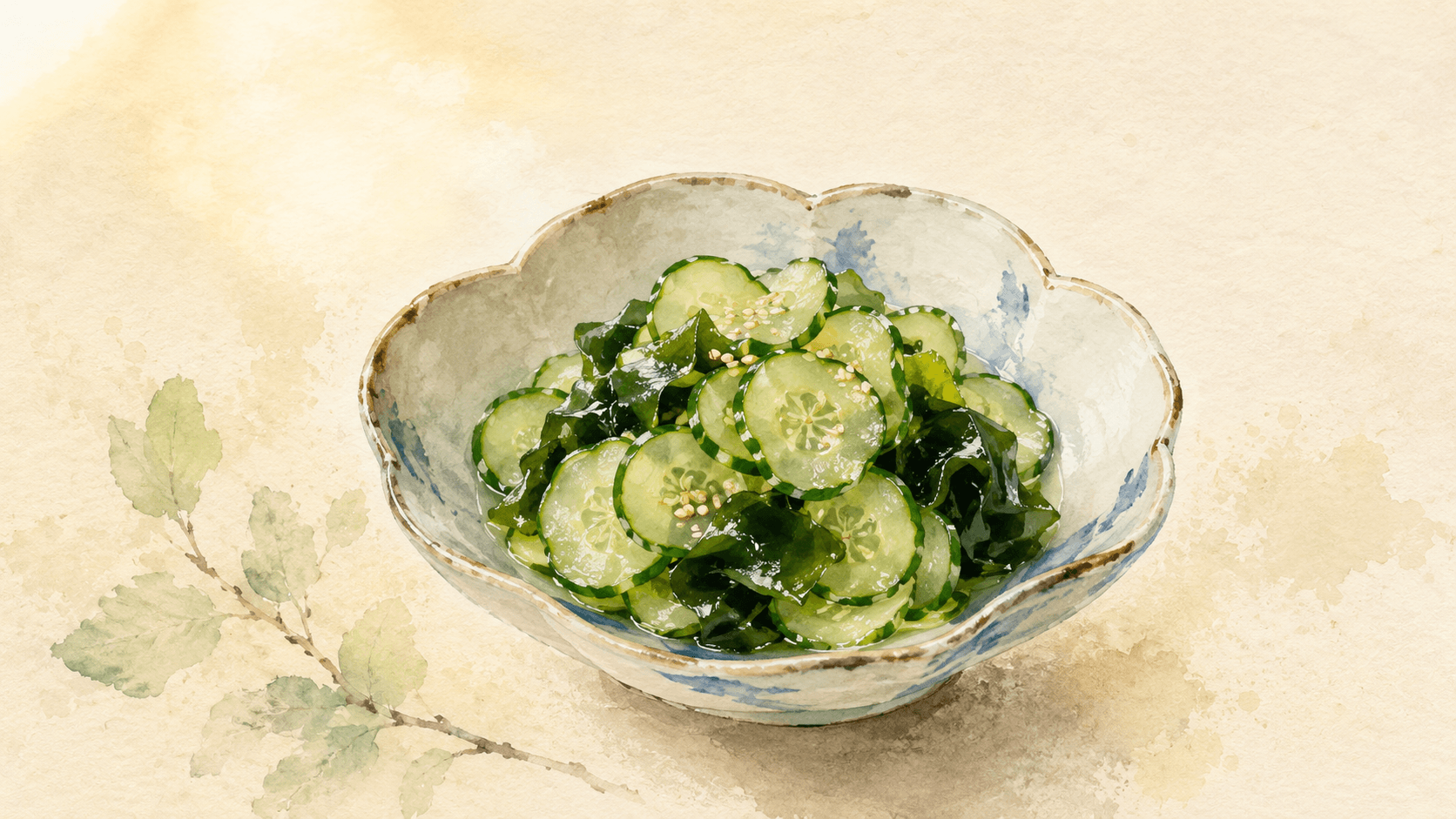
Vinegar-dressed vegetables with the san-bai-zu ratio — 3 parts vinegar, 1 part soy, 1 part mirin — a Japanese salad built on salt-wilting, acidity balance, and the logic of seasoned vinegar.
Contents (7 sections)▾
Ingredients
- 1 medium Japanese cucumber (about 200 g), or 1/2 English cucumber
- 1 tsp fine sea salt (for salt-wilting)
- ---
- San-bai-zu dressing:
- 3 tbsp rice vinegar (about 45 ml)
- 1 tbsp soy sauce (about 15 ml)
- 1 tbsp mirin (about 15 ml)
- 1 tsp sugar (optional — mirin provides sweetness, sugar adjusts if needed)
- ---
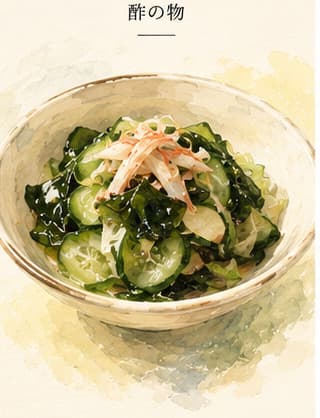
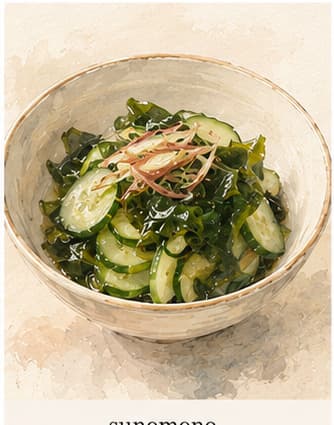
- Optional additions: 10 g dried wakame seaweed (rehydrated), small cooked shrimp, thin-sliced octopus, or thinly shaved daikon
Steps
Slice the cucumber as thinly as possible — ideally 1–2 mm, using a mandoline. Place in a bowl, sprinkle with the teaspoon of salt, and toss to coat. Let stand for 10–15 minutes. The salt draws water out of the cucumber cells through osmosis, wilting the slices and concentrating the flavor slightly. This step is not optional: undrained cucumber will dilute the dressing on contact.
Squeeze the salted cucumber slices firmly in your hands to remove as much liquid as possible. The squeezed cucumber should feel almost dry. This concentrated, slightly salted cucumber is the base of the dish. If using wakame, rehydrate in cold water for 5 minutes, squeeze dry, and cut into bite-size pieces.
Make the san-bai-zu: combine the rice vinegar, soy sauce, and mirin in a small saucepan. Heat gently just to a simmer — the brief heat mellows the vinegar's sharpest edge and evaporates a small amount of the mirin's alcohol, making the dressing rounder and more cohesive. Remove from heat and let cool to room temperature. If using sugar, add it while the dressing is warm. Taste: the ratio produces a tart, savory, lightly sweet dressing; the balance point is where no single element dominates.
Combine the cucumber (and wakame and any other additions) with the cooled dressing just before serving. Toss gently to coat every piece. The dressing should lightly coat the cucumber, not drown it. Serve in a small bowl or dish — sunomono is presented as a small portion, not a large salad. Serve immediately or within 10 minutes; longer and the cucumber releases more water, thinning the dressing.
Tools you'll want
Why this works
Sunomono is a lesson in acidity management and osmotic extraction — two techniques that, once understood, apply across a wide range of preparations.
The salt-wilting step exploits osmosis: the salt concentration outside the cucumber cells is higher than inside, so water moves out through the cell membranes to equalize the concentration. The cucumber slices collapse, releasing 20–30% of their water content into the bowl. This matters for three reasons: (1) the dressing makes contact with a less watery substrate and isn't diluted on contact; (2) the cucumber flavor is slightly more concentrated; (3) the texture is pleasantly softer and more pliable, rather than the crisp crunch of raw cucumber. The squeezing step removes the remaining surface and cellular water, ensuring the cucumber is nearly dry when it meets the dressing.
The san-bai-zu ratio — 三杯酢, literally "three-cup vinegar" — is 3 parts vinegar : 1 part soy : 1 part mirin by volume. It is one of the most fundamental ratios in Japanese cooking, used across a wide range of aemono (dressed dishes), sunomono, and dipping sauces. The math of the ratio is easy to remember and scales linearly: 1 tbsp each of soy and mirin, 3 tbsp rice vinegar — that's the base for one or two servings. For a larger batch, multiply uniformly.
Why this ratio works: rice vinegar is mild (about 4–5% acidity, compared to 5–7% for Western white wine vinegar), which means the 3-part volume of vinegar delivers the right level of acidity without the harshness of a stronger acid. Soy sauce adds salt and umami simultaneously — it is doing double duty that salt and a glutamate separately could not replicate as elegantly. Mirin adds sweetness and, crucially, the mellow caramel-adjacent sweetness from its fermentation sugars (which have a different molecular profile than white sugar), plus a light gloss. The brief heating of the dressing rounds the sharpest volatile acids in the vinegar and integrates the flavors more cohesively than simply combining raw ingredients.
The optional wakame is not just garnish — it adds a marine, slightly oceanic note that complements the acidity and gives the dish more textural contrast. Traditional sunomono almost always includes either wakame or a second ingredient (shrimp, octopus, clam) to add interest beyond cucumber.
Common mistakes
Skipping the salt-wilting step.
Target: Salt cucumber slices with 1 tsp salt per medium cucumber, rest 10-15 minutes, then squeeze firmly.
Why it matters: Un-wilted cucumber releases water into the dressing within 3 minutes — dressing becomes watery, flavors flat. The wilt is structural: water comes out, dressing stays concentrated.
What to do: Salt → wait → squeeze firmly until no more water comes out.
Workarounds:
- Time-short → reduce to 5 minutes with slightly more salt (1.5 tsp); less complete but workable.
Insufficient squeezing.
Target: Cucumber should feel almost dry when bundled in your hands after squeezing.
Why it matters: Salt-wilted cucumber still holds cellular water. Inadequate squeezing = water leaches into dressing during the meal. The squeeze is the bridge between wilt and final concentration.
What to do: Press firmly between palms or in a clean towel. Discard the expelled liquid.
Workarounds:
- Want extra control → use a clean cotton towel; wraps the cucumber and lets you squeeze more uniformly.
Wrong vinegar type.
Target: Japanese rice vinegar (a mild vinegar made from fermented rice, 4-5% acidity) — mild, slightly sweet. NOT white wine vinegar or apple cider vinegar.
Why it matters: Western vinegars (5-7% acidity) are 1.5-2x stronger; using them straight makes the dressing harshly sharp. The 3-part vinegar ratio works specifically because rice vinegar is mild.
What to do: Buy from an Asian/Japanese grocery. "Rice vinegar" label, NOT "seasoned rice vinegar" (which already has sugar and salt).
Workarounds:
- Only Western vinegar → dilute 30-40% with water before measuring; not authentic but functional.
Making dressing too far ahead.
Target: Make san-bai-zu (the 3-vinegar : 1-soy : 1-mirin Japanese dressing) same day — the volatile aromatics decay quickly.
Why it matters: Mirin's (a sweet rice cooking wine used widely in Japanese cuisine) gentle sweetness and soy's umami both lose intensity within 24 hours. Day-old dressing tastes flat compared to fresh. The 5-minute prep is worth doing fresh each time.
What to do: Prep at the same time as the cucumber wilt — they finish together.
Workarounds:
- Need to make ahead → refrigerate covered, use within 24 hours; expect mild flavor loss.
Dressing too early.
Target: Combine cucumber + dressing within 5 minutes of serving. Toss gently, eat right after.
Why it matters: Salted cucumber still releases water slowly. After 10 min of contact with dressing, the sauce dilutes — the bright clean acidity of fresh sunomono fades.
What to do: Plan the timing. Cucumber and dressing both ready, combine just before plating.
Workarounds:
- Make-ahead → keep cucumber and dressing separate; combine at the table or moment of serving.
Over-salting the wilt.
Target: 1 tsp salt per 200 g cucumber maximum. More than that and the dish tastes flat-salty rather than seasoned.
Why it matters: Excess salt over-concentrates the cucumber and overpowers the dressing's delicate balance. The salt is for osmosis, not for seasoning.
What to do: Measure salt by spoon — don't sprinkle by eye.
Workarounds:
- Salt-sensitive → rinse salted cucumber briefly in cold water after wilting (before squeezing) to reduce final salt level.
What to look for
- After salt-wilting: cucumber slices visibly softer and translucent at the edges, a pool of water in the bowl. Osmosis is working.
- After squeezing: compact, nearly dry bundle. Water should not drip when squeezed firmly.
- Dressing: pale golden, fragrant, slightly syrupy. Tart first, with savory and sweet notes following.
- Dressed sunomono: every slice coated, dressing lightly visible but not pooling. The vinegar glistens on the cucumber.
Chef's view
The san-bai-zu ratio is worth committing to memory exactly because it is a ratio, not a fixed recipe. 3:1:1 scales to any quantity — 1 tbsp rice vinegar, 1 tsp each soy and mirin, makes a dressing for a single portion. 6 tbsp vinegar, 2 tbsp each soy and mirin, makes a larger batch for a dinner party. The ratio also accepts small adjustments: more mirin for a sweeter, gentler dressing (good with delicate white fish or clams); slightly less soy for a lighter, more acidic version (good with octopus or bitter vegetables). The base ratio is where you start; the adjustments come from tasting.
The Japanese cucumber (kyuri) is the ideal cucumber for sunomono: thin skin, minimal seeds, and a delicate flavor that doesn't compete with the dressing. English cucumber works well. Standard thick-skinned North American cucumbers have too much seed content and more pronounced green cucumber flavor — peel, halve, and seed them before slicing.
Chef Test Notes
Tested san-bai-zu with and without the brief heating step. The heated version was noticeably rounder and more cohesive — the vinegar's sharp top notes mellowed and the mirin's sweetness integrated more evenly. The raw, unheated version was sharper and more one-dimensional, though still usable. The heating step adds 3 minutes and is worth the effort for a finished, restaurant-quality dressing.
Related glossary terms
- Osmosis — the mechanism by which salt draws water from the cucumber cells during wilting
- Umami — the savory depth contributed by soy sauce in the dressing, doubling as the salt component
- Mirin — the fermented rice condiment that contributes sweetness, gloss, and aromatic depth to the san-bai-zu
- San-bai-zu — the 3:1:1 vinegar:soy:mirin ratio at the foundation of this dressing
Get the essays in your inbox — free
Weekly notes on flavor, fermentation, and food history — the writing behind the Atlas of Flavor. No spam; unsubscribe anytime.