
Gomaae
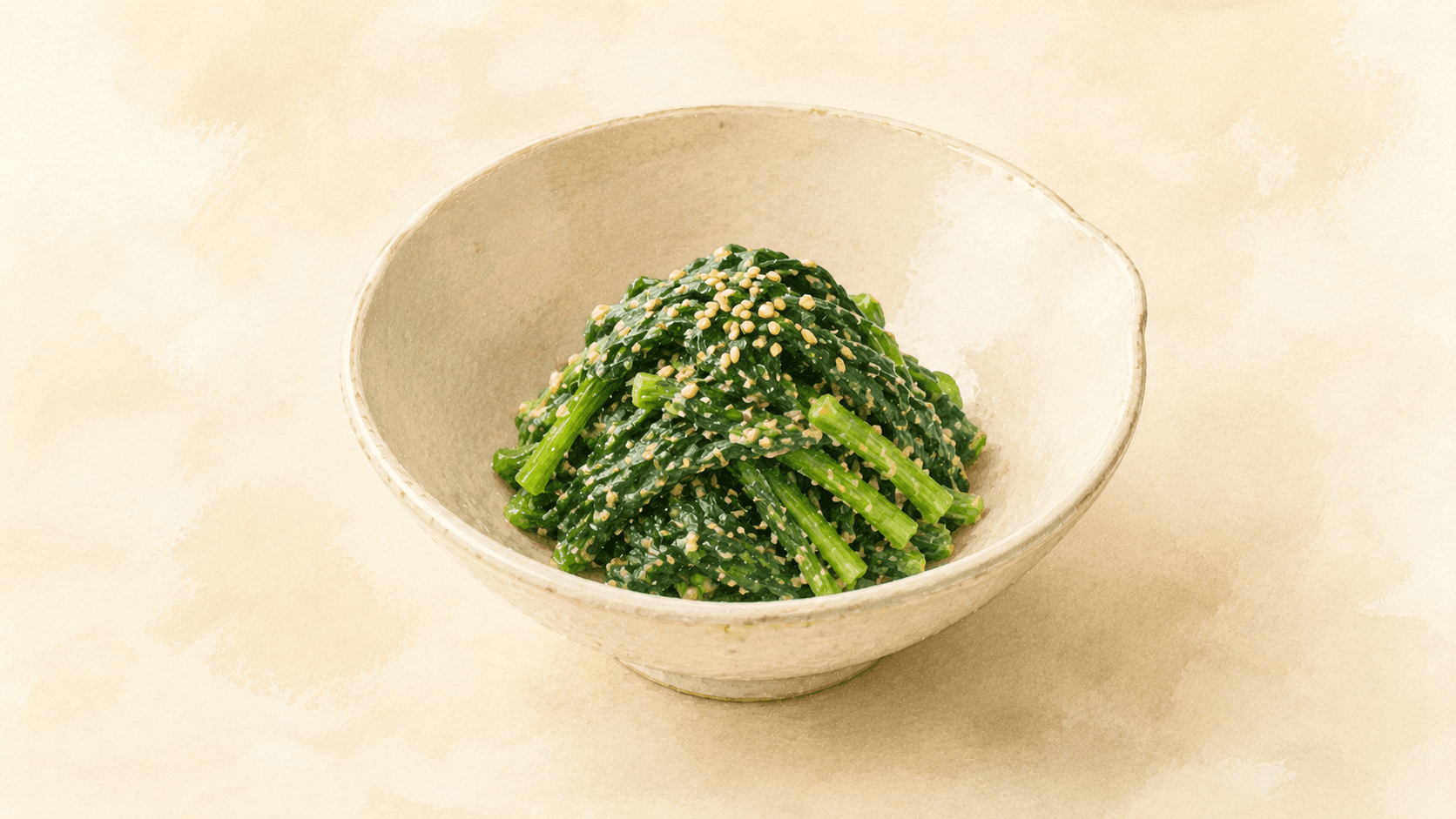
Blanched vegetables dressed in freshly ground sesame paste, soy, mirin, and sugar — a Japanese side dish where the grinding technique matters as much as the ratio.
Contents (7 sections)▾
Ingredients
- 200 g fresh spinach (or green beans, or blanched broccolini)
- 4 tbsp white sesame seeds (about 40 g)
- 1.5 tbsp soy sauce
- 1 tbsp mirin
- 1 tbsp sugar
- Fine sea salt for blanching water
Steps
Toast the sesame seeds in a dry skillet over medium-low heat, stirring constantly, for 3–5 minutes until they are lightly golden and fragrant. They should pop slightly and turn from pale ivory to a warm tan. Do not walk away — sesame burns fast. Spread on a plate to cool.
Grind the sesame in a suribachi (Japanese mortar with a ridged interior) or a standard mortar and pestle. Grind in circular motions, pressing firmly against the ridges. After 2–3 minutes, about 60–70% of the seeds should be crushed to a rough, oily paste and the rest remain partially whole. The oil released from the seeds is the dressing's fat base and flavor carrier. A food processor can substitute but gives a finer, more uniform result; the rough grind of a mortar has a different flavor quality — more aromatic, slightly coarser.
Add the soy sauce, mirin, and sugar to the ground sesame in the mortar (or in a bowl) and mix thoroughly into a thick dressing. Taste: it should be nutty, savory, slightly sweet. Adjust sugar or soy if needed. The dressing is intentionally quite thick — it will loosen when it meets the water-releasing vegetables.
Bring a large pot of water to a rolling boil. Salt generously — as salty as pasta water. Add the spinach and blanch for exactly 60–90 seconds. Spinach is done when it is bright, vivid green and slightly softened but still with a faint bite — not gray, not mushy. Immediately transfer to a bowl of ice water to stop the cooking and preserve the color.
Squeeze the cooled spinach firmly in your hands to remove as much water as possible. Too much residual water will dilute the dressing. Cut the squeezed spinach into 3–4 cm lengths. Dress just before serving — the dressing and the vegetables should meet at the last moment to prevent the green from drawing and the dressing from thinning.
Tools you'll want
Why this works
Gomaae (a Japanese side of blanched greens tossed in a sweet-savory ground-sesame dressing) is built on two simple acts: extracting oil from sesame seeds by grinding, and removing water from vegetables by blanching and squeezing. Both steps look optional. Neither is.
When sesame seeds are toasted, the volatile aromatic compounds inside — pyrazines, furans, and a dozen others — are activated. The heat drives the water off and concentrates the flavor. When you then grind the toasted seeds, you rupture the cell walls and release the oil. That oil is both the fat medium of the dressing and its primary flavor carrier. Sesame oil bought in a bottle has been extracted by industrial pressure; the oil released by hand-grinding fresh-toasted seeds is structurally different — it is raw and present, not processed and flat. This is why gomaae made with store-bought sesame paste tastes competent but not alive.
The blanching step does two things simultaneously. First, it cooks the spinach (or other vegetables) to just the right texture — softened enough to yield to the dressing but not so far gone that it releases water on standing. Second, the rapid plunge into ice water after blanching fixes the chlorophyll. Chlorophyll is the molecule that makes plants green. Above about 70°C, the magnesium ion at the center of the chlorophyll molecule is displaced by a hydrogen ion, producing pheophytin — a dull olive-gray compound. The ice bath halts this conversion instantly, locking in the vivid green color. Without the ice bath, even perfectly cooked spinach turns army-green within 5 minutes.
The squeezing step removes residual water from inside the blanched vegetable. This matters for the dressing: a watery vegetable will dilute the sesame paste and soy sauce on contact, producing a thin, pale dressing where there should be a richly coating one. Squeeze firmly. More firmly than feels polite.
The ratio — 4 tbsp sesame : 1.5 tbsp soy : 1 tbsp mirin : 1 tbsp sugar — produces a dressing in the standard Japanese goma-ae range. Sesame is the dominant flavor; soy provides salt and umami; mirin provides sweetness and slight gloss; sugar adjusts the sweetness level. The mirin's sweetness is mellower than sugar's because of the sugars produced during fermentation; they have different molecular weights and interact differently on the palate.
Common mistakes
Using pre-ground sesame paste directly.
Target: Freshly ground toasted sesame seeds for premium gomaae. Nerigoma (Japanese sesame paste) is acceptable for casual use.
Why it matters: Store-bought sesame paste has a processed, flat quality. Fresh-ground produces a different aromatic profile entirely.
What to do: Toast whole sesame seeds, grind in a suribachi (Japanese mortar) until coarse-to-fine paste.
Workarounds:
- For nerigoma users, refresh it by stirring in a teaspoon of newly-toasted seeds — adds aromatic top notes.
Under-toasting sesame.
Target: Toast whole white sesame until fragrant and lightly golden — not brown, not burned.
Why it matters: Pale unsmoked sesame lacks the aromatic depth that defines gomaae. The dressing is sesame's showcase — under-toasted sesame produces flat sauce.
What to do: Dry pan, medium heat, constant motion. Pull when seeds pop and smell nutty.
Workarounds:
- For premium aroma, use kuro goma (black sesame) for half the quantity — bolder flavor.
Over-blanching.
Target: 60–90 seconds in boiling water for spinach. NEVER more than 2 minutes.
Why it matters: Gray spinach is the hallmark of gomaae done wrong. Past 2 minutes, chlorophyll converts — color goes from jade to olive drab.
What to do: Time it. Set up ice bath BEFORE you start blanching.
Workarounds:
- For thinner stems, even shorter (45 sec). Thick stems → 90 sec.
Skipping the ice bath.
Target: Plunge spinach into ice water immediately after blanching.
Why it matters: Without stopping the heat, carry-over cooking continues for minutes — colorconversion to olive proceeds. Ice bath locks in jade green.
What to do: Have ice water ready. Tongs from boiling water to ice in one motion.
Workarounds:
- No ice → very cold tap water + brief plunge — less effective but better than nothing.
Squeezing not aggressive.
Target: Squeeze blanched spinach as dry as possible.
Why it matters: Loosely-squeezed spinach releases water into the dressing within minutes, diluting the sauce. The signature gomaae texture requires very dry spinach.
What to do: Wrap in a clean kitchen towel and SQUEEZE HARD. Should yield a tight ball.
Workarounds:
- For maximum dry-ness, double-squeeze: first rough squeeze, then squeeze again after 5 min rest.
Dressing too far in advance.
Target: Dress within 5 minutes of serving.
Why it matters: Even properly-squeezed spinach releases some moisture over time. Pre-dressed gomaae thins out within 15 minutes.
What to do: Have dressing ready, spinach ready, combine at the last moment.
Workarounds:
- For meal prep, store dressing and spinach separately, combine at serving.
What to look for
- Sesame after toasting: lightly golden, fragrant, a few seeds popping. Not pale, not brown.
- After grinding: roughly 60% paste, 40% partially crushed. The oil is visible and fragrant. The mortar will smell strongly of fresh sesame.
- Spinach after blanching: vivid, bright green, slightly softened. Not gray, not limp.
- After squeezing: compact, nearly dry block. You should not be able to squeeze more water out.
- Dressed gomaae: each piece coated, not swimming. The dressing is thick and adheres rather than pooling at the bottom.
Chef's view
The suribachi is one of the tools in Japanese cooking that has no real Western equivalent. It is a ceramic mortar with a ridged interior — the ridges do the actual grinding work, catching the seeds and pressing them against each other with each circular stroke. The result is a rougher, more varied grind than a smooth mortar produces: some seeds are fully crushed to paste, others are just cracked, and the mixture holds both the fine oil and the coarse texture at once. The flavor of this rough grind is different from the flat uniformity of a food processor output or a commercial sesame paste.
For home cooks without a suribachi, a standard mortar and pestle works well, though the ridges do help. A food processor with a small bowl is the fastest option and works technically — the result will be smoother and slightly less aromatic, but the dish will be good.
The vegetables in gomaae are not limited to spinach. Green beans, broccolini, chrysanthemum greens (shungiku), snap peas, and asparagus all work well. The principle is the same: blanch to just-done, ice bath, squeeze or drain thoroughly, dress at the last moment.
Chef Test Notes
Tested three sesame approaches: freshly ground toasted seeds, store-bought sesame paste (nerigoma), and store-bought sesame paste thinned with a small amount of sesame oil. The fresh-ground result was noticeably more aromatic and had a slightly grainy texture that was pleasant. The commercial paste was smooth but had a flat, slightly oxidized note in the background. The thinned paste was a reasonable middle-ground for everyday use.
Related glossary terms
<!-- beginner-glossed v1 -->Get the essays in your inbox — free
Weekly notes on flavor, fermentation, and food history — the writing behind the Atlas of Flavor. No spam; unsubscribe anytime.