
Sauce Suprême
Velouté reduced with cream — the daughter sauce that shows the difference between a cream-finished sauce and an egg-yolk-finished one, and why both matter.
Contents (7 sections)▾
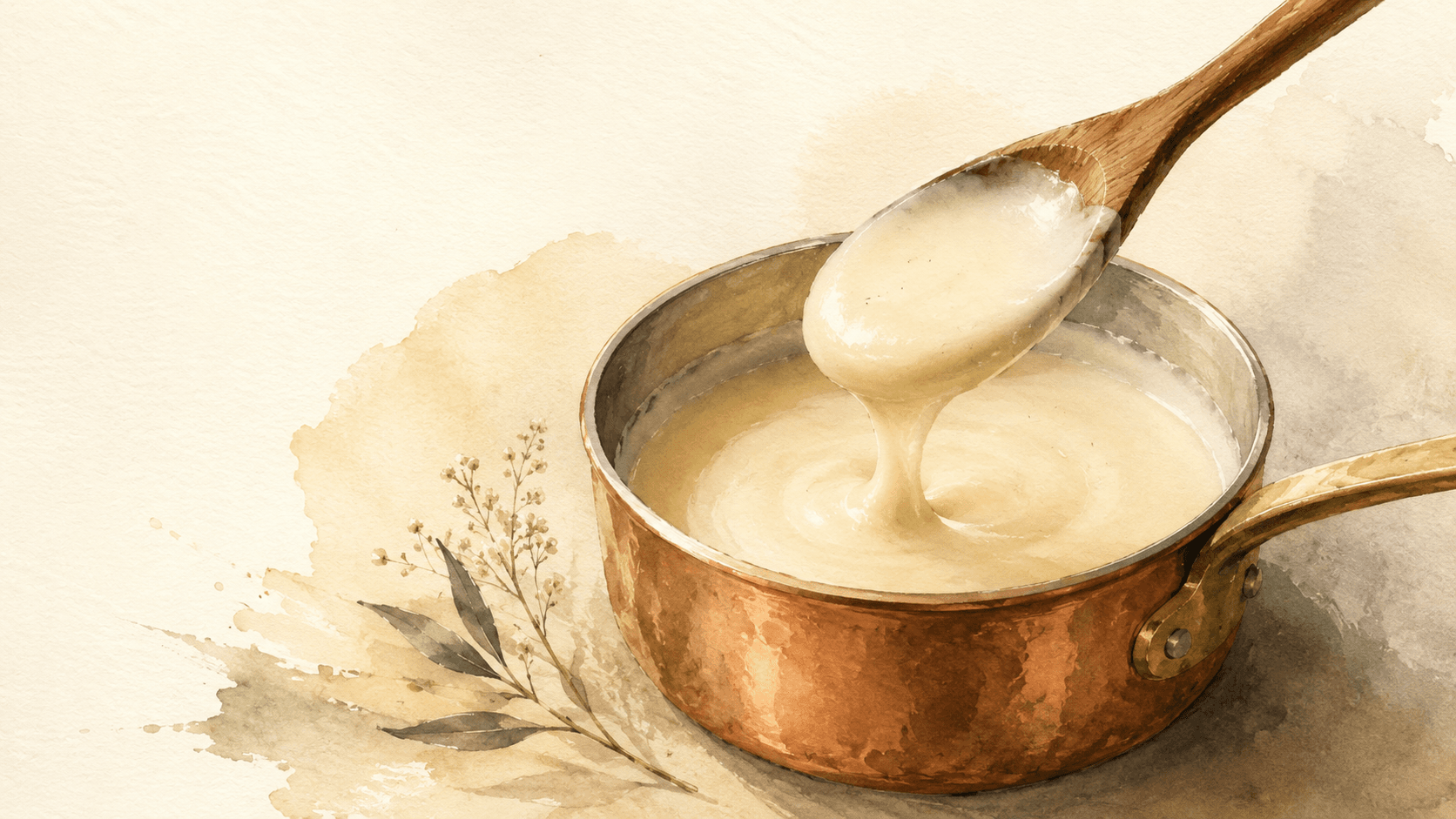
Ingredients
- 500 ml finished velouté sauce (hot, made from chicken stock)
- 120 ml heavy cream (35% fat)
- 30 g unsalted butter (cold, cut into cubes — for mounting)
- Fine sea salt and white pepper to taste
- Squeeze of lemon juice (optional, to finish)
Steps
Bring the velouté to a gentle simmer in a heavy-bottomed saucepan. It should be smooth and pourable — if it has a skin, whisk it smooth or strain through a fine-mesh strainer first.
Add the heavy cream and stir to incorporate. Bring the mixture back to a simmer and reduce, stirring occasionally, until the sauce is reduced by about one quarter and coats the back of a spoon more thickly than the original velouté. This reduction concentrates the cream's proteins and sugars, enriching the sauce's flavor and giving it a noticeably silkier body.
Remove from heat. Add the cold butter cubes a few at a time, whisking briskly after each addition. This is mounting (monter au beurre) — the cold butter emulsifies into the hot sauce, adding richness, gloss, and a slightly lighter texture. Do not return to the boil after mounting; the emulsion will break.
Taste and adjust: white pepper is the classic seasoning, not black (which would visually mark the pale sauce). A small squeeze of lemon juice at the end is optional but can brighten the finish. Strain through a fine-mesh strainer for a perfectly smooth service sauce. Use immediately or hold in a bain-marie (barely warm water bath) with a cartouche of parchment pressed to the surface.
Tools you'll want
- · Tri-ply stainless saucepan (1.5–2 qt / 18cm)
- · Balloon whisk (24cm / 11-inch)
- · Sauce strainer (chinois, perforated, or fine-mesh, 19–25cm)
- · Digital kitchen scale (gram precision)
Why this works
Sauce Suprême is the cream-enriched daughter of velouté — the stock-and-roux mother sauce. Understanding what cream does to velouté, and how it differs from what egg yolk does, is the core lesson of this sauce.
When you add cream to a velouté and reduce, three things happen. First, the cream's water evaporates, concentrating the proteins and sugars in both the cream and the existing velouté. This is why the sauce becomes richer tasting — not just creamier, but more intensely flavored. Second, the cream proteins (primarily caseins) stabilize the sauce structurally, interacting with the gelatinized starch from the roux to create a more cohesive, silkier mouthfeel. Third, the cream fat increases the sauce's ability to carry fat-soluble flavor compounds, including those from the stock aromatics, making the sauce taste more complete.
The contrast with sauce Allemande (the egg-yolk-finished velouté derivative) clarifies what cream does and does not contribute. Egg yolks thicken more aggressively — a small amount of yolk liaison thickens far more than the same volume of cream, because coagulating proteins bind much more water than fat does. But yolks also add a richer, slightly eggy quality that cream does not. Suprême is lighter in flavor despite being richer in fat; Allemande is more substantial but has a characteristic depth from the yolk.
The mounting step (monter au beurre — whisking cold butter into the hot finished sauce) is a refinement, not a structural necessity. What it does is add a thin emulsion of butter fat into the sauce's water phase, which increases gloss, adds richness on the palate, and gives the sauce a slightly lighter, airier texture. The cold butter emulsifies because the butter fat is solid enough to disperse as tiny droplets before melting, not because it is fundamentally different from the cream fat already in the sauce. This is why the sauce must not return to the boil after mounting — at high heat, the butter emulsion breaks and the fat pools on top.
Common mistakes
Boiling after adding cream.
Target: Gentle simmer only — small bubbles, never rolling boil.
Why it matters: Rolling boil breaks the fat-in-water structure — cream separates, sauce becomes greasy and grainy.
What to do: Drop heat to lowest stable simmer after cream goes in.
Workarounds:
- Already boiled → whisk in 1 tbsp cold cream off-heat; may rescue.
Not reducing enough.
Target: Sauce coats the back of a spoon — visibly thicker after cream simmers.
Why it matters: Cream initially dilutes the velouté; only reduction concentrates it back to coating texture. Under-reduced = thin and weak.
What to do: Be patient — cream needs time to reduce. Visual check, not time.
Workarounds:
- Need quick body → small amount of beurre manié (kneaded butter+flour) for emergency thickening.
Returning to boil after mounting.
Target: Hold warm (60-65°C), not hot. Never reheat past gentle simmer.
Why it matters: Mounted butter emulsion breaks at high temperature — fat pools, gloss disappears.
What to do: Bain-marie for holding. Make to order if possible.
Workarounds:
- Broke → whisk in 1 tsp warm cream off-heat; partial recovery.
Using warm/hot butter for mounting.
Target: Cold butter cubes — straight from fridge, cut into cubes.
Why it matters: Cold butter disperses as tiny solid droplets before melting = clean emulsion. Soft/melted butter goes in as liquid fat = no emulsion.
What to do: Pre-cube cold butter before reaching the mounting stage.
Workarounds:
- Butter softened → refrigerate 10 minutes before mounting.
Using black pepper.
Target: White pepper only for this pale ivory sauce.
Why it matters: Black pepper specks are a visible presentation fault in pale French sauces. White pepper provides equivalent heat without dark specks.
What to do: Season generously with white pepper before adjusting salt.
Workarounds:
- No white pepper → strain the sauce through fine mesh after seasoning with black; removes most specks.
What to look for
- Before cream addition: smooth velouté, just barely coating. The base is correct.
- After cream, before reduction: thinner, more pourable. The cream has diluted the velouté — expected.
- After reduction: thicker, coating the spoon cleanly. The cream has concentrated.
- After mounting: noticeably glossier, slightly lighter. The butter emulsion is in.
- On the plate: stays in place, doesn't run immediately. Correct consistency for a plate sauce.
Chef's view
The distinction between suprême (a chicken-velouté daughter sauce finished with cream and mounted with butter) and allemande was a point of serious contention among classical French sauce taxonomists. In Escoffier's original system, suprême was cream-finished; Allemande was yolk-finished. The modern French kitchen, operating under time and practical constraints, often blurs the line — many contemporary recipes add a small amount of yolk even to "suprême" to ensure stability and body. The purist view is that suprême should be cream only; the practical view is that the distinction matters most when you are trying to understand the underlying logic of sauce-making, not when you are feeding a table.
For a practical suprême in a home kitchen, I would skip the egg yolk entirely and rely on the cream reduction (concentrating a sauce by gentle simmering so water evaporates and flavor intensifies) and butter mounting (monter au beurre — whisking cold butter into the warm sauce off the heat to add gloss and richness) for stability. The sauce is easier to manage, less prone to curdling, and the flavor is clean and modern. For a classical suprême served in a formal context, the formula here is the correct one.
Chef Test Notes
Tested suprême at three cream reduction levels: minimal (barely reduced), 25% reduction, and 50% reduction. The 25% reduction produced the best balance — noticeably richer and more cohesive than the barely-reduced version, without the slightly heavy, over-reduced quality of the 50% version. The 25% target in the recipe reflects this finding.
Related glossary terms
- Velouté — the mother sauce this is derived from
- Daughter sauce — the category suprême belongs to within French sauce taxonomy
- Monter au beurre — the technique of whisking cold butter into a hot sauce to add gloss and richness
- Reduction — what concentrates the cream and builds the sauce's body
Get the essays in your inbox — free
Weekly notes on flavor, fermentation, and food history — the writing behind the Atlas of Flavor. No spam; unsubscribe anytime.