
Blanquette de Veau
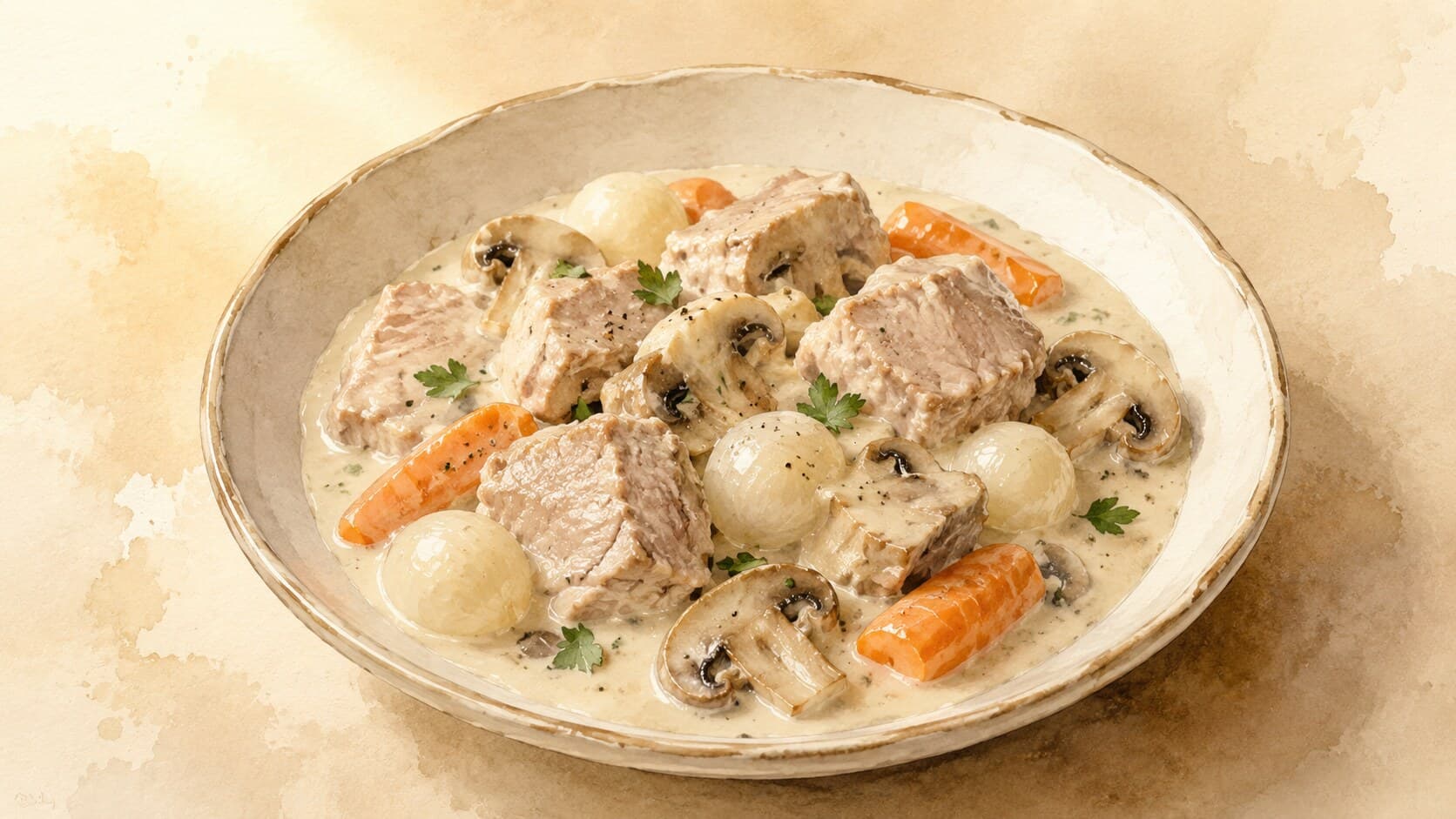
White veal stew — poached without browning, finished with a cream and egg yolk liaison over a velouté base, teaching the pure physics of gentle heat without any Maillard.
Contents (8 sections)▾
Ingredients
- 800 g veal shoulder or breast, cut in 4 cm cubes (or substitute chicken thighs)
- 1 medium onion, peeled and studded with 2 cloves
- 2 medium carrots, roughly cut
- 2 stalks celery
- 1 bouquet garni (thyme, bay leaf, parsley stems, leek green)
- 1 tsp fine sea salt, plus more to taste
- ---
- For the sauce:
- 40 g unsalted butter
- 40 g all-purpose flour
- 500 ml poaching liquid (strained, from above)
- 100 ml heavy cream
- 2 egg yolks
- 1 tbsp fresh lemon juice
- White pepper to taste
- ---
- Garnish: 150 g pearl onions (blanched and peeled), 150 g small button mushrooms (cooked in butter and lemon)
Steps
Blanch the veal: place the cubed veal in a large pot of cold water. Bring slowly to a boil — this draws out the proteins and impurities from the meat into the water, which you then discard. Drain, rinse the veal under cold water, and rinse the pot. This step ensures the finished stew is white and clean, not grey and cloudy. This is the foundational 'white cooking' technique.
Return the blanched veal to the clean pot. Cover with fresh cold water by about 5 cm. Add the onion-with-cloves, carrots, celery, bouquet garni, and salt. Bring slowly to a bare simmer — 85°C, no more. Poach for 60–75 minutes, skimming any foam that rises. The veal is done when it yields to a probe without resistance but still holds its shape. It should not be falling apart. Remove the veal and keep warm. Strain and reserve 500 ml of the poaching liquid — this is your stock.
Make a velouté: in a clean heavy-bottomed saucepan, melt the butter over medium-low heat. Add the flour and cook, whisking, for 1–2 minutes to make a white roux. Gradually whisk in the warm poaching liquid in 3–4 additions, whisking smooth after each. Simmer for 8–10 minutes until the sauce coats a spoon. This is the velouté base of the blanquette.
Prepare the cream and egg liaison: in a small bowl, whisk together the egg yolks and heavy cream. Temper by ladling 3–4 spoonfuls of the hot velouté into the liaison while whisking. Pour the tempered liaison back into the velouté, stirring over very low heat for 1–2 minutes. Do not boil — the egg proteins will curdle above 85°C.
Add the lemon juice and white pepper. Taste and adjust salt. Return the veal to the sauce. Add the cooked pearl onions and mushrooms. Gently heat through — do not boil — for 5 minutes. The sauce should be silky, pale cream-white, and lightly coating. Serve immediately with steamed rice, egg noodles, or boiled potatoes.
Tools you'll want
- · Tri-ply stainless saucepan (1.5–2 qt / 18cm)
- · Balloon whisk (24cm / 11-inch)
- · Sauce strainer (chinois, perforated, or fine-mesh, 19–25cm)
- · Digital kitchen scale (gram precision)
Why this works
Blanquette de veau is the deliberate inverse of coq au vin. Where coq au vin browses, sears, and Maillard-colors (browns via the Maillard reaction, the chemistry that turns surfaces brown and savory under dry heat) everything it can, blanquette suppresses all browning — no sear, no caramelization, no dark roux — and relies entirely on the gentle transformation of connective tissue by sustained low heat in liquid.
The name says it all: blanc — white. The dish is "white" because the veal is never allowed to color. The technique is built around this constraint and it demands a different understanding of what heat does to meat.
The initial blanching step (not blanching in the vegetable sense, but the French blanchir — bringing cold meat to a simmer in plain water and discarding that water) is what makes the broth stay clean. Muscle and connective tissue contain myoglobin, blood proteins, and other compounds that, when heated from cold, coagulate into grey foam. In a braise like coq au vin, this foam is irrelevant — it gets swept up in the complex dark sauce. In a blanquette, where the sauce is pale and delicate, that cloudiness would ruin the appearance. The cold-water start draws these compounds out gradually; discarding the first water removes them before the real cooking starts.
The poaching temperature — 85°C, a steady gentle simmer — is also specific. Above 90°C, muscle proteins tighten aggressively and the meat becomes stringy and dry before the collagen (the tough connective tissue in meat) has fully converted to gelatin (the silky substance that makes slow-cooked meat tender). At 85°C, the collagen conversion proceeds, the muscle proteins remain relaxed, and the veal becomes tender without losing its integrity. This is the same physics as braising, but the lower temperature and lighter environment (water vs red wine) produce a fundamentally different result: pale, tender, and clean-tasting rather than dark, rich, and complex.
The liaison (egg yolks and cream) that finishes the velouté is the same logic as in Mornay and crème anglaise — controlled protein coagulation enriching a starch-thickened base without scrambling. The lemon juice is structural: it brightens the whole dish, cutting through the dairy richness, and its acidity prevents the sauce from tasting flat or heavy.
Common mistakes
Skipping the initial blanching.
Target: Cover veal in cold water, bring to a boil, simmer 5 minutes, drain, rinse veal.
Why it matters: Without blanching, the broth turns grey and cloudy with surface proteins. Blanchette (the white character) is impossible — the stew is just "veal stew with white sauce."
What to do: Cold water start, hard boil briefly, drain, rinse. Then proceed with the proper poach.
Workarounds:
- For extra-clean blanquette, blanch twice (10 minutes the second time with aromatics).
Searing the meat.
Target: NO sear, NO browning. Veal goes from cold water to gentle poach — never touches a hot pan.
Why it matters: Even light searing introduces Maillard flavors and color that contradict the "white" character. Blanquette is defined by the absence of browning.
What to do: Resist the urge. Poach raw. The flavor comes from the slow extraction in the poaching liquid.
Workarounds:
- If you accidentally seared, accept you're making "blanquette-adjacent veal stew." Different category.
Poaching at a boil.
Target: 85 °C only — surface should barely shiver. NEVER a full simmer.
Why it matters: Rolling boil toughens veal and makes the broth murky. The delicate poach is the technique's name (poacher = to poach).
What to do: Lowest possible heat. Use a thermometer if you're unsure.
Workarounds:
- For more stable temperature, transfer to a 130 °C oven after initial heat-up.
Adding the liaison to boiling sauce.
Target: Off the heat, slowly whisk yolk-cream liaison into hot (NOT boiling) sauce.
Why it matters: Above 85 °C, the egg yolks curdle. Once curdled, the liaison breaks visibly into grainy bits — unrecoverable.
What to do: Off heat. Temper (gradually warm the cold egg-cream mix by whisking in a little hot sauce so it doesn't scramble) liaison with a ladle of hot sauce first. Then return to barest warmth.
Workarounds:
- Strain curdled sauce, return to pan over very gentle heat, whisk to recover. Partial save.
Under-seasoning.
Target: Generous white pepper + finishing lemon juice + salt.
Why it matters: Pale, dairy-heavy sauces need acid and pepper to stay lively. Without lemon, blanquette tastes flat. Without white pepper, it lacks the warming background.
What to do: Add lemon juice in the final minute. White pepper liberally.
Workarounds:
- For deeper warmth, add a tiny pinch of nutmeg to the sauce.
Wrong cut of veal.
Target: Veal SHOULDER or BREAST — needs connective tissue for sauce body.
Why it matters: Lean veal cutlet/loin produces dry, flavorless meat at blanquette's cooking time. Shoulder's gelatin enriches the sauce as it cooks.
What to do: Ask the butcher for stewing-grade veal shoulder. Cubes about 4 cm.
Workarounds:
- Veal too expensive? Pork shoulder produces "blanquette-style pork" — different but excellent.
What to look for
- After initial blanching: white, clean veal, clear water. All grey impurities have been drawn out.
- During poaching: steady 85°C, barely shivering. If bubbles are actively breaking the surface, turn the heat down.
- Veal at 75 minutes: yields to a skewer with no resistance, holds its shape. Not falling apart, not tough.
- Finished sauce: pale cream-white, silky, coats a spoon cleanly. No grey cloudiness, no greasiness.
- On the plate: the sauce holds around the meat without separating. Correct liaison consistency.
Chef's view
Blanquette de veau occupies an interesting position in the French canon: it is simultaneously one of the most technically demanding recipes and one of the most visually understated. The visual restraint — that insistent whiteness — is not accidental. It is a statement of technique, of control, of the cook's ability to manage heat so precisely that no color develops anywhere in the dish. A perfectly made blanquette is impressive in the way a very clean sentence is impressive: nothing wasted, nothing extraneous.
The veal can be substituted with chicken (thighs, bone-in) with good results — the technique is identical and the cooking time similar. Lamb can also work, though it brings a stronger flavor that competes somewhat with the delicacy of the white sauce. Traditional blanquette uses veal because the mild flavor and high collagen content of veal shoulder are ideal: it contributes body to the sauce without dominating the taste.
Chef Test Notes
Tested with and without the initial blanching step. Without: the stew was noticeably greyer and the sauce developed a slightly murky, grey-tinged appearance within 15 minutes of poaching. With: the stew remained white throughout. The blanching adds 10 minutes to the process and is entirely worth it. Also tested liaison at 80°C versus 88°C: at 88°C, small granules of cooked egg were detectable even after straining. Keep the heat very low after adding the liaison.
A note on history
Blanquette de veau is one of the oldest documented French stews — recipes appear as early as the early 18th century. Unlike coq au vin, which has a relatively recent written history despite its peasant origins, blanquette was always associated with classical French cooking. Carême wrote about it; Escoffier codified it. The white stew format — meat poached in broth, sauce made from that broth, finished with cream and egg — is one of the structural foundations of the French kitchen. It is the template from which dozens of other white stews descend.
Related glossary terms
- Poaching — cooking in liquid at below-simmer temperature; the technique the veal is cooked by
- Liaison — the egg yolk and cream mixture that finishes and enriches the sauce
- Velouté — the mother sauce whose technique forms the base of the blanquette sauce
- Blanchir — the initial cold-water blanch that removes impurities and keeps the stew white
Get the essays in your inbox — free
Weekly notes on flavor, fermentation, and food history — the writing behind the Atlas of Flavor. No spam; unsubscribe anytime.