
Coq au Vin
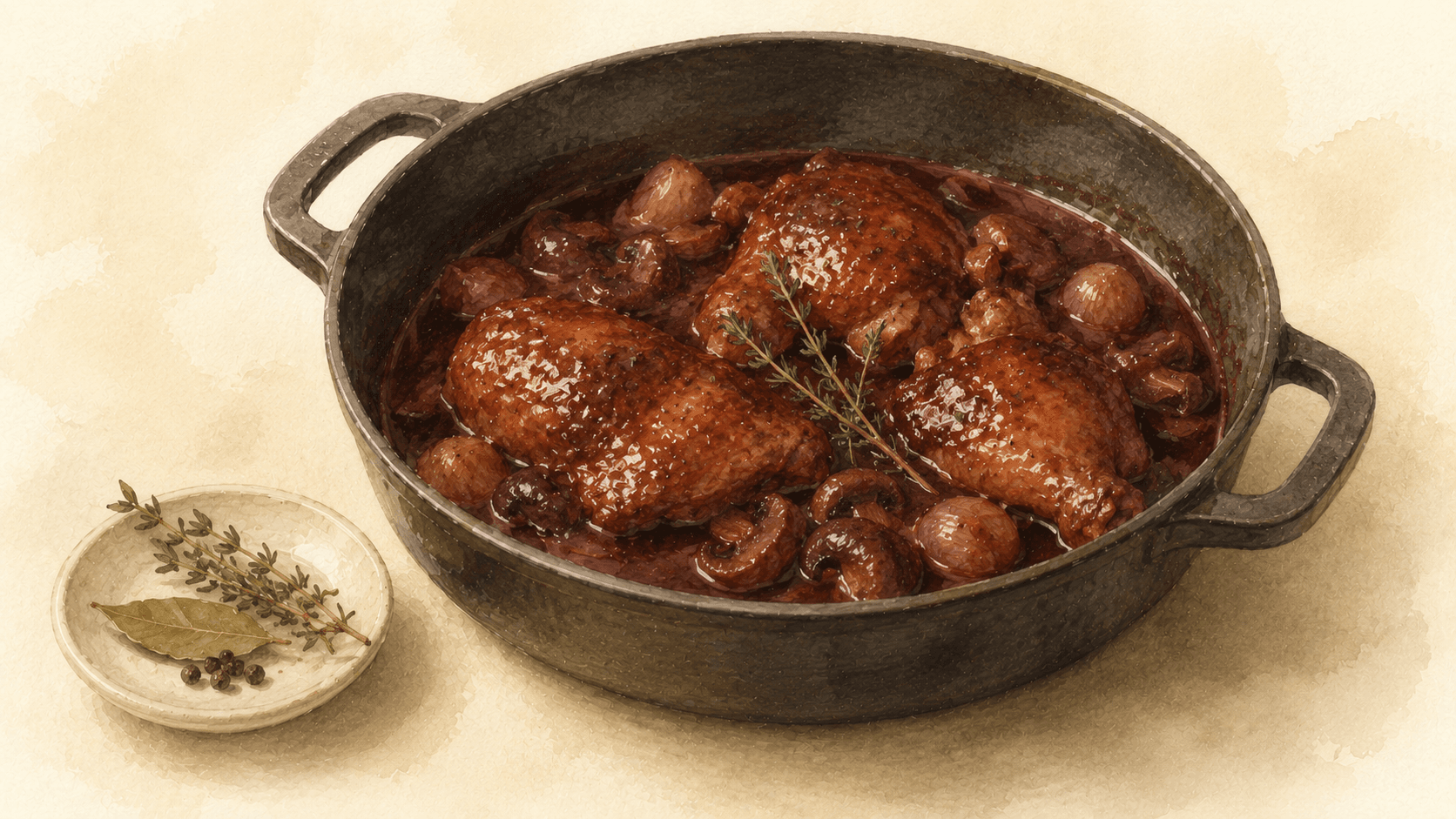
Chicken braised in red wine until the collagen converts to gelatin — a peasant dish formalized by Escoffier that teaches the physics of long, wet heat.
Contents (8 sections)▾
Ingredients
- 1 whole chicken, about 1.5 kg, cut into 8 pieces (or 4 bone-in thighs and 4 drumsticks)
- 750 ml full-bodied red wine (Burgundy, Côtes du Rhône, or any earthy Pinot Noir)
- 150 g lardons (smoked pork belly cut into thick batons) or thick-cut bacon
- 200 g small button or cremini mushrooms, cleaned and halved if large
- 150 g pearl onions, peeled (or shallots, halved)
- 2 medium carrots, cut in 3 cm pieces
- 3 cloves garlic, smashed
- 1 bouquet garni (thyme, bay leaf, parsley stems)
- 2 tbsp tomato paste
- 2 tbsp all-purpose flour
- 30 g unsalted butter
- 2 tbsp neutral oil
- Fine sea salt and black pepper
- Fresh flat-leaf parsley, to finish
Steps
Season the chicken pieces generously all over with salt and pepper. Pat dry with paper towels — moisture on the surface prevents browning. Let rest uncovered for 10 minutes while you prepare the other components.
In a large Dutch oven or heavy-bottomed braising pot, render the lardons over medium heat until the fat is released and they are lightly golden. Remove with a slotted spoon and set aside, leaving the fat in the pot. Add the butter and oil. Brown the chicken pieces skin-side down in batches — do not crowd the pan. The goal is deep mahogany color on the skin, which takes 5–7 minutes per side. Move each piece as it's done and set aside.
In the same fat, sauté the pearl onions until golden, about 5 minutes. Add the garlic and carrots and cook 2 minutes more. Stir in the tomato paste and cook, stirring, for 1 minute until it darkens slightly — this caramelizes the tomato sugars and deepens the sauce color.
Sprinkle the flour over the vegetables and stir to coat. Cook for 1 minute. This creates an in-pan roux that will thicken the braising liquid. Pour in the wine and scrape up the browned bits from the bottom — those are the Maillard residues that give the sauce its depth. Add the bouquet garni. Bring to a simmer.
Return the chicken and lardons to the pot. The liquid should come about two-thirds up the chicken. Partially cover and braise at a gentle simmer — 85–90°C — for 60–75 minutes. The collagen in the chicken joints and connective tissue is converting to gelatin during this time. You'll know it's working when the sauce thickens on its own and the meat pulls away from the bone with light pressure.
In the last 15 minutes, sauté the mushrooms separately in butter over high heat until golden. Add them to the pot for the final 10 minutes. They go in last to avoid them becoming waterlogged.
Remove the bouquet garni. Taste and adjust seasoning. If the sauce is too thin, remove the chicken and reduce the liquid over medium heat for 5–10 minutes. Finish with fresh parsley. Serve with crusty bread, egg noodles, or creamy mashed potatoes.
Tools you'll want
- · Digital kitchen scale (gram precision)
Why this works
Coq au vin is a masterclass in what slow, wet heat does to protein — specifically, to collagen.
Chicken's connective tissue — the silvery sheets around joints, the cartilage at the ends of bones — is made largely of collagen. At temperatures between 70 and 80°C, held for a long time, collagen unwinds from its triple-helix structure and dissolves into gelatin. Gelatin has a remarkable property: it sets into a soft gel when cooled and melts silkily at body temperature. In a braise (slow gentle cooking in liquid), this dissolved gelatin passes directly into the cooking liquid, giving the finished sauce its body, its gloss, and the quality chefs call "mouth-feel" — the way the sauce coats the inside of your mouth and doesn't feel thin or watery.
The wine is not just flavor. Alcohol is a solvent that extracts fat-soluble flavor compounds from the aromatics and carries them into the sauce. Tannins in the red wine bind to muscle proteins and help tenderize the meat over the long cook. The acidity keeps the cooking liquid just below neutral, which affects both the rate of collagen conversion and the eventual flavor balance of the sauce. When you reduce the wine before or during cooking, you are concentrating all three — alcohol, tannins, and acid — along with the aromatic compounds.
The lardons (short thick strips of fatty bacon or pork belly) and the initial browning of the chicken are not optional aesthetics. The Maillard reactions from browning the chicken skin produce hundreds of new flavor compounds — the same class of reactions that makes toast, seared steak, and roasted coffee smell the way they do. Without browning, coq au vin tastes flat: technically a braise, but lacking the depth that makes the dish. The scraped-up browned bits from the pan bottom (the fond) are the most concentrated Maillard residue in the pot, and they dissolve into the wine when it goes in.
The in-pan roux (flour stirred into the vegetables before adding wine) is the sauce's thickening mechanism. Unlike a separate roux, it works its way into the sauce gradually, giving a less starchy, more integrated result than a separately thickened sauce added at the end.
Common mistakes
Boiling instead of braising.
Target: 85–90 °C simmer — bubbles should barely break the surface.
Why it matters: A hard boil toughens muscle fibers before collagen converts to gelatin. The result is meat that's both dry AND surrounded by thin sauce — the worst of both worlds. Slow collagen conversion at 80–90 °C is what gives coq au vin its silken texture.
What to do: Use a heavy-lidded pot. Once the wine simmers, transfer to a 130 °C oven or hold on the lowest possible stovetop burner. Check temperature with a thermometer if you have one.
Workarounds:
- No oven? Use a flame tamer or heat diffuser on the smallest burner.
- Pressure cooker shortcut: 25 minutes at high pressure gives 75 minutes of conventional braise. Loses some flavor complexity but saves 50 minutes.
Skipping the browning.
Target: Deep mahogany color on both sides of each chicken piece, about 4 minutes per side.
Why it matters: Browning produces the Maillard compounds that give coq au vin its depth. Pale chicken in red wine is poached chicken in wine — a different, lesser dish. The browned fond (stuck-on bits) is where 60 % of the final flavor lives.
What to do: Pat chicken dry. Use a wide pan with enough oil. Don't crowd. Don't move the pieces until they release cleanly from the pan.
Workarounds:
- Skin-on, bone-in chicken renders fat and browns best. Skinless chicken thighs work but need a bit more added fat.
- If browning is uneven, finish under the broiler for 2 minutes after braising for surface color.
Using bad wine.
Target: A drinkable Burgundy or Pinot Noir — not necessarily expensive (¥1,500–3,000 range is fine).
Why it matters: Cooking concentrates everything in the wine, including off-flavors. A wine that smells thin and chemical produces a thin, chemical sauce. The cliché "don't cook with wine you wouldn't drink" is literally true.
What to do: Open a second bottle to drink while cooking — same wine, same place of origin. If you can drink a glass, the cook will use a bottle.
Workarounds:
- Stuck with a thin wine? Add 1 tbsp tomato paste + 1 tsp red wine vinegar to deepen the body.
- Coq au vin blanc (white wine version) is regionally legitimate — Alsace style. Use a Riesling if your reds are problematic.
Adding mushrooms too early.
Target: Mushrooms separately browned in butter, added in the final 10 minutes.
Why it matters: Mushrooms are 90 % water. Added at the start, they release that water into the braise, dilute the sauce, and themselves never develop the deep flavor that browning produces.
What to do: While the chicken braises, sauté mushrooms in a separate pan in butter — single layer, high heat, salt only after browning. Add to the braise in the final 10 minutes.
Workarounds:
- For one-pan simplicity, brown the mushrooms BEFORE the chicken (using the same pan), set aside, then proceed.
- Dried porcini reconstituted in water adds depth — use the soaking liquid in the braise.
Under-braising.
Target: 75–90 minutes total braising time. Test: the meat should pull from the bone with gentle pressure.
Why it matters: Collagen conversion is time-dependent — it doesn't speed up with more heat (which would damage the protein). 75 minutes at 85 °C is the minimum window for proper conversion.
What to do: Set a timer for 60 minutes, check at that point, then assess every 15 minutes until done. Resist the urge to crank the heat.
Workarounds:
- Pre-marinating the chicken in red wine for 12–24 hours starts the collagen breakdown before cooking — can shave 15 minutes off the braise time.
- Older birds (the "coq" in coq au vin originally meant a tough rooster) need 2+ hours. Modern chicken needs 75–90 minutes.
Not deglazing properly. (deglazing means pouring in liquid to lift the tasty browned bits stuck to the pan)
Target: Scrape every bit of the brown fond from the pan when the wine goes in.
Why it matters: The browned bits at the pan bottom hold the most concentrated flavor compounds in the entire dish. Leaving them attached is leaving the dish's signature in the pan.
What to do: Use a wooden spoon as soon as the wine starts bubbling. Scrape, scrape, scrape — the fond should fully release before adding any other liquid.
Workarounds:
- Stuck fond? Add the wine cold, then heat gradually — the slow temperature rise loosens stubborn bits more reliably than hot wine.
- A splash of brandy (1 tbsp) added before the wine helps dissolve fond via alcohol's solvent properties.
What to look for
- Chicken skin after browning: deep mahogany, dry, slightly crisped edges. Not pale gold, not burned.
- After 45 minutes of braising: meat pulling slightly from the joint ends. The collagen is converting.
- Sauce at 75 minutes: coats the back of a spoon, darkened and glossy. Gelatin is in the sauce.
- Finished dish: chicken falls from the bone with a fork, sauce has a slight gel quality at room temperature. The braise is done.
Chef's view
The origin story of coq au vin is inseparable from the animal it was designed for: a rooster (coq), not a hen or a broiler. Roosters develop far more connective tissue than egg-laying hens and have a depth of flavor that a young broiler chicken will never match. The long braise was the peasant's solution — a way to render a tough bird edible, while the wine masked the age. By the time Escoffier codified the dish in Le Guide Culinaire (1903), the rooster had largely given way to younger birds, and the technique had been systematized. The physics, though, remain the same as they always were.
My version takes one liberty with the classic: I sear the mushrooms separately, off to the side, rather than cooking them in the braise from the start. This is purely about texture. A mushroom braised for 75 minutes has given everything it has to the sauce and has become essentially a vehicle for the sauce's flavor. A mushroom sautéed hard in butter for 3 minutes and added in the last 10 minutes still has its own texture — a slightly firmer bite in a dish that is otherwise very soft. For a formal dinner, I add both: some braised early for sauce depth, some sautéed at the end for texture contrast.
Chef Test Notes
Tested three wine types: Burgundy (Pinot Noir), Côtes du Rhône (Grenache-dominant), and a generic table wine. The Burgundy produced the most nuanced result, but the Côtes du Rhône was close and a better value proposition. The generic table wine produced a slightly flat, one-dimensional sauce. All three worked technically; the wine quality difference showed in the finishing note.
A note on history
Coq au vin's origins are genuinely peasant. The Burgundy region's farming families had roosters that had outlived their usefulness; the wine was the local currency of flavor; the long cooking was done in whatever heavy pot sat over a wood fire. The dish existed in rough form for centuries before it appeared in any cookbook. The version Escoffier wrote is a formalization, not an invention — he gave names and proportions to something rural France had been doing empirically for generations.
Related glossary terms
- Gelatin — the protein produced when collagen converts under long, moist heat
- Braising — the technique of cooking submerged in liquid at low temperature over time
- Maillard reaction — the browning chemistry that creates depth before the braise begins
- Reduction — what the wine does during the long simmer, concentrating flavor
Get the essays in your inbox — free
Weekly notes on flavor, fermentation, and food history — the writing behind the Atlas of Flavor. No spam; unsubscribe anytime.