
Ratatouille Niçoise
The Niçoise version of ratatouille cooks each vegetable separately before combining, which preserves distinct textures and colors that the common stewed version cannot achieve: the technique difference between the two approaches explains why the dish has a contested identity.
Contents (7 sections)▾
Ingredients
- 1 medium aubergine (about 300 g / 10 oz), cut into 2 cm cubes
- 2 medium zucchini (about 300 g / 10 oz total), cut into 2 cm pieces
- 2 medium red or yellow bell peppers (about 250 g / 9 oz total), cut into 2 cm pieces
- 3 medium tomatoes (about 350 g / 12 oz), seeded and roughly chopped
- 1 medium onion, thinly sliced
- 3 cloves garlic, finely sliced
- Good quality olive oil (about 80–100 ml total, used in stages)
- Fresh thyme, bay leaf, fresh basil to finish
- Salt and black pepper
Steps
Salt the aubergine cubes: toss with 1 tsp salt in a colander and let drain for 20 minutes. Pat dry. This draws out moisture and reduces bitterness. (Zucchini and peppers do not need salting.)
Cook each vegetable separately. Start with the aubergine: heat 3 tbsp olive oil in a wide pan over medium-high heat. Add the aubergine and cook, tossing occasionally, until golden and tender with some caramelized edges — about 8–10 minutes. Season and remove to a bowl. Repeat with the zucchini (5–7 minutes, less oil) and the peppers (7–8 minutes, until softened with some char). Remove each to separate bowls.
In the same pan, reduce heat to medium-low. Add 2 tbsp olive oil and cook the onion slowly until soft and pale gold — about 10 minutes. Add the garlic and cook 1 minute more. Add the tomatoes, thyme, and bay leaf. Season. Cook uncovered, stirring occasionally, for 12–15 minutes until the tomatoes have broken down into a soft, concentrated sauce.
Return the separately cooked aubergine, zucchini, and peppers to the tomato-onion base. Fold gently to combine — do not stir vigorously; you want each vegetable to remain distinct, not meld together. Heat through gently for 5 minutes. Taste and adjust seasoning. Remove bay leaf and thyme stems.
Transfer to a serving dish. Scatter fresh basil over the top. Drizzle with a final pour of good olive oil. Ratatouille Niçoise can be served warm, at room temperature, or cold the next day — it improves with resting.
Tools you'll want
- · Digital kitchen scale (gram precision)
Why this works
Ratatouille Niçoise and the common stewed ratatouille use the same vegetables — aubergine (also called eggplant — the long purple summer vegetable), zucchini, peppers, tomatoes, onion, garlic, olive oil, and Provençal herbs (the rosemary-thyme-savory blend from the south of France). The difference is entirely in method, and that difference produces a completely different result.
In the stew version, all vegetables go into the pot together (or nearly so) and cook as a unit for 30–45 minutes. The vegetables break down, exchange moisture and soluble flavor compounds, and become a unified soft mass. The flavors merge into a whole; the textures converge toward soft. This is a legitimate and delicious version, but it is not Niçoise.
The Niçoise approach (the "Nice-style" method, named for the city of Nice on the French Riviera) cooks each vegetable separately and at its own ideal temperature and duration, then combines them at the end with minimal further cooking. The reasoning is that each vegetable has a different moisture content, different structural integrity, and different ideal cooking endpoint. Aubergine needs the moisture driven out and some caramelization on the surface; zucchini is tender but relatively firm; peppers need softening and a touch of char; tomatoes need the most liquid driven off. In a stew, the fastest-cooking vegetables are overdone by the time the slowest ones reach their optimum. In the Niçoise method, each reaches its optimum independently.
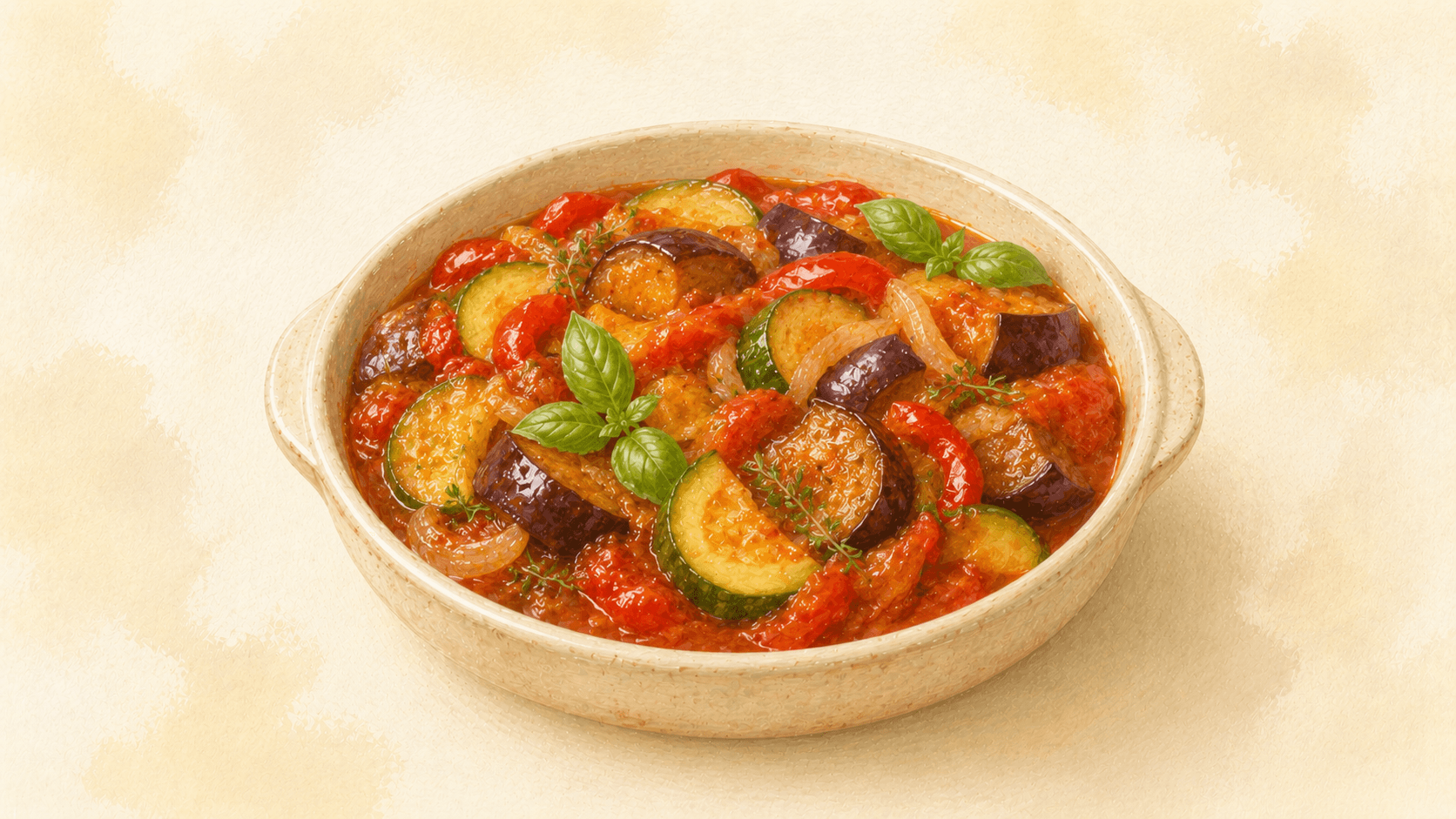
The visual consequence is the most immediately apparent: the Niçoise version retains distinct colors — the green of the zucchini, the red-yellow of the peppers, the purple-brown of the aubergine, the red of the tomato base. The stew becomes a uniform amber-brown as the colors merge. The textural consequence is equally significant: each vegetable in the Niçoise version can be identified by texture in the mouth, while the stew is uniformly soft.
Neither version is "authentic" in the sense of being the original or the only correct form — the traditional home cooking of Nice has included both approaches for generations. But the Niçoise name is specifically associated with the method of separate cooking and careful assembly.
Common mistakes
Skipping the aubergine salting.
Target: Toss diced aubergine with 1 tsp kosher salt per medium aubergine, rest 30 minutes, blot dry.
Why it matters: Aubergine vacuoles are full of water and bitter solanine-family alkaloids. Salt draws both out through osmosis, partly collapsing the cellular structure. An unsalted aubergine in a pan absorbs 2–3× more oil and can stay bitter.
What to do: Salt, drain, blot — don't rinse (you'd undo the dehydration).
Workarounds:
- No time? Microwave the diced aubergine for 4–5 minutes uncovered — pulls water out via direct heat.
- For oil-light versions, roast the salted aubergine on a sheet pan at 220 °C for 20 minutes instead of pan-frying.
Combining the vegetables too early.
Target: Each vegetable separately sautéed to its target doneness, then folded together for the last 3–5 minutes only.
Why it matters: This is the entire point of the Niçoise-style ratatouille. Water release rates differ wildly — aubergine, zucchini, peppers, and tomatoes all cook to different schedules. Combining them all in one pan from the start produces the muddy stew Provençal cooks specifically want to avoid.
What to do: Have all vegetables prepped before you start. Cook each in batches in the same pan, transferring to a holding bowl. Combine at the very end.
Workarounds:
- One-pan version: cook in order of resilience — aubergine first (longest), then peppers, zucchini, then tomato/onion. Stagger by 5-minute intervals.
- Sheet-pan version: roast aubergine, zucchini, peppers separately on different trays (different temperatures), then combine.
Under-reducing the tomato base.
Target: Tomato base cooked down by 50 % from raw volume — soft, sweet, slightly jammy texture.
Why it matters: The tomato base provides the sauce that ties everything together. Under-reduced, it adds water that dilutes the carefully-developed texture of the separate-cooked vegetables — the dish goes from "Provençal stew" to "watery vegetable mix."
What to do: Reduce the tomato to a thick, glossy state before combining with the other vegetables. You should be able to drag a wooden spoon through it and see the bottom of the pan briefly.
Workarounds:
- For deeper flavor without long reduction, use canned San Marzano tomatoes (lower water content than fresh).
- Stuck with watery tomatoes? Add 1 tbsp tomato paste to fast-track concentration.
Over-crowding the pan.
Target: Single layer with at least 1 cm spacing between pieces.
Why it matters: Each vegetable needs to brown (Maillard), not steam. A crowded pan drops the temperature and steam from one vegetable saturates the surface of others.
What to do: Use the widest pan you own. Cook in 2–3 batches if necessary.
Workarounds:
- Sheet-pan roast at 220 °C — gives you 4× the surface area of a frying pan.
- Two pans on two burners simultaneously if you have them.
Vigorous stirring at the combination stage.
Target: Fold gently with a silicone spatula, 5–8 strokes maximum, just enough to distribute.
Why it matters: The separately-cooked vegetables are already tender. Aggressive stirring breaks the cubes into the very mush you spent the previous 40 minutes avoiding.
What to do: Treat the combination like a salad. Fold, don't stir.
Workarounds:
- For service: combine on the plate, not in the pan — even gentler.
- Layered presentation (alternating colors on the plate) is the restaurant trick that avoids stirring entirely.
What to look for
- Aubergine, after cooking: golden edges with some caramelization, fully tender throughout, not mushy. Should hold its cube shape.
- Zucchini, after cooking: lightly golden, still has structural integrity. Should have a slight bite remaining.
- Peppers, after cooking: softened, slight char at edges, sweetness concentrated. No longer raw-crunchy.
- Tomato base: thick, concentrated, jammy texture. No visible standing liquid in the pan.
- Combined dish: distinct vegetable pieces visible and identifiable; each retaining its color. Not a uniform mush.
Chef's view
The famous Pixar film Ratatouille (2007) depicts neither the stew nor the strictly Niçoise version — the film's dish is a confit byaldi (a fine-dining preparation where each vegetable is sliced very thin and arranged in overlapping rings before baking), a carefully layered baked preparation developed by chef Michel Guérard and later adapted by Thomas Keller and his team. The confit byaldi is a third distinct preparation, visually beautiful and technically demanding, made by thinly sliced vegetables baked slowly in the oven over a pipérade base. The Niçoise method covered here is the traditional home version; the confit byaldi is a restaurant technique.
The question of whether to serve ratatouille warm, at room temperature, or cold is answered by the physics of olive oil. Olive oil, which is the cooking and finishing fat throughout, solidifies slightly below room temperature and becomes opaque and waxy. At room temperature and warm, it flows and coats the vegetables. At refrigerator temperature, it loses this quality. My view: serve warm or at room temperature; if storing in the fridge, allow 30–40 minutes to come to room temperature before serving.
The next-day ratatouille is often said to be better than the freshly made version, and this is structurally true: overnight, the separate vegetables exchange some flavor compounds through the tomato base, moving slightly toward a unified whole without losing their individual texture. The balance point between "unified" and "distinct" is actually at its best on day two.
Chef Test Notes
I made both the stew version and this Niçoise version side by side from the same ingredient batch. The stew took about 30 minutes total and produced a soft, fully unified dish with a complex but single-note flavor. The Niçoise version took 80 minutes total and produced a visually and texturally distinct result — each vegetable identifiable, each contributing its specific character. Tasted cold the next day, the Niçoise version had closed the gap slightly on unified flavor, but retained its textural character. The stew was unchanged. Both are worth knowing.
Related glossary terms
- Caramelization — the browning reaction that gives the separately cooked vegetables their depth
- Sautéing — the dry-heat cooking method used for the separate vegetable stages
- Reduction — the principle behind cooking down the tomato base to a concentrated sauce
Get the essays in your inbox — free
Weekly notes on flavor, fermentation, and food history — the writing behind the Atlas of Flavor. No spam; unsubscribe anytime.