
Glazed Carrots
Butter, sugar, and water reduce around the carrots until the liquid forms a glaze: the Vichy method is a wet-heat technique that produces tenderness and sheen in the same pan, and it is fundamentally different from the dry heat of roasting.
Contents (7 sections)▾
Ingredients
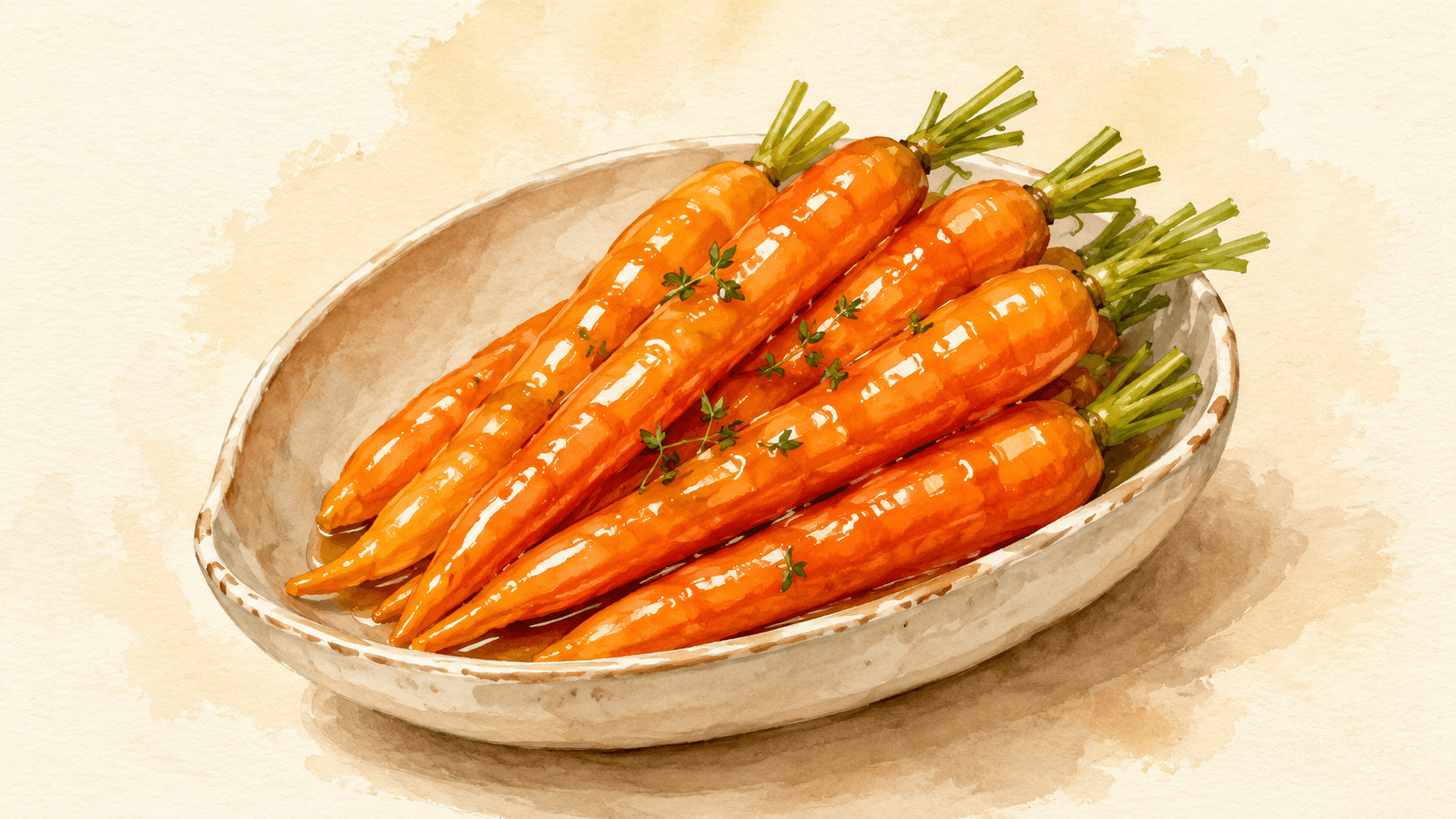
- 500 g carrots (about 1 lb), peeled and cut into rounds 5 mm thick or turned into tournées
- 30 g unsalted butter (2 tbsp)
- 10 g sugar (2 tsp) — or up to 15 g for a sweeter glaze
- 200 ml water (just enough to come about halfway up the carrots)
- 3 g fine sea salt (1/2 tsp)
- Fresh thyme or flat-leaf parsley to finish (optional)
Steps
Place the carrots in a wide sauté pan in a single layer — crowding traps steam and prevents glazing. Add butter, sugar, salt, and enough water to reach halfway up the carrots. The exact amount of water matters less than the principle: you want enough liquid to cook the carrots through, but not so much that there is a large surplus to reduce.
Bring to a boil over medium-high heat, then reduce to a steady simmer. Cook uncovered, adjusting heat as needed to maintain active reduction. The carrots will poach gently while the water reduces. After 12–15 minutes, test a carrot with a thin knife — it should slide through with slight resistance, not mush.
Once the carrots are nearly tender, increase the heat to medium-high. The remaining water will evaporate quickly now; the butter and sugar will begin to coat the carrots in a glossy film. Shake the pan gently and toss occasionally — this distributes the glaze as it thickens. Watch closely: the window between 'glossy glaze' and 'burnt sugar' is about 60–90 seconds.
When the pan bottom shows only a thin sheen of butter-sugar film and the carrots are fully coated and shining, remove from heat. Check seasoning, add a small extra knob of butter off the heat for shine if desired, and scatter parsley or thyme. Serve immediately — the glaze sets as it cools.
Tools you'll want
- · Digital kitchen scale (gram precision)
Why this works
Glazed carrots in the French style — carottes glacées à la Vichy — are built on a single elegant principle: you cook the vegetable and make its sauce in the same pan at the same time. Water conducts heat gently around the carrots, cooking them from the outside in without the drying effect of dry heat. As the water evaporates, the dissolved butter and sugar concentrate until they form a thin, transparent glaze (a glossy, syrup-like coating that clings to the food) that coats each piece. The result is a carrot that is fully tender throughout, uniformly shiny, and seasoned all the way through.
The contrast with roasted carrots is instructive. Roasting uses dry heat — high oven temperatures (200°C+) drive off surface moisture rapidly, encouraging caramelization and Maillard reactions at the exterior while the interior steams in its own moisture. The result is concentrated, lightly charred sweetness with varied texture (slightly crisped outside, soft inside). The glazing method is the opposite: low-to-medium moist heat, no exterior browning, uniform texture throughout, with the sweetness coming from concentration rather than pyrolysis.
The sugar in the glaze plays a chemical role beyond sweetness. As the water reduces, sucrose concentrates in the pan and eventually undergoes partial hydrolysis into glucose and fructose in the residual heat and slight acidity. These smaller sugars have a higher hygroscopic tendency — they hold onto remaining moisture and produce the glossy, transparent film that gives the carrots their characteristic shine. A glazed carrot without any added sugar is possible, but the natural sugars in the carrot alone rarely concentrate enough to produce the same visual and textural effect.
The butter provides both flavor and glaze stability. Milk solids in the butter bind with the sugar solution and help create a coating rather than a mere liquid drip. This is structurally similar to the finishing butter (monter au beurre) in French sauces — the fat stabilizes the water-based film around each piece of food.
Common mistakes
Too much water at start.
Target: Water reaching only halfway up the carrots — not covering them.
Why it matters: Too much water = reduction takes too long = carrots overcook before glaze forms. Halfway-water is the perfect amount to cook AND reduce simultaneously.
What to do: Pour water carefully. Adjust for next time based on pan size and carrot quantity.
Workarounds:
- Too much water added? Drain off excess after first 5 minutes of cooking.
Covering the pan.
Target: Uncovered throughout the entire cook. Evaporation is the technique.
Why it matters: Covered pan traps steam → carrots cook in wet heat without reduction → no glaze. The dish depends on the water evaporating to leave behind concentrated butter-sugar coating.
What to do: Lid stays off. Watch the level reduce.
Workarounds:
- For uniform cooking, gently swirl the pan every 2 minutes — alternative to stirring.
Crowding the carrots.
Target: Single layer in a wide pan. No overlapping pieces.
Why it matters: Overlapping pieces trap steam between them → uneven cooking and patchy glaze. Single layer ensures uniform exposure to heat and reduction.
What to do: Use a wide pan (28 cm+) appropriate for the quantity.
Workarounds:
- Large batch → cook in waves rather than crowding.
Walking away during glaze phase.
Target: Constant attention in the final 2 minutes — gentle tossing as the glaze forms.
Why it matters: Transition from "glaze forming" to "burnt caramel" is under 2 minutes at high heat. Inattention destroys the dish.
What to do: Stay at the stove. Toss gently with a wooden spoon.
Workarounds:
- For more margin, reduce heat to medium-low for the final glaze phase.
Glaze cools in the pan.
Target: Serve immediately after glazing.
Why it matters: Glaze sets as carrots cool — they fuse together and lose the glossy coating. Reheating in water can revive but the first glaze is best.
What to do: Time the dish to coincide with service.
Workarounds:
- Hold briefly → keep on lowest heat with a splash of water + butter.
Under-salting.
Target: Salt in the cooking liquid — about 1/2 tsp per 500 g carrots.
Why it matters: Without sufficient salt, the sweetness reads one-dimensional. Salt in the cooking liquid seasons throughout.
What to do: Salt at the start. Taste at the end and adjust.
Workarounds:
- For deeper flavor, finish with flaky sea salt at serving — bright punctuation.
What to look for
- At the start: water, butter, and sugar bubbling around the carrots. The liquid should be actively simmering, not boiling hard.
- Mid-cook: carrots showing slight translucency at the edges. A knife tip meets gentle resistance — not crunchy, not collapsing.
- Glaze forming: the liquid in the pan has reduced to a syrupy film; the carrots are picking up a visible sheen. Shake the pan to distribute.
- Done: each carrot coated in a thin transparent glaze; the pan bottom shows only a butter-sugar smear with no pooled liquid. Color: deep orange with an amber glaze, not pale.
Chef's view
The Vichy name comes from the mineral water of Vichy, France — the classical recipe specifies using Vichy water (lightly sparkling, slightly alkaline) in place of plain water, on the theory that its mineral content produces a better glaze. In practice, good tap water or still mineral water works well. The mineral content of Vichy water softens the carrots slightly faster because the dissolved minerals affect pectin hydrolysis, but the difference is marginal and the technique is the same.
The cut matters for more than aesthetics. Uniform thickness is essential — if some pieces are twice as thick as others, they cook at different rates and the thin ones will be over-glazed and potentially burnt before the thick ones are tender. A mandoline set to 5 mm, or careful knife work, is more than cosmetic precision.
The classical French version uses baby carrots (carottes nouvelles) turned into barrel-shaped tournées — seven-sided olive shapes about 4–5 cm long. This produces the most elegant presentation and is what you find in a restaurant kitchen. For home cooking, rounds cut evenly on a slight bias achieve nearly the same result without the laborious turning.
Chef Test Notes
I tested the sugar level across three batches: 10 g (the recipe), 0 g (no added sugar), and 20 g. The no-sugar version glazed, but the coating was thin and slightly dull — the carrot's natural sugars produced some shine but not enough body. At 20 g the glaze was noticeably sweeter and moved toward a confection register rather than a savory side dish. The 10 g balance is right — enough to produce the glossy film, not enough to make the dish feel sweet.
Related glossary terms
- Reduction — the mechanism that concentrates the cooking liquid into a glaze
- Caramelization — the transformation the residual sugars undergo in the final high-heat stage
- Braising — the wet-heat cooking principle the Vichy method belongs to
Get the essays in your inbox — free
Weekly notes on flavor, fermentation, and food history — the writing behind the Atlas of Flavor. No spam; unsubscribe anytime.