
Nukazuke-style Pickles
Vegetables fermented in a rice bran bed — a quick fridge version (3–7 days) that captures the lactic acid fermentation of the traditional nukadoko without the year-long cultivation.
Contents (9 sections)▾
Ingredients
- 500 g rice bran (nuka — fresh or roasted; fresh has more active microbes)
- 50 g fine sea salt (10% of bran weight)
- 400–450 ml water (enough to bring bran to a miso-paste consistency)
- 10 g kombu, cut into small pieces
- 10 g dried shiitake, whole or crumbled
- 5 g dried chili pepper (togarashi), 1–2 whole
- ---
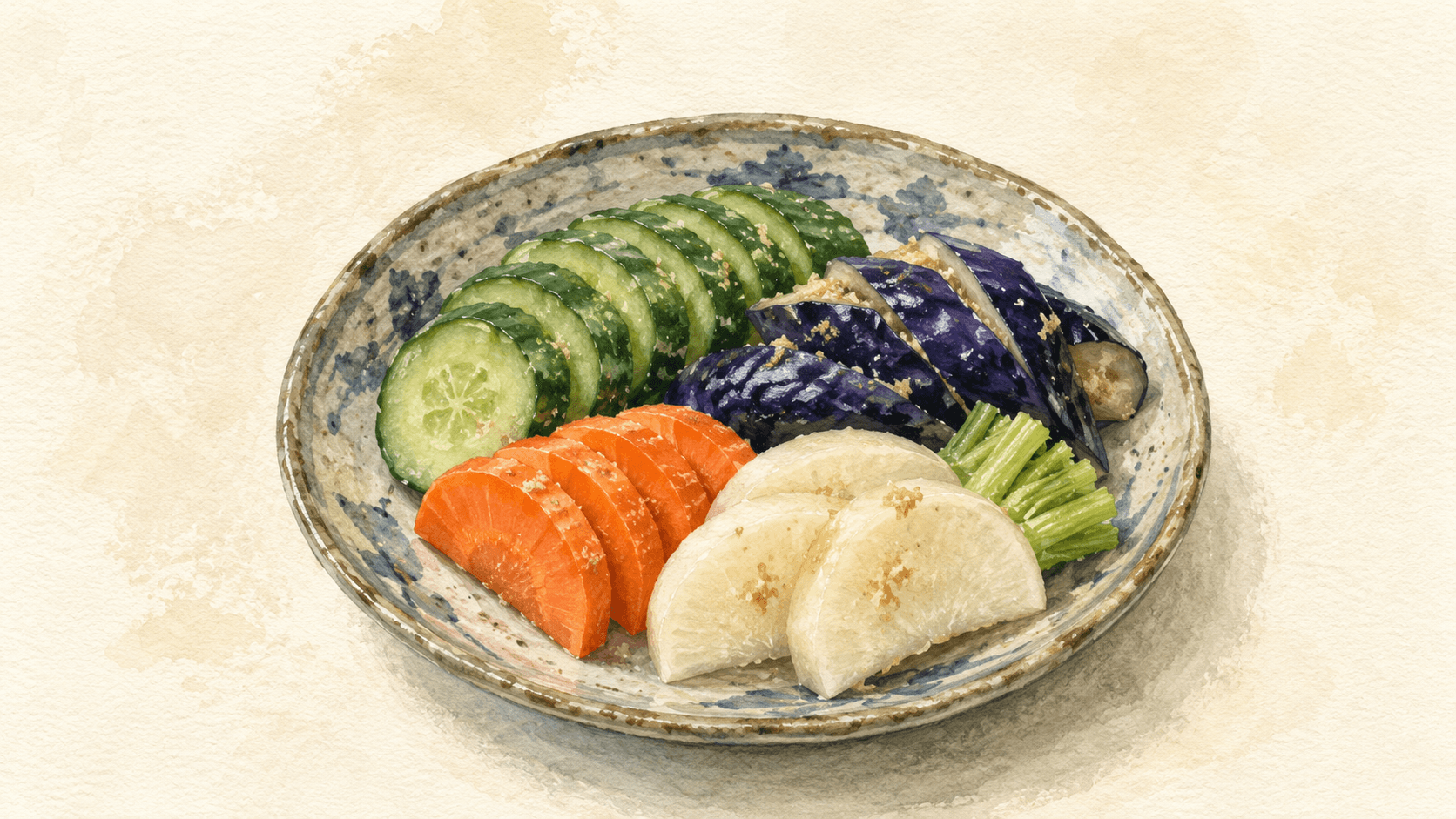
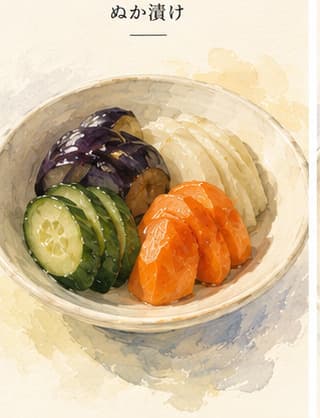
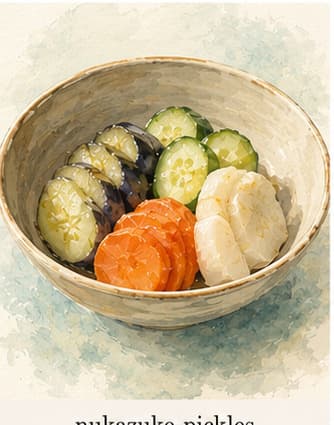
- Vegetables to pickle (choose any): cucumber (halved), daikon (quarter-sliced), carrot (quarter-sliced), turnip (halved), cabbage (wedges), eggplant (halved and salted first)
Steps
Build the nukadoko (bran bed): Combine the rice bran and salt in a deep container — a clean ceramic or plastic tub, at least 2 liters. Add water gradually, mixing with your hands until the mixture resembles a stiff but pliable miso paste. It should hold its shape when squeezed but not crumble. Tuck in the kombu, shiitake, and chili. These add umami, complexity, and act as natural preservatives.
Conditioning: Before pickling, the bed needs to develop its microbial population. At room temperature, this would take 1–2 weeks of daily turning (turning introduces oxygen and prevents harmful anaerobic bacteria). For a fridge version: keep at 4–6°C and turn every 2 days for the first week before pickling in it. This is slower but more controllable. Alternatively, add 2 tbsp of well-established nukadoko from a friend or a commercial starter to accelerate colonization.
Prepare the vegetables: wash and dry thoroughly — surface moisture introduces unwanted bacteria. Rub cucumber and other thin-skinned vegetables with a pinch of salt and let sit 5 minutes to start the initial dehydration. Do not rinse; the residual salt is part of the pickling chemistry.
Bury the vegetables completely in the bran bed, pressing them in firmly. There should be no exposed vegetable surface. Smooth the top of the bed. Cover the container (not airtight — the bed needs to breathe slightly) and refrigerate.
Pickling times (fridge, 4–6°C): cucumber — 6–12 hours for light, 1–2 days for deeper flavor; daikon — 1–3 days; carrot — 2–4 days; turnip — 1–2 days; eggplant — 8–16 hours. Remove vegetables, rinse off the bran, slice, and serve. Return the bran to the container, stir it, and refrigerate for next use. Turn the bed (stir from the bottom up) every 2–3 days.
Tools you'll want
- · Digital kitchen scale (gram precision)
Why this works
Nukazuke is built on lactic acid fermentation (the process where bacteria turn sugars into a mild acid that both preserves and flavors the food) — the same biological process behind yogurt, kimchi, and sourdough bread. The rice bran bed (nukadoko) is a microbial ecosystem: naturally occurring lactobacillus bacteria, fed by the starches and sugars in the bran (nuka — the brown husk layer removed when polishing rice), produce lactic acid as a metabolic byproduct. That lactic acid is what pickles the vegetables, gives them their characteristic sour depth, and preserves them safely.
Salt is the regulator. At 8–12% of the bran weight, salt creates an environment selective for lactobacilli — bacteria that thrive under salty, slightly acidic conditions — while suppressing most pathogens and molds. Too little salt and the ferment goes wrong (soft, slimy vegetables; foul smells). Too much and the microbial activity slows to a halt and you have salted but not fermented vegetables.
The vegetables contribute back to the bed. As they release moisture through osmosis, they carry their own microbial populations and sugars into the nukadoko. A long-maintained bed builds flavor complexity over months and years — the composition of the microbial community shifts, the kombu and shiitake decompose slightly and deepen the umami character, and the whole system develops what Japanese cooks describe as the bed's aji (taste, personality). A three-day-old bed produces pleasant, fresh-tasting pickles. A three-year-old bed produces something with far more character.
The fridge version in this recipe sacrifices some of that character for controllability. Fermentation at 4–6°C is 5–10 times slower than at room temperature, which means the lactic acid accumulates slowly, the vegetables absorb flavor gradually, and the risk of the bed going wrong is lower. The result is still genuinely fermented — lactic acid bacteria are active even at low temperatures — but the flavor is cleaner and less complex than a traditionally maintained bed.
Turning the bed is not optional maintenance. It introduces oxygen to the top layer, which inhibits anaerobic bacteria (including the ones responsible for off-smells and sliminess) and redistributes the salt and microbes evenly. A neglected bed develops a distinctive unpleasant smell from anaerobic activity at depth. Stir from the bottom up, twice weekly minimum.
Common mistakes
Wet vegetables.
Target: Completely dry vegetables before burying — wash, then pat thoroughly.
Why it matters: Surface moisture introduces uncontrolled bacteria — can disrupt the lactic bacteria balance, leading to off-smells or slime.
What to do: Dry on rack 10 min after washing. Pat with clean towel.
Workarounds:
- Want fastest dry → fan briefly or use a salad spinner.
Insufficient salt.
Target: 10-12% salt by bran weight — non-negotiable lower limit.
Why it matters: Salt selects for lactobacilli and suppresses pathogens/molds. Under-salted bed develops pink/gray layers, ammonia-like smell.
What to do: Measure salt by weight. Salt is for safety + flavor selection, not just taste.
Workarounds:
- Bed went off → add salt + stir thoroughly; bury eggplant 2-3 days without other vegetables.
Airtight sealing.
Target: Loose lid or cloth cover — gas exchange essential.
Why it matters: Sealed airtight = anaerobic bacteria dominate (responsible for off-smells, slime). The bed needs CO2 out, trace O2 in.
What to do: Loose-fitting wooden or plastic lid, or breathable cloth.
Workarounds:
- Worried about smells in fridge → cloth + loose lid; still allows gas exchange.
Over-pickling.
Target: Short side of suggested time for first few rounds (cucumber 12 hr, daikon 1-2 days).
Why it matters: Long burial = too salty, soft texture. Each bed has its own rhythm; over-pickling is the most common beginner mistake.
What to do: Set timer, test early. Pull while still slightly firm; flavor develops on the plate too.
Workarounds:
- Over-pickled → rinse briefly in cold water before eating; takes the edge off saltiness.
Not turning regularly.
Target: Stir bottom-to-top every 2-3 days in fridge, daily at room temp.
Why it matters: Stagnant bed develops anaerobic pockets — bad smells and texture issues. Stirring redistributes microbes and oxygen.
What to do: Clean hands (or clean gloves), reach to the bottom and turn the bed completely.
Workarounds:
- Frequent neglect → set a calendar reminder; missed stirrings are the #1 beginner failure.
Discarding a "bad" bed too soon.
Target: Try to recover before discarding — most off-bed states are fixable.
Why it matters: A bed represents weeks of microbial development. Most "bad" beds (slight smells, surface film) are recoverable with intervention.
What to do: Add salt + stir thoroughly + bury eggplant + 2-3 days rest without new vegetables.
Workarounds:
- Truly inedible (rotting smell, visible mold colonies) → discard and start fresh.
What to look for
- Fresh bed: miso-paste consistency, slightly salty and bran-sweet smell. Not wet, not powdery.
- After 1 week in fridge: slightly more complex smell, a hint of sourness. Fermentation is beginning.
- Pickled cucumber after 12 hours: slight give, starting to look slightly translucent at the surface. Osmosis is working.
- Pickled daikon after 2 days: pale, slightly translucent, faint sour smell. Ready to eat.
- The bed over time: deepening smell, slightly darker color. The microbial ecosystem is developing.
Substitutions
- Cucumber → daikon, carrot, eggplant, turnip, cabbage, or napa. Soft vegetables (cucumber, eggplant) need 6–12 hours; hard vegetables (daikon, carrot) need 12–24.
- Salt content of the nuka bed → no substitution. The salt percentage is what suppresses spoilage organisms. Don't reduce it for "healthier" pickles.
- Rice bran (nuka) → wheat bran in a pinch. Works but produces a different, less rounded flavor. Stick to rice bran for the real article.
- Yeast / lactic starter → none needed. The bed self-inoculates from the air and the vegetables. Patience does the work.
Make-ahead and storage
- The nuka bed is a live preparation. Stir daily — twice in summer — to keep the surface alternating between oxygen-exposed and submerged. A bed left unstirred surfaces yeast in 2–3 days.
- Refrigerate the whole bed during heat waves (above 28 °C ambient) and when traveling for more than 2 days. Cold slows the fermentation but does not stop it.
- Pickled vegetables themselves: refrigerate after removing from the bed; eat within 3 days. Surface mold growth is real and means the batch is over.
- Discard the bed if you see colored mold (red, green, black), if the smell turns sharply ammoniac, or if you see slimy strings. The salt cure is reliable but not absolute; when in doubt, discard the bed and start fresh.
- A note on shelf life. A well-tended bed lasts years. A neglected one fails in weeks. The bed is what you take care of; the pickles are the bed's report card.
Chef's view
The traditional nukadoko is one of the few food preparations where the cook is genuinely tending a living system rather than applying a technique. A well-maintained bed might live for decades — some beds in Japan are reportedly hundreds of years old, with microbial cultures passed down across generations. The daily turning, the burying and retrieving, the small adjustments of salt and water: these are the maintenance of an ecosystem, not the following of a recipe.
The fridge adaptation here is not the same thing. It is a sincere approximation — genuinely fermented, usable immediately, significantly less demanding to maintain. I recommend it as a starting point, particularly for cooks who want to understand what lactic acid fermentation produces without committing to a room-temperature bed requiring daily attention. Once you have tasted the pickles from a week-old fridge bed, you may find yourself curious about what a well-maintained traditional bed would taste like. That is the intended direction of travel.
The kombu (a thick dried kelp that gives Japanese broth its savory backbone) and shiitake in the bed are not decoration. Kombu releases glutamic acid (the free amino acid behind umami flavor) gradually, and that free glutamate deepens the flavor of everything pickled in the bed. Shiitake contributes guanylic acid — a different umami compound that synergizes with glutamate. The chili is a mild preservative and adds background heat. Over time, these components become part of the bed's character.
Chef Test Notes
Tested two beds in parallel for 3 weeks: one with only salt and nuka (control), one with kombu, shiitake, and chili additions. By week two the kombu/shiitake bed produced noticeably more complex pickles — more umami depth, a rounder finish. The control bed pickles were clean and pleasant but simpler. Both were good; the umami additions are worth including from the start.
Related glossary terms
- Fermentation — the metabolic process by which lactobacilli produce lactic acid in the bran bed
- Umami — the savory depth contributed by kombu and shiitake in the bed, and by the lactic acid itself
- Tsukemono — the broad category of Japanese pickles, of which nukazuke is one of the most complex methods
Get the essays in your inbox — free
Weekly notes on flavor, fermentation, and food history — the writing behind the Atlas of Flavor. No spam; unsubscribe anytime.