
Nikujaga
Beef, potato, and onion simmered in dashi, soy sauce, mirin, and sugar. The sweetness balance — soy and sugar in 1:1 proportion — is the defining variable.
Contents (7 sections)▾
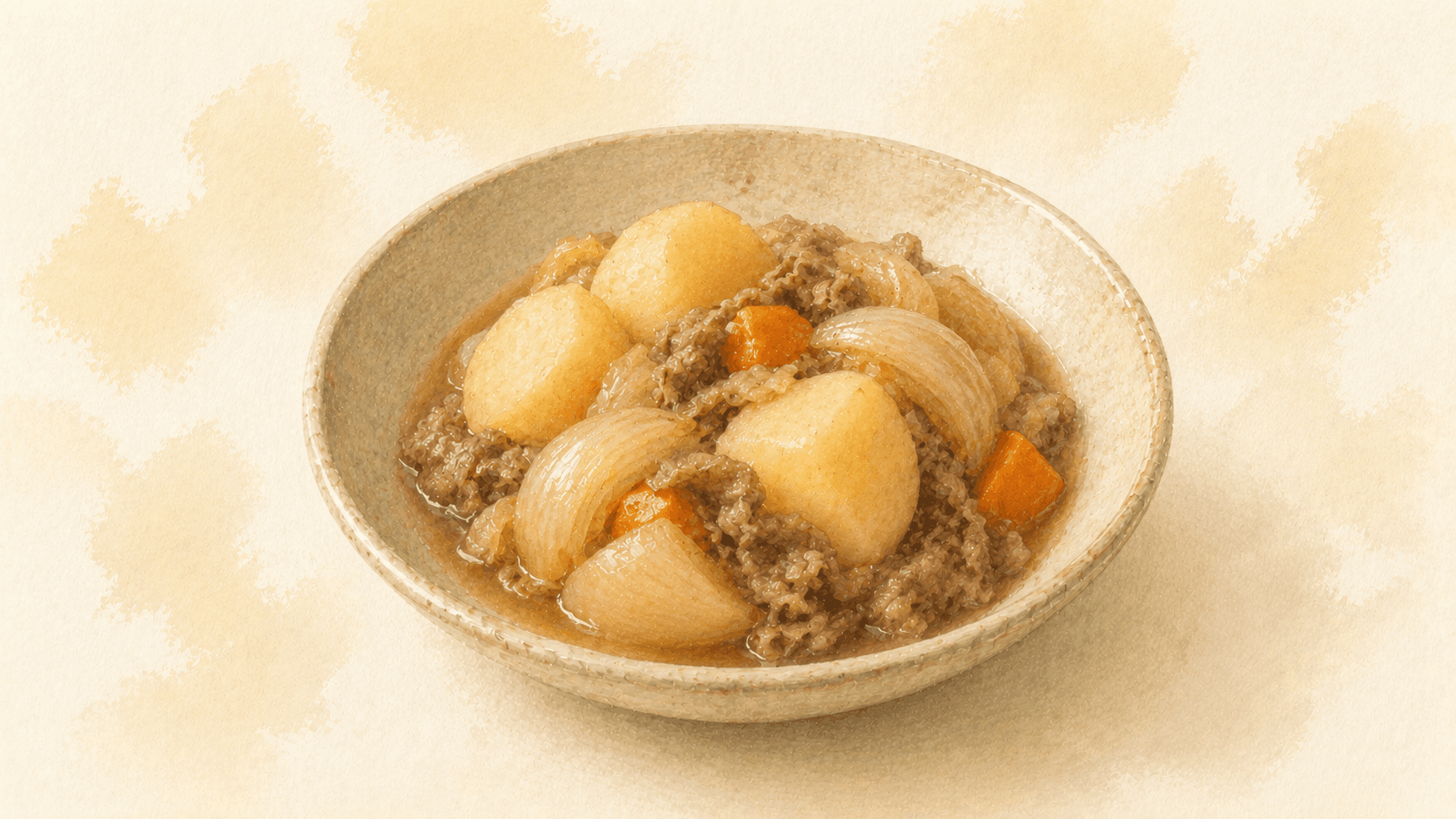
Ingredients
- 300 g thinly sliced beef (sukiyaki cut, about 10 oz) — or thinly sliced pork
- 400 g waxy potatoes, peeled and cut into large chunks (approx. 14 oz)
- 1 large onion, about 200 g — cut through the root into 8 wedges
- 200 ml dashi (kombu + katsuobushi, or instant)
- 3 tbsp soy sauce (about 45 ml)
- 3 tbsp mirin (about 45 ml)
- 2 tbsp sake (about 30 ml)
- 1.5 tbsp sugar (about 20 g)
- 1 tbsp neutral oil
- 50 g snow peas or sugar snap peas — blanched, to finish
- 100 g shirataki noodles (optional — traditional addition)
Steps
Heat the oil in a medium heavy pot over medium-high heat. Add the beef in a loose layer — do not crowd. Stir briefly, 30–60 seconds, until just no longer pink. You are not browning deeply; this is a light sear to add a little browned flavor and render some fat. Remove the beef and set aside.
In the same pot over medium heat, add the onion wedges cut-side down. Cook 2–3 minutes without moving until the cut faces are lightly golden. This short caramelization adds sweetness and depth to the broth.
Add the potato chunks and stir to coat in the oil. Add the dashi, soy sauce, mirin, sake, and sugar. Stir gently to combine. The liquid should come about halfway up the vegetables — add a little water if needed.
Bring to a gentle simmer, then add back the beef (and shirataki, if using). Cover with a drop lid (otoshibuta) or a small plate that sits directly on the food. This keeps the ingredients submerged in the shallow liquid and prevents the potatoes from breaking. Simmer over low heat for 20–25 minutes.
Check the potatoes by pressing with a chopstick — they should yield with no resistance. Taste the broth: it should be sweet and savory in balance, deeply colored. If it tastes sharp, simmer 2–3 more minutes uncovered to mellow. Add the blanched snow peas, stir gently once, and serve.
Tools you'll want
- · Digital kitchen scale (gram precision)
Why this works
Nikujaga is a canonical Japanese nimono (simmered dish) — and it is also a lesson in flavor layering with dashi (Japanese stock made from kombu and bonito flakes), soy, mirin (a sweet rice wine used to add gloss and gentle sweetness), and sugar, the four-element system that underlies most Japanese cooking.
The sweetness balance is the central variable. Mirin and sugar both add sweetness, but they are not interchangeable. Mirin is a fermented rice-wine sweetener with residual amino acids and a slightly viscous body — it contributes gloss and a layered sweetness with a low off-note. Sugar adds direct sucrose sweetness and also drives Maillard browning at higher temperatures. In nikujaga, both are present: the mirin rounds the broth while the sugar deepens it. A dish made with only mirin will taste light and delicate; only sugar will taste blunt and sharp. The combination gives the broth its characteristic body.
The dashi underneath all of it is doing more than adding moisture. Dashi is glutamate-rich — from both the kombu and the katsuobushi — and glutamate amplifies the perception of savory flavors through umami. The soy sauce adds its own glutamate load. Together, the dashi and soy create a broth that tastes much deeper than its components suggest.
The otoshibuta — drop lid (a small inner lid that rests directly on the food to press it down into the simmering liquid) — is the practical secret of most Japanese nimono. It keeps a small volume of liquid in contact with the surface of each ingredient by gentle pressure, without the agitation of a bubbling full boil. The potatoes simmer evenly, absorb the broth as they cook, and stay in large pieces rather than breaking apart.
Common mistakes
Boiling rather than simmering.
Target: Bare simmer — you should hear it murmuring, see barely any bubbles. About 85 °C.
Why it matters: A hard boil breaks the potato cells into starch clouds (cloudy broth) and toughens the thin beef into stringy fibers. Both errors are irreversible.
What to do: Once the broth comes to a boil, immediately drop heat to the lowest setting. Use a heat diffuser if your stove won't go low enough.
Workarounds:
- Already cloudy? You can't fully recover, but pulling fully cooked potato out and reducing the broth uncovered may concentrate flavor.
- For dinner-party staging, transfer to a 130 °C oven after the initial boil — most stable temperature control.
Skipping the otoshibuta (drop lid).
Target: Use a wooden, silicone, or improvised foil drop lid that sits directly on the ingredients.
Why it matters: Nikujaga uses a thin layer of liquid — only enough to come halfway up the potatoes. Without the drop lid, the top of the ingredients dry out and the broth needs to be doubled, diluting the flavor. The drop lid keeps everything in liquid contact without stirring.
What to do: Cut a parchment circle slightly smaller than the pot, with a small hole in the center to release steam. Lay directly on top of the ingredients.
Workarounds:
- No drop lid? A small ceramic plate that fits inside the pot works.
- "Foil drop lid": tear off a sheet of aluminum foil, crumple, smooth out, fit to pot.
Adding all the beef at the start.
Target: Brief sear at the start (1 minute), remove, return for the last 5 minutes of cooking.
Why it matters: Beef sliced thin for nikujaga (about 2 mm) is fully cooked in 60 seconds of contact with broth. 30 minutes of simmering makes it tough, dry, and flavor-leached.
What to do: Sear → remove → cook vegetables → add beef back at the midpoint or end → cook 5 minutes more.
Workarounds:
- For deep-flavored beef, marinate the seared beef in 1 tbsp soy sauce + 1 tsp mirin while the vegetables cook — pre-seasons it.
Under-seasoning the broth.
Target: Broth tastes ASSERTIVELY sweet-savory when sampled alone — it will mellow when combined with the neutral potatoes.
Why it matters: Potatoes absorb seasoning. A broth that tastes "right" in the pot will taste bland once it's diluted by the volume of potatoes. Always season slightly stronger than your target.
What to do: Standard ratio: dashi 200ml + soy sauce 2 tbsp + mirin 2 tbsp + sake 1 tbsp + sugar 1 tbsp. Taste — should be on the sweet-aggressive side.
Workarounds:
- Bland finished dish? Make a small batch of stronger broth, pour over portions when serving.
- For deeper savory, use beef-bone dashi (boil beef bones for 30 minutes) instead of pure dashi.
Wrong potato.
Target: Starchy potatoes — danshaku (Japanese), russet (US), King Edward (UK).
Why it matters: Nikujaga's signature is potatoes that have absorbed the broth deeply and turned almost creamy at the center, but still hold their shape. Waxy potatoes (Yukon Gold, Maris Piper) don't absorb broth as well and stay too firm. Starchy potatoes give the right balance.
What to do: Cut into bite-sized chunks (3 cm cubes), trim sharp edges (mentori) to prevent crumbling during simmering.
Workarounds:
- Mentori (edge trimming) is traditional — gives a more elegant presentation and prevents the corners from breaking off.
Onions cut too small.
Target: Onions cut into wedges (8 wedges per onion), NOT diced.
Why it matters: Diced onions dissolve into the broth and disappear. Wedges retain their identity, develop sweetness through caramelization, and add textural variation.
What to do: Cut from root to top in 8 wedges. Don't separate the layers — leave attached at the root.
Workarounds:
- For smaller onions, 6 wedges work too.
What to look for
- Sear: brief, light color on the beef — not deep brown. Just enough to lightly brown and render.
- Onion caramelization: light gold on the cut face. Adds sweetness; do not push to dark.
- Simmering: barely visible bubbles at the surface. Not boiling; not still.
- Potato done: chopstick passes through without resistance. Takes 20–25 minutes at low simmer.
- Broth: deep amber, sweet and savory together, coating the spoon lightly.
Chef's view
Nikujaga is often described as one of Japan's "home cooking" dishes — the kind that every family makes slightly differently. The Yokosuka Navy story claims the dish was invented by naval cook Tōgō Heihachirō trying to reproduce the British beef stew he had eaten in the 1870s. The story is almost certainly apocryphal, but it points to something real: nikujaga occupies the structural space that a European braise or stew occupies in Western cooking — a complete meal built from protein, starch, and aromatic in a flavored liquid.
The ratio of soy sauce to sugar is the most personal variable in the recipe. This recipe uses 1:1 by volume (3 tbsp soy : 1.5 tbsp sugar), which sits at the sweeter end of the savory spectrum. For a more assertive, less sweet version, reduce the sugar to 1 tbsp and increase the soy to 4 tbsp. Neither is more authentic; they are regional preferences.
Chef Test Notes
Tested with both waxy and floury potato varieties. Waxy potatoes (like May Queen or fingerling) held their shape and absorbed the broth well. Floury potatoes dissolved at the edges, creating a starchy haze in the broth — which some recipes actually prize for its body-giving effect. The choice is textural preference. Waxy is more photogenic; floury gives a thicker, richer broth.
Related glossary terms
- Dashi — the umami base the broth is built on
- Nimono — the Japanese simmered-dish category nikujaga belongs to
- Mirin — the fermented sweetener that gives the broth gloss and depth
- Otoshibuta — the drop lid that makes Japanese simmering work at low liquid levels
Get the essays in your inbox — free
Weekly notes on flavor, fermentation, and food history — the writing behind the Atlas of Flavor. No spam; unsubscribe anytime.