
Soboro Don
Three colors, one bowl: chicken soboro, tamago soboro, and rice. The assembly recipe for the tri-color don — where the seasoning ratios and rice temperature determine the whole.
Contents (8 sections)▾
Ingredients
- For the rice:
- 300 g short-grain Japanese rice, cooked (see Onigiri recipe for method)
- For the chicken soboro:
- 250 g ground chicken (thigh preferred)
- 25 ml sake
- 25 ml mirin
- 20 ml soy sauce
- 10 g granulated sugar
- 5 g fresh ginger, finely grated
- For the tamago soboro:
- 3 large eggs
- 10 g granulated sugar
- 2 g fine sea salt
- 5 ml mirin
- 5 g unsalted butter or neutral oil
- Optional third color:
- 60 g shelled edamame (blanched), or 10 g shredded pickled ginger (beni shōga), or thinly sliced shiso
Steps
Cook the rice as described in the Onigiri recipe. Divide into two bowls while hot. Hot rice for soboro don is deliberate: the heat will keep the soboro components warm long enough to eat the bowl before it cools, and the steam from the rice slightly softens the soboro, integrating the moisture of the seasoning into the rice surface.
Make the chicken soboro: combine the sake, mirin, soy sauce, sugar, and ginger in a cold pan. Add the ground chicken. Cook over medium heat, breaking the chicken into fine, separate granules with 4–5 chopsticks held together (or a fork). The goal is dry, separate granules — not clumped meat, not a smooth paste. Cook until all liquid has evaporated and the chicken begins to sizzle audibly in its own fat — about 8–10 minutes. Ground chicken must be cooked fully through — its surface bacteria are worked all the way in — so check the thickest patch of granules with an instant-read thermometer and confirm 74 °C / 165 °F; the dry granules and colour are the texture cue, not the safety check. The soy sauce will Maillard-brown slightly at the contact point between meat and pan in the final 2 minutes; this browning concentrates the savory flavor.
Make the tamago soboro: beat the eggs with the sugar, salt, and mirin until uniform. Heat butter or oil in a small pan over medium-low heat. Pour in the egg mixture and cook, using 4–5 chopsticks or a fork, in continuous small stirring motions to produce very fine, separate, dry granules — similar in technique to the chicken soboro but requiring more attention since eggs cook much faster. Pull from heat when 80% set and residual heat finishes the cooking. The target is pale, fine, dry granules — not moist soft curds, not dry crumble.
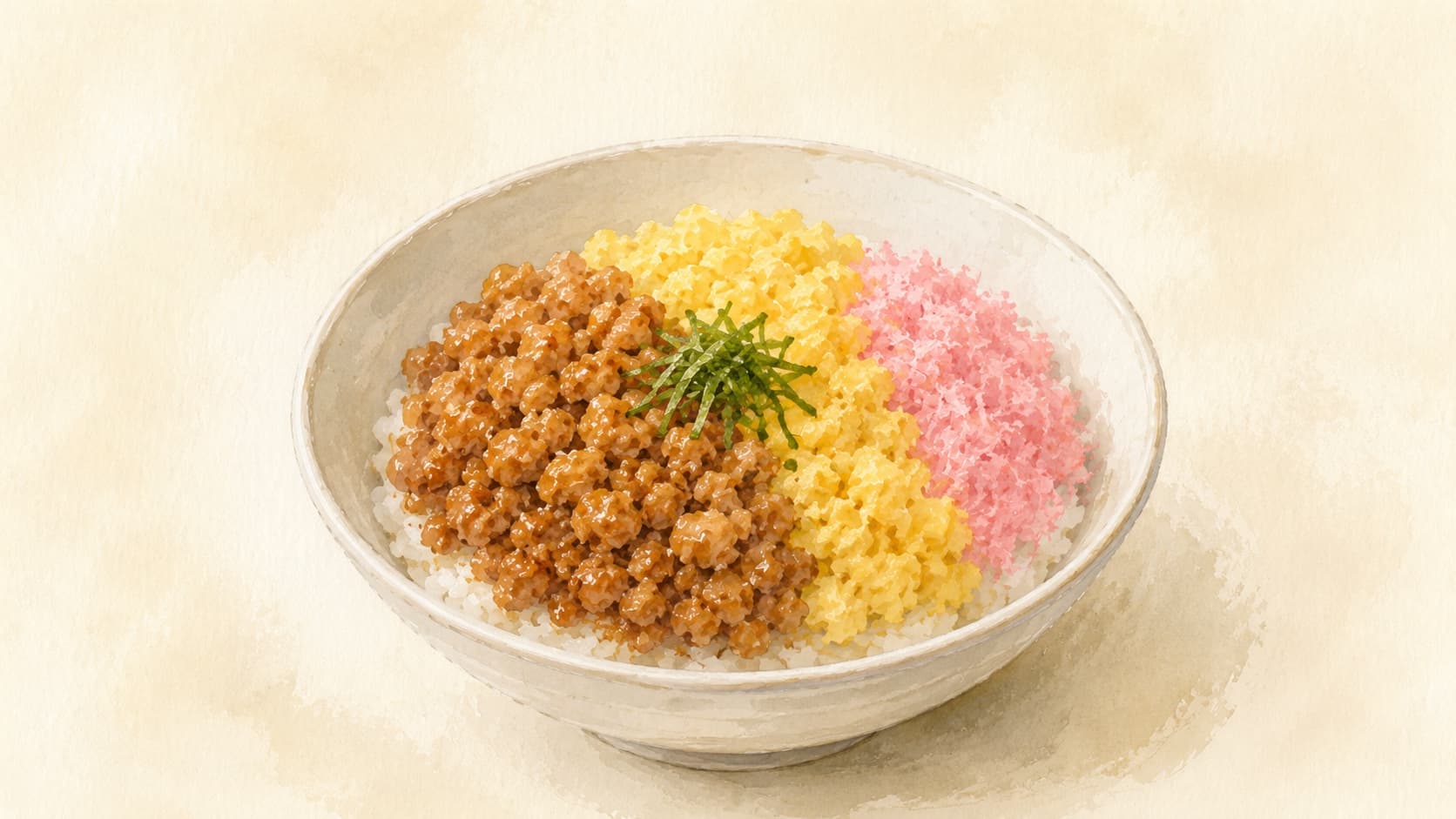
Assemble the don: place the hot rice in the bowl to one side of center. Arrange the chicken soboro over one half of the rice surface and the tamago soboro over the other half, meeting at the center. Place the optional third color in the gap between or as a garnish at the center. The visual arrangement is part of the dish — soboro don is defined by the tri-color presentation. Do not mix before eating; the contrast of seasoned soboro against plain white rice is the point.
Serve immediately. The don is best eaten within 5 minutes of assembly — the soboro components are dry and will absorb moisture from the rice and steam, softening the granule texture over time.
Tools you'll want
- · Digital kitchen scale (gram precision)
Why this works
Soboro don is an assembly recipe — the techniques for each component are separate, and the quality of the final bowl depends on executing each correctly and assembling them in the right sequence.
The chicken soboro is built on the dry-frying technique: meat is cooked in its own expressed fat with the seasonings, with the goal of producing individual, dry, separate granules with concentrated, lacquered-on flavor rather than a sauce-coated mass. The key is continuous mechanical separation — using chopsticks or a fork to keep each granule apart while the liquid cooks down. As the sake and mirin evaporate, the soy sauce and sugar remain on the surface of the meat, caramelizing into a thin, sticky lacquer on each granule. The faint Maillard reaction in the final dry minutes creates the savory-sweet character that distinguishes soboro from a simple ground meat preparation.
The tamago soboro uses the same granule-forming principle applied to eggs. The sugar and mirin in the tamago soboro mixture serve both taste and texture functions: sugar raises the coagulation temperature of the egg proteins slightly, giving more time to work the eggs into small granules before they set firm. The result is pale, fine, slightly sweet egg crumbles — a textural and flavor counterpoint to the dark, savory chicken.
The ratio of sake:mirin:soy:sugar in the chicken soboro (5:5:4:2 by volume) is the standard hon-tsukeyaki ratio for ground meat soboro. This ratio produces a balance where the sweetness does not dominate but the seasoning penetrates fully. The ginger amount (2% of meat weight) is positioned to provide aromatics that reduce the gamey note of thigh meat without tasting specifically of ginger.
About the tri-color presentation
Traditional soboro don uses three components: chicken soboro (brown), tamago soboro (yellow), and a green element. The green is region- and season-dependent: blanched edamame in summer, shredded shiso (perilla), thin green onion rounds, or beni shōga (pickled red ginger) as a contrast color and acidic note.
The three-color presentation is not merely visual. The unseasoned white rice is the fourth element — its mildness provides contrast to both the highly seasoned soboro components, and the plain rice surface absorbs the slight moisture released by the soboro without becoming soggy in the first 5 minutes of eating. The bowl is designed to be eaten quickly, from edge to center, mixing the components as you go.
Common mistakes
Chicken soboro (Japanese ground meat finely simmered into dry granules) forms clumps instead of granules.
Target: Fine, dry, separate granules — each piece coated independently in lacquered glaze.
Why it matters: Clumped chicken soboro has wrong texture (small meatballs in sauce). The signature of well-made soboro is granule separation against rice — visually and structurally.
What to do: 4-5 chopsticks held together (or a fork) — break the meat aggressively from the moment it hits the pan. First 90 seconds decide the outcome.
Workarounds:
- Already clumped → continue breaking with patience; may not reach optimal but partially salvageable.
Tamago soboro over-cooked.
Target: 80% set — residual heat finishes it off the pan. Pale, fine, barely-moist granules.
Why it matters: Over-cooked egg soboro turns yellow-brown, dry, crumbly — wrong color and wrong texture. The window from "almost done" to "overdone" is 30 seconds.
What to do: Pull off heat early. Continue stirring off-heat as residual cooks finish.
Workarounds:
- Over-cooked → add 1 tsp warm cream or mirin off-heat; rehydrates slightly without ruining structure.
Using cold rice.
Target: Hot rice (~60°C) — freshly cooked or rewarmed to steaming.
Why it matters: Cold rice doesn't release the steam that integrates the soboro into the rice surface. Result: dry separated layers, flat overall flavor. Hot rice's vapor is the unsung component.
What to do: Time the rice to finish with the soboro assembly. Plate immediately while rice is hot.
Workarounds:
- Leftover rice → microwave with a splash of water, covered, until steaming hot before plating.
Mixing before serving.
Target: Three distinct color zones visible from above — eat by zone, mixing as you go.
Why it matters: Pre-mixed soboro don loses the textural and visual contrast that defines the dish. The diner gets to control the ratio in each bite. Pre-mixing flattens that experience.
What to do: Plate as three zones. Provide chopsticks; let the eater mix at the table.
Workarounds:
- Bento format → still maintain zones with paper or natural separation (perilla leaves work).
Over-sweetening the tamago soboro.
Target: 10 g sugar per 3 eggs maximum. Should taste sweet relative to the chicken, not sweet on its own.
Why it matters: Too sweet egg soboro becomes dessert-like — clashes with the savory chicken. The yellow is meant to be subtly sweet, providing contrast through mild balance.
What to do: Measure sugar by weight, not by eye. Taste a small piece before plating.
Workarounds:
- Want less sweetness → 8 g sugar; not flat, just understated.
Wrong third-color choice.
Target: Green element that adds color, brightness, or acid — edamame (young green soybeans in the pod), shiso (a fragrant Japanese herb leaf), scallion, beni shōga (red pickled ginger), or snap peas. NOT a sauce or wet component.
Why it matters: A wet third element disrupts the dry-granule architecture; the right green provides contrast without sogginess. Beni shōga adds welcome acid.
What to do: Pick one green per bowl. Don't combine multiple greens — visual clarity matters.
Workarounds:
- No fresh green → toasted nori strips work as a textural/visual substitute.
What to look for
- Chicken soboro during cooking: liquid bubbles and evaporates. The granules are separating. When the sizzling changes from wet (steam hissing) to dry (fat popping), the seasoning has cooked down.
- Chicken soboro finished: dark, glossy-coated granules that don't stick together. If you press them gently and they stick, there is still moisture remaining.
- Tamago soboro finished: pale yellow, fine, barely moist granules. Not clumped, not wet. Should look like fine, pale crumbs.
- Assembled don: three distinct colors and textures visible from above. Each component is dry enough to hold its position on the rice without spreading.
Chef's view
Soboro don is, at its core, a textures recipe. The same components made wet — chicken in a soy-mirin sauce, eggs soft and moist — would produce a perfectly edible donburi but not a soboro don. The defining quality is the granule texture: dry, separate, intensely seasoned crumbles against the plain white rice.
There is a related preparation called soboro bento, which uses the same components packed into a bento box, where the dry granule texture serves a practical function as well as an aesthetic one: dry soboro does not leak, does not make the rice soggy, and holds its presentation through a morning of being carried. The quality standard for bento soboro and restaurant soboro is identical — the dry granule technique is both the aesthetic and the engineering solution.
For the tamago soboro, some modern versions use more egg (4 or 5 eggs per 2 servings) and a small amount of cream cheese or mascarpone beaten in, which produces a softer, creamier granule. This is a valid variation but moves away from the traditional dry-granule texture toward a richer, moister version.
Chef Test Notes
Tested ground chicken thigh against ground chicken breast for the soboro. Thigh produced a richer, more consistently dry granule — the higher fat content expressed during cooking provided enough lubrication to prevent the granules from sticking, even at lower liquid amounts. Breast produced acceptable results but required careful temperature control to avoid drying out. Tested the sake:mirin:soy ratio against variations: reducing mirin by half and increasing sake produced a less sweet, more straightforwardly savory result — acceptable but less complex. Tested tamago soboro sugar amounts: 8 g, 10 g, 15 g per 3 eggs. At 15 g the sweetness was distracting; at 8 g the eggs tasted flat. 10 g was the balance point.
Related glossary terms
- Maillard reaction — the browning of the chicken soboro in its final dry-cooking stage
- Caramelization — the sugar in the soy-mirin lacquer caramelizing on the surface of each soboro granule
- Protein coagulation — the egg-science behind tamago soboro granule formation
Get the essays in your inbox — free
Weekly notes on flavor, fermentation, and food history — the writing behind the Atlas of Flavor. No spam; unsubscribe anytime.