
Kinpira Gobo
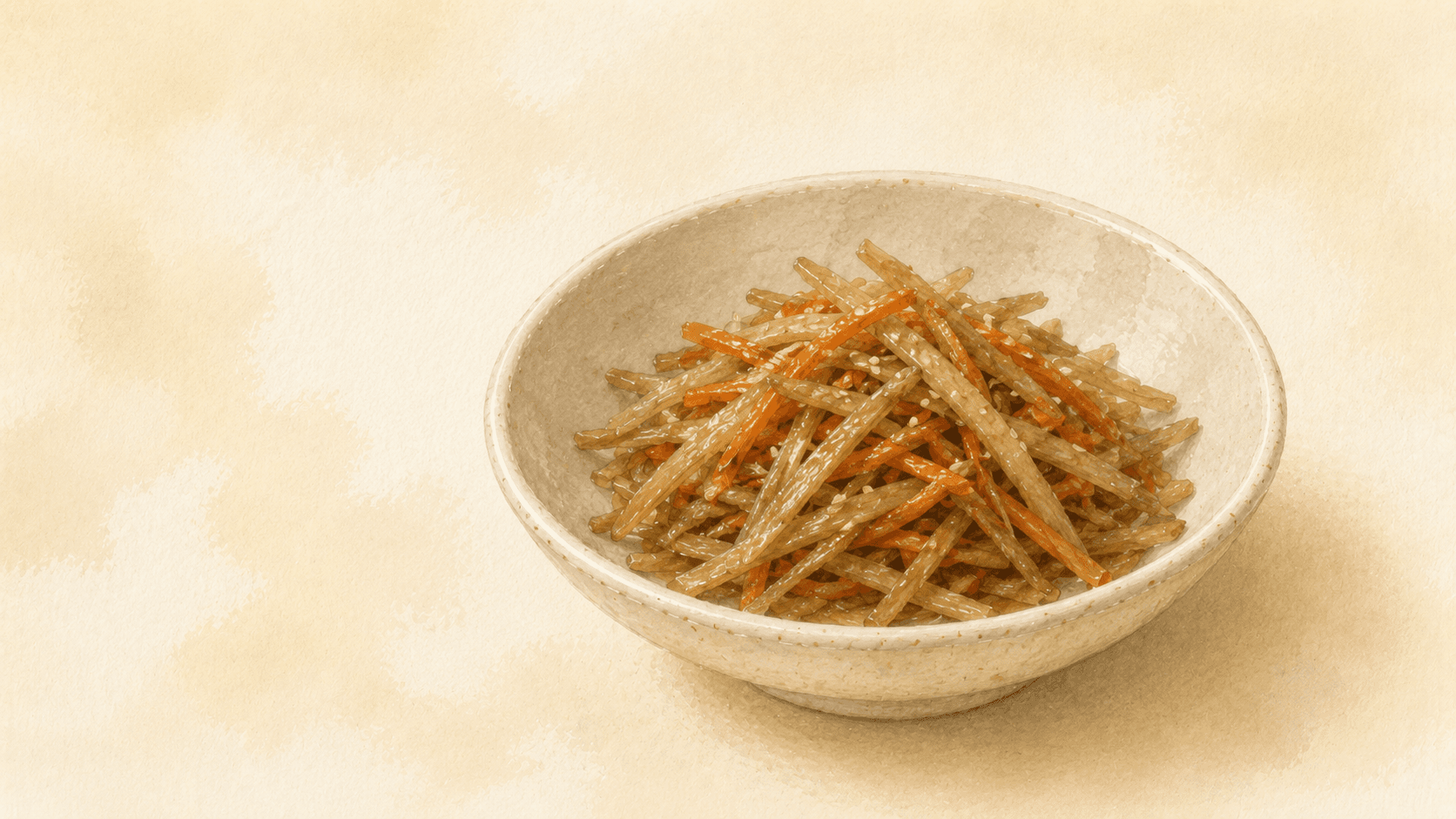
Burdock root and carrot stir-fried in sesame oil, then simmered in soy sauce, mirin, and sugar. The kinpira method — fry first, then braise-glaze — is the defining technique for root vegetables in Japanese cooking.
Contents (7 sections)▾
Ingredients
- 200 g burdock root (gobo), scrubbed (about 7 oz)
- 100 g carrot, peeled
- 1.5 tbsp sesame oil
- 2 tbsp soy sauce
- 2 tbsp mirin
- 1 tbsp sake
- 1 tsp sugar
- 1–2 dried red chili peppers, seeded (optional but traditional)
- 1 tbsp toasted white sesame seeds
- Cold water with a splash of rice vinegar — for soaking the burdock
Steps
Scrub the burdock root clean with a stiff brush under cold water — do not peel. The skin holds much of the flavor and the characteristic earthiness of gobo. Cut into julienne strips about 4–5 cm long and 2–3 mm wide, or into thin diagonal shavings using the sasagaki technique (shaving directly with a knife as if sharpening a pencil). Drop the cut burdock immediately into cold water with a splash of vinegar to prevent browning. Soak for 5–10 minutes, then drain well and pat dry.
Cut the carrot into matching julienne strips of the same length and thickness as the burdock.
Heat the sesame oil in a wide frying pan or wok over medium-high heat. Add the chili pepper(s) if using and toast for 30 seconds until fragrant. Add the drained burdock and stir-fry continuously for 2–3 minutes until slightly softened but still firm — the burdock should have some color and the sesame oil fragrance should be strong.
Add the carrot and stir-fry together for 1 more minute. The carrot cooks faster than the burdock; adding it later ensures both are done at the same time.
Reduce heat to medium-low. Add the soy sauce, mirin, sake, and sugar together in one addition. Stir to coat all the vegetables. Cook, stirring occasionally, until the liquid has reduced to a glaze and the vegetables are coated evenly — about 3–4 minutes. The pan should be nearly dry and the vegetables should glisten. Remove the chili. Finish with sesame seeds. Serve at room temperature or cold — kinpira improves after resting.
Tools you'll want
- · Digital kitchen scale (gram precision)
Why this works
Kinpira is a Japanese cooking technique, not a recipe — it refers to the sequence of stir-frying a vegetable in oil until partially cooked, then adding sweet-savory liquid that reduces to a glaze. The kinpira technique is applied to burdock most classically but works equally with lotus root, carrot, celery, green beans, and other firm vegetables.
The burdock root is the challenge ingredient. Gobo has a distinctly earthy, faintly bitter flavor and a fibrous texture that takes longer than most vegetables to become palatable. Two things make it work: the initial stir-fry in sesame oil, which breaks down the fiber and brings out its earthy, toasted flavor; and the reduction glaze, which simultaneously seasons the vegetable and finishes its cooking. The vinegar soak removes excess astringency (from polyphenols that oxidize on cutting) and prevents the cut surface from turning brown.
The sequence — 炒める (stir-fry first) → 煮からめる (braise-glaze second) — is the kinpira method's defining characteristic. The stir-fry stage dries the surface, drives off initial moisture, and begins the tenderizing of the fiber. The braise-glaze stage finishes cooking and coats every surface in the seasoning. If you add the seasoning liquid too early (before the fry stage is complete), the vegetables steam rather than fry, and the texture becomes soft and bland. If you wait too long and the liquid evaporates completely, the sugars in the mirin and soy will burn rather than glaze.
The chili — togarashi — is traditional and functional. Dried chili's capsaicin compounds provide counter-heat that makes the sweet-savory glaze feel more dynamic on the palate. The quantity is small, and the chili is removed before serving, leaving only a background warmth rather than a dominant spice note.
Common mistakes
Cutting the burdock too thick.
Target: Thin julienne (matchstick) OR sasagaki (shavings like sharpening a pencil) — about 2 mm thick.
Why it matters: Kinpira's flavor relies on high surface-area-to-volume ratio. Thin pieces glaze evenly and cook through in the brief stir-fry window. Thick slices are undercooked inside with glazed outsides — wrong texture.
What to do: Use a sharp knife. Sasagaki technique: hold the burdock root upright, shave thin pieces with the knife while rotating. Looks like pencil shavings.
Workarounds:
- For beginners, julienne with a mandoline. Sasagaki is the traditional technique.
Skipping the vinegar soak.
Target: Soak cut burdock in cold water + 1 tbsp vinegar for 5–10 minutes. Drain before cooking.
Why it matters: Burdock oxidizes immediately on cutting (turns brown). More critically, raw burdock has significant polyphenol astringency that makes the finished dish harsh. The acidulated water soak removes most of this.
What to do: Cut burdock → drop pieces into vinegar water → soak → drain.
Workarounds:
- For deeper de-bittering, soak in rice rinsing water instead of vinegar water — traditional Japanese method.
Adding seasoning before stir-fry is complete.
Target: Stir-fry burdock in sesame oil for 2–3 minutes until softened and starting to color, THEN add soy + mirin + sugar.
Why it matters: Premature liquid addition prevents the burdock from developing its sesame-oil fragrance. The texture becomes braised rather than stir-fried — different dish.
What to do: High heat. Stir-fry burdock until it starts to caramelize. Then add seasoning all at once.
Workarounds:
- For deeper flavor, add a small amount of toasted sesame seeds to the oil before adding burdock.
Too much seasoning liquid.
Target: Seasoning liquid reduces to ALMOST NOTHING — just enough to glaze the vegetables.
Why it matters: Excess unreduced liquid produces a wet, stewy result. Kinpira's signature is the dry-glazed surface that traps the savory sweetness on each piece.
What to do: Use just enough liquid to coat. Standard ratio: 1 tbsp soy + 1 tbsp mirin + 1 tsp sugar per medium burdock root. Cook until liquid evaporates.
Workarounds:
- Over-wet? Continue stir-frying on high heat until liquid evaporates.
Forgetting chili flakes.
Target: Shichimi togarashi (Japanese 7-spice) or chili flakes added at the end — about 1/4 tsp per serving.
Why it matters: Kinpira's "kinpira" refers to a folk hero of strength — the chili kick is part of the dish's identity. Without it, kinpira reads as "burdock teriyaki" — different.
What to do: Add at the end so the chili doesn't burn.
Workarounds:
- No shichimi? Standard red chili flakes work. Adjust quantity to taste.
What to look for
- Before soaking: burdock cut thin, uniform. Consistent thickness means consistent cooking.
- In the oil: vigorous sizzle, sesame fragrance, beginning to soften. 2–3 minutes.
- Adding seasoning: liquid hits the hot pan and immediately steams and sizzles. Good — the pan is hot enough.
- Glaze-down: liquid reducing, vegetables shining. The pan should be nearly dry at the finish.
- Done: each piece coated in a dark, sticky glaze. No pooled liquid; bright sesame seeds on top.
Chef's view
Kinpira gobo is a representative Japanese okazu — a side dish that accompanies rice, contributing flavor contrast, texture variety, and nutritional diversity alongside plainer main dishes. It keeps well in the refrigerator for 4–5 days, and its flavor actually improves with time as the glaze penetrates deeper into the vegetable. Making a larger batch than you need and refrigerating the rest is the natural way to use this recipe.
The sasagaki cut (削ぎ切り method of shaving the burdock directly into thin ribbons, like sharpening a pencil) produces a different texture from julienne. Sasagaki pieces are thinner and more irregular, with a higher surface area that absorbs the glaze more quickly and produces a softer final texture. Julienne gives a more toothsome bite and a more uniform appearance. Both are traditional; the choice is textural preference.
Chef Test Notes
Tested three cut styles: julienne (3mm), thin diagonal slices, and sasagaki. Julienne gave the best texture contrast — still firm in the center with glaze on the outside. Thin diagonal slices were acceptable but became slightly too soft after the glaze stage. Sasagaki produced the most intense flavor absorption and the softest texture. For a bento box or make-ahead dish, sasagaki; for a restaurant presentation with more textural interest, julienne.
Related glossary terms
- Kinpira — the Japanese stir-fry-then-braise-glaze technique this recipe uses
- Mirin — the fermented sweetener that contributes gloss and layered sweetness to the glaze
- Gobo — the burdock root, its flavor, and how to handle it
- Sesame oil — toasted sesame oil's role as an aromatic base in Japanese stir-frying
Get the essays in your inbox — free
Weekly notes on flavor, fermentation, and food history — the writing behind the Atlas of Flavor. No spam; unsubscribe anytime.