
French Onion Soup
Patience is the technique. Onions caramelized for 45–60 minutes develop sweetness through Maillard-driven reactions above 160°C that cannot be rushed without losing depth.
Contents (7 sections)▾
Ingredients
- 1 kg yellow onions, thinly sliced (about 4 large onions — approx. 35 oz)
- 40 g unsalted butter
- 1 tbsp neutral oil
- 1 tsp fine sea salt (to add early)
- 120 ml dry white wine or dry vermouth
- 1 litre good-quality beef stock (or a combination of beef and chicken)
- 1 bay leaf
- 3–4 sprigs fresh thyme
- Fine sea salt and black pepper to season
- 8 slices baguette, about 1.5 cm thick — toasted until dry
- 150 g Gruyère cheese, coarsely grated (about 5 oz)
Steps
Melt the butter and oil together in a large, wide, heavy-bottomed pot over medium-low heat. Add all the onions and the 1 tsp salt. Stir to coat. The salt draws moisture from the onions and begins the softening process. Cover and cook for 10 minutes, stirring once or twice, until the onions are limp and have released considerable water.
Uncover the pot and increase heat slightly to medium. Cook, stirring every 5–10 minutes, for 40–50 minutes. This is the long caramelization phase. The onions will shrink dramatically, turning from pale ivory to light gold to deep amber. Do not rush this with high heat — the color comes from Maillard reactions and caramelization above 160°C, but the sugars must develop gradually or they will burn rather than caramelize. If the onions are sticking too aggressively, add a splash (30 ml) of water to deglaze the fond and continue.
When the onions are uniformly deep mahogany-brown and smell deeply sweet and savory, add the wine. Increase heat to medium-high and stir, scraping up all the browned fond from the bottom. The wine will reduce in 2–3 minutes, leaving the concentrated pan fond in the onions.
Add the beef stock, bay leaf, and thyme. Bring to a simmer, then reduce heat to low and cook uncovered for 15–20 minutes. Taste and season with salt and pepper. Remove the bay leaf and thyme sprigs. The broth should be rich and savory with a deep onion-sweetness; if it tastes thin, simmer a few more minutes.
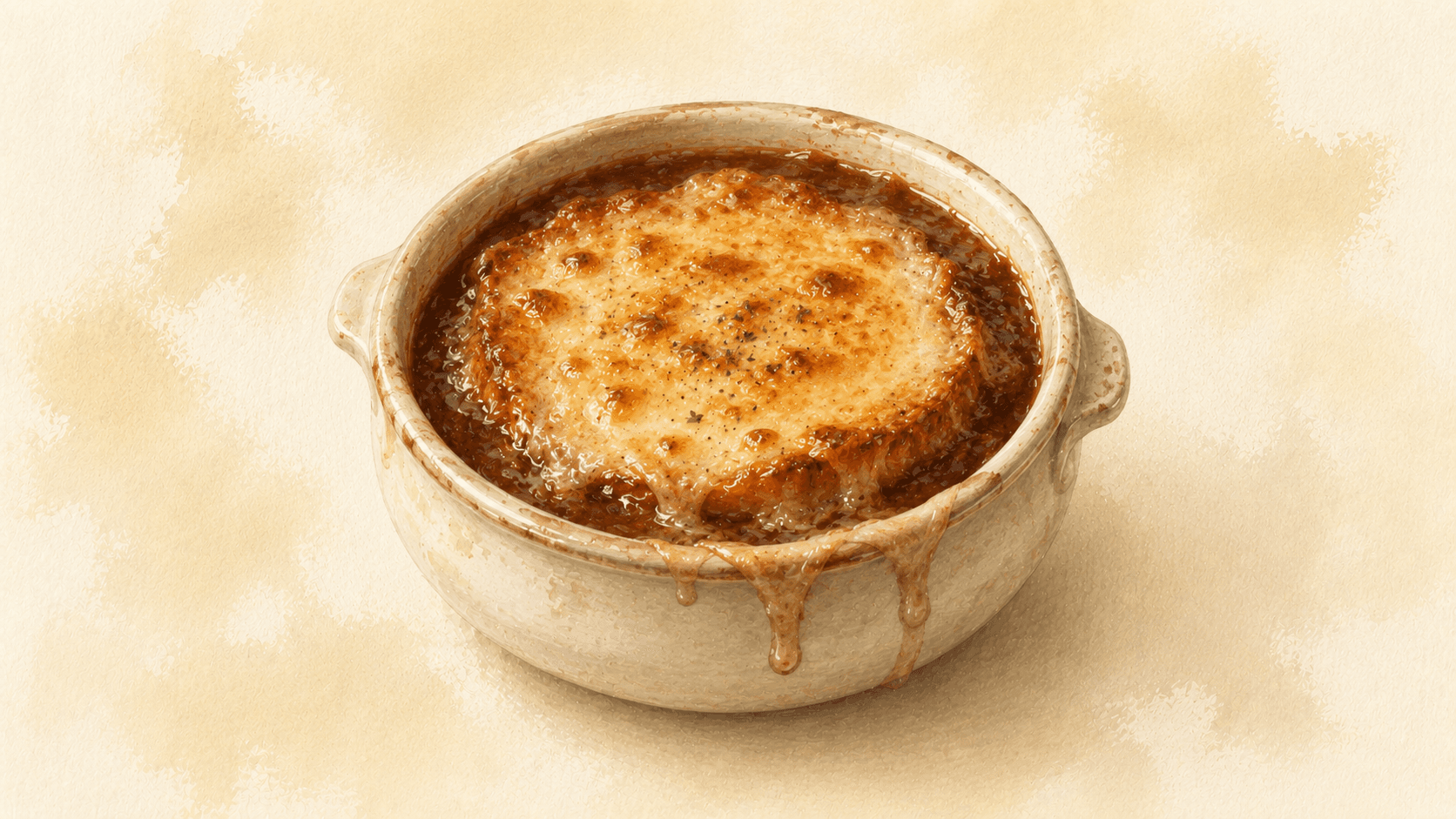
Preheat the broiler on high. Ladle the soup into oven-safe ceramic crocks. Place a toasted baguette slice (or two, overlapping) on top of the soup surface. Heap the grated Gruyère over the bread. Place the crocks on a baking tray and broil 8–12 cm from the heat source for 3–5 minutes, until the cheese is deeply golden and bubbling at the edges. Serve immediately in the hot crocks.
Tools you'll want
Why this works
French onion soup is, at its core, a lesson in the chemistry of browning. The transformation from raw pungent onion to sweet, deeply savory broth requires two related but distinct processes: caramelization and Maillard reactions, both of which require temperatures well above 100°C to proceed.
Onions are about 5% sugar by weight, primarily fructose and glucose. When cooked at low heat for a long time, the cellular structure breaks down, releasing these sugars. At around 160°C, caramelization begins: the sugars themselves undergo thermal decomposition, breaking apart and recombining into hundreds of new aromatic compounds — the characteristic sweet, slightly bitter, complex flavor of caramelized onion. Simultaneously, the amino acids and proteins present in the onion react with the reducing sugars through Maillard reactions, producing brown pigments and a second set of savory, roasted aromas. These two processes reinforce each other, which is why deeply caramelized onions have both sweetness and a savory depth.
The critical constraint is time. High heat shortens the time but burns the sugars before the full complexity develops, giving a bitter, scorched result. Low-medium heat over 45–60 minutes allows both processes to proceed through their full sequence. Stirring occasionally but not constantly allows the fond (the browned layer on the pot bottom) to develop without burning — this fond is then incorporated back into the onions every time you stir, building flavor each cycle.
The beef stock amplifies the existing umami. Onions contain glutamate; beef stock is glutamate-rich; Gruyère contains glutamate from its aging. The soup at its best is a compound umami experience — each element separately would be less than the total.
Common mistakes
Rushing the caramelization.
Target: 60–90 minutes on medium-low heat. Stir every 5 minutes. Onions should turn deep mahogany, not just "golden brown."
Why it matters: High heat scorches the onion exteriors before the interior sugars develop. Result: bitter-edged, unevenly colored onions that never reach the deep sweetness of proper caramelization. There is no shortcut for this step.
What to do: Patience. Use a wide, heavy pot. Stir, walk away, stir, walk away.
Workarounds:
- Speed up slightly with 1/2 tsp baking soda added to the onions — raises pH, accelerates Maillard. Trade-off: slight soapy taste if overdone.
- Pre-cook onions in pressure cooker (15 min high pressure) → then finish in pan for color.
Not deglazing the fond.
Target: Deglaze every 10–15 minutes with a splash of water or wine — scrape the dark residue back into the onions.
Why it matters: The dark residue on the pot bottom is concentrated flavor. Left too long without deglazing, it turns from "fond" (flavor) to "carbon" (bitter). Properly deglazed, it dramatically deepens the onion's flavor.
What to do: Have a small cup of water or wine nearby. Whenever the bottom turns dark brown, splash, scrape with a wooden spoon, continue.
Workarounds:
- For even deeper flavor, deglaze with sherry or dry vermouth instead of water — adds aromatic depth.
Using poor-quality stock.
Target: Homemade beef or beef-veal stock. Failing that, the best store-bought you can find.
Why it matters: French onion soup cannot hide weak stock. The broth is the final medium — if it tastes watery or "commercial," no amount of caramelized onion compensates. The dish is built on stock.
What to do: Make stock the day before (or have it frozen). For store-bought, look for refrigerated brands (Kitchen Basics, Pacific Foods).
Workarounds:
- Cheating: simmer store-bought stock for 30 minutes with a bone, a piece of beef shin, and aromatics — significant flavor boost.
Under-toasting the bread.
Target: Baguette slices toasted until cracker-dry — almost too hard to bite normally.
Why it matters: Soft bread absorbs soup and turns to mush in seconds. The bread must hold its structure even as it soaks slightly, providing textural contrast to the soup and cheese.
What to do: Toast slices in a 200 °C oven for 10 minutes per side. They should be deeply golden and rock-hard.
Workarounds:
- Day-old or stale baguette is perfect — start with dry bread to skip the deep toast.
Wrong cheese.
Target: Gruyère (or Comté) — sharp, nutty, melts smoothly. Authentic ratio: 100 g per bowl.
Why it matters: Mozzarella melts into greasy strings; cheddar dominates with sharpness; pre-shredded "Swiss" has anti-caking agents. Gruyère is the only correct choice.
What to do: Grate fresh from a block. Pile generously on the bread before broiling.
Workarounds:
- No Gruyère? Comté is the closest substitute. Emmental + Parmigiano produces similar character.
Not serving immediately.
Target: Serve straight from the broiler — within 30 seconds.
Why it matters: The melted cheese crust congeals as it cools, losing both the stretchy texture and visual appeal. Even 5 minutes ruins it.
What to do: Pre-warm the soup bowls. Assemble (soup + bread + cheese), broil for 2 minutes, take directly to the table.
Workarounds:
- For dinner parties, prep individual bowls ahead, broil to order.
What to look for
- First 10 minutes (covered): onions limp, swimming in released water. This is the softening phase — correct.
- Long caramelization (40–50 min): color progresses from ivory to gold to amber to mahogany. This should take time; do not force it.
- Fond on the pot: dark brown, not black. Black means burning; scrape and add a splash of water if it's going too dark too fast.
- After wine addition: fond dissolved, onions glistening with concentrated liquid.
- Finished soup: rich amber, sweet and deeply savory. Onion flavor should be almost unrecognizable — transformed.
- Under the broiler: cheese bubbling and deep golden. Not pale, not burnt.
Chef's view
The origin of French onion soup is Parisian — specifically the Les Halles market district, where the soup served as pre-dawn sustenance for market workers, made from the abundant onions available at the market and cheap beef bones. The Les Halles of Paris was demolished in 1971, but the association between the soup and the working city persists in its French name: soupe à l'oignon gratinée des Halles.
The Gruyère is not optional in a classical preparation. The combination of aged cheese, good stock, and caramelized onion creates a specific layered umami that is the identity of the dish. Some preparations use Emmental or Comté — both are acceptable if the aging is comparable. Processed cheese will give you a different texture but none of the complexity.
Chef Test Notes
Tested caramelization duration at 30, 45, and 60 minutes. At 30 minutes, the onions were golden but one-dimensional in flavor — sweet but lacking depth. At 45 minutes, a clear secondary layer of savory complexity had developed. At 60 minutes, the color was the deepest and the flavor the most complex, but the difference from 45 minutes was smaller than the jump from 30 to 45. For most purposes, 45 minutes is the minimum; 60 minutes is better if time allows.
Related glossary terms
- Caramelization — the thermal decomposition of sugars above 160°C that creates the onions' sweetness and color
- Maillard reaction — the amino-acid-and-sugar reaction that adds savory depth alongside caramelization
- Fond — the caramelized deposits on the pot bottom that carry concentrated flavor
- Gruyère — the aged alpine cheese whose glutamate content and melt make it ideal for this preparation
Get the essays in your inbox — free
Weekly notes on flavor, fermentation, and food history — the writing behind the Atlas of Flavor. No spam; unsubscribe anytime.