
Crème Anglaise
Egg yolks, sugar, milk, cream, a vanilla bean, ten minutes of patient stirring. The dessert sauce that teaches what 'nappe' really means — and where the line is between custard and scrambled egg.
Contents (8 sections)▾
Ingredients
- 200 ml whole milk
- 100 ml heavy cream (35% fat)
- 1 vanilla bean, split lengthwise (or 5 g vanilla extract, added at the end)
- 4 large egg yolks (about 80 g)
- 60 g caster sugar
- 1 pinch fine sea salt
Steps
Combine the milk, cream, and the split vanilla bean (scrape the seeds into the pan and add the pod too) in a small heavy saucepan. Warm over medium-low heat until it just reaches a steady gentle steam — wisps rising, no bubbles yet. Pull off the heat and let the vanilla infuse for 5 minutes.
Meanwhile, whisk the yolks, sugar, and salt in a bowl for about 30 seconds — until the mixture lightens to pale yellow and the sugar mostly dissolves. Do not beat air into it; this is a gentle blend, not a foam.
Remove the vanilla pod from the warm milk. Now temper: pour about a third of the warm milk-cream into the yolks in a slow stream while whisking constantly. The yolks come up in temperature gradually rather than scrambling on contact. Pour the tempered yolk mixture back into the saucepan.
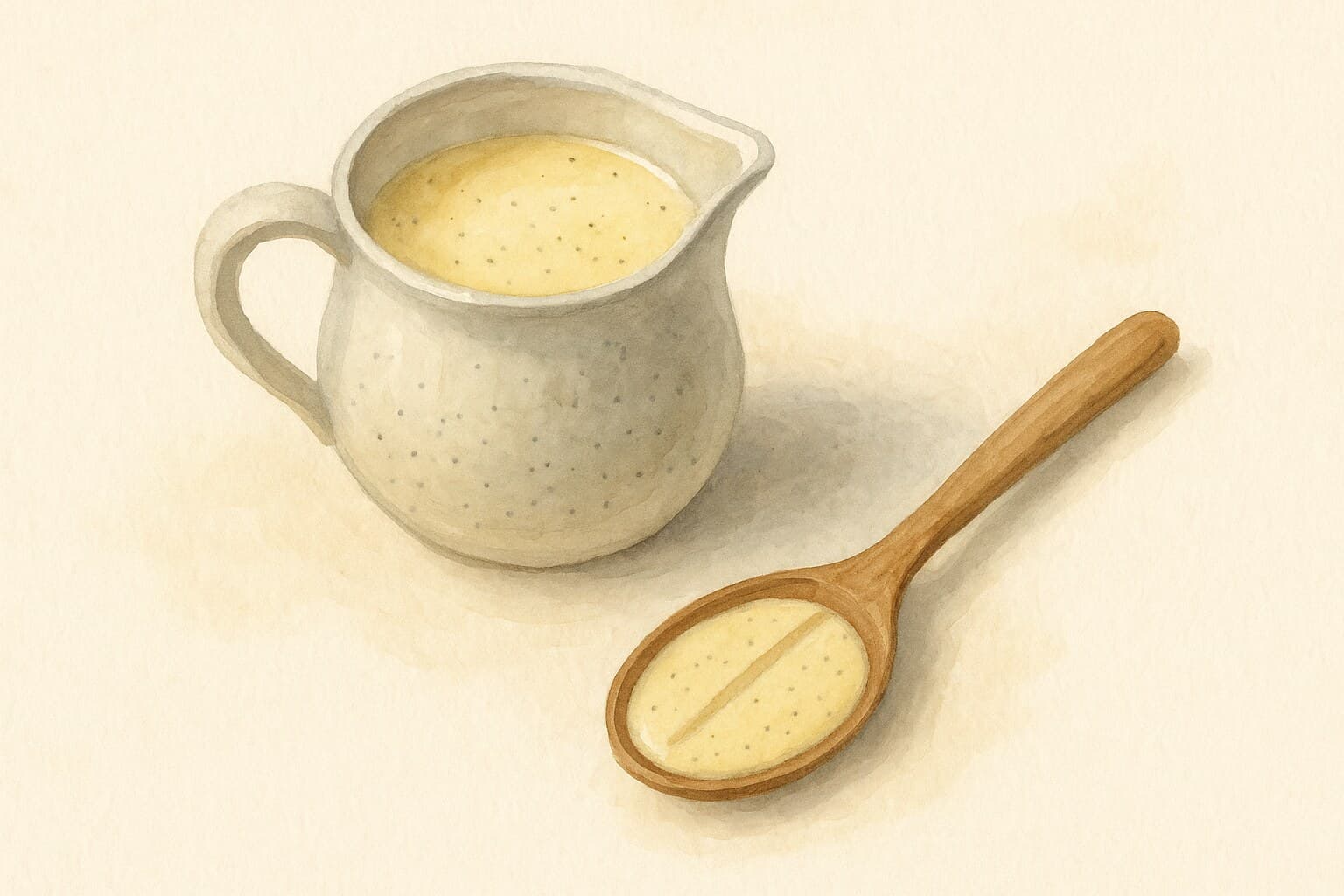
Cook over medium-low heat, stirring constantly with a wooden spoon, scraping the bottom and sides. The mixture will thicken slowly. Aim for around 82°C (180°F) — well below the boiling point. The sauce is ready when it coats the back of the spoon and a finger drawn across leaves a clean line that holds for about a second. This is the nappe stage. 6-8 minutes.
Pull off the heat immediately. Strain through a fine-mesh sieve into a clean container (this catches any small set bits and gives you a silky finish). Cool at room temperature briefly, then refrigerate covered. Serve cold over cake, poached fruit, brownies, or warm pudding. Keeps 2 days refrigerated; do not freeze.
Tools you'll want
- · Balloon whisk (24cm / 11-inch)
- · Tri-ply stainless saucepan (1.5–2 qt / 18cm)
- · Sauce strainer (chinois, perforated, or fine-mesh, 19–25cm)
- · Instant-read digital thermometer
Why this works
Crème anglaise is the recipe that teaches what "nappe" (the point where the sauce just coats the back of a spoon) really means — and where the exact line is between a successful custard and scrambled egg. Both are made of the same things in nearly the same ratio. The only difference between them is temperature control in the last three minutes.
Egg yolks contain proteins that begin to denature and link together at around 65°C, and set firmly into a solid by around 85°C. A custard is a sauce that has thickened because some yolk proteins have unfolded and started forming weak bonds with each other — but stopped before they form a rigid network. Push past about 84°C and the proteins suddenly fully bond. Curds form. You have sweet scrambled egg.
The way to stay on the right side of that line is gradual heat, constant stirring, and an explicit target temperature. Around 82°C (180°F) is the textbook sweet spot. Below 78°C the custard is still thin. Above 85°C it breaks. Between those, the sauce thickens noticeably, coats the back of a spoon, and holds the nappe line.
The dairy choice matters. Pure cream gives a very rich, slightly cloying sauce. Pure milk gives a thin custard that won't coat properly. The 2:1 milk-to-cream ratio in this recipe is the home standard — thick enough to nappe, light enough to pour. The yolks supply structure and emulsifying lecithin; the sugar lowers the protein denaturation temperature very slightly (giving a wider working window); the salt amplifies vanilla.
Tempering is the technique that prevents scrambling. Pouring hot dairy into cold yolks all at once would shock the yolks past 80°C in seconds; instead, you pour a thin stream of warm dairy into the yolks while whisking, raising them gradually. Then everything goes back into the pan to finish at a single uniform temperature, slowly.
Common mistakes
Cooking too hot.
Target: Medium-LOW heat (not medium). Stir constantly, scraping the bottom.
Why it matters: The single most common failure. Yolks coagulate above 82 °C — the threshold is narrow. Overheating starts at the bottom where contact with the pan is hottest.
What to do: Heavy-bottomed pan, low burner. Constant stirring with a flat-bottomed wooden spoon, scraping every part of the pan.
Workarounds:
- Truly nervous? Use a double boiler — slower but virtually idiot-proof.
Skipping the temper.
Target: Pour hot infused dairy SLOWLY into whisked yolks while whisking constantly.
Why it matters: Cold yolks into hot dairy curdles instantly. Tempering raises yolk temperature gradually to match the dairy.
What to do: Whisk yolks + sugar. Add hot dairy ONE LADLE at a time, whisking. Once half is in, pour the rest more freely.
Workarounds:
- Curdled? Strain immediately — may rescue. Bring smooth strained custard back to gentle heat with extra cream.
Trusting time instead of temperature.
Target: Pull at 82 °C (± 2°). Use a digital thermometer.
Why it matters: Home stoves vary wildly — 6 minutes on one stove is 10 on another. Temperature is the only reliable measure.
What to do: Probe thermometer in the pan. Stir constantly until 82 °C reached. Pull immediately.
Workarounds:
- No thermometer? Use the nappe test: spoon dipped in, finger drawn across the back — line stays clean for 1 second = done.
Boiling.
Target: NEVER boil. If you see a single bubble, you've gone too far.
Why it matters: Past 85 °C the yolks coagulate visibly. Once curdled, the custard cannot be uncurdled.
What to do: Lift pan from heat at the first sign of bubbling. Strain immediately into a cold bowl to stop further coagulation.
Workarounds:
- Slightly curdled? Immersion blender on low for 5 seconds — sometimes recovers texture.
Not straining.
Target: Pass the finished crème anglaise through a fine sieve before serving.
Why it matters: Even properly-cooked custard has a few small over-cooked bits from the pan bottom. Straining is the difference between silky and slightly grainy.
What to do: Pour through the finest mesh sieve into a cold bowl. Press through with a wooden spoon if needed.
Workarounds:
- For ultimate smoothness, use a chinois (cone-shaped fine strainer).
What to look for
- The thermometer. This is the most reliable cue. 82°C ± 2°C is the target.
- The nappe test. Lift the wooden spoon, run a finger across the back. If the line stays clean for a second, the custard is done. If the line fills back in immediately, keep going (gently).
- The sound. A custard cooking properly is silent. If you start to hear small bubbles in the pan, you're at the edge of breaking; pull off the heat immediately.
- The visual. Properly thickened crème anglaise has a clear gloss and a very pale ivory-yellow color, with the dark vanilla seeds visible as fine specks. Curdled custard goes lumpy and dull.
Chef's view
There are several views on the cream-to-milk ratio. Classical French recipes often use pure milk, which gives a thinner, more pourable sauce. Modern restaurant kitchens lean toward 50/50 milk and cream, which gives a richer body that pairs with cake and fruit at body temperature. My view: 2:1 milk-to-cream as the home default — thick enough to coat without overwhelming the dessert it dresses.
A note on vanilla. The bean is worth the extra step, every time. Vanilla extract added at the end of cooking works in a pinch, but the bean infuses the dairy with both seeds and pod oils that extract cannot replicate. If you have a bean, use it; the spent pod can be rinsed, dried, and used to scent sugar.
A note on safety. Crème anglaise contains lightly cooked egg yolks held to around 82°C — well above the salmonella inactivation threshold (around 71°C held for 15 seconds, or 60°C held longer). Properly made, it's safe. The food-safety question is in the cold storage afterward: keep refrigerated, eat within 2 days, do not leave at room temperature longer than 2 hours. As with any dish containing minimally cooked eggs, pasteurized eggs are recommended for at-risk groups (pregnant, immunocompromised, very young, elderly).
Chef Test Notes
I tested the final cook temperature at three points with a probe thermometer in the pan:
- Pulled at 78°C — sauce was clearly pourable but the nappe line filled back in within a second
- Pulled at 82°C — clean nappe line that held a beat, glossy ivory finish (the recipe above)
- Pulled at 85°C — the line held longer, but the second test of three showed faint graininess in the strainer
82°C was the most repeatable target. Without a thermometer the back-of-spoon nappe test is honest enough, but the margin between "thickened" and "curdled" is genuinely thin — once I can hear the faintest bubble at the edge of the pan, the sauce is already at the upper edge and needs to come off immediately. A bowl of cold water in the sink, ready to land the saucepan in if the temperature climbs too fast, has saved me more than one batch.
A note on history
Custards are old — the Romans documented egg-and-milk preparations in De re coquinaria (4th-5th century), and medieval European cookbooks describe them as "creams" centuries before the French codified the form. The puzzling part is the name. Crème anglaise — "English cream" — is French, and the French naming probably points back to 17th-century English nursery custards that French nobility adopted (and refined) during the cross-channel exchange of court cuisines. By the time the French got hold of it, their version had already diverged: thinner, more elegant, more reliant on vanilla.
Antonin Carême (1784-1833) — the chef who built the architecture of modern French cuisine — is the figure who codified custards as a category. He is also the source of the modern distinction between crème pâtissière (with starch, sets firm — fills tarts and éclairs) and crème anglaise (pure egg-and-dairy, pours — sauces puddings and cakes). Both come from the same family; the small change is what they're used for. Carême also standardized vanilla as the default aromatic, replacing the older floral and spice infusions (rose, orange flower, mace) of earlier centuries. Pierre Hermé and the modern Parisian pastry scene preserved that taxonomy — and so the home cook today inherits Carême's two-century-old distinction without quite realizing it.
Related glossary terms
- Emulsion — the yolk-driven sister mechanism behind hollandaise and mayonnaise
- Reduction — the nappe test originates here; both share the spoon-coating standard
- Lactic fermentation — for an alternative dairy register; not used here but informs adjacent custards
Get the essays in your inbox — free
Weekly notes on flavor, fermentation, and food history — the writing behind the Atlas of Flavor. No spam; unsubscribe anytime.