
Cơm Tấm (Vietnamese Broken Rice)
Broken rice is not a substitute for regular rice — it is a different geometry, a different surface area, a different sauce-absorption rate. Cơm tấm is built around that difference.
Contents (8 sections)▾
Ingredients
- 300 g broken jasmine rice (tấm) — if unavailable, broken long-grain works; regular jasmine does not substitute
- Water for cooking (slightly more than your standard ratio — broken rice absorbs more)
- 2 thin-cut pork chops (about 200 g total, for sườn nướng)
- 2 tbsp fish sauce (marinade)
- 1 tsp sugar (marinade)
- 1 tsp garlic, minced (marinade)
- 1 tsp lemongrass, finely minced (marinade, optional but traditional)
- Pinch of turmeric (marinade)
- 2 eggs (for chả trứng)
- 100 g ground pork (for chả trứng)
- Fish sauce and pepper to taste (for chả trứng)
- Spring onions, thinly sliced (for mỡ hành — spring onion oil)
- 2 tbsp neutral oil (for mỡ hành)
- Pickled daikon and carrot (đồ chua) to serve
- Cucumber slices to serve
- Nước chấm to serve: fish sauce, lime juice, sugar, warm water, garlic, chili
Steps
Marinate pork chops: combine fish sauce, sugar, garlic, lemongrass, and turmeric. Coat the chops and marinate at least 30 minutes. The fish sauce provides salt and umami; the sugar will aid browning; the turmeric gives color.
Cook broken rice: rinse the rice gently (broken rice is fragile — don't scrub). Cook with slightly more water than you would use for regular rice. The broken grains absorb more. Cook until just done — tender but not mushy. A rice cooker works perfectly.
Make chả trứng: beat eggs, mix with ground pork and season with fish sauce and pepper. Either steam the mixture in a ramekin until set (15 minutes), or pour into a lightly oiled pan and cook like a thick omelette over medium-low heat until fully set. Cut into squares or wedges. Cook the ground meat until it reaches 71 °C / 160 °F on an instant-read thermometer (no longer pink throughout) — colour, float and time are guides, not the safety test.
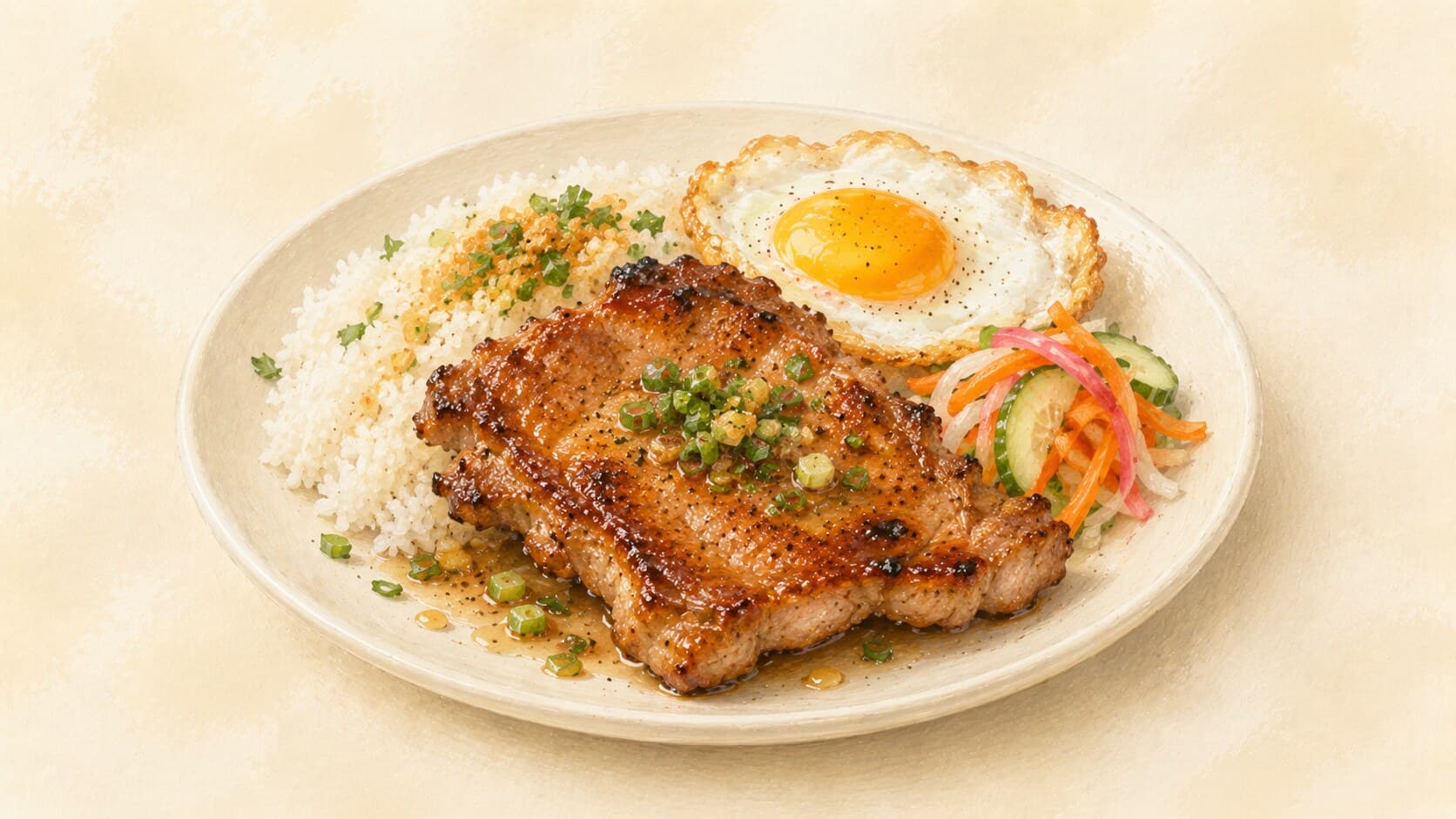
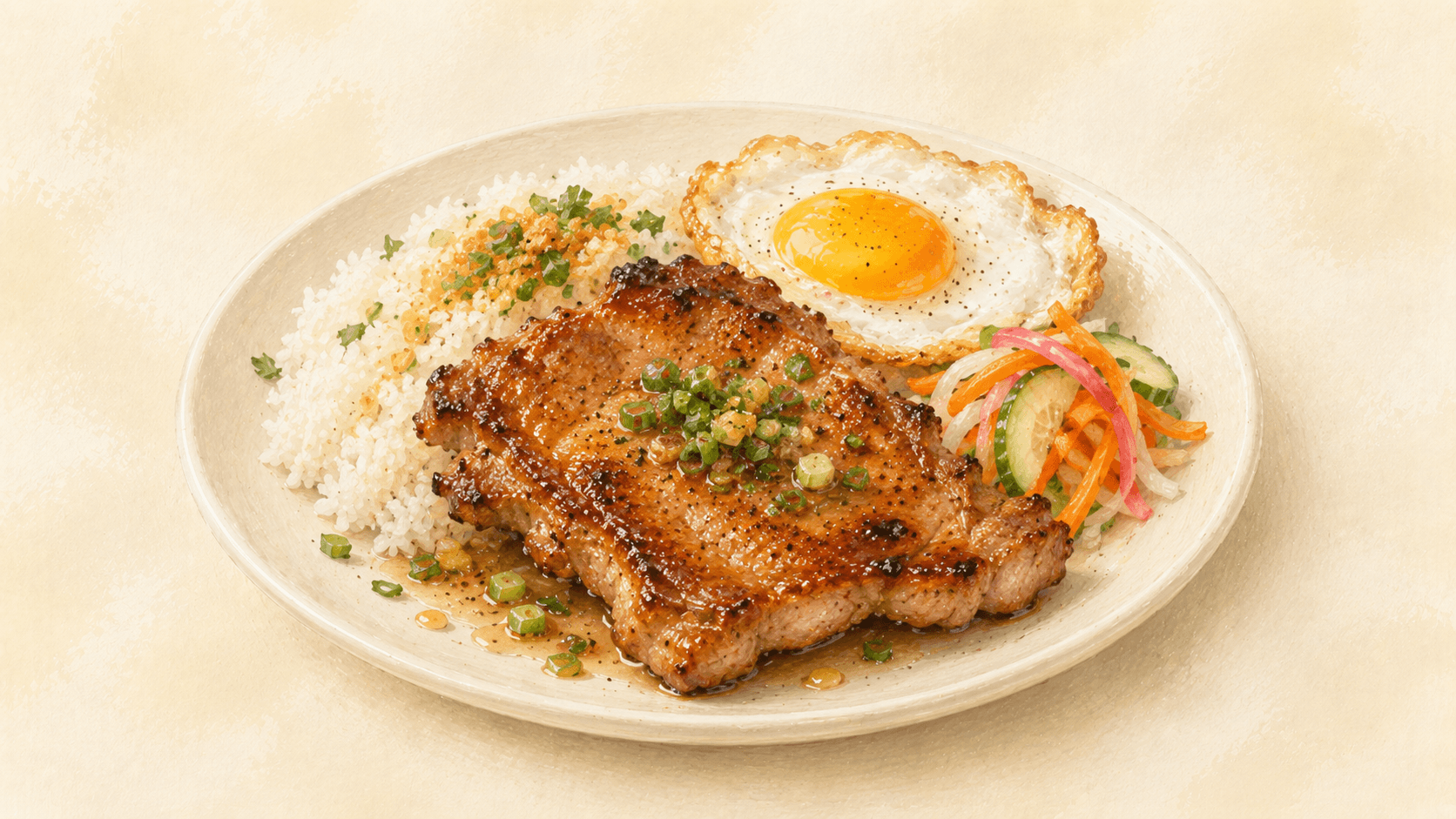
Grill or pan-fry pork chops over high heat. The sugar in the marinade aids browning rapidly — don't move the chop for the first 2 minutes after it hits the heat. Cook until deeply caramelized on both sides, the surface nearly charred at the edges. The chop should be thin enough to cook through in 3–4 minutes per side.
Make spring onion oil (mỡ hành): place thinly sliced spring onions in a bowl. Heat 2 tbsp oil in a small pan until very hot — just before smoking. Pour the hot oil directly over the spring onions. The sizzle cooks them gently and infuses the oil with their fragrance. This fragrant oil goes directly over the rice.
Assemble the plate: broken rice in the center, grilled chop alongside, chả trứng on the side, đồ chua, cucumber slices. Drizzle the spring onion oil over the rice. Serve with nước chấm separately.
Tools you'll want
Why this works
The premise of cơm tấm is starch geometry. "Tấm" means the broken fragments that fall from rice grains during milling — not a different variety of rice, but the same grain at a different particle size. When a jasmine grain breaks into two or three fragments, its surface-area-to-volume ratio increases significantly. More surface area means more exposure to sauce, more absorption per unit of rice, and a different mouthfeel: the broken grain hydrates faster, soaks up sauce more eagerly, and creates a slightly sticky, cohesive texture that holds together on a fork or chopstick. Regular jasmine rice, with its intact, intact-jacketed grains, does not produce this effect. The geometry is different. The dish is built around that difference.
The pork chop marinade does two things simultaneously. The fish sauce draws moisture to the surface of the meat through osmosis and seasons it through the protein structure. The sugar sits on the outer surface ready to caramelize the moment the chop hits a hot pan. When a marinated, sugar-containing surface contacts a very hot pan, the Maillard reaction and caramelization happen together, producing the intensely dark, slightly charred crust that is the visual and flavor signature of the sườn nướng (grilled pork chop). Without the sugar, you get browned pork. With the sugar and high heat, you get the specific mahogany-edged, slightly sticky glaze that is a different thing entirely.
The spring onion oil (mỡ hành) is the element that makes the rice coherent. Broken rice, hot from the cooker, has a slightly bland, starchy neutral quality. The hot oil poured over spring onions creates a Maillard-adjacent reaction on the contact surfaces of the onion slices — not full browning, but enough to volatilize the sulfur compounds and mellow the raw onion sharpness into something sweet and fragrant. Poured over the rice, this infused oil acts simultaneously as fat (coating the grains, improving mouthfeel), as seasoning (the onion fragrance), and as visual signal (the glistening of the rice surface).
The đồ chua — the quick pickle of daikon and carrot — cuts through the richness of the pork fat and the starchy weight of the rice. It is acetic acid and osmotic pickling: the salt and sugar draw moisture from the vegetables, concentrating flavor and texture simultaneously. A plate of cơm tấm without đồ chua feels heavy and one-dimensional. With it, the plate becomes a study in contrast.
Common mistakes
Using regular jasmine rice.
Target: Broken rice (cơm tấm) — available at Vietnamese groceries.
Why it matters: Whole jasmine rice produces a technically correct plate, but NOT cơm tấm. Sauce absorption, mouthfeel, and the way rice holds on the fork are all different. The "broken" character is the dish's defining feature.
What to do: Source from a Vietnamese grocery (or online). Broken long-grain rice is the closest substitute.
Workarounds:
- To approximate, crack jasmine rice in a food processor briefly — different but closer.
Under-caramelizing the pork chop.
Target: Dark — almost alarming — surface with genuinely charred edges. Cast-iron or very hot grill, NO moving for 2 minutes.
Why it matters: The instinct to pull when "just cooked" produces pale pork. Cơm tấm depends on aggressive char — that's the signature aroma and texture.
What to do: High heat. Don't move. Trust the char.
Workarounds:
- Weak burner → use grill or broiler instead.
Cool oil over scallions for spring onion oil.
Target: Oil heated to ALMOST SMOKING (220+°C), then poured over chopped scallions in a heat-proof bowl.
Why it matters: Warm oil produces wilted scallions with mild flavor. Very hot oil "explodes" the aromatics into the oil — dramatic difference in fragrance and color.
What to do: Heat oil aggressively. Pour over scallions in a glass or metal bowl. Sizzle should be loud.
Workarounds:
- Microwave the oil briefly (covered) for 60 seconds — works similarly.
Skipping the đồ chua (pickled vegetables).
Target: Julienned daikon + carrot in rice vinegar + sugar + salt for 1+ hours.
Why it matters: Đồ chua looks like garnish but is structural — the acid resets the palate between bites of fatty pork. Without it, the plate gets monotonous after 3 bites.
What to do: Make ahead. Even 20 minutes pickling produces results.
Workarounds:
- Quick version: salt vegetables briefly, then dress with vinegar + sugar.
Wrong rice-to-water ratio.
Target: Broken rice uses ~10% MORE water than whole jasmine rice. Cook for slightly less time.
Why it matters: Broken grains have more exposed starch surface, absorb water faster. Standard ratios under-hydrate broken rice, leaving it chalky.
What to do: Test the ratio with your specific brand. Should be tender throughout, slightly cohesive.
Workarounds:
- For ultimate results, soak broken rice 30 minutes before cooking — pre-hydrates the grain.
What to look for
- The broken rice cooked: tender throughout, holding together but not mushy. The grain texture should be slightly cohesive — more than regular rice, less than porridge.
- The pork chop at the right moment: a dark mahogany crust, edges with a slight char, surface glossy from the caramelized marinade. Pull it and it should feel firm; a springy resistance means it is done without being dry.
- The spring onion oil while pouring: an audible sizzle when hot oil hits the spring onions. If it is quiet, heat the oil more.
- The đồ chua: crisp, tangy, slightly sweet. If it is soft, the salt pulled too much moisture out for too long. Quick pickles need no more than 30–60 minutes.
- The assembled plate: the spring onion oil gives the rice a light glistening. Dry, matte rice means the oil did not get hot enough.
Chef's view
Cơm tấm is the dish that made me understand broken rice as a technical ingredient rather than a budget by-product. The first time I consciously compared a plate made with tấm against the same plate made with regular jasmine rice, side by side, the difference in sauce absorption was genuinely surprising. The broken rice holds the nước chấm in a different way — the sauce seeps into the grain fragments rather than running off the surface. The eating experience is more integrated. The plate makes more sense.
The multi-component structure of cơm tấm — rice, chop, chả trứng, đồ chua, spring onion oil — is not decoration or abundance. Each component exists for a functional reason in the eating architecture of the plate. Remove any one of them and the plate becomes less coherent. This is the type of design that emerges from a street-food culture where every element earns its place because the price point and competition are merciless.
Chef Test Notes
I tested three versions of the marinade with the same pork chops:
- Fish sauce + sugar only (no lemongrass, no turmeric): Cleanest Maillard crust, no aromatic distraction. Very good — actually the purest version if you want just the pork-and-caramel note. Missing the fragrance that lemongrass contributes.
- Full marinade with lemongrass (the recipe): Deeper, more complex aroma. The lemongrass note reads as background fragrance, not dominant. The turmeric contributes color more than flavor. This is the version that smells like cơm tấm stalls at 6am.
- Fish sauce + sugar + garlic, no lemongrass: Intermediate — cleaner than the full marinade, more complex than option 1. A good weeknight version when lemongrass is not available.
I also tested the spring onion oil at three oil temperatures:
- Warm oil (~120°C): No significant sizzle. Spring onions wilted gently, mild flavor. Did not penetrate the rice in the same way.
- Very hot oil (~200°C, just below smoke point): Aggressive sizzle, spring onions slightly charred at edges. Oil fragrance was dramatic. This is the correct version.
- Oil past smoke point: Spring onions burned instantly, acrid smell. Do not use.
A note from HCMC
Cơm tấm is HCMC's default quick meal — the dish the city runs on at breakfast and lunch. The stalls that make it start the charcoal grill at 5am. By 9am, many are sold out of pork chops. When I first moved to the city, my local stall had three plastic tables on the pavement and a single woman cooking. The broken rice smells different from regular rice when it is just cooked — slightly nuttier, with less of the floral jasmine fragrance — and the spring onion oil over the top is the smell that, for me, means HCMC morning.
Related glossary terms
- Maillard reaction — the caramelized crust on the pork chop and the slight sizzle of the spring onion oil are both Maillard-adjacent browning; the sugar in the marinade is the accelerant.
- Starch — broken rice demonstrates starch geometry: smaller particle size means more surface area, faster hydration, and a different sauce-absorption behavior.
- Umami — fish sauce in the marinade, the nước chấm alongside, and the pork itself all contribute umami; this is why cơm tấm tastes more deeply savory than its simple ingredients suggest.
Get the essays in your inbox — free
Weekly notes on flavor, fermentation, and food history — the writing behind the Atlas of Flavor. No spam; unsubscribe anytime.