
Bún Chả (Grilled Pork with Rice Noodles)
The dipping sauce is the dish. Bún chả is a study in balancing four competing forces — sweet, sour, salty, sharp — without letting any one of them win.
Contents (8 sections)▾
Ingredients
- 300 g pork shoulder, minced or finely chopped (for patties)
- 200 g pork belly, thinly sliced
- 2 tbsp fish sauce (for marinade)
- 1 tbsp sugar
- 2 cloves garlic, minced
- 1 shallot, minced
- Black pepper to taste
- 200 g dried rice vermicelli, soaked and cooked
- Fresh herbs: perilla, mint, lettuce leaves
- For nước chấm: 3 tbsp fish sauce, 3 tbsp lime juice (or rice vinegar), 2 tbsp sugar, 4 tbsp warm water, 1–2 cloves garlic finely minced, 1 fresh red chili sliced (optional)
Steps
Mix minced pork shoulder with fish sauce, sugar, garlic, shallot, and pepper. Mix vigorously — you want the protein to develop slightly so the patty holds together. Rest at least 30 minutes.
Form into small patties, about 4 cm diameter, slightly flattened. Keep the pork belly slices separate — they cook differently and faster than the patties.
Make the nước chấm: dissolve sugar in warm water first. Add fish sauce, lime juice, garlic, and chili. Taste carefully. It should be simultaneously sweet, sour, salty, and sharp — not harmonious, but in tension. If any one dimension dominates, adjust. This balance is the dish.
Grill over charcoal or under a very hot broiler. Patties need genuine caramelization — pale grilled pork is wrong here — so cook until the outside is deeply browned and the fat edges are slightly charred. But the char is a flavour cue, not a doneness test: these are ground-pork patties, so confirm the centre reaches 71 °C / 160 °F on an instant-read thermometer with no pink — don't judge doneness by the dark colour alone. Pork belly cooks faster; watch it separately.
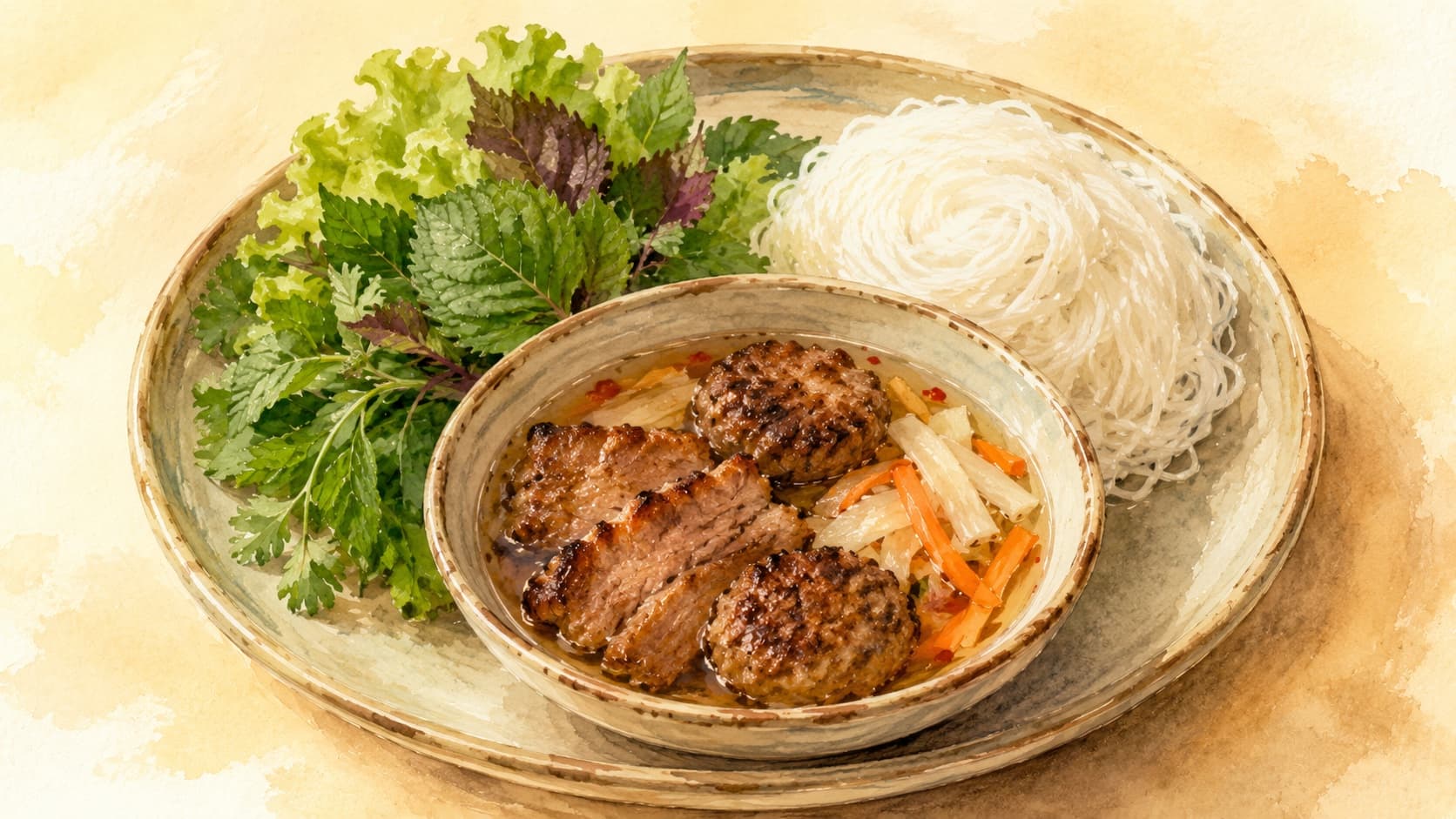
Serve the traditional Hanoi way: noodles on a separate plate or bowl, pork placed directly into the dipping sauce bowl, herbs alongside. Eat by dipping noodles and herbs into the sauce-and-pork bowl. This is not a soup — the liquid is the dipping sauce.
Tools you'll want
Why this works
Bún chả is built on a single piece of flavor logic: tension, not harmony. Most Western dipping sauces aim for a coherent, integrated flavor — the components blend into something unified. The nước chấm in bún chả is designed to do the opposite. It is simultaneously sweet (from the dissolved sugar), acidic (from the lime), salty and umami-rich (from the fish sauce, a salty, savory liquid made from fermented fish), and sharp (from the raw garlic and chili). These four qualities do not resolve into a single impression — they compete, and that competition is what makes the sauce interesting. A nước chấm where the lime dominates tastes flat. One where the fish sauce dominates tastes salty and one-dimensional. The correct version keeps all four in dynamic tension, and each dip of noodle or herb accentuates a different one depending on what else is in your mouth.
The grilling is the second structural element. Bún chả is a Hanoi dish, and in Hanoi it is traditionally cooked over charcoal. The caramelization of the pork — the deep, slightly charred browning on the exterior — is not incidental. The sugar in the marinade (the seasoned mixture the meat soaks in beforehand) participates in the Maillard reaction (the browning that develops flavor and color when food meets high heat) and caramelization simultaneously. When the pork surface reaches the 140–150°C range, the sugars in contact with the hot metal or charcoal undergo rapid browning. This browning produces hundreds of new aromatic compounds, including pyrazines and furanones that contribute the characteristic "grilled meat" fragrance that makes bún chả smell the way it does from a block away. Pale, oven-steamed pork would be a different dish.
The reason the patty needs vigorous mixing is myosin extraction. Pork shoulder contains significant myofibrillar proteins. When you mix the minced meat with salt (from the fish sauce) and physically work it, the myosin proteins begin to unfold and create sticky, gel-like bonds. This is the same mechanism that holds a sausage together and gives a burger patty its structural integrity. A patty made by gently combining the ingredients and immediately grilling will fall apart; a patty mixed for two minutes and rested for thirty minutes will hold its shape cleanly over the grill.
Common mistakes
Building a "harmonious" nước chấm.
Target: Each of the four flavor dimensions — sweet, sour, salty, sharp — should be ASSERTIVELY identifiable, not blended.
Why it matters: Nước chấm is supposed to feel like "a small argument, not a consensus." If you taste and think "this is balanced and pleasant," it's not aggressive enough — the sauce will read as muted against the smoky charcoal pork.
What to do: Standard base: 3 tbsp fish sauce + 3 tbsp sugar + 3 tbsp lime juice + 6 tbsp warm water + 2 cloves minced garlic + 1 small chili minced. Taste — each dimension should announce itself.
Workarounds:
- Too sweet? Add more lime, never more fish sauce (water-dilute first if needed).
- Too sharp/salty? Add water + sugar in equal parts.
Under-browning the pork.
Target: Deep mahogany-to-dark-brown caramelization on the exterior. Fat edges should show slight char.
Why it matters: There's a strong instinct to pull the patties off at "cooked through" interior temperature — but that's too early for surface browning. Bún chả is defined by aggressive Maillard caramelization; pale pork patties miss the dish entirely.
What to do: Preheat the grill / broiler properly (10 minutes). Don't move the patties for 2 minutes per side. Look for the dark color as your flavour cue — but confirm safety with the thermometer: ground-pork patties must reach 71 °C / 160 °F in the centre, and the dark colour is not by itself proof they are cooked through.
Workarounds:
- No proper grill? Broiler on high, rack at the top position is the best home substitute.
- Cast-iron skillet preheated for 5 minutes works for stove-only kitchens.
Patties too large or too thick.
Target: 4 cm wide × 1 cm thick patties.
Why it matters: Small thin patties cook through and develop full surface browning simultaneously. Large/thick patties either dry out before the inside cooks, OR the inside cooks before the exterior browns — both failures.
What to do: Form patties about the size of a half-dollar coin. Aim for uniformity — variability means uneven cooking.
Workarounds:
- For finger food, even smaller patties (3 cm) are fine.
- Pork belly slices (also classic for bún chả) can be used alongside patties for textural variation.
Wrong pork.
Target: Ground pork shoulder with 20 % fat content. NO leaner.
Why it matters: Bún chả's signature is the rendered fat (fat that has melted out of the meat as it cooks) that mingles with the charcoal smoke during grilling. Lean pork patties stay pale and steam-textured, missing the dish's defining quality.
What to do: Ask the butcher for "fatty pork mince" or grind shoulder yourself. Don't drain rendered fat from the cooked patties — that's flavor.
Workarounds:
- Only lean ground pork? Add 30 g pork belly diced fine + 20 g pork fat per 500 g lean — restores the ratio.
Serving noodles submerged in the sauce.
Target: Noodles served SEPARATELY in their own bowl, alongside the dipping sauce containing the pork.
Why it matters: Bún chả is NOT a noodle soup. The structure is: small handful of rice vermicelli + herb pile + dip into the meat-laden sauce per bite. Submerging everything turns it into "Vietnamese pho-ish soup" — different dish entirely.
What to do: Three separate bowls: noodles, herbs (basil, mint, perilla, lettuce), nước chấm + grilled pork. Diner assembles each bite.
Workarounds:
- For solo dinners, set up the components in a single tray — less authentic but still respects the structural intent.
Skipping the green papaya/carrot pickle.
Target: A small bowl of pickled green papaya + carrot, sweet-sour and lightly salted, served alongside.
Why it matters: The pickled vegetables sit in the nước chấm during the meal, softening and contributing crunch. Without them, the dipping sauce is one-dimensional.
What to do: Julienne, salt 10 minutes, drain, mix with rice vinegar + sugar. Rest 30 minutes minimum.
Workarounds:
- No green papaya? Daikon is the standard substitute.
- For winter, kohlrabi has the same crunch and mild sweetness.
What to look for
- The nước chấm before serving: each of the four dimensions — sweet, sour, salty, sharp — should be independently identifiable on the palate. If you taste it and think "nice," add more lime or more fish sauce.
- The patty mix before forming: slightly sticky, with white protein strands forming as you pull the meat apart. Under-mixed is loose and wet.
- The pork during grilling: the exterior should develop a deep mahogany to dark brown color. If it stays pale, the heat is too low.
- The pork belly: thin slices over high heat for 2–3 minutes per side; fat should render slightly and develop charred edges.
- The fat in the sauce bowl: when the grilled pork is placed in the nước chấm, the pork fat will begin to dissolve into the sauce, giving it a slight haze. This is correct and desirable — it rounds the acid without softening the sharp edges.
Chef's view
There is a version of this dish that is delicate and clean and restaurant-beautiful, and there is the version that works. The version that works has pork with genuine char on it, a sauce that makes you slightly squint, and herbs that you grab with your fingers and dip rather than arrange. I find it difficult to make bún chả correctly in an environment where I am also trying to be tidy. The dish is designed for high heat, confident seasoning, and eating with your hands. Restaurants have tamed it. The street versions — charcoal smoke filling a narrow alley, the sauce in a small metal bowl — have not.
The nước chấm ratio I use is not fixed. I adjust it every time based on the lime and the fish sauce of the day. Some limes are more acidic than others; some fish sauce brands are saltier. The ratio in this recipe is a starting framework. The only reliable test is tasting and adjusting.
Chef Test Notes
I tested three grilling methods for the pork patties with identical marinade:
- Broiler, oven rack at highest position, 5 minutes per side: Good caramelization on the top surface, underside stayed pale and damp from the juices released. The second side needs flipping to a dry part of the rack.
- Cast iron skillet over high heat: Best surface caramelization. The pork fat renders into the pan and the patties fry in their own fat for the last minute, which produces the deepest browning. The downside: more spattering.
- Charcoal grill: The correct version. The smoke penetrates slightly, the direct radiant heat from below gives a different quality of surface browning, and the fat dripping onto coals produces aromatic smoke that cycles back onto the pork. If you have a charcoal setup, use it.
I also tested nước chấm acidity ratios — lime juice vs. rice vinegar:
- Lime juice only: Brighter, more aromatic, slightly more bitter on the finish. More volatile — the citrus character fades after 30 minutes.
- Rice vinegar only: Flatter, more neutral, more stable over time. Tastes more like a generic dipping sauce.
- Half lime, half rice vinegar: Best for the bowl-sitting application — the lime provides initial aromatics, the vinegar provides background acidity that doesn't fade as the pork sits in it.
A note from HCMC
Bún chả is technically a Hanoi dish and sits outside HCMC's natural food vocabulary. The southern food culture does not particularly claim it. The best version I found in HCMC was in a small shophouse in District 3, run by a northern family who had moved south and refused to adapt the dish to southern taste — no extra sweetness, no modifications. The charcoal smoke came straight out into the narrow street. The woman cooking did not look up when I came in; she was watching the grill.
Related glossary terms
- Maillard reaction — the browning chemistry that makes charcoal-grilled pork smell the way it does; the sauce alone cannot create this.
- Umami — fish sauce is one of the most concentrated umami sources in Vietnamese cooking; it is doing more than providing salt in the nước chấm.
- Emulsion — the fat from grilled pork slowly dissolving into the acid sauce is a loose emulsification; it is why the sauce gets rounder as the meal progresses.
Get the essays in your inbox — free
Weekly notes on flavor, fermentation, and food history — the writing behind the Atlas of Flavor. No spam; unsubscribe anytime.