
Bún Bò Huế (Hue-Style Spicy Beef and Pork Noodle Soup)
Built on lemongrass and shrimp paste, not star anise — learning to distinguish it from phở is learning to hear the architecture of two different broth philosophies working from different foundations.
Contents (8 sections)▾
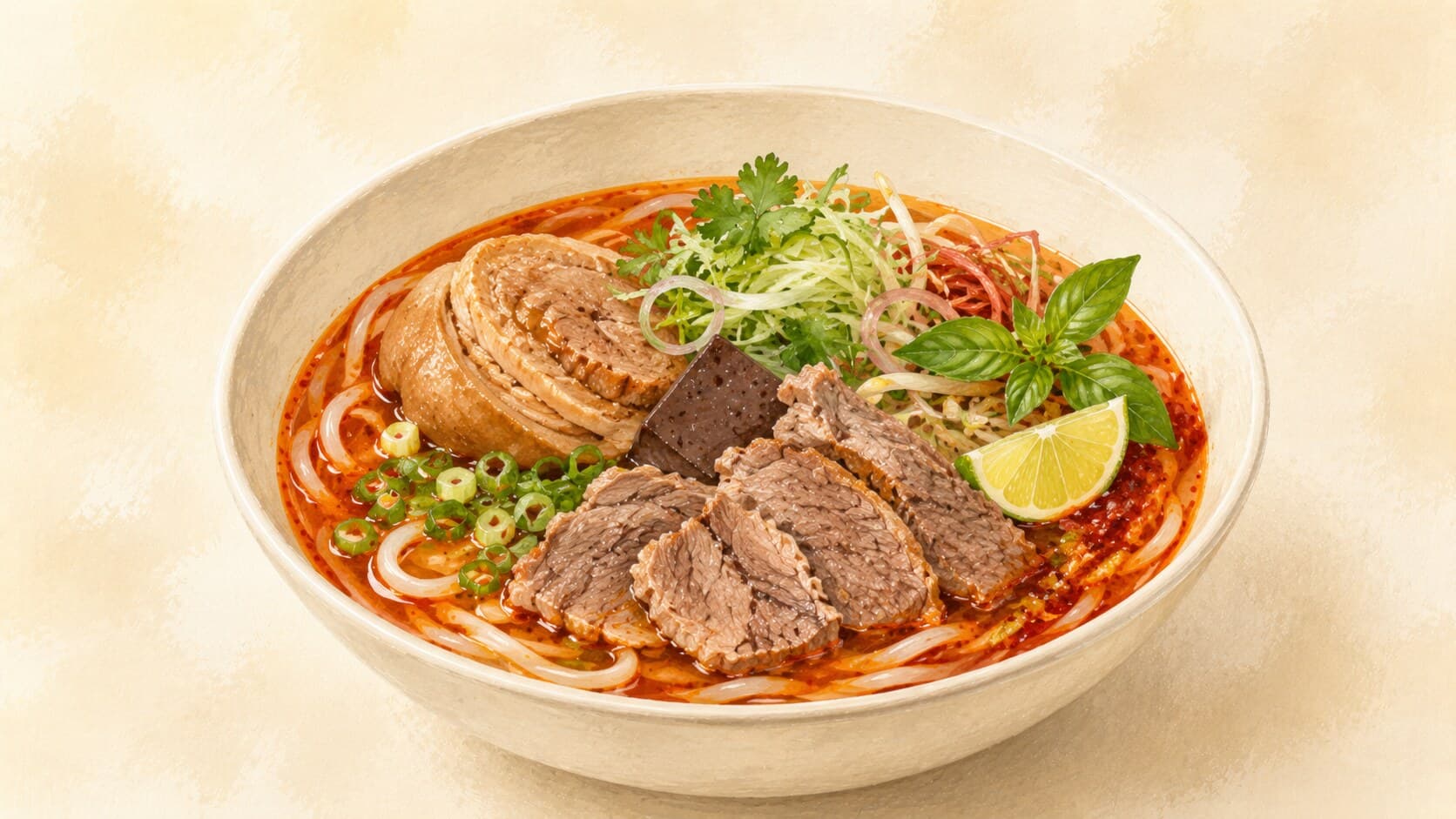
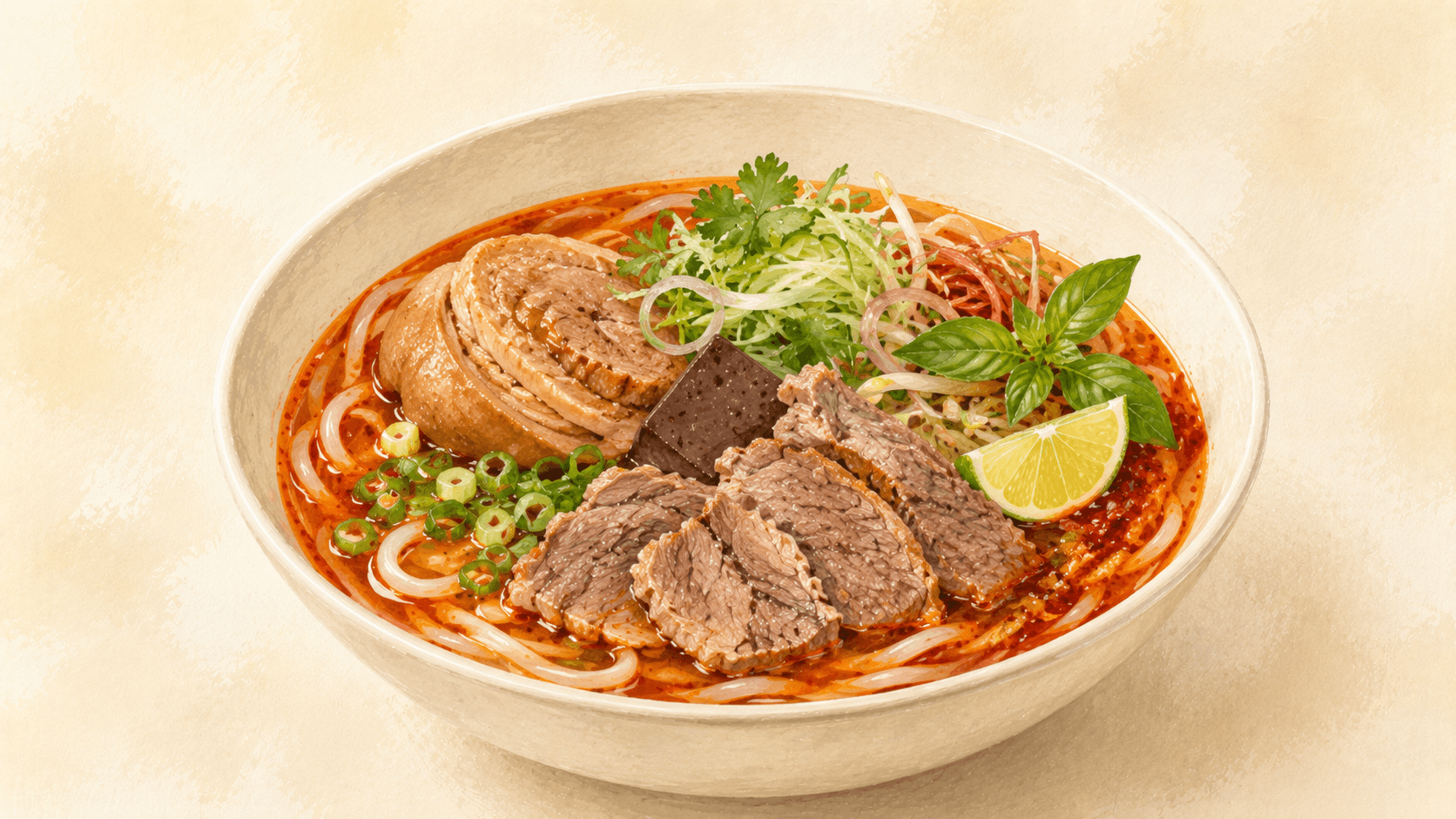
Ingredients
- **For the broth:**
- 500 g beef shank or beef bone
- 500 g pork trotters (chân giò), cut into pieces
- 3 stalks lemongrass, bruised and cut into 5 cm pieces
- 4 dried red chilies (or 1–2 fresh)
- 2 tbsp mắm ruốc (fermented shrimp paste) — non-negotiable for authentic flavor
- 2 tbsp fish sauce
- 1 tbsp sugar
- 1 tsp annatto seeds (for color — or ½ tsp turmeric as substitute)
- **For serving:**
- 400 g thick round rice noodles (bún bò Huế noodles are thicker than phở noodles)
- Bean sprouts
- Banana blossom, shredded
- Perilla, mint, lime
- Chili oil or fresh chili
Steps
Blanch beef and pork trotters: place in cold water, bring to a boil, drain, rinse thoroughly. This removes blood proteins and impurities that would cloud the broth and produce off-flavors.
In a dry pan, briefly toast the lemongrass and dried chilies until fragrant — about 2 minutes. Crush the lemongrass stalks with the flat of a knife to expose more surface area for extraction.
Add blanched meat and bones to a pot with 3 L cold water. Bring to a gentle simmer over medium heat. Skim any remaining foam in the first 15 minutes.
In a small pan, heat annatto seeds in 2 tbsp neutral oil for about 2 minutes until the oil turns deep red-orange. Strain out the seeds and pour the colored oil into the broth. This is what gives bún bò Huế its distinctive reddish hue.
Add lemongrass, chilies, fish sauce, and sugar. Reduce to a steady simmer — not a rolling boil. Simmer for 2.5–3 hours until the bones are soft and the broth is deeply savory.
Add mắm ruốc: dissolve 2 tbsp in a small amount of hot broth first, then stir into the pot. Do not boil after adding — the fermented shrimp paste's volatile aromatic compounds dissipate quickly above a bare simmer. Season to taste with additional fish sauce.
Remove the bones and pork trotters; slice the tender meat into serving portions. Cook noodles separately according to package directions, divide into deep bowls, add meat, and ladle the hot broth over. Serve immediately with fresh herbs, bean sprouts, banana blossom, and lime.
Tools you'll want
- · Instant-read digital thermometer
Why this works
The difference between bún bò Huế and phở is architectural. Phở is built on the Maillard products (the browned, savory compounds that form when food is cooked over high heat) of charred onion and ginger and the sweet aromatic extraction of star anise, cinnamon, and clove — a north Vietnamese broth that draws heavily from Chinese spice trade influence. Bún bò Huế dispenses with all of that. It is built on lemongrass (a fragrant, citrusy stalk used to flavor broths) (citral and myrcene — the dominant volatile compounds in the stalk) and mắm ruốc (fermented shrimp paste), which provides a deep glutamate base without the sweetness of star anise. The result is a broth that is spicier, more pungent, more minerally assertive, and notably less sweet.
The annatto seeds are purely a chromophore — they contain bixin, a carotenoid pigment that is fat-soluble. Heating annatto in oil extracts the bixin and produces the deep reddish-orange color that makes bún bò Huế immediately identifiable. The seeds themselves contribute almost no flavor at the concentrations used here. You are extracting color into fat, not seasoning the broth. This is why you must strain the seeds out before adding the colored oil.
The sequence of adding mắm ruốc matters. Fermented shrimp paste contains both volatile aromatic compounds (which you want in the broth) and heat-sensitive esters that degrade above a simmer. If you add the paste early and boil the broth for two hours, you are driving off the aromatic top notes and leaving behind the more aggressive minerally base. The correct moment is at the end, dissolved in hot broth and stirred in over low heat. The broth should never return to a full boil after the paste is added.
Common mistakes
Boiling the broth hard.
Target: Bare simmer (85 °C) — surface barely moving, occasional bubble breaking through.
Why it matters: Hard boiling emulsifies fat into the broth, producing a cloudy, fatty result with heavy mouthfeel. It also accelerates extraction of bitter compounds from the marrow. The gentle simmer is a different extraction mechanism, not just patience for patience's sake.
What to do: Bring to a boil to start, then immediately reduce heat to lowest setting. Use a flame tamer if your stove won't go low enough.
Workarounds:
- For unattended cooking, transfer pot to a 130 °C oven after initial boil — most stable temperature.
Adding mắm ruốc at the start.
Target: Dissolve mắm ruốc (Vietnamese shrimp paste) and add in the FINAL 15 minutes of cooking only.
Why it matters: This is the most consequential timing error. The paste's aromatic compounds are volatile — added at the start and simmered for 3 hours, they evaporate, leaving only the fermented funk without the aromatic complexity that defines bún bò Huế.
What to do: Mix 2 tbsp mắm ruốc with 1/2 cup of warm broth, strain to remove gritty bits, add to the pot in the last 15 minutes.
Workarounds:
- No mắm ruốc? Use 2 tbsp fish sauce (a salty, savory liquid made from fermented fish) + 1 tsp anchovy paste as a less-funky approximation.
- For a milder profile, use half the mắm ruốc plus extra fish sauce.
Using phở noodles.
Target: Thick round rice noodles ("bún bò"), about the diameter of a pencil.
Why it matters: Phở noodles are flat and thinner — they don't have the resistance to stand up to bún bò Huế's heavy, spicy broth. The texture of every bite changes: too thin = the broth overwhelms the noodle; too flat = wrong mouthfeel.
What to do: Source from a Vietnamese grocery (look for "bún bò" or thick round vermicelli).
Workarounds:
- No bún bò? Thick udon is the closest non-Vietnamese substitute (texturally, not flavor-wise).
- Round rice vermicelli (any thickness over 2 mm) is acceptable.
Skipping the bone blanching (a quick pre-boil that's drained off to clean the bones).
Target: Cold-water start: cover bones with cold water, bring to a hard boil for 10 minutes, drain, scrub with a brush, rinse thoroughly. THEN start the actual broth.
Why it matters: Beef shank and pork trotters carry blood proteins that coagulate into grey scum when heated. Without blanching, those proteins disperse permanently into your 3-hour broth, producing off-flavors no amount of skimming can remove.
What to do: This is a 10-minute investment that protects 3 hours of simmering. Non-negotiable.
Workarounds:
- Pre-blanched bones (from some Vietnamese butchers) save time but verify they were properly handled.
Under-building the lemongrass.
Target: Minimum 3 stalks, thoroughly bruised with the flat side of a knife to crack the interior cells.
Why it matters: Lemongrass's aromatic oils are stored in the interior cells. Un-bruised stalks release only a fraction of the compounds — your broth tastes "thin" even with the right ingredients.
What to do: Trim ends, smash the stalks lengthwise with a heavy knife handle. Tie with kitchen string for easier removal.
Workarounds:
- Frozen lemongrass works almost as well as fresh — use 4 stalks instead of 3 to compensate.
- Lemongrass paste from a tube — use 2 tbsp + 1 tbsp lemon zest. Different but workable.
Skipping the annatto oil (dầu màu điều).
Target: Make annatto-infused oil: 3 tbsp oil + 1 tbsp annatto seeds, simmer 5 minutes, strain. Add to broth.
Why it matters: The deep orange-red color of bún bò Huế comes from annatto seeds infused into oil. Without it, the broth is brown — visually wrong and missing the slight peppery note annatto contributes.
What to do: Source annatto seeds (or buy pre-made annatto oil) from a Latin or Asian grocery. The infusion takes 5 minutes.
Workarounds:
- No annatto? Mild paprika + a touch of tomato paste approximates the color (not the flavor).
Wrong garnishes.
Target: Banana blossom, mung bean sprouts, mint, perilla, sawtooth coriander, lime wedge, sliced banana flower, chili-shrimp paste — all served alongside.
Why it matters: Bún bò Huế is built on aggressive garnishing at the table. Each garnish adds a layer: bean sprouts for crunch, herbs for freshness, lime for acid, chili paste for additional heat. Without the table-side build, the bowl reads as one-note.
What to do: Set up garnish plates before serving. Diners add their own.
Workarounds:
- No banana blossom? Skip it — most herbs and bean sprouts cover the textural variety.
What to look for
- The broth color before serving: A deep amber with a reddish-orange tint from the annatto — not pale, not brown. If the color is pale, the annatto extraction was insufficient.
- The surface of the broth: A thin layer of orange-tinted fat should be visible — not a thick grease layer, not fully defatted. This is the flavor layer.
- The mắm ruốc integration: The broth should smell assertive and complex — lemongrass forward, with a fermented depth underneath. If the fermented note is absent, the paste was added too early and the aromatics dissipated.
- The pork trotter texture: After 3 hours of simmering, the gelatinous skin should be soft enough to cut with the side of a chopstick. Underdone trotter is chewy in a bad way.
- The noodle separation: Cook noodles separately and rinse briefly with hot water before adding to bowls — if they sit in the broth while it's still simmering, they overcook and become mushy within minutes.
Chef's view
The thing I had to unlearn about bún bò Huế is that it is not a variant of phở. I spent time thinking of it as the spicier, more southern cousin of phở bò — a modification of the same template. That framing is wrong. It is a different dish from a different culinary tradition — Central Vietnamese, not Northern — and it draws on ingredients that the North uses rarely. The mắm ruốc is the tell: fermented shrimp paste does not appear in phở at all. The lemongrass is the other tell — present in bún bò Huế at a concentration where you cannot miss it, absent in phở.
The best bowl I had in Vietnam was in a small shop in Huế that served nothing else. The broth was darker than HCMC versions, noticeably spicier, and the shrimp paste concentration was higher — the fermented note was the first thing you tasted, not the lemongrass. In HCMC, the same dish is often adjusted for Southern Vietnamese palates that prefer less intensity. That's a legitimate adaptation. But knowing the Huế original changes how you read the HCMC version.
Chef Test Notes
Test 1 — mắm ruốc timing. I made two identical batches: one with the paste added at the 30-minute mark (simmered 2.5 hours), one with paste added in the last 10 minutes. The late-addition broth had a dramatically more complex aromatic profile — lemongrass notes were distinct, the fermented base had lift to it. The early-addition broth had fermented depth without the top notes. Both were edible; only one tasted correct.
Test 2 — lemongrass bruising vs. slicing. Bruised stalks (smashed with a knife back) versus thinly sliced rings in the same broth. The bruised version extracted more citral — the broth had a more pronounced lemongrass character. Sliced rings produced a slightly sharper, more vegetal lemongrass note. I prefer bruised for the rounder extraction, though sliced works in a pinch.
Test 3 — annatto amount. 1 tsp vs. 1 tbsp in 2 tbsp oil. The 1 tsp version produced a pale amber broth with only a hint of red tint. The 1 tbsp version was markedly more orange-red and visually correct. The flavor difference was negligible — the annatto is carrying color, not taste — but the visual identity of the dish depends on the color.
A note from HCMC
In Huế itself, the broth runs significantly spicier than HCMC versions — the same dish on a spectrum from barely-tingling in the south to genuinely fiery if you order it in the original city. The shrimp paste concentration is also regional. I have found that HCMC versions often use less mắm ruốc and more sugar to balance toward Southern palates. I cook mine to roughly the midpoint: assertive but not aggressive, with the fermented note audible but not the only note.
Related glossary terms
- Mắm ruốc — fermented shrimp paste; the foundational seasoning of bún bò Huế and a key differentiator from Northern Vietnamese broths.
- Annatto — a fat-soluble red-orange pigment extracted from annatto seeds, used for color rather than flavor.
- Extraction — the process of drawing flavor compounds from solid ingredients into liquid through heat and time.
Get the essays in your inbox — free
Weekly notes on flavor, fermentation, and food history — the writing behind the Atlas of Flavor. No spam; unsubscribe anytime.