
Aioli
Garlic and olive oil emulsified by hand in a mortar — the Provençal sauce that is both simpler than mayonnaise in concept and more demanding in execution, with garlic as the structural soul.
Contents (9 sections)▾
Ingredients
- 4–6 cloves garlic (about 25–30 g), peeled
- 1 egg yolk — pasteurized, or from a shell egg treated to destroy Salmonella (for the modern method; omit for the purist traditional method, which is egg-free — see the safety note)
- 150 ml extra-virgin olive oil (good quality — this is where the flavor lives)
- 1 tbsp fresh lemon juice
- 1/2 tsp fine sea salt
- Optional: 1 tsp cold water (to help emulsify if needed)
Steps
Traditional mortar method: Place the peeled garlic cloves and salt in a large stone mortar. Pound and grind to a smooth, completely homogeneous paste — no visible garlic pieces, no fibers. This typically takes 5–8 minutes of steady grinding. The paste should look like a pale ivory cream and smell intensely of raw garlic. The garlic proteins and the grinding action are the primary emulsifying force in this traditional version.
Begin adding olive oil drop by drop — literally one or two drops at a time — while grinding continuously in the same circular motion. As the oil is incorporated into the garlic paste, an emulsion forms: the tiny oil droplets are trapped in the water phase of the garlic juice by the proteins and mucilages released during grinding. Do not rush. If the emulsion breaks (the sauce becomes oily and separated), you went too fast.
After the first 30–40 ml has been incorporated successfully and the emulsion is stable and thick, you can increase to a thin, steady stream. Continue adding oil, grinding and stirring to incorporate. If the aioli becomes very stiff, add 1 tsp of cold water to loosen it slightly and restore fluidity. Finish with lemon juice, mix thoroughly, and taste for salt.
Modern blender method (with egg yolk): Place the egg yolk, salt, and lemon juice in a blender or food processor. Pulse briefly. With the machine running, add the olive oil in a very thin stream — literally drops for the first 30 seconds. Once the emulsion has formed and the mixture is thick, you can add the oil faster. Crush the garlic to a paste (using a garlic press or mortar) and add to the finished emulsion. Taste and adjust.
Both methods produce aioli, but they are different sauces in texture and character. The mortar-only aioli is denser, more aromatic, and has a direct garlic intensity. The egg-yolk version is creamier, more stable, and has a lighter mouthfeel. For serving with bouillabaisse or as a dipping sauce for vegetables (Le Grand Aïoli), the traditional method is authentic. For a versatile sandwich or condiment aioli, the egg-yolk version is more practical.
Tools you'll want
Why this works
Aioli is one of the oldest emulsions (smooth, stable mixes of oil and a water-based liquid that would normally separate) in recorded European cooking. In its most traditional Provençal form, it contains only two ingredients: garlic and olive oil, with salt. No egg. The garlic itself provides the emulsifying agents — a combination of mucilaginous polysaccharides in the garlic cells and proteins released during the grinding — that hold the oil droplets suspended in the garlic's water phase.
This is fundamentally different from mayonnaise, which relies on lecithin in egg yolk as its primary emulsifier. In aioli, the emulsification is less stable and more physically demanding to achieve — the reason the traditional method takes 15–20 minutes of steady mortar work is that you need to build the emulsion slowly and mechanically, relying on the grinding action to continuously create new surface area for the oil to disperse into. Every drop of olive oil must be physically incorporated before the next is added; rushing breaks the emulsion.
The garlic's flavor in aioli is different from cooked garlic or garlic in a sauce. Raw garlic contains allicin, formed when the enzyme alliinase contacts the substrate alliin when the cell walls are ruptured — this is why crushed garlic is much more pungent than sliced garlic (more cell wall rupture, more contact). In the mortar-grinding process, the maximum cell wall damage occurs, releasing the maximum allicin. The result is an intense, sharp, slightly hot garlic character that is central to authentic aioli. Garlic that has been crushed and then left to rest for 10 minutes (allowing the allicin reaction to complete) is even more pungent.
Olive oil is not interchangeable with neutral oil here. The flavor is the point — a peppery, grassy, slightly bitter extra-virgin olive oil is what gives the sauce its Provençal character. The fat crystal structure of olive oil also differs from refined vegetable oils, affecting the emulsion's texture. High-quality olive oil produces a thicker, more stable aioli than light or mild olive oil.
The modern version with egg yolk is a practical adaptation, not the traditional form. It is more stable, faster to make, and the egg yolk's lecithin provides a strong structural scaffold for the emulsion. The flavor is somewhat different — the raw garlic is added after emulsification rather than being the structural agent, which means it plays a flavoring role rather than a structural one.
Safety — the modern (egg-yolk) version. The blender version is built on a raw egg yolk that is never cooked, so it carries a Salmonella risk. Grinding, salt, lemon, olive oil, and refrigeration do not remove that hazard — chilling only slows bacteria, and this method has no validated Salmonella kill step. Use a pasteurized egg yolk, or a yolk from a shell egg treated to destroy Salmonella — an ordinary "fresh" or washed shell egg is not the same thing. Pregnant people, infants and young children, older adults, and anyone immunocompromised should use pasteurized egg — or make the traditional mortar version, which contains no egg at all.
Common mistakes
Refrigerator-cold garlic.
Target: Room-temperature garlic (out of fridge 30 minutes before grinding).
Why it matters: Cold garlic doesn't grind smoothly — fibrous pieces remain that won't emulsify. Room-temperature garlic crushes cleanly into a paste that disperses oil properly.
What to do: Take garlic out ahead. Smash with the flat of a knife before mortar/pestle work to start the cellular breakdown.
Workarounds:
- For consistent results, grate garlic on a microplane — extreme cellular breakdown produces near-instant emulsification.
Adding oil too fast.
Target: Drop-by-drop for the first 30 seconds, accelerating only after thickening visible.
Why it matters: Oil added faster than the existing emulsion can absorb breaks the sauce. Once broken, recovery is harder than starting over.
What to do: Patient drip. Watch the emulsion thicken before increasing the flow.
Workarounds:
- Broken aioli? Start a new pasteurized egg yolk in a clean bowl. Slowly whisk the broken aioli into the fresh yolk — recovers the emulsion.
Too few garlic cloves.
Target: At least 1 large clove per person — traditional Provençal aioli uses MORE.
Why it matters: Timid aioli (one clove per 150 ml oil) tastes like barely-flavored mayonnaise. Aioli's name means "garlic and oil" — the garlic should be present.
What to do: Don't fear the garlic. 2–3 cloves minimum for a small batch.
Workarounds:
- For milder flavor, blanch garlic (briefly dip it in boiling water, then stop the cooking) for 30 seconds in boiling water first — tames sharpness while preserving aroma.
Skipping salt in the grinding step.
Target: Add salt to garlic BEFORE adding any oil.
Why it matters: Salt draws moisture from garlic cells (osmosis), creating additional liquid for oil to disperse into. Holding salt until the end misses this mechanical advantage.
What to do: Crush garlic + salt together in the mortar until smooth. THEN start the oil.
Workarounds:
- For deeper umami, use fleur de sel or other flaky finishing salts.
Using bland olive oil.
Target: Fruity, peppery Spanish or Italian EVOO. Not extra-pungent — pure bitter EVOO produces bitter aioli.
Why it matters: Olive oil is 90% of the flavor. The oil should taste delicious on its own — that's how you'll taste it on the final plate.
What to do: Smell-test before using. Should smell green and grassy.
Workarounds:
- For balanced flavor without pure pungency, blend EVOO with neutral oil (50/50) — softer profile, still flavorful.
What to look for
- Garlic paste before oil: smooth, homogeneous, pale ivory-cream. No fibers, no chunks. Smells intensely of raw garlic.
- After first 20 ml of oil: slightly thickened, no oil pooling. The emulsion is forming.
- Fully emulsified: thick, will hold shape in the mortar, no oiliness. Spoon lifts clean.
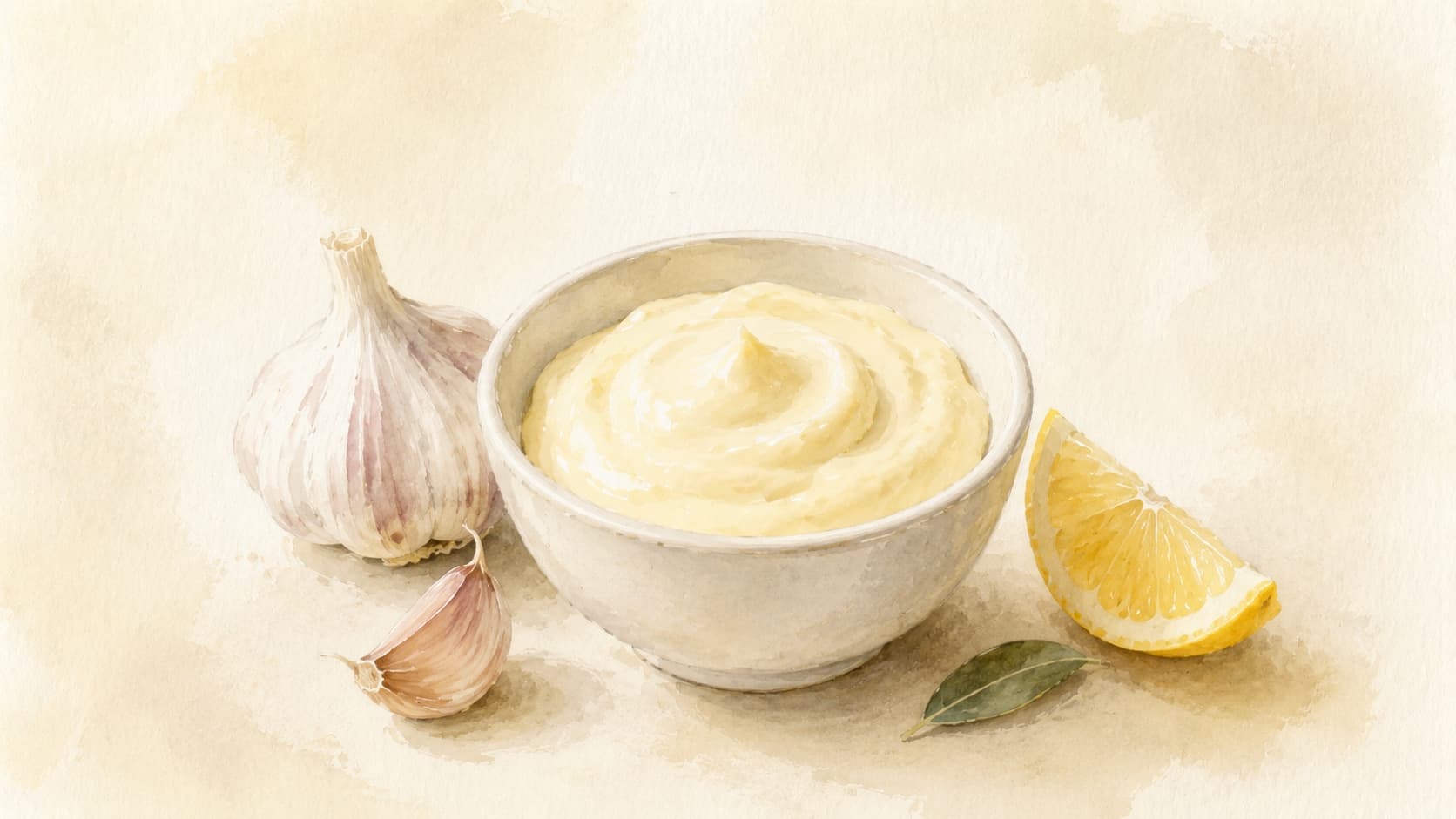
- Finished aioli: dense, slightly glossy, pale ivory. Tastes of garlic first, olive oil second.
Chef's view
The traditional aioli without egg is uncompromising — in flavor, in effort, and in what it demands from the cook's attention. A traditional Provençal cook would not consider the egg-yolk version aioli at all; they would call it a garlic mayonnaise (which is also good, just different). The argument for the mortar method is entirely qualitative: the sauce tastes like garlic and olive oil, not like cream or egg. It is structurally transparent in a way that the egg-yolk version is not.
Le Grand Aïoli — the Provençal feast where aioli is served as a communal sauce alongside salt cod, hard-boiled eggs, boiled vegetables, and snails — requires the traditional form. The intensity of the garlic is not just a preference; it is the point of the dish. The accompaniments are chosen specifically to be mild enough that the aioli can overwhelm them gently.
For a modern kitchen serving aioli as a condiment — with fries, grilled chicken, fish tacos — the egg-yolk version is the sensible choice. Made with pasteurized egg it holds in the refrigerator for 3–4 days — chilling slows spoilage but is not a Salmonella kill step — and the garlic level can be adjusted without affecting the emulsion. Use the traditional method when aioli is the centerpiece; use the modern method when it is a component.
Chef Test Notes
Tested both methods in parallel, blind. The mortar aioli had a noticeably sharper, more immediate garlic heat and a slightly denser, less smooth texture. The egg-yolk version was creamier and milder. Tasters without context preferred the egg-yolk version; tasters with context (served alongside poached cod and vegetables as a Grand Aïoli) strongly preferred the traditional version. The appropriate method depends entirely on the context of service.
A note on history
Aioli is one of the few sauces in the French repertoire with a clear pre-classical origin. The Provençal word aioli is a compound of ai (garlic) and òli (oil) in the Occitan language — the language of southern France before northern French became dominant. The sauce predates anything Carême or Escoffier wrote, predates French classical cuisine, and belongs to the Mediterranean tradition of oil-and-garlic emulsions that includes the Spanish allioli and the Catalan alioli. It entered the formal French repertoire late — Escoffier mentions it, but as a regional specialty rather than a foundational sauce.
Related glossary terms
- Emulsion — the fundamental structure of aioli: oil droplets dispersed in a water phase
- Allicin — the compound produced when garlic cell walls are ruptured, responsible for the sharp garlic character
- Mayonnaise — the egg-yolk cold emulsion that shares aioli's structural logic but differs in fat type and flavoring agent
Continue the lesson
After the audio walkthrough above:
- Take it further with the book: see Part 2: Sauces and Structure for the deeper treatment of emulsification.
- Why this lesson sticks: Aioli trains emulsification, garlic-infusing, and texture control.
Get the essays in your inbox — free
Weekly notes on flavor, fermentation, and food history — the writing behind the Atlas of Flavor. No spam; unsubscribe anytime.