
Tomato Sauce Base
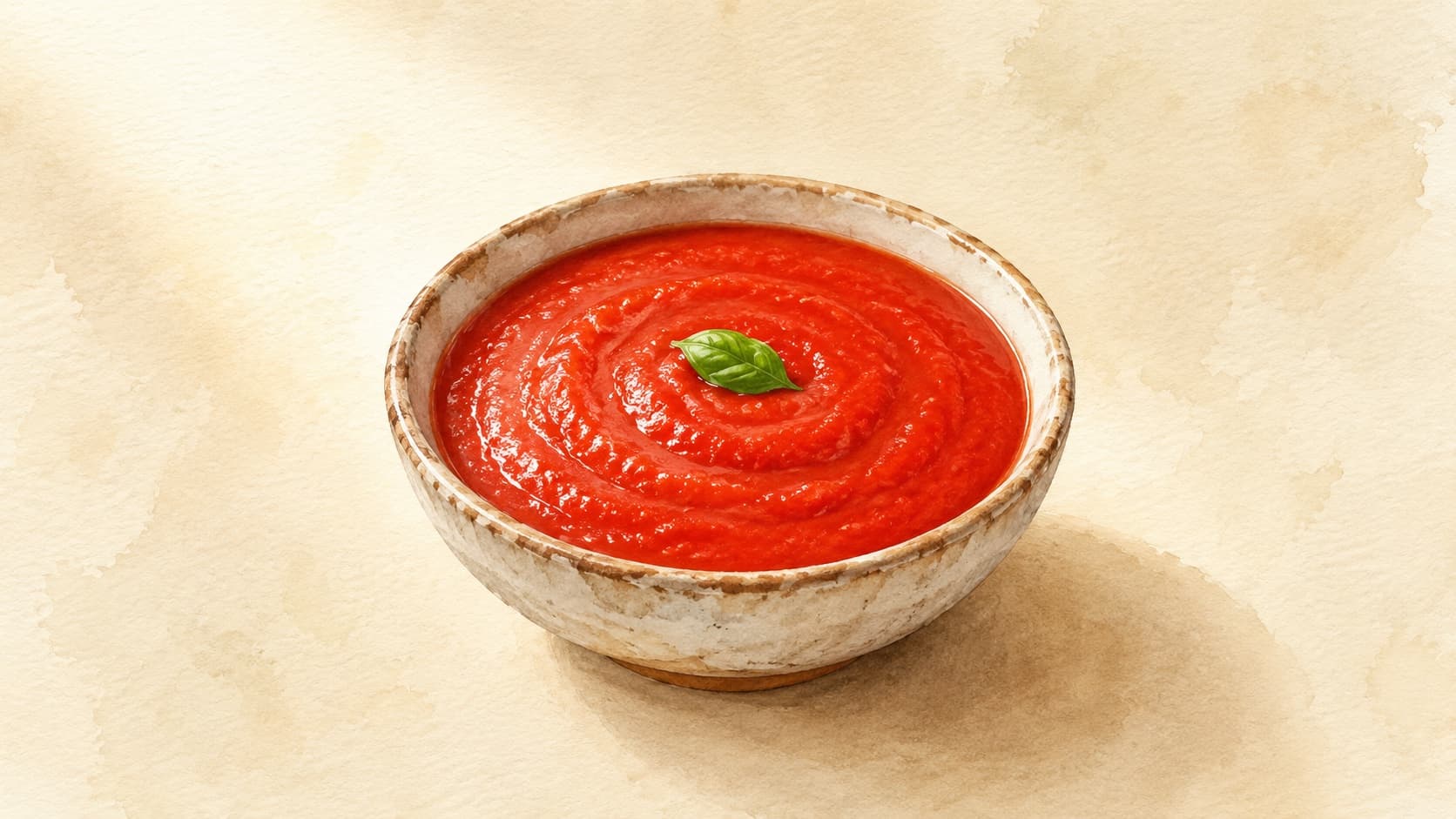
This versatile tomato sauce base is essential for a variety of Italian dishes, delivering rich flavor and umami.
Contents (6 sections)▾
Ingredients
- 800 g canned whole tomatoes
- 2 tbsp olive oil
- 1 medium onion, finely chopped
- 2 cloves garlic, minced
- 1 tsp salt
- 1 tsp sugar
- 1/2 tsp black pepper
- 1 tsp dried oregano
- 1/2 tsp dried basil
- Fresh basil leaves, for garnish (to taste)
Steps
In a large saucepan, heat the olive oil over medium heat for about 2 minutes until shimmering.
Add the chopped onion and sauté for 5-7 minutes until translucent, stirring occasionally to prevent burning.
Stir in the minced garlic and cook for an additional 1-2 minutes until fragrant, being careful not to let it brown.
Pour in the canned tomatoes, breaking them up with a spoon, and add salt, sugar, black pepper, oregano, and basil. Bring to a simmer over medium heat.
Reduce the heat to low and let the sauce simmer for 10-12 minutes, stirring occasionally to ensure it thickens evenly.
Why this works
The foundation of this tomato sauce base lies in the balance of sweet and savory elements, achieved through careful sautéing and simmering. The onions, when cooked until translucent, release natural sugars that enhance the sauce's sweetness, while the garlic adds depth of flavor. The canned tomatoes provide a rich umami profile, and the herbs enhance the taste, embodying the essence of Italian cuisine. If the sauce seems too acidic, adjusting with a pinch more sugar can help balance the flavors, creating a harmonious blend. This technique ensures that the sauce has a rich, concentrated flavor and a smooth texture, making it versatile for pasta dishes, pizza, or as a base for stews.
Common mistakes
- Garlic burned. Garlic in cold oil that comes up slowly is sweet; garlic in hot oil within 30 seconds is bitter. Sweat (cook gently in fat over low heat to soften without browning) — don't sear.
- Tomato not cooked long enough. Canned tomato has a raw, metallic edge for the first 8–10 minutes. Push past it to where the oil splits and rises as a thin orange ring — that's the doneness flag.
- Lid on the whole time. A trapped-steam pan stays watery; lid cracked or off lets the sauce concentrate.
- Adding basil too early. Basil cooked for 30 minutes tastes like hay. Tear and stir in during the last 60 seconds, off heat.
What to look for
- Garlic: faint golden edges, sweet aroma, no smoke. If you smell sharpness, lower the heat and continue.
- The split: a thin ring of oil separates around the edge of the pan when the sauce is ready — the canned-tomato "raw" taste is gone. (The "split" is when the oil clearly breaks away from the tomato — a visual sign the sauce has reduced enough.)
- Color: deep brick-red, not bright crimson. Bright = undercooked.
- Spoon test: drag a wooden spoon across the bottom of the pan — the trail should hold open for 1 second before the sauce closes back.
Substitutions
- Whole peeled canned tomato → passata. Passata (Italian-style tomatoes cooked and sieved into a smooth purée, sold in jars or cartons) is smoother, faster (no crushing), slightly thinner result.
- San Marzano → any good whole-peeled. Look for low acidity on the label; brand matters less than ripeness.
- Fresh tomato (in season only) → 1 kg fresh = 1 × 800 g can. Score, blanch, peel, then proceed. Out of season, canned wins every time.
- Olive oil → butter (50/50 with oil). A French direction; warmer, rounder sauce.
Make-ahead and storage
- Refrigerate within 2 hours of cooking. Keeps 5 days in a sealed container; flavor improves on day 2.
- Freeze up to 3 months. Portion in 250–500 ml containers; leave 2 cm headspace as the sauce expands when freezing.
- Reheat gently with a splash of water. High heat darkens the sauce and turns it acrid; warm to a barely-simmer.
- Surface oil cap (for refrigerator life). A thin film of olive oil on top, in a clean jar, slows oxidation and adds 1–2 days to fridge life.
- Safety note: Cooked tomato sauce should not sit at room temperature longer than 2 hours (1 hour above 30 °C). If the surface shows mold or the aroma turns sharp or alcoholic, discard rather than judge by smell alone.
Get the essays in your inbox — free
Weekly notes on flavor, fermentation, and food history — the writing behind the Atlas of Flavor. No spam; unsubscribe anytime.