
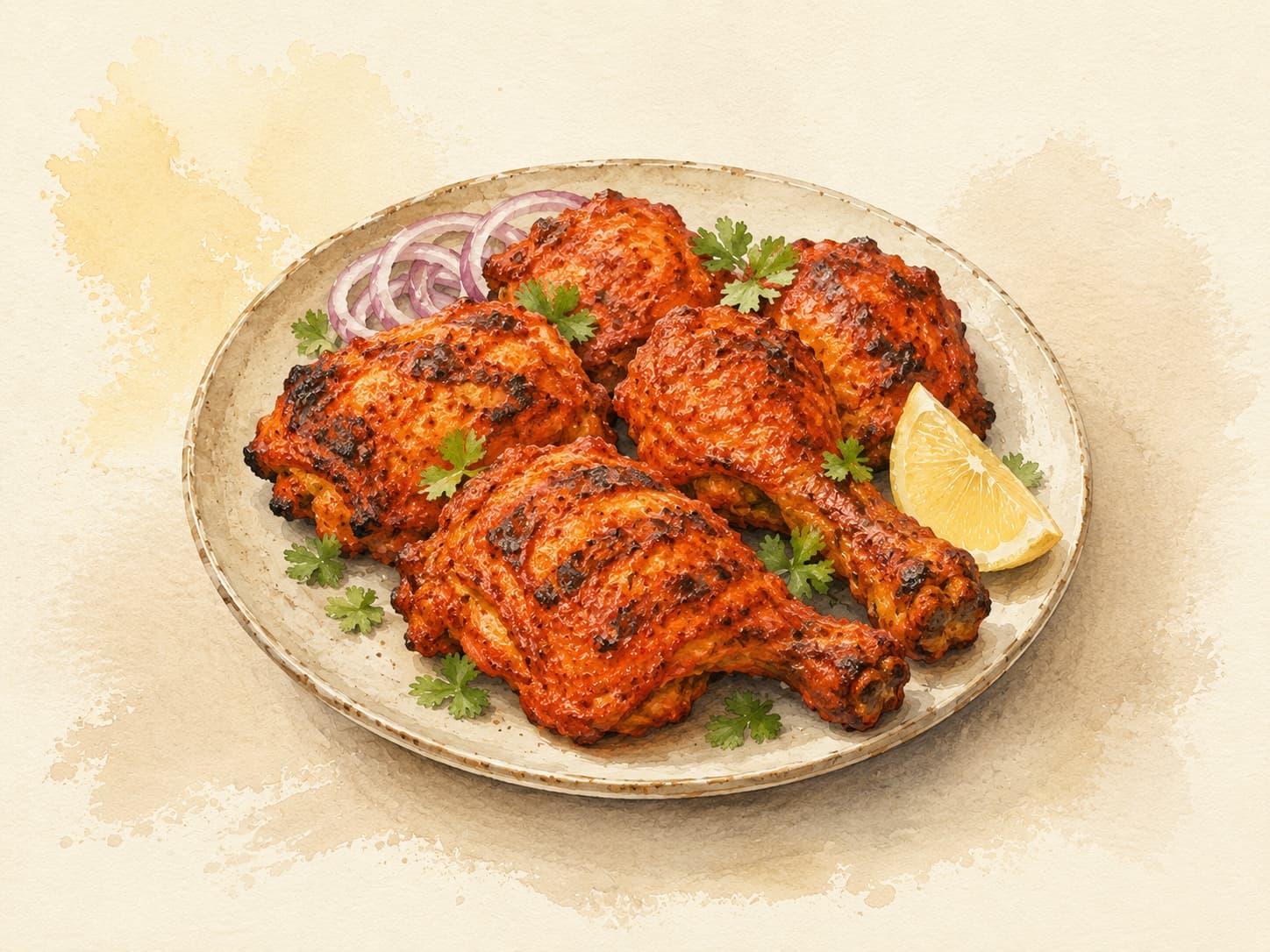
Tandoori Chicken
A marinated chicken dish cooked at high temperatures to achieve a distinct smoky flavor.
Contents (5 sections)▾
Ingredients
- 4 chicken thighs, bone-in and skinless
- 1 cup plain yogurt
- 2 tablespoons vegetable oil
- 2 tablespoons lemon juice
- 1 tablespoon tandoori masala
- 1 teaspoon ground cumin
- 1 teaspoon smoked paprika
- Salt to taste
Steps
In a bowl, combine yogurt, oil, lemon juice, tandoori masala, cumin, paprika, and salt.
Add chicken thighs to the marinade, ensuring they are fully coated.
Refrigerate for at least 1 hour, preferably overnight.
Preheat a grill or oven to high heat.
Cook the chicken for 15-20 minutes, turning occasionally. The high heat and the spice rub darken the surface fast, so char is not proof of doneness — cook until the thickest part reaches 74 °C / 165 °F on an instant-read thermometer with no pink at the bone.
Serve hot, garnished with fresh cilantro.
Tools you'll want
Why this works
Tandoori chicken gains its flavor from marination. Yogurt tenderizes the meat, while spices infuse it with depth. High cooking temperatures create a Maillard reaction, leading to a charred exterior. The acidity from lemon juice enhances the flavor and helps in moisture retention.
A well-balanced marinade is crucial. The right proportions of yogurt and spices allow for even coating. This ensures consistent flavor throughout the chicken. Marinating for several hours, ideally overnight, maximizes the absorption of flavors.
Cooking at a high temperature is key to achieving a crispy exterior. It also contributes to the signature smoky taste associated with traditional tandoori cooking. Maintain proper heat to avoid drying out the chicken.
Common mistakes
Single-stage marinade instead of two-stage.
Target: Two-stage marinade: (1) lemon juice + salt + ginger-garlic paste for 30 min, (2) yogurt + spices for 4–24 hours.
Why it matters: Yogurt's pH is too high for effective enzymatic tenderization. The acidic first-stage opens the meat fibers; the yogurt-spice second stage infuses flavor and provides the gentle tenderization. Single-stage marinade leaves the chicken less tender and less flavorful.
What to do: Score the chicken deeply (it lets the marinade penetrate). Mix lemon + salt + ginger-garlic. Rub in for 30 minutes. Then add yogurt + masala (an Indian blend of toasted ground spices, the flavor base of curries and tandoori dishes) for the long marinade.
Workarounds:
- Time short? Single-stage marinade still works, just less ideal — at minimum, marinate 4 hours.
Using cold tandoori marinade in cold meat.
Target: Marinate at ROOM TEMPERATURE for the final 1 hour before cooking (after refrigerated overnight marinade).
Why it matters: Cold-from-the-fridge chicken hitting hot grill cooks unevenly — outside burns while inside stays raw. Room-temperature start lets heat distribute evenly.
What to do: Remove from fridge 1 hour before cooking. The yogurt should be at room temp too.
Workarounds:
- Bring marinade temperature up faster with a 10-minute soak in warm water (sealed in a bag).
Using boneless chicken.
Target: Bone-in chicken — thighs, drumsticks, or full leg quarters. NOT boneless breast.
Why it matters: Tandoori chicken is cooked at very high heat. Boneless chicken (especially breast) cooks through in 5 minutes — by the time you get the signature char, it's dry. Bone-in pieces have the thermal mass to survive the heat and stay juicy.
What to do: Use thighs or drumsticks. Score the meat through to the bone for marinade penetration.
Workarounds:
- Boneless chicken? Cook on lower heat (190 °C) for longer time. Different but workable.
Wrong cooking surface or heat.
Target: Tandoor oven (a traditional Indian cylindrical clay oven heated with charcoal or wood that can hit 500 °C+), or a very hot grill / broiler set to maximum heat. Cooking time 8–10 minutes.
Why it matters: Tandoori chicken's defining feature is the high-heat char — deep red-black spots on a creamy yogurt-coated surface. Conventional oven at 200 °C produces baked chicken with red coating, not tandoori.
What to do: Use highest heat available. Broiler on max, cast-iron pan at smoking, or grill with hot coals.
Workarounds:
- Home version: roast at 230 °C for 8 minutes, finish under the broiler for 2 minutes — produces the closest approximation.
Not scoring the chicken.
Target: Make deep cuts (down to the bone) in the meat, 2 cm apart.
Why it matters: Marinade penetrates only ~3 mm into intact meat. Scoring multiplies the marinade-exposed surface area and lets flavor reach the interior. The signature deep red color comes from this penetration.
What to do: Sharp knife, deep cuts at 2 cm intervals. Both sides of larger pieces.
Workarounds:
- For deeper penetration, use a Jaccard meat tenderizer (or fork-stab) before marinating.
Skipping the final ghee or butter brush.
Target: Brush with melted ghee (Indian clarified butter with the milk solids removed, prized for its high smoke point and nutty flavor) or butter twice during cooking — once at 5 minutes, once when removing.
Why it matters: The ghee adds fat (yogurt marinade is low-fat), browning, and crispiness that distinguish tandoori from "yogurt-marinated chicken."
What to do: Have a small bowl of melted ghee and pastry brush ready. Brush midway and at end.
Workarounds:
- For deeper flavor, add 1/2 tsp kashmiri chili powder to the ghee — produces a more vibrant red.
What to look for
- A vibrant red color on the surface.
- Charred, crispy edges indicating high heat cooking.
- An internal temperature of 74°C / 165°F at the thickest part on a food thermometer — this is the safety check; char, red colour, and clear juices vary and are not reliable on their own.
- A fragrant, smoky aroma.
- Tender meat that pulls away easily from the bone.
Chef's view
Tandoori chicken is steeped in Indian culinary tradition. It reflects the fusion of flavors and techniques passed down through generations. The method of cooking in a tandoor, a clay oven, imparts a unique smoky flavor, typically challenging to replicate at home without one.
The use of yogurt as a marinade is not just for flavor but also for enhancing texture. It plays a crucial role in making the chicken tender, a technique used widely in various cuisines. Understanding these nuances can improve your cooking and deepen your appreciation for this classic dish.
<!-- beginner-glossed v1 -->Get the essays in your inbox — free
Weekly notes on flavor, fermentation, and food history — the writing behind the Atlas of Flavor. No spam; unsubscribe anytime.