
Soft Scrambled Eggs
Low heat, constant movement, remove from heat before they look done. The recipe is about understanding protein coagulation — and when to stop it.
Contents (7 sections)▾
Ingredients
- 4 large eggs (about 200 g total, shelled)
- 20 g cold unsalted butter, cut into small cubes
- 15 g crème fraîche or heavy cream (optional, for finish)
- 2 g fine sea salt
- 1 g white pepper
Steps
Crack the eggs into a bowl and beat them until the yolks and whites are fully combined and no streaks of white remain — but do not overbeat. You want a unified liquid, not a froth. A froth incorporates air, which will produce dry, airy curds. Beat with a fork, not a whisk.
Place a small, heavy-bottomed saucepan (not a non-stick frying pan) over the lowest heat your stove allows. Add about half the butter. Let it melt fully and foam gently before adding the eggs. The pan should feel warm when you hold your palm 3 cm above it — not hot.
Pour in the eggs. Do not stir immediately. Wait 10 seconds, then begin moving the eggs slowly and continuously with a silicone spatula or wooden spoon, making broad, gentle strokes from the edge toward the center. The idea is not to break up curds but to fold liquid egg over the setting edges, keeping the whole mass moving as one. This is the continuous-movement technique that distinguishes soft scrambled eggs from set scrambled eggs.
Every 30 seconds, pull the pan off the heat for 10 seconds while continuing to stir. This is the most important step. Egg proteins coagulate between 63°C and 70°C; at 70°C and above, they contract, expel moisture, and become rubbery. Pulling the pan off the heat slows coagulation and gives you more control over when to stop. Watch for the texture to shift from liquid to barely set — small, soft, creamy folds with no liquid pooling at the bottom of the pan.
With ordinary (non-pasteurized) eggs, keep cooking gently until the eggs are fully set — no sheen of liquid egg left — then remove from heat and stir in the remaining butter cubes and the crème fraîche if using; residual heat only refines the texture, it is not a Salmonella kill step. For a soft, creamy finish, use eggs pasteurized in the shell (through to the contents) or a pasteurized egg product — for everyone, not only high-risk diners — and you may take them off at about 80% set, adding the butter and crème fraîche off the heat. Season with salt and white pepper. Serve immediately on warm plates.
Tools you'll want
Why this works
Scrambled eggs are a lesson in protein coagulation at low temperature. The chemistry is simple: egg proteins are long, folded chains that begin to unfold and bond to each other (denature and coagulate) when heated. The question is at what rate, and how far you let the process go.
Egg whites begin coagulating around 63°C. Yolks begin slightly higher, around 65°C. The window between "just set" and "rubbery" is narrow — roughly 5–8°C. High heat drives the temperature through that window quickly and unevenly: the bottom of the pan sets into firm rubber while the top is still liquid, producing the uneven, dry scramble most people know from a diner. Low heat keeps the entire mass in the 63–70°C window long enough to set uniformly into the small, creamy curds that define soft scrambled eggs.
The continuous movement technique works in conjunction with low heat. Moving the eggs constantly prevents any one spot from staying in contact with the hot pan surface long enough to overcook. The spatula folds the liquid egg over the setting portions from the outside in — coagulating the outside more slowly, distributing the heat more evenly, and producing smaller, more uniform curds than a static cook would.
The finishing step — removing from heat before the eggs look done and adding cold butter — applies the same principle in reverse. Residual heat in the egg mass and the pan continues to coagulate the proteins even after the burner is off. Pulling early, and reducing the temperature with cold butter, is what gives the final preparation its characteristic softness and surface sheen. Without this step, carryover cooking takes the eggs past the point of peak texture while they're being carried to the table.
Safety note. Soft-scrambled eggs are pulled when about 80% set — small glossy curds with a film of liquid still visible — so this method does not include a validated step that reliably kills Salmonella; the residual heat that finishes them on the plate, the soft look, and the timing are not proof that it is safe. To keep this soft texture safely, use eggs pasteurized in the shell, through to the contents (heat-treated to destroy Salmonella) or a pasteurized liquid egg product; an ordinary egg that has only been washed, graded, or surface-sanitized — no matter how fresh — is not pasteurized through the contents. For high-risk diners (pregnancy, immunocompromised, very young or old), use pasteurized eggs, or continue cooking until the eggs are fully set and the curds are dry to the spoon. The dish loses the silky texture but gains the safer doneness.
Common mistakes
Using high heat.
Target: Lowest heat your stove allows. Eggs should take 6-8 minutes, not 2.
Why it matters: High heat drives temperature past the 63-70°C window in seconds — bottom turns rubbery while top stays raw. The diner-style scramble that defines mediocre eggs. Low heat keeps the whole mass in the coagulation window evenly.
What to do: Lowest setting. Pan should feel warm (not hot) when you hover your palm 3 cm above it before adding eggs.
Workarounds:
- Stove too hot even at lowest → use the bain-marie (double boiler) method: bowl over barely simmering water; takes longer but completely controllable.
Not moving the eggs enough.
Target: Continuous slow folding with silicone spatula or wooden spoon — broad strokes from edge to center, every 1-2 seconds.
Why it matters: Static eggs = bottom over-cooks, top stays liquid. Continuous movement distributes heat and creates the small uniform curds that define soft scrambled eggs.
What to do: Don't multitask. Both hands on the pan and spatula throughout the cook.
Workarounds:
- Tired arm → switch hands, but never stop moving.
Cooking until they look done.
Target: Remove from heat at 80% set — still glossy, with creamy folds, slight wet sheen visible.
Why it matters: Carryover heat continues to cook eggs for 30-60 seconds after pan leaves heat. By the time eggs LOOK done in the pan, they're over by the time they reach the plate.
What to do: Pull at "almost done". Add cold butter off-heat to stop the cook and finish texture.
Workarounds:
- Want firmer texture → still pull at 85% set; even firm scrambled eggs benefit from controlled stopping point.
Using a non-stick frying pan (a coated skillet designed for fast release, which heats fast and wide).
Target: Small heavy-bottomed saucepan (18 cm, 2-3 mm wall thickness) — not a wide nonstick frying pan.
Why it matters: Nonstick is designed for fast release and uniform heat — wrong for slow scrambling. Wide flat surface spreads eggs and sets them fast; saucepan walls keep eggs in a tight mass.
What to do: Saucepan with rounded walls. Stainless or tri-ply ideal.
Workarounds:
- Only have nonstick → drop to even lower heat, accept slightly different texture.
Salting too early.
Target: Salt at the end, or just before eggs go in the pan. Never overnight or hours ahead.
Why it matters: Salt in raw eggs breaks down protein network over time — eggs separate into watery liquid + tighter protein clumps. Surface salt at the end seasons without disrupting structure.
What to do: Beat eggs first, salt later. Last 30 seconds of cook or after plating.
Workarounds:
- If salting in advance is unavoidable → keep to under 5 minutes before cooking; minimal disruption.
Skipping the cold butter finish.
Target: Cold butter cubes (5-10 g) stirred in off-heat at the end. Optional: 1 tbsp crème fraîche (a thick, slightly tangy cultured cream from France).
Why it matters: The cold butter drops the temperature, halts coagulation, and emulsifies into the eggs — adds the signature glossy creamy sheen. Without it, eggs are good but not great.
What to do: Pull pan off heat, drop in cold butter cubes, stir until incorporated. Plate immediately.
Workarounds:
- Dairy-free → cold neutral oil works less well; crème fraîche or sour cream substitutes are closer.
What to look for
- Before cooking: a uniform amber-yellow liquid with no visible white streaks. Dense, not frothy.
- Early in the pan: the edges begin to turn opaque and pale. This is coagulation starting at the contact surface.
- Mid-cook: small, soft folds forming. The mass is moving as a unit; no liquid pooling at the bottom.
- Cue to remove from heat: about 80% set — still glossy, with creamy folds that move fluidly. This is the moment to pull and finish with cold butter.
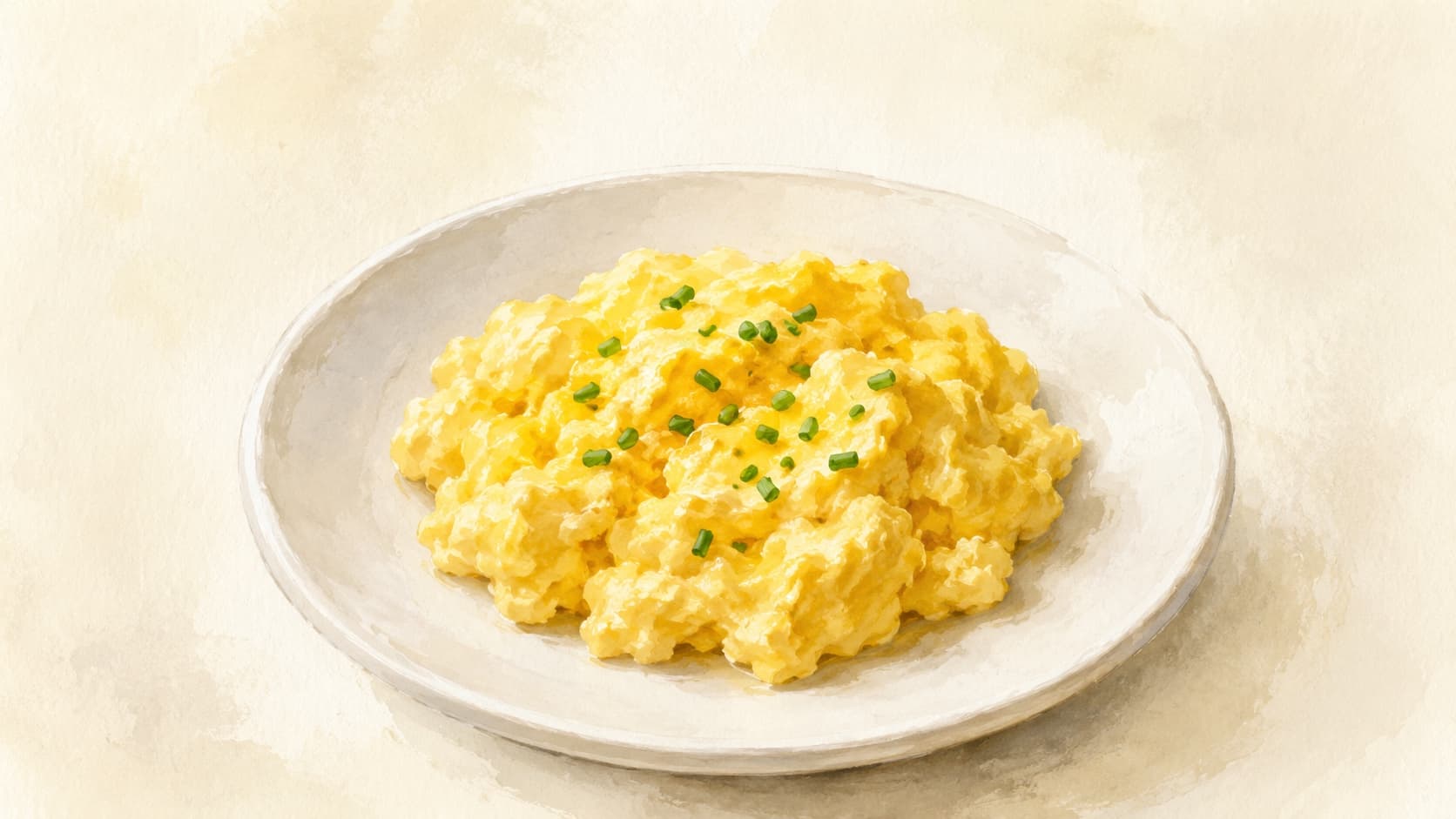
- Plated: small, glossy, cream-colored folds. They should not hold a rigid shape but settle softly on the plate.
Chef's view
The difference between soft scrambled eggs as described here and the standard diner scramble is not really about the recipe — the ingredients are nearly identical. It is entirely about the temperature and time relationship. A cook who understands protein coagulation at 63–70°C can make soft scrambled eggs on any stove, with any pan, and no recipe at all. A cook who doesn't understand it will overshoot every time, regardless of what the recipe says.
Gordon Ramsay's famous version uses a similar technique but moves the pan on and off heat more aggressively and finishes with crème fraîche. Jacques Pépin's version uses a bain-marie (a double-boiler setup where the cooking vessel sits over hot water rather than direct heat) for the most controlled possible heat. Both arrive at the same texture from different directions. What they share is low effective temperature and constant movement.
My preference is the saucepan method without a bain-marie for home cooking — the bain-marie takes significantly longer and requires a second vessel. The on-off heat technique with a small, thick saucepan gives sufficient control with less setup. The key variable to internalize is the carryover: the eggs will continue cooking for 30–60 seconds after the pan leaves the heat. Factor that in before you decide to pull them.
Chef Test Notes
Tested with different pan types: a small saucepan (18 cm diameter, 2.4 mm tri-ply), a non-stick frying pan, and a stainless steel frying pan. The small saucepan produced the most consistent results — the rounded base and tall walls kept the egg mass contained and made the on-off heat technique easier. The non-stick frying pan produced flat, fast-coagulating curds without the creamy folds. The stainless frying pan scorched slightly at the contact point before the eggs were done. Also tested crème fraîche vs heavy cream as the finishing addition: crème fraîche added a mild acidity that balanced the richness; heavy cream was cleaner but less interesting.
Related glossary terms
- Protein coagulation — the mechanism at the center of this technique
- Maillard reaction — the contrast: this recipe deliberately avoids the Maillard reaction
- Emulsion — the yolk fat dispersed in the white water phase creates the egg's starting structure
Get the essays in your inbox — free
Weekly notes on flavor, fermentation, and food history — the writing behind the Atlas of Flavor. No spam; unsubscribe anytime.