
Sauce Robert
Onion, white wine, mustard, and demi-glace: one of the oldest named sauces in French culinary literature, recorded by La Varenne in 1651, the mustard goes in off the heat because boiling it destroys the volatile compounds responsible for its sharpness.
Contents (8 sections)▾
Ingredients
- 250 ml demi-glace (or good reduced veal stock if demi-glace is unavailable)
- 150 ml dry white wine
- 1 medium onion (about 150 g / 5 oz), very finely chopped
- 30 g unsalted butter, divided
- 1 heaped tsp Dijon mustard (about 15 g)
- Salt and white pepper
- Optional: 1 tsp white wine vinegar to sharpen
Steps
Melt half the butter (15 g) in a saucepan over medium-low heat. Add the finely chopped onion and sweat gently, without browning, until completely soft and translucent — about 10 minutes. The onion should collapse into the butter without taking any colour. If it begins to brown, reduce heat.
Add the white wine. Increase heat to medium and reduce the wine by two-thirds — about 8 minutes. The mixture will smell sharp initially; as the alcohol cooks off and the onion-wine liquid concentrates, the sharpness will round.
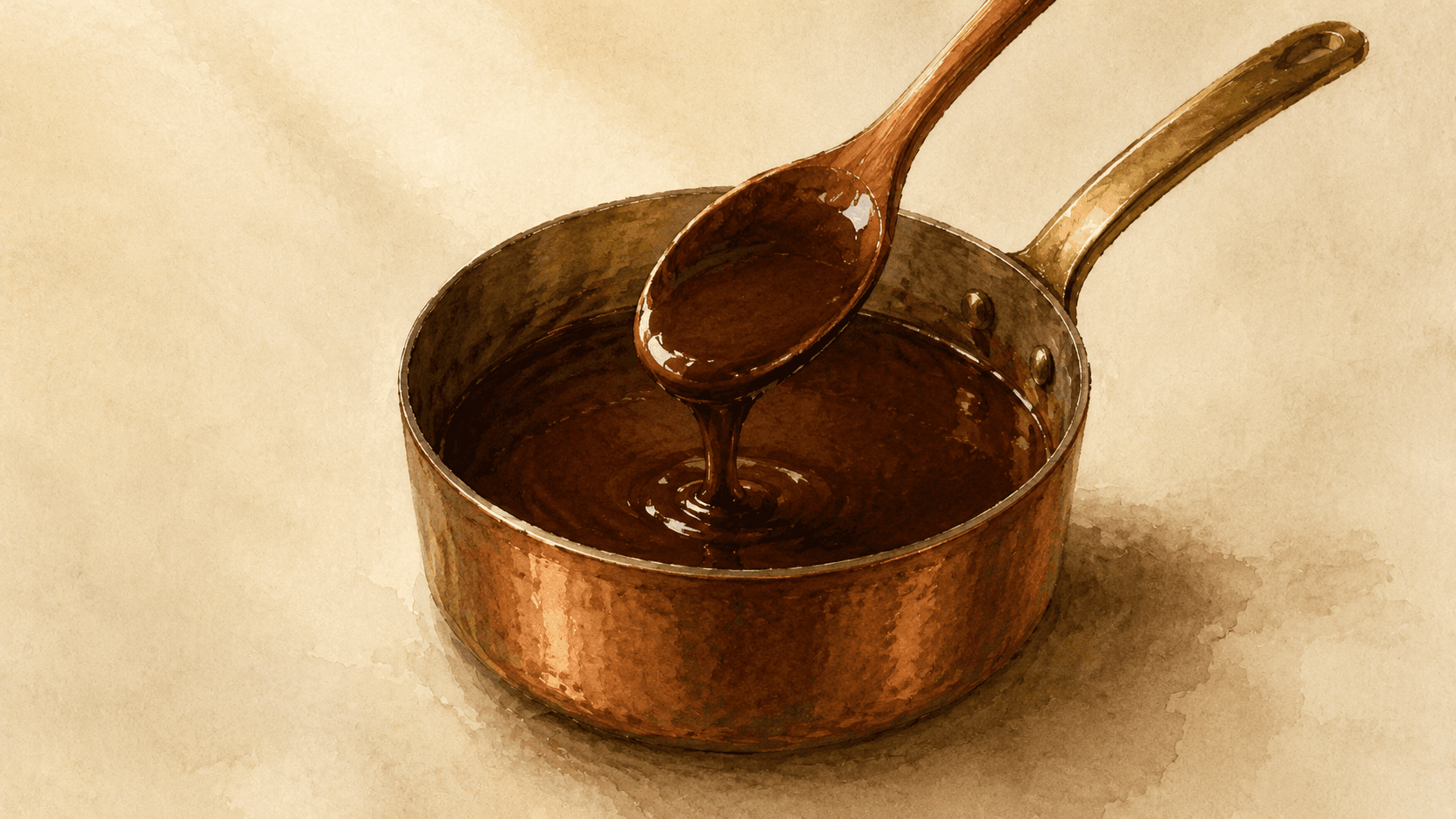
Add the demi-glace. Bring to a gentle simmer and reduce by about one quarter, until the sauce coats a spoon lightly — about 7 minutes. The sauce should be a glossy, medium-bodied brown. Season with salt and white pepper.
Remove from the heat entirely. Add the Dijon mustard and the remaining 15 g of cold butter, and whisk vigorously to incorporate. The cold butter emulsifies into the sauce and adds gloss; the mustard provides the characteristic sharpness. Do not return the sauce to the boil after adding mustard — heat above 60°C causes the volatile isothiocyanates in the mustard to degrade rapidly, and the sauce loses its distinctive character. Serve immediately or hold in a bain-marie below 60°C.
Tools you'll want
- · Tri-ply stainless saucepan (1.5–2 qt / 18cm)
- · Balloon whisk (24cm / 11-inch)
- · Digital kitchen scale (gram precision)
- · Instant-read digital thermometer
Why this works
Sauce Robert is built on the same basic architecture as most classical French compound sauces: a flavored reduction added to a concentrated base. The flavored reduction here is onion and white wine; the concentrated base is demi-glace. The mustard is the finishing element that separates sauce Robert from all other brown onion sauces.
The mustard chemistry is the most important technical point in the recipe. Dijon mustard's characteristic pungency comes from isothiocyanates — volatile sulfur compounds produced when the mustard seed's myrosinase enzyme contacts glucosinolate substrates. These isothiocyanates are highly volatile at cooking temperatures. Above 60°C, they degrade rapidly and the characteristic sharp, nose-clearing mustard note disappears, leaving only the acidity of the vinegar base and the mild flavor of the mustard proteins. This is why the mustard goes in off the heat, last. This is not a guideline for preference; it is a chemical necessity if you want the sauce to actually taste of mustard.
The onion preparation is equally important. A sauce Robert built with browned onion (as in a standard onion sauce) is a different animal — the Maillard-caramelized onion flavors compete with and mask the mustard. The correct preparation is onion sweated without color — the goal is to extract the onion's sweet, savory compounds while avoiding the bitter, toasted notes of browning. A properly sweated onion collapses into the butter over 10 slow minutes, soft and translucent, and contributes sweetness and body to the wine reduction without darkening the sauce.
The white wine reduction step drives off ethanol and concentrates the tartaric and malic acids from the wine, along with its aromatic esters. This acid component is what provides the forward brightness that gives sauce Robert its character against the deep backdrop of the demi-glace.
Common mistakes
Browning the onion.
Target: Sweat onion 10 min — collapsed, soft, translucent, no color whatsoever.
Why it matters: Browned onion produces a different sauce — toasted flavors compete with and mask mustard. The classical Robert needs sweet, savory onion without Maillard.
What to do: Low heat, butter, lid on. Onion should melt rather than fry.
Workarounds:
- Onion started to brown → restart with new onion; the color is irreversible.
Adding mustard over heat.
Target: Off heat, mustard added at the very end after butter mount.
Why it matters: Above 60°C, mustard's isothiocyanates (the sharp pungent compounds) volatilize. Heated mustard tastes flat and bitter — the entire point of sauce Robert is lost.
What to do: Pull sauce off heat completely before adding mustard. Whisk in vigorously.
Workarounds:
- Mustard heated by mistake → add fresh mustard at the end to restore the pungent note; old mustard's flavor stays as background.
Using whole-grain mustard.
Target: Smooth Dijon mustard — the classical choice. Whole-grain is a variation, not the original.
Why it matters: Whole-grain has intact seeds = less free isothiocyanate per spoonful. Smooth Dijon has the highest concentration of the volatile compound that defines the sauce.
What to do: Buy good French Dijon (Maille, Edmond Fallot). Use sparingly — it's strong.
Workarounds:
- Whole-grain only available → use 1.5x the amount; closer but still less sharp.
Under-reducing the wine.
Target: Reduce wine by at least 2/3 before adding demi-glace — until syrupy and barely coating the bottom.
Why it matters: Insufficient reduction = raw alcohol in the sauce + diluted demi-glace. The wine should concentrate to almost a glaze before the brown stock arrives.
What to do: Visual check: pan should look almost empty before adding demi-glace.
Workarounds:
- Used too much wine → reduce 5 extra minutes; the time compensates.
Skipping the butter mount.
Target: Cold butter cubes swirled in off-heat at the very end — adds gloss, body, rounds the acid.
Why it matters: Without monter au beurre, sauce Robert is sharper and flatter — mustard's edge is unsupported. The butter is structural.
What to do: 15-20 g cold butter, off-heat, swirl until incorporated. Plate immediately.
Workarounds:
- Dairy-free → cold neutral oil works less well; cold cream is acceptable substitute.
What to look for
- Sweating onion (10 minutes): collapsed, soft, translucent, no brown colour whatsoever. Smells sweet and savory, not toasted.
- After wine reduction: reduced by two thirds, mixture is thick and syrupy; smell is wine-savory, no raw alcohol. The liquid barely coats the bottom of the pan.
- After adding demi-glace and reducing: medium-bodied brown sauce, coats a spoon lightly. Color is medium brown — lighter than demi-glace alone.
- After mustard and butter: glossy, slightly lighter in color. Taste: sharp forward note from mustard, rounded by butter, savory depth from demi-glace. The mustard note should be prominent but not harsh.
Chef's view
Sauce Robert (a classical French mustard pan sauce traditionally served with pork) is the French sauce that most clearly demonstrates the principle of "addition at the end without heat" — a technique the classical French kitchen uses for butter (beurre blanc, monter au beurre — French for "to mount with butter," meaning to whisk cold butter into a warm sauce off the heat for gloss and body), for cream in some sauce reductions, and here for mustard. The point is always the same: some flavoring compounds are volatile and heat-fragile; they survive only if added to a warm (not hot) sauce at the last moment.
The pork pairing is not accidental. Mustard has a long traditional affinity for pork — mustard's pungency cuts through pork fat and tempers it, the way acid in a vinaigrette cuts through the fat of a rich salad. Sauce Robert appears in the classic pairing with pork chops (côtes de porc à la Robert) and with duck, both relatively fatty proteins. The sauce's acidity and sharpness perform a balancing function against the fat, not just a flavoring one.
My view on demi-glace (a French brown sauce reduced by roughly half from a base of brown stock and espagnole) substitution: a good, well-reduced veal stock produces a credible sauce Robert, but a true demi-glace produces a noticeably deeper, more rounded result. The demi-glace is worth making for this sauce specifically because it is the only base that gives the mustard-wine combination the depth it needs.
Chef Test Notes
I tested the mustard addition at three temperatures: at 80°C (sauce returned to a simmer), at 60°C (sauce off heat but still quite warm), and at 45°C (sauce off heat and slightly cooled). The 80°C version had almost no perceptible mustard character — the sauce tasted like a brown onion sauce. The 60°C version had a mild mustard note. The 45°C version had the full, sharp, characteristic sauce Robert finish. The temperature of the sauce at mustard addition is the single most impactful variable in this recipe.
A note on history
Sauce Robert is among the oldest named preparations in the French culinary canon. François Pierre La Varenne (1615–1678) recorded it in Le Cuisinier François (1651), the foundational text of classical French cuisine that preceded both Carême and Escoffier by more than a century. La Varenne's original recipe was simpler — onion, wine, vinegar, butter — but the mustard element and the brown sauce base were present in various forms within a generation. By the 18th century, sauce Robert had its mustard and its brown sauce base firmly in place. Antonin Carême and later Escoffier both included it in their systematic classifications. The sauce appears in Escoffier's Le Guide Culinaire (1903) in a form nearly identical to this recipe.
The name "Robert" is unresolved. La Varenne does not explain it; subsequent culinary historians have speculated that it referred to a specific cook, a specific region, or simply a common given name applied to the preparation. Unlike sauce béarnaise (clearly named for the Béarn region) or sauce bordelaise (clearly named for Bordeaux), sauce Robert's name has no secure etymology beyond the text record.
Related glossary terms
- Demi-glace — the brown base that provides the foundation and depth of the sauce
- Reduction — the wine-concentration step that provides the forward acid component
- Emulsion — what the finishing butter creates when whisked into the warm sauce
- Isothiocyanate — the volatile compound in mustard that must be protected from heat
Get the essays in your inbox — free
Weekly notes on flavor, fermentation, and food history — the writing behind the Atlas of Flavor. No spam; unsubscribe anytime.