
Sauce Chasseur
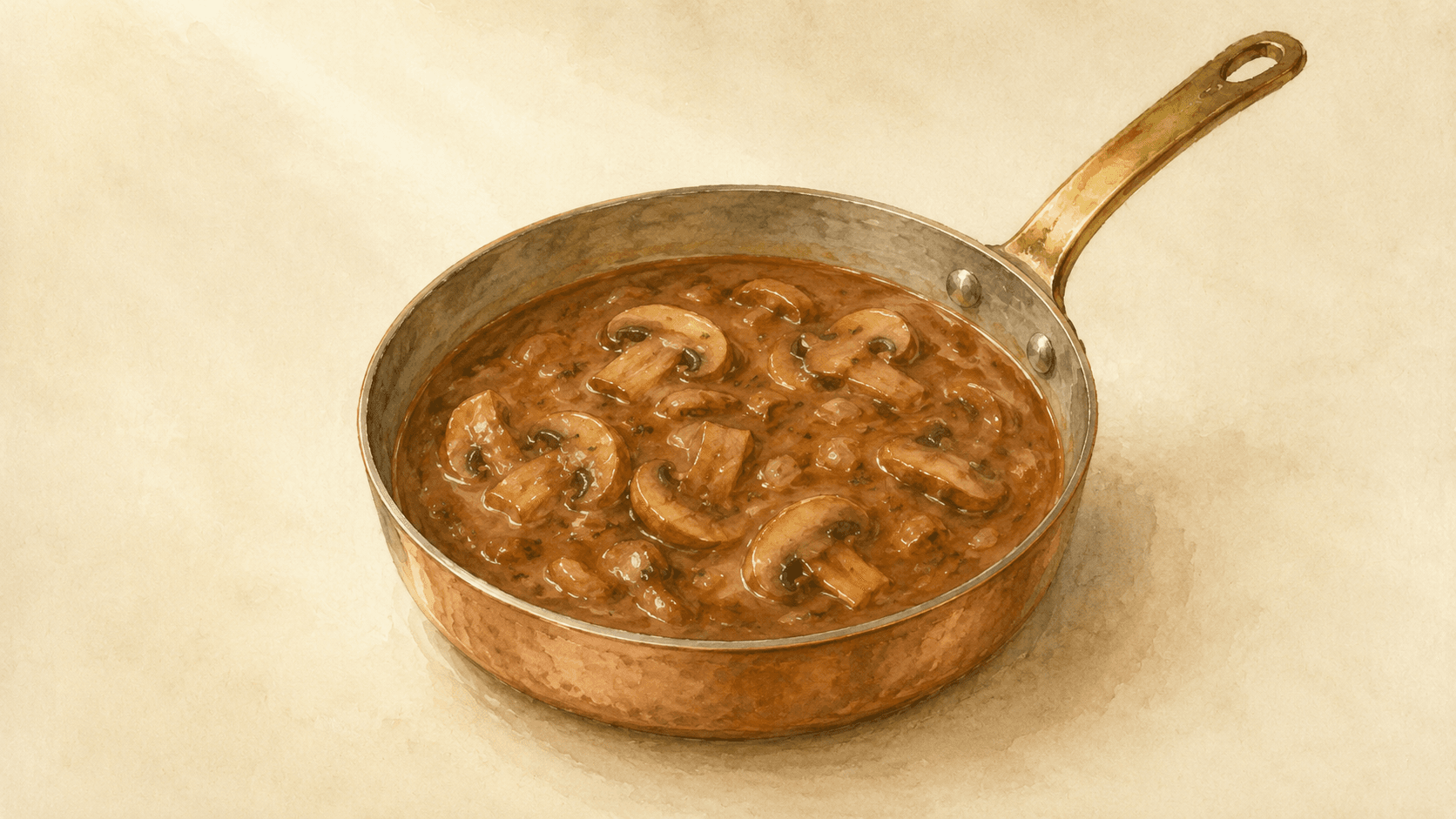
Hunter's sauce: shallots, white wine, tomato, tarragon, and demi-glace. A French compound sauce built on reduction — each ingredient added in a sequence designed to preserve its distinct contribution.
Contents (9 sections)▾
Ingredients
- 2 shallots, finely minced (about 60 g)
- 150 g cremini or button mushrooms, thinly sliced
- 120 ml dry white wine
- 200 ml demi-glace (or 400 ml reduced brown stock)
- 150 g canned whole tomatoes, drained and roughly chopped (or 2 ripe fresh tomatoes, peeled)
- 15 g unsalted butter, divided — 10 g for cooking, 5 g to finish (monter au beurre)
- 1 tbsp neutral oil
- 2 tbsp fresh tarragon leaves, chopped (or 1 tbsp dried)
- 1 tbsp fresh flat-leaf parsley, chopped
- Fine sea salt and black pepper
Steps
Heat the oil and 10 g of butter in a wide saucepan over medium heat. Add the shallots and cook, stirring, until translucent and softened — about 3 minutes. They should not color. This first stage extracts the volatile aromatics into the fat.
Add the mushrooms and increase heat to medium-high. Cook undisturbed for 2 minutes, then stir. The mushrooms will release their water and begin to brown lightly. Cook until most of the moisture has evaporated and the mushrooms are beginning to color at the edges, about 5 minutes total.
Add the white wine and increase heat to high. Stir to deglaze the pan, scraping up any fond from the bottom. Reduce the wine by about two-thirds — until the pan is nearly dry and the wine's raw alcohol note has cooked off. This takes 3–4 minutes.
Add the demi-glace and the tomatoes. Stir to combine. Reduce the heat to a steady simmer and cook uncovered for 10–12 minutes, until the sauce has thickened slightly and the flavors have married. Taste: the sauce should be rich and savory with the tomato providing body and a faint acidity, not a pronounced tomato flavor.
Off the heat, swirl in the remaining 5 g of cold butter (monter au beurre) — this creates a light gloss and rounds the finish. Add the tarragon and parsley. Season with salt and pepper. Serve immediately over pan-roasted chicken thighs, seared veal, or roasted game birds.
Tools you'll want
- · Tri-ply stainless saucepan (1.5–2 qt / 18cm)
- · Sauce strainer (chinois, perforated, or fine-mesh, 19–25cm)
Why this works
Sauce chasseur is a French compound sauce — a base sauce (demi-glace) extended with a flavoring combination (shallots, wine, tomato, herbs) that is specific to this preparation. The word "chasseur" means hunter in French, and the sauce was classically associated with game: pheasant, rabbit, partridge, venison. Over time it migrated to poultry and veal.
The structure is a reduction sauce. Each step removes water to concentrate flavor and build viscosity: the wine reduces to concentrate its aromatics; the demi-glace reduces to build body; the tomatoes cook down to contribute acid and a secondary umami from their glutamate content. The mushrooms do not reduce but contribute texture and another layer of savory depth.
Tarragon is the identifying herb. It has a licorice-anise character that is specific to French classical cooking — you find it in béarnaise, in tarragon chicken, in this sauce. Fresh tarragon added off the heat preserves its volatile oils; dried tarragon added earlier survives the simmer better but with a slightly flatter flavor. Either works; the decision is about whether you want the bright top-note of fresh herb or the more integrated but less vivid contribution of dried.
The final monter au beurre — mounting with butter — is the finishing move in most French compound sauces. Cold butter whisked or swirled into a hot sauce creates a temporary emulsion that gives the sauce gloss and a slightly rounder, richer mouthfeel. The sauce should be served promptly; if it sits and is reheated, the emulsion breaks and the gloss is lost.
Common mistakes
Insufficient wine reduction.
Target: Reduce wine to near-dry (just a glaze on the pan) before adding demi-glace.
Why it matters: Raw alcohol creates a sharp edge under the richness — even good demi-glace can't mask it. The reduction is structural.
What to do: 2/3 reduction minimum, ideally to syrupy near-dry consistency before stock goes in.
Workarounds:
- Used too much wine → continue reducing 5-10 min more before adding demi-glace.
Too much tomato.
Target: Tomato is supporting role — about 1 tbsp concassée or paste per cup of final sauce.
Why it matters: Chasseur should taste of wine, mushroom, and meat depth — not tomato-mushroom dish. Excess tomato shifts identity entirely.
What to do: Small amount only. Cook longer to reduce tomato into the background.
Workarounds:
- Added too much → continue reducing to concentrate; tomato becomes less dominant relatively.
Using stock without adjustment.
Target: Demi-glace ideally; if using stock, reduce by at least 50% extra.
Why it matters: Demi-glace is pre-reduced by half — substituting stock 1:1 gives thin, watery sauce. Demi-glace step is what gives chasseur its weight.
What to do: Plan reduction time — 30-40 extra minutes with stock to match body.
Workarounds:
- Time-short → 1 tsp gelatin dissolved in warm water for body without long reduction; not authentic but functional.
Adding fresh herbs too early.
Target: Tarragon + parsley at the very end, off-heat, within 30 sec of serving.
Why it matters: Volatile oils in tarragon and parsley dissipate within 5-10 min of simmering. Late addition keeps the brightness that defines chasseur.
What to do: Chop while sauce simmers. Add after pulling from heat, just before plating.
Workarounds:
- Want stronger herb presence → dried tarragon early + fresh at end (double layer).
Over-salting before final reduction.
Target: Light pinch during cook, final salt adjustment AT the end.
Why it matters: Sauce concentrates as it reduces — salt added early becomes over-concentrated. Final volume = final salt level.
What to do: Taste at the end before adjusting. Demi-glace is already salted; less needed than you'd think.
Workarounds:
- Over-salted → add 1 tsp warm cream or extra demi-glace to dilute.
What to look for
- Shallots: translucent, soft, no color. They are melting into the sauce rather than browning.
- Wine reduction: nearly dry, no sharp alcohol smell. The wine has cooked in and concentrated.
- Mid-simmer: sauce visibly thickening, coating the back of a spoon. The demi-glace is doing its work.
- Done: rich amber color, sauce coats a spoon and holds a clean line. Monter au beurre added off-heat gives gloss.
Substitutions
- Cremini → button mushrooms or a 50/50 with shiitake. Shiitake darkens and deepens the sauce; pure button is cleaner.
- Cognac → brandy or armagnac. All three behave the same; the flavor shifts subtly toward fruit (armagnac) or grain (brandy).
- White wine → dry sherry. Sherry intensifies the nutty register that suits chicken; stick to wine for veal or rabbit.
- Tomato paste → 1 tsp gochujang for an off-script version. Adds umami and gentle heat — works under duck or pork, less so under chicken.
Make-ahead and storage
- Hold warm up to 1 hour over barely-warm water; stir occasionally to prevent the butter from separating.
- Refrigerate finished sauce for 2 days max. Reheat gently in a saucepan over low heat — never microwave; the emulsion goes grainy.
- Mushroom-and-shallot base freezes well. Cook just to the deglaze step, cool, freeze in 200 ml portions. Finish with the wine and tomato at service time.
- Don't add the final butter until plating if you plan to hold. Cold butter into hot sauce off-heat is the safest finish.
Chef's view
Sauce chasseur (literally "hunter's sauce," named for game cooking) occupies an interesting position in the classical repertoire: it is both a specific named sauce and an illustration of the broader system of French compound sauces (a base "mother" sauce extended into a specific named variant by adding flavoring ingredients). The method — aromatics in fat, deglaze with wine, add base sauce, add flavoring elements, finish with butter and herbs — applies to a dozen other sauces in the classical canon, including sauce Robert (shallot, white wine, mustard, demi-glace) and sauce diable (shallot, white wine, cayenne, demi-glace). Learning chasseur is learning the template.
The relationship between chasseur and Italian cacciatore ("hunter" in Italian) is debated but instructive. Both involve tomato, wine, mushrooms, and aromatics; both are associated with game or poultry. The Italian version tends to use more tomato, more olive oil, and less of a reduced meat base. The French version is more precisely architectured around the demi-glace (a French brown sauce reduced by roughly half from a base of brown stock and espagnole). They are parallel responses to the same culinary challenge.
Chef Test Notes
Tested with both fresh and canned tomatoes. Canned tomatoes (San Marzano-type, drained) gave a more consistent result with a cleaner acidity. Fresh tomatoes in summer gave a brighter flavor but needed 3–4 minutes of extra cooking to reduce the additional moisture. The demi-glace quality makes the largest difference in the final sauce — a well-reduced house-made demi-glace produced a sauce with significantly more depth than commercial stock reduction. If making this for a serious occasion, the demi-glace is worth making from scratch.
Related glossary terms
- Demi-glace — the concentrated brown stock base that defines the sauce's body
- Reduction — the evaporative concentration at the center of the sauce's method
- Monter au beurre — the cold-butter finishing technique that adds gloss
- Fond — the caramelized deposits deglazed from the pan in step 3
Get the essays in your inbox — free
Weekly notes on flavor, fermentation, and food history — the writing behind the Atlas of Flavor. No spam; unsubscribe anytime.