
Pad Krapow Gai
Pad Krapow Gai is a Thai dish of stir-fried chicken with chili, garlic, and Thai basil, typically served with rice.
Contents (5 sections)▾
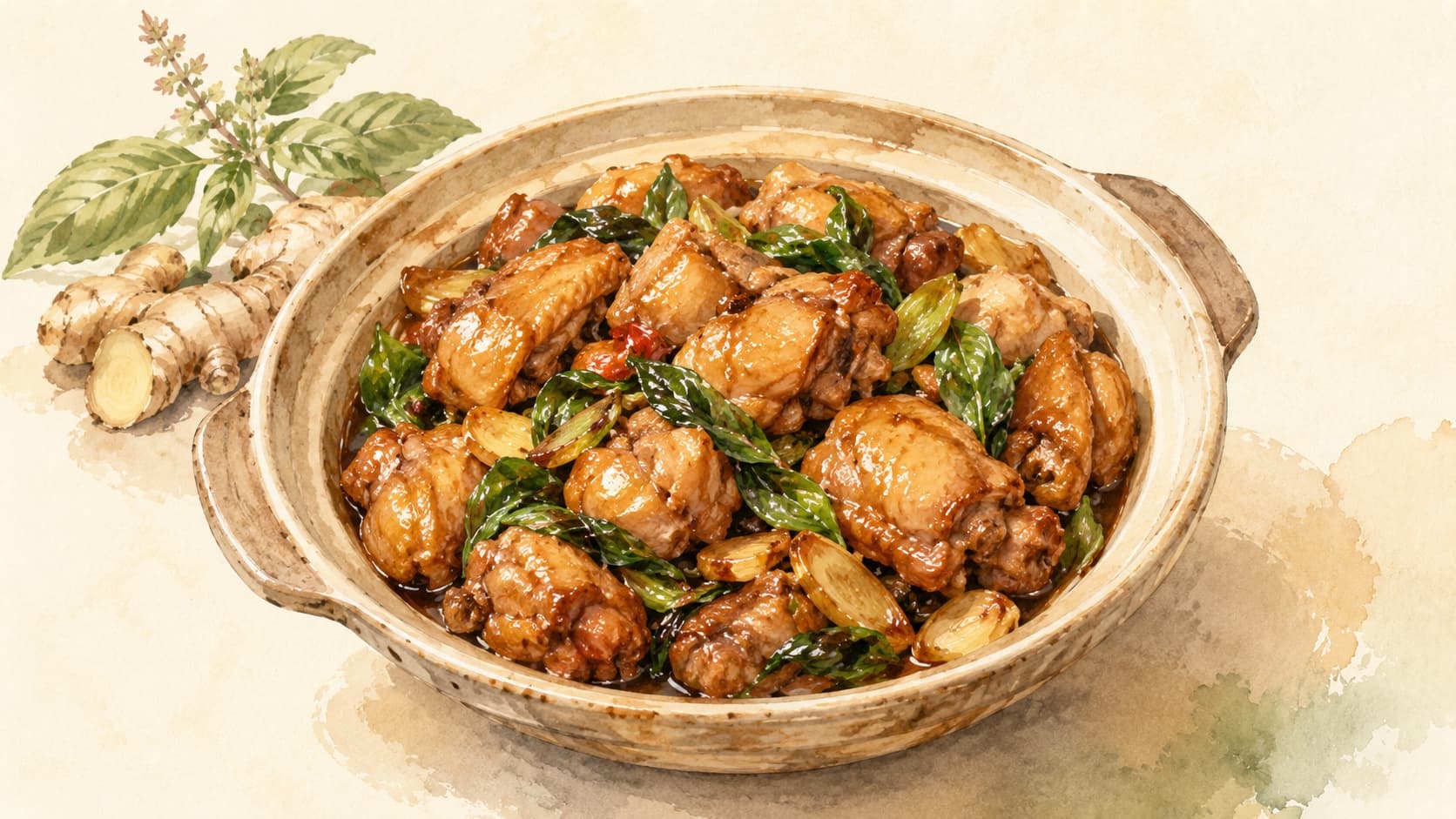
Ingredients
- 300 g ground chicken
- 2 cloves garlic, minced
- 2 Thai bird's eye chilies, chopped
- 2 tbsp vegetable oil
- 1 tbsp fish sauce
- 1 tbsp soy sauce
- 1 tsp sugar
- 1 cup holy basil leaves
- 1 fried egg, for serving
- cooked jasmine rice, for serving
Steps
Heat 2 tablespoons of vegetable oil in a large skillet over medium-high heat. This allows the oil to become hot enough to stir-fry the chicken evenly.
Add 2 minced garlic cloves and 2 chopped bird's eye chilies to the skillet. Sauté for about 30 seconds until fragrant, enhancing the flavor base of the dish.
Add 300 grams of ground chicken to the skillet. Stir-fry for 5-7 minutes, breaking it into small crumbles until slightly browned. Ground chicken carries its surface bacteria mixed all the way through, so cook it fully: it must reach 74 °C / 165 °F — check the thickest clump with an instant-read thermometer. The browning and time are texture cues; the measured temperature is the safety check.
Stir in 1 tablespoon of fish sauce, 1 tablespoon of soy sauce, and 1 teaspoon of sugar. Cook for another 2 minutes, allowing the flavors to meld.
Finally, add 1 cup of holy basil leaves and stir for 1 minute until the leaves are wilted. This step is crucial as it adds freshness and aroma.
Serve the Pad Krapow Gai over cooked jasmine rice, topped with a fried egg. A runny yolk is traditional, but it is undercooked egg with no validated *Salmonella* kill step: to keep it runny, use an egg **pasteurized in the shell** (treated through to the contents) — freshness, a 生食用 label, appearance, time, and residual heat are not substitutes — otherwise cook the yolk fully through. Either way, set the white fully opaque. High-risk diners (pregnancy, immunocompromised, very young or old) should use a pasteurized egg or a fully cooked yolk.
Why this works
The key to a successful Pad Krapow Gai lies in the high heat and quick cooking process, which allows the chicken to sear and brown quickly while absorbing the flavors of garlic, chilies, and fish sauce. The use of holy basil is non-negotiable, as it provides a unique, aromatic flavor. If the dish seems too salty, adding a touch of sugar can help balance the flavors. Conversely, if you find it too spicy, serve it with a side of jasmine rice to tone it down. This dish encapsulates the essence of Thai cooking, where bold flavors and fresh ingredients come together harmoniously.
Safety note (fried egg). The fried egg (kai dao) is served with a soft, runny yolk. Softness, the glassy look, cooking time, and residual pan heat are not by themselves proof the egg is safe: this method has no validated Salmonella kill step. To keep the runny yolk, use an egg pasteurized in the shell (treated through to the contents) — ordinary freshness, or a "raw-eating" (生食用) label, is not the same as pasteurized. High-risk diners (pregnancy, immunocompromised, very young or old) should use a pasteurized egg or cook the yolk fully through.
Common mistakes
Pulling the chicken before it is fully cooked through. Target: Ground (minced) chicken must reach an internal temperature of at least 74°C (165°F), measured with a food thermometer in the thickest clump. Hold at full cook for at least a few seconds after that. Colour and clear juices vary from pan to pan and are not the safety test. Why it matters: Ground poultry has its surfaces (and any Salmonella or Campylobacter on them) mixed throughout the meat — there is no "outside" to sear safely. A pink centre in stir-fried ground chicken is not stylish, it is undercooked. Vulnerable diners (young children, pregnant people, elderly, immunocompromised) should always have it cooked fully through. What to do: Break the meat into small clumps as it hits the wok and keep moving it. When it looks uniformly tan, give it another 30 seconds, then check the thickest clump with an instant-read thermometer — it should read at least 74°C (165°F). Uniform colour and clear juices are helpful cues, but the thermometer is what confirms it is safe.
Treating the fried egg as decoration only. Target: Traditional kai dao has a glassy white and a soft yolk. For safety the white must be fully opaque; a soft or runny yolk is undercooked egg, so to keep it soft use an egg pasteurized in the shell (see the safety note above), otherwise cook the yolk fully through — for every diner, not only vulnerable ones. Why it matters: Whole-shell raw or barely cooked egg can carry Salmonella on the shell or inside. The runny-yolk look is iconic but it is a known risk point for sensitive eaters. What to do: Fry over hot oil so the white sets fast (about 60 seconds for opaque whites). To keep the yolk soft, use a pasteurized-in-shell egg; otherwise flip and cook the yolk fully through (about another 30 seconds). High-risk diners should always have a pasteurized or fully cooked yolk.
Bruising the holy basil by stir-frying it too long. Target: Holy basil (krapow) goes in for the final 20–30 seconds, off-heat or at the very edge of the heat, just until it wilts. Why it matters: The peppery, clove-like aromatics in holy basil are volatile (they evaporate fast under heat); long stir-frying drives them off and leaves a flat, vegetal note. The dish gets its name from this herb — without its perfume, it is just spicy minced chicken. What to do: Have the basil ready at the side of the wok. Cut the heat, add the leaves, fold twice, and serve.
Working in a wok that is not hot enough. Target: The pan should smoke faintly when the oil hits it; chicken should hiss loudly on contact, not sit and weep liquid. Why it matters: Stir-fry depends on dry, intense surface heat to drive the Maillard reaction (browning that creates savory depth). A cool wok lets the meat release water, which then steams instead of sears — flavors stay flat and the texture goes grey. What to do: Preheat the empty wok over high heat for 30–60 seconds before adding oil, then garlic and chilli, then meat. Work in two batches if your wok is small.
What to look for
- Holy basil leaves that go from glossy and stiff to barely wilted in seconds. The moment they soften and turn deep matte green, the dish is done — pulling the pan now keeps the perfume in.
- Chicken in small, uniform clumps with golden-brown edges and no visible pink. Colour is a cue, not proof — confirm the thickest clump reads at least 74°C (165°F) on a thermometer; any pink means back to the heat and another check.
- A pan sauce that looks almost dry — just glossy beads of seasoned oil clinging to the meat. Pad krapow is not saucy; if there is liquid pooling, the wok was not hot enough.
- Aroma that lifts the moment fish sauce hits the pan: sharp, savoury, slightly funky. That funky note is the umami signature; if it smells flat, the heat was too low to ignite the fish-sauce sugars.
A note on history
Phat kaphrao (the Thai-script transliteration of pad krapao/pad krapow — "stir-fried with holy basil") is a relatively young dish by Thai standards. Food historians place its rise around the reign of King Rama VII (r. 1925–1935), with Chinese-Thai cooks beginning to sell it from open kitchens; the real explosion was in Bangkok between the 1940s and 1960s, when wok cooking, jasmine rice and quick lunches became the backbone of urban working life. The "holy" in holy basil is Ocimum tenuiflorum, a peppery clove-scented herb cultivated across South and Southeast Asia, and it is the herb — not the meat — that defines the dish (Wikipedia: Phat kaphrao, Hot Thai Kitchen).
Get the essays in your inbox — free
Weekly notes on flavor, fermentation, and food history — the writing behind the Atlas of Flavor. No spam; unsubscribe anytime.