
Onsen Tamago
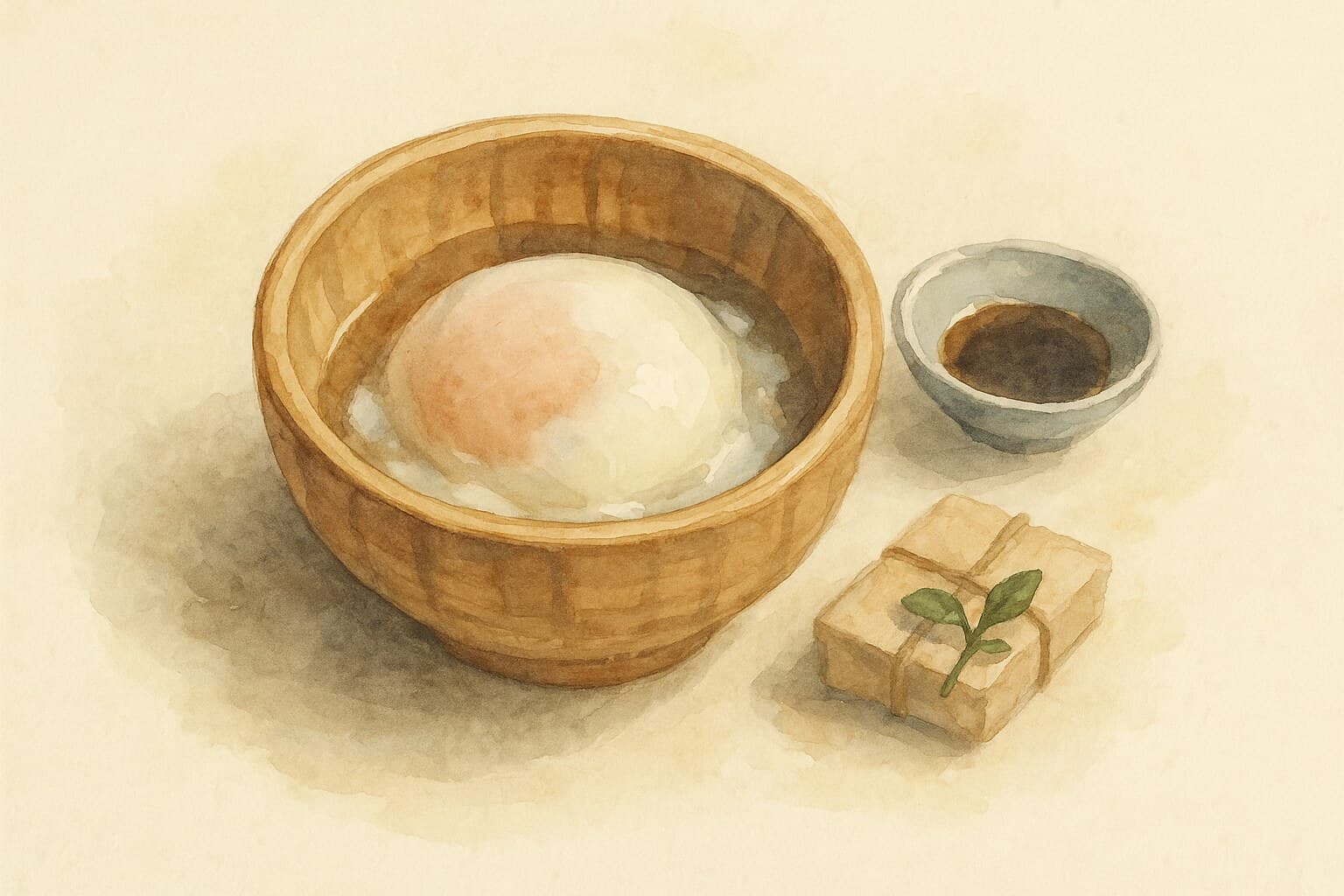
Onsen Tamago is a delicately slow-cooked egg, achieving a creamy texture that perfectly complements various dishes.
Contents (6 sections)▾
Ingredients
- 2 large eggs
- 1 liter water
- 1 tablespoon soy sauce
- 1 teaspoon mirin
- to taste green onions, finely chopped
Steps
Bring 1 liter of water to a gentle simmer in a pot over medium heat, ensuring it maintains a temperature of around 70-75°C (158-167°F).
Gently place the eggs in the simmering water and cook for 15 minutes to achieve a soft, creamy texture.
After 15 minutes, remove the eggs from the water and plunge them into an ice bath for 5 minutes to stop the cooking process.
Peel the eggs carefully and serve them with a drizzle of soy sauce, mirin, and a sprinkle of finely chopped green onions.
Why this works
Onsen Tamago, or 'hot spring egg' (named because they were traditionally cooked in the warm water of natural hot springs), is a Japanese delicacy that relies on precise temperature control to achieve its unique texture. Cooking the eggs at a low temperature of 70-75°C allows the proteins to coagulate gently, resulting in a creamy white and a custard-like yolk. This technique avoids the rubbery texture that often results from boiling eggs at high temperatures. If the temperature seems too high, reduce the heat to ensure a slow and steady simmer. If it breaks during cooking, don't worry; simply strain the egg into a bowl and enjoy it as a scramble, which still retains its delicious umami flavor. The use of soy sauce and mirin (a slightly sweet, low-alcohol Japanese rice wine used as a seasoning) seasons the dish, pairing beautifully with the eggs' rich texture and enhancing their natural flavors.
Common mistakes
- Temperature too high. Above 70 °C the white sets fully and you lose the signature half-set quivering texture. Keep the bath 65–68 °C.
- Insufficient time at temperature. Below 30 minutes the yolk hasn't thickened. The whole point is the yolk reaching a slow, creamy consistency.
- Trying to do it with boiling water. A vacuum flask, sous-vide bath, or covered pot held off-heat — these work. A pot on the stove drifts too much.
- Cracking too early. Let the egg cool 1 minute before cracking — the white is delicate immediately out of the bath and can tear.
What to look for
- Water temperature: hold steady at 66 °C (instant-read probe is the only reliable check; touch is too imprecise here).
- Time: 30 minutes minimum for a large egg, 35 for extra-large.
- The white: once cracked, the white should pour slowly — half-set, like a soft custard, not a fully set jelly.
- The yolk: warm, intact, distinctly thicker than a raw yolk but still flowing when pierced.
Substitutions
- Sous-vide bath → vacuum flask preheated with boiling water. Pour boiling water in, wait 2 minutes for the flask to warm, dump, refill to 66 °C, add egg, seal. Holds within 1 °C for the 30-minute window.
- Plain → with cold dashi-shoyu (1:1 dashi to soy + a splash of mirin) poured over. The standard ryokan presentation.
- Standard-size egg → quail egg at 60 °C for 12 minutes. Same principle, smaller package.
- Onsen → poached. Different texture entirely (set white, runny yolk). Onsen is half-set white + thick warm yolk — not the same dish.
Make-ahead and storage
- Best served within 10 minutes of cracking. The white sets further as it cools.
- Refrigerate intact eggs up to 24 hours after the bath. The half-set state is stable cold, but the dashi-shoyu sauce should be added at service time.
- Do not reheat. A second heating finishes setting the white and turns the yolk hard.
- Egg-safety note: Pasteurization is incomplete at 66 °C. People at higher risk (pregnant, immunocompromised, very young, very old) should use commercially pasteurized eggs or skip this dish.
Get the essays in your inbox — free
Weekly notes on flavor, fermentation, and food history — the writing behind the Atlas of Flavor. No spam; unsubscribe anytime.