
Larb Moo
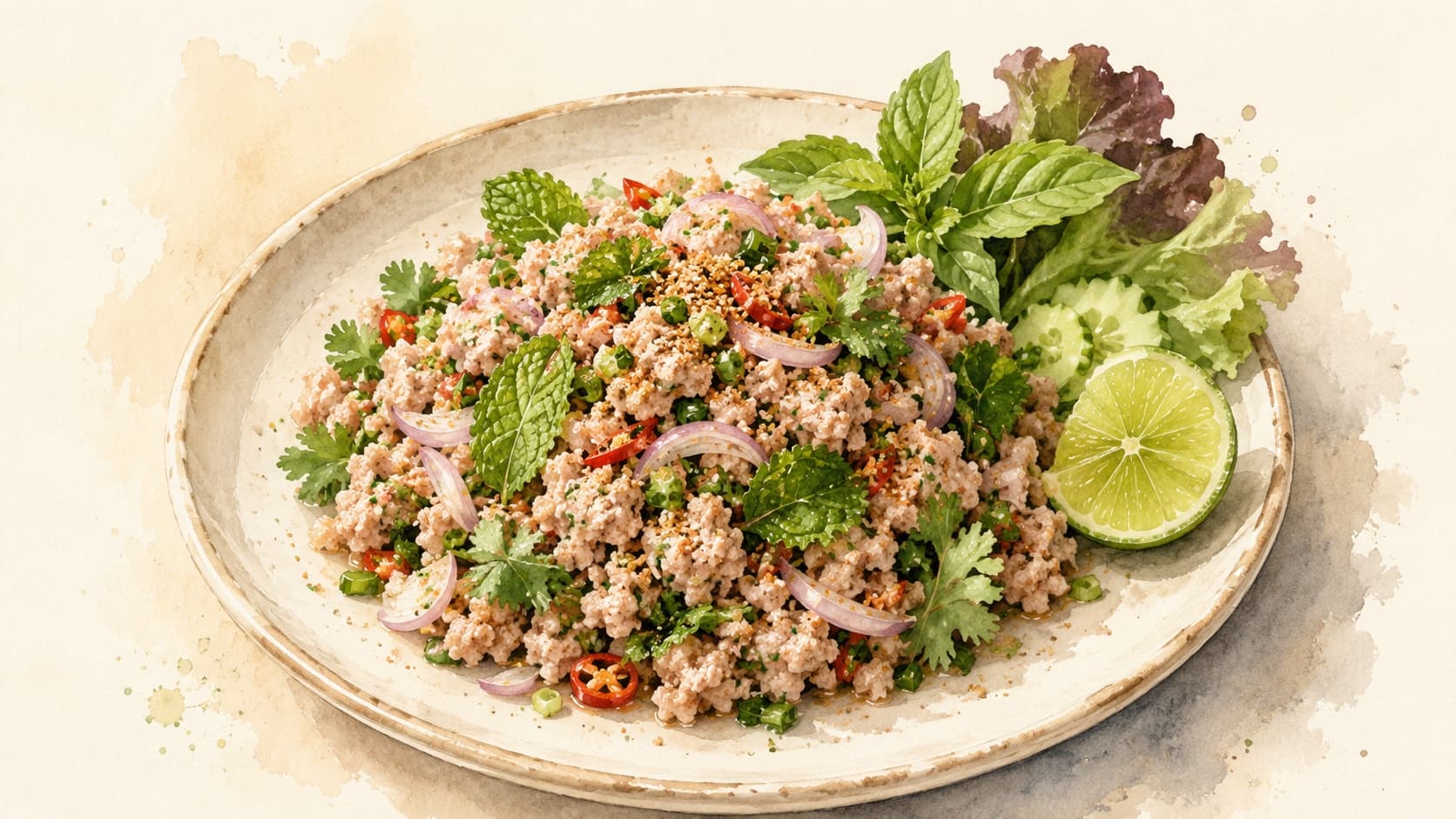
Larb Moo is a Thai minced pork salad, combining ground meat, herbs, lime juice, and fish sauce for a balance of flavors and textures.
Contents (5 sections)▾
Ingredients
- 500g ground pork
- 3 tablespoons of fish sauce
- 2 tablespoons of lime juice
- 1 tablespoon of roasted rice powder
- 1 tablespoon of chili flakes
- 1/2 cup of chopped fresh mint
- 1/2 cup of chopped cilantro
- 1/4 cup of sliced green onions
Steps
In a wide heavy skillet, cook the ground pork over medium heat until browned. Cook the ground meat until it reaches 71 °C / 160 °F on an instant-read thermometer (no longer pink throughout) — colour, float and time are guides, not the safety test.
Stir in the fish sauce, lime juice, chili flakes, and roasted rice powder.
Remove from heat and mix in mint, cilantro, and green onions.
Serve warm or at room temperature, garnished with additional herbs.
Tools you'll want
- · Digital kitchen scale (gram precision)
Why this works
The key to Larb Moo lies in the balance of flavors and the texture of the meat. Cooking the pork at medium heat allows for controlled browning, developing depth without drying out. The acidity from the lime juice and the umami of fish sauce penetrate the meat, enhancing its flavor while keeping it juicy. Roasted rice powder adds a unique nuttiness and acts as a binding agent, giving the dish a satisfying texture.
The combination of fresh herbs at the end maintains their vibrant color and aromatic quality. This step is critical; if added too early, they lose their brightness and pungency. The dish's overall structure relies on the interplay of crunchy herbs and tender pork, creating a refreshing yet hearty meal.
Common mistakes
Skipping the toasted rice powder (khao khua).
Target: 1 tbsp uncooked sticky rice toasted in a dry pan until deep golden, then ground to a coarse powder.
Why it matters: Khao khua is larb's defining ingredient. It provides nutty aroma, slight crunch, and absorbs the dressing into the meat — without it, the dish is just a pork salad. The toasting develops the distinctive nutty flavor through Maillard reaction (the browning chemistry that gives toasted bread and roasted nuts their smell — proteins and sugars meeting dry heat).
What to do: Toast 5–10 minutes in a dry pan, shaking constantly. Cool, grind in a mortar or spice mill to a coarse texture (sand-like, not flour-like).
Workarounds:
- No sticky rice? Use jasmine or any long-grain — different but acceptable.
- Quick version: use rice flour toasted in a dry pan for 3 minutes — less texture but similar aroma.
Using cooked or warm meat.
Target: Cook the pork in a small amount of water/broth (NOT oil), then mix the dressing into the warm meat (not hot, not cold).
Why it matters: Traditional larb uses water-cooked or "kao soi" (steamed) meat, not pan-fried. The water-cooking preserves the meat's juiciness and lets the dressing penetrate. Pan-frying creates browned bits that taste good but aren't traditional and skew the flavor toward "stir-fry with herbs."
What to do: Add minced pork to a small amount of simmering water/broth, break apart with a wooden spoon, and cook until it reaches 71°C / 160°F on an instant-read thermometer (about 3–4 minutes) — with minced pork, colour is not the safety test — then drain.
Workarounds:
- For deeper flavor, brown half the meat in oil and water-cook the other half — combine.
- Modern interpretation: pan-fry quickly in 1 tsp oil — different but defensible.
Wrong dressing balance.
Target: 2 tbsp fish sauce + 2 tbsp lime juice + 1 tsp sugar + 1 tsp Thai chili flakes (prik bon) per 300 g pork.
Why it matters: Larb is built on the Thai flavor trinity: salty (fish sauce), sour (lime), spicy (chili). The sugar is BARELY there — just to round the edges. Most home cooks over-sugar or under-acid the dish.
What to do: Mix dressing in a separate bowl, taste, adjust. Add to warm meat right before serving.
Workarounds:
- Too salty? Add more lime (and a touch more chili to keep heat balanced).
- Too sour? Add a pinch more sugar (NOT more fish sauce).
Skipping the fresh herbs.
Target: Generous handfuls of mint, cilantro, sawtooth coriander (pak chee farang), and thinly sliced shallot — added off-heat at the end.
Why it matters: The herbs are not garnish; they're a major flavor component. Each adds a different note: mint (cooling), cilantro (citrusy), sawtooth coriander (sharp, almost grassy), shallot (sweet sharpness). Without them, the dish has no aromatic dimension.
What to do: Tear or chop herbs at the last second. Mix into the warm meat just before plating.
Workarounds:
- No sawtooth coriander? Just use more cilantro — different but workable.
- For a "winter larb" when fresh herbs are scarce, dried mint and dried lime leaf add some compensation.
Heating the dressing.
Target: All dressing ingredients are added OFF-HEAT, mixed with warm (not hot) meat.
Why it matters: Lime juice and fresh herbs are heat-sensitive — boiling kills the volatile aromatics. The dish should be assembled at "warm tea" temperature, not "hot soup."
What to do: Cook meat, drain, let cool for 2 minutes, then dress. Serve at room temperature or just slightly warm.
Workarounds:
- If serving cold (next day), revive with a fresh squeeze of lime and a small handful of new herbs.
What to look for
- Vibrant colors from fresh herbs.
- A slight sheen from the cooked pork.
- A fragrant aroma of lime and spices.
- A harmonious mix of textures between the meat and herbs.
Chef's view
Larb Moo is not just a dish; it's a celebration of Thai culture. Originating from Laos, it embodies the region's love for fresh herbs and bold flavors. Each ingredient in Larb serves a purpose, from the fragrant herbs to the zesty lime. This dish reflects the importance of balance in Thai cuisine, where flavors must harmonize to create an enjoyable experience.
In Thailand, Larb is often served during gatherings, symbolizing community and connection. Understanding the nuances of this dish allows cooks to appreciate its cultural significance, transforming a simple meal into a shared celebration.
<!-- beginner-glossed v1 -->Get the essays in your inbox — free
Weekly notes on flavor, fermentation, and food history — the writing behind the Atlas of Flavor. No spam; unsubscribe anytime.