
Karaage
Twice-marinated, twice-fried chicken — potato starch mechanics and a two-temperature fry sequence produce the crust that defines the dish.
Contents (9 sections)▾
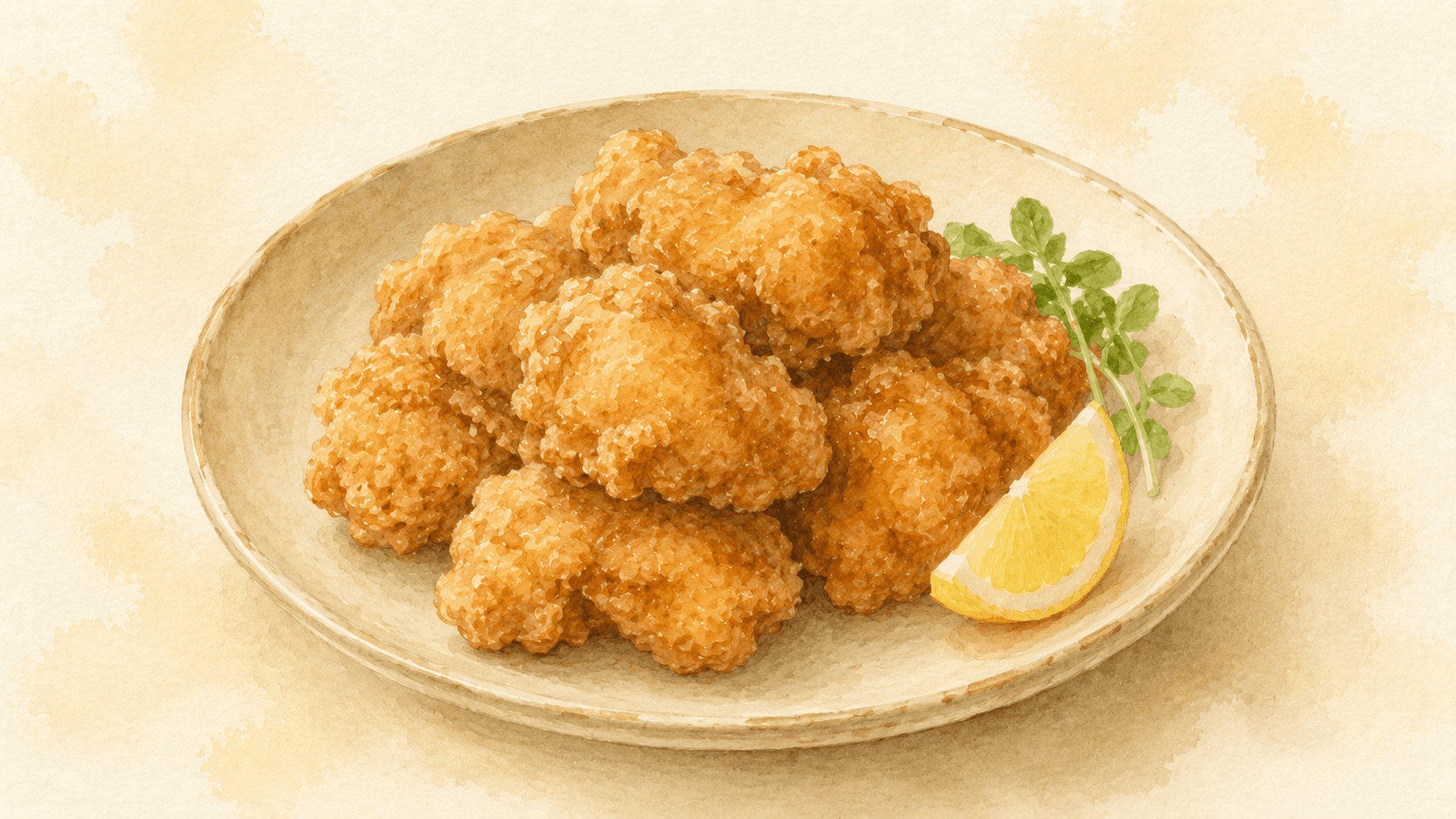
Ingredients
- 500 g boneless chicken thighs (skin on), cut into 3–4 cm pieces
- —
- First marinade (flavor):
- 30 ml soy sauce
- 30 ml sake
- 10 g fresh ginger, grated (juice included)
- 2 garlic cloves, grated
- —
- Second marinade (binding):
- 1 egg yolk
- —
- Coating:
- 50 g potato starch (katakuriko)
- —
- For frying:
- Neutral oil for deep frying (at least 6 cm deep)
- —
- To serve:
- Lemon wedges
- Shredded cabbage or Japanese mayonnaise (optional)
Steps
First marinade. Combine soy sauce, sake, grated ginger (with its juice), and grated garlic in a bowl. Add the chicken pieces, toss to coat, cover, and refrigerate for at least 30 minutes — up to 2 hours. The sake and soy penetrate the muscle fiber and season it from within; the ginger and garlic add aromatic depth.
Second marinade. Just before coating, add the egg yolk to the marinated chicken and toss to coat. The egg yolk creates a thin, sticky layer over the chicken surface that helps the potato starch adhere evenly and forms a richer, more blistered crust during frying.
Coat with potato starch. Add the potato starch to the chicken and toss until all pieces are evenly coated. The starch will look slightly damp and clumpy from absorbing the marinade moisture — this is correct. Do not add more starch to compensate; the clumps will become the textural blisters that define karaage.
First fry at 160°C. Heat oil to 160°C. Fry the chicken pieces in batches — do not overcrowd — for about 4–5 minutes, until the surface is set and the chicken is nearly cooked through (interior around 70°C — an intermediate stage, not yet the final safe temperature) but not deeply browned. Remove and drain on a rack. Rest for at least 3 minutes. This first fry cooks the chicken most of the way without over-browning the crust; the hotter second fry finishes cooking it.
Second fry at 185°C. Raise the oil temperature to 185°C. Return all the chicken pieces to the oil and fry for 90 seconds to 2 minutes, until deep golden-brown with a blistered, crackling exterior. The high-heat second fry drives out residual moisture from the crust, creating the characteristic karaage texture. By the end the chicken should be fully cooked: check the thickest piece with a food thermometer — it must read at least 74°C (165°F), the safe temperature for chicken. Colour, blistering, and fry time are texture cues, not the safety test. Drain on a rack (not paper towels — paper towels create steam underneath and soften the crust). Serve immediately with lemon wedges.
Tools you'll want
Why this works
Karaage is Japanese fried chicken, but the technique that produces its characteristic crust is meaningfully different from Western fried chicken methods, and understanding why explains the whole recipe.
The most important single choice is potato starch (katakuriko) over cornstarch or flour. Potato starch gelatinizes differently during frying: it forms a thinner, more irregular crust that blisters and cracks in oil at high temperature. The blisters are not a defect — they are the goal. Each blister is a small pocket where steam from the chicken's moisture pushed through the coating before the starch set; when the crust dries at high temperature, those pockets become hollow, fragile, crackling structures. Flour produces a smooth, breadcrumb-like shell. Cornstarch produces something in between. Only potato starch produces the specific texture that karaage is known for.
The two-marinade sequence is also technically deliberate. The first marinade (soy, sake, ginger, garlic) seasons the chicken from within. Sake in particular is important: it acts as a tenderizer (the ethanol disrupts muscle proteins slightly) and also as an odor suppressor for the chicken. The second marinade (egg yolk only, added just before coating) creates a thin, sticky, emulsified layer over the surface. This does two things: it helps the potato starch adhere more evenly, and it contributes to the blister formation by adding a richer, more protein-dense interface between chicken and starch.
The double-fry sequence — low temperature first (160°C), rest, high temperature second (185°C) — solves a problem inherent to frying dense protein. At 160°C, heat penetrates to the center without the exterior burning; at 185°C, the exterior dries out and crisps intensely. Frying at a single high temperature cooks the outside before the center is done, or cooks the center but chars the outside. The two-stage approach decouples "cooking through" from "crisping the exterior," doing each at its optimal temperature.
Draining on a wire rack, not paper towels, matters because karaage needs air circulation under the pieces to prevent steam from re-softening the crust.
Common mistakes
Using cornstarch instead of potato starch.
Target: Potato starch (katakuriko) — never cornstarch or flour as the primary coating.
Why it matters: Potato starch gelatinizes differently in hot oil — it produces the irregular blistered crust that defines karaage. Cornstarch gives a uniform crisp shell (closer to popcorn chicken); flour gives a breaded surface. Both are different dishes.
What to do: Buy katakuriko from a Japanese or Asian grocery. Read the label; "potato starch" on the back is the right confirmation.
Workarounds:
- Only have cornstarch → use 70/30 cornstarch+rice flour mix; closer in behavior, still not authentic blister.
Frying at a single temperature.
Target: 160°C first fry (4-5 min) → rest 3 min → 185°C second fry (90 sec - 2 min).
Why it matters: Single-temp frying forces a compromise — interior cooks but exterior browns too much, OR exterior crisps but interior is raw. The double fry decouples "cook through" from "crisp exterior," letting each happen at its optimal temperature.
What to do: Deep-fry thermometer. Plan for two passes from the start.
Workarounds:
- No thermometer → wooden chopstick test: at 160°C, slow steady bubbles. At 185°C, vigorous immediate bubbles.
Overcrowding the oil.
Target: 4-5 pieces max per batch. Oil temperature should drop no more than 10°C.
Why it matters: Cold chicken dropped into oil acts as thermal sink — too many pieces collapse the temperature, pieces poach in their juices rather than fry. Result: soft, pale, greasy karaage.
What to do: Work in batches. Let oil return to target temperature between batches.
Workarounds:
- Need to fry many at once → use a deeper, narrower pot with more oil volume for better thermal mass.
Not resting between fries.
Target: 3-5 minutes rest between first and second fry, pieces on a wire rack.
Why it matters: Resting allows interior heat to redistribute (residual cooking) and the exterior moisture to migrate outward and start evaporating. Skipping = soggy interior, less dramatic blister formation.
What to do: Rack ready before first fry. Drain → wait → second fry.
Workarounds:
- Time-short → minimum 2 minutes is acceptable; still better than zero rest.
Draining on paper towels.
Target: Wire rack for both drying and serving — not paper towels.
Why it matters: Paper towels trap steam under the chicken pieces → crust softens within 2-3 minutes. Wire rack allows steam to escape downward, preserving crispness for 10+ minutes (the typical eating window).
What to do: Set rack over baking sheet before frying. Place fried pieces directly.
Workarounds:
- No wire rack → metal cooling rack or chopsticks laid across a plate to elevate pieces.
Too short a first marinade.
Target: 30 minutes minimum, up to 12 hours overnight in fridge.
Why it matters: Under 30 min, soy and sake haven't penetrated muscle fiber — interior tastes plain, only surface is seasoned. Long marination (overnight) develops the deep, integrated flavor that defines great karaage.
What to do: Plan ahead. Marinate before work, fry in the evening.
Workarounds:
- Need to fry soon → use slightly stronger marinade (extra ginger, garlic) and rest at room temp 45 min instead of cold.
What to look for
- After first marinade: chicken pieces look darker, surface slightly tacky from soy and ginger.
- Starch coat: slightly clumpy and damp — the clumps will become blisters.
- First fry: light golden, not brown; pieces float and sizzle steadily; interior around 70°C — an intermediate stage, not yet the safe final temperature.
- After rest: exterior looks slightly matt and dry.
- Second fry: rapid color change to deep gold-brown, blisters visibly forming and popping; the thickest piece reaches at least 74°C / 165°F on a thermometer.
- On the rack: crust sounds hollow when tapped with a chopstick, pieces have a slight sheen.
Substitutions
- Chicken thigh → drumstick (bone-in). Bone-in needs 1–2 minutes longer per fry; the meat is juicier and the skin is the same.
- Potato starch → cornstarch. Cornstarch crisps slightly less aggressively but works. Avoid all-purpose flour for karaage — it goes pasty, not crisp.
- Soy sauce + sake marinade → soy + ginger + grated apple. A common Japanese family variation; apple's enzymes tenderize.
- Double fry → single longer fry at 170 °C. Saves time but the crust is thicker and less honeycomb-light. Use the double fry whenever you have 10 minutes.
Make-ahead and storage
- Best within 20 minutes of frying. Crust softens as the moisture inside the meat migrates outward.
- Refrigerate cooked karaage within 2 hours of frying. Keeps 2 days; bring back with a hot oven (200 °C, 5 minutes) on a rack — never the microwave, which goes soggy.
- Don't refrigerate marinated raw chicken longer than 24 hours. The acid (sake, ginger) starts breaking down the protein into a mealy texture.
- Marinated raw chicken freezes well for up to 3 weeks. Thaw overnight in the fridge — never at room temperature — and fry as usual.
Chef's view
The wire rack instruction is the detail most often skipped, and it is the detail that determines whether karaage stays crisp for the 10 minutes it takes to eat it or softens into something disappointing before it reaches the table. Karaage is a dish that requires the last 5 minutes of cook time to overlap with the first 5 minutes of eating time.
The double-fry logic is the exportable principle here. Decoupling "cooking through" from "crisping" applies beyond karaage to any protein where the interior and exterior have different ideal thermal histories — duck confit, double-fried potato chips, twice-cooked pork belly. The specific temperatures differ; the structural logic is the same.
Chef Test Notes
I tested potato starch versus cornstarch versus a 50/50 mix across four batches each. Potato starch consistently produced more pronounced blistering and a lighter, more fragile crunch. Cornstarch was more uniform, less characterful. The mix was intermediate. I also tested single-fry at 175°C (the "compromise" temperature many recipes suggest): the interior was cooked but the exterior was less crisp and the blisters were minimal. The double fry produced superior results in every batch.
Related glossary terms
- Katakuriko — the potato starch that creates karaage's signature blistered crust
- Double fry — the two-temperature technique that decouples cooking through from crisping
- Marinating — the two-stage flavor and binding process
- Izakaya — the informal Japanese dining context where karaage is canonical
Get the essays in your inbox — free
Weekly notes on flavor, fermentation, and food history — the writing behind the Atlas of Flavor. No spam; unsubscribe anytime.