
Harira
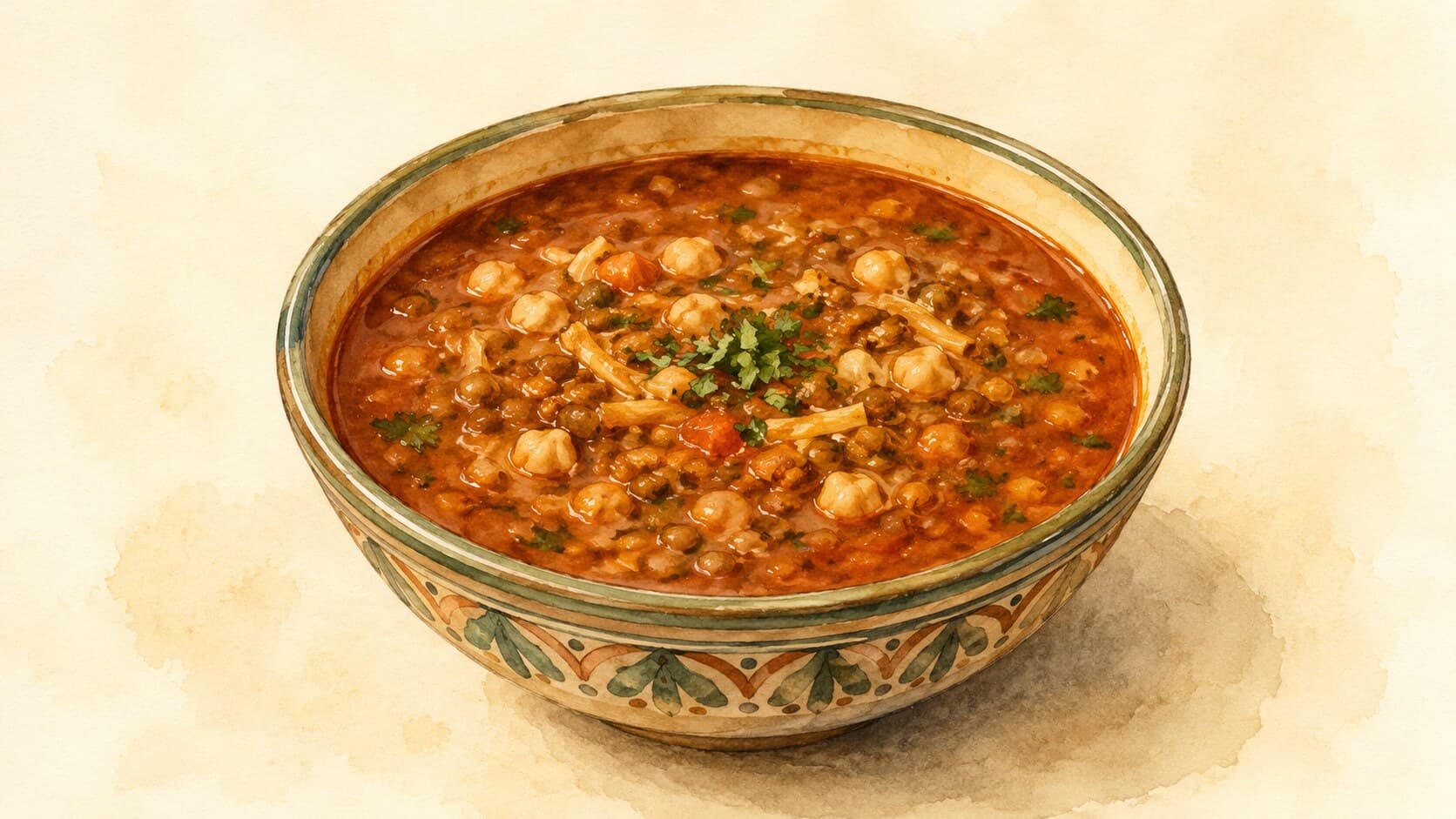
Harira is a Moroccan soup made with spiced lamb, lentils, and chickpeas, traditionally served during Ramadan iftar meals.
Contents (5 sections)▾
Ingredients
- 200 g lamb, diced
- 1 onion, chopped
- 2 cloves garlic, minced
- 1 tsp ground cumin
- 1 tsp ground cinnamon
- 1 tsp ras-el-hanout
- 400 g canned tomatoes, chopped
- 100 g lentils, rinsed
- 200 g chickpeas, cooked
- 1 liter water
- 2 tbsp flour
- 1 tbsp olive oil
- Salt to taste
- Black pepper to taste
- Fresh cilantro, chopped, for garnish
Steps
In a large pot, heat olive oil over medium heat. Add the diced lamb and cook for about 5 minutes until browned; this enhances the flavor.
Stir in the chopped onion and minced garlic. Sauté for 3-4 minutes until the onion is translucent.
Add ground cumin, cinnamon, and ras-el-hanout, cooking for an additional minute to release their aromas.
Pour in the chopped tomatoes, lentils, chickpeas, and water. Season with salt and black pepper. Bring to a boil.
Reduce heat to low, cover, and simmer for 20 minutes until the lentils are tender.
In a small bowl, mix flour with a little water to create a paste. Gradually stir into the soup to thicken it.
Allow the soup to simmer for another 5 minutes. Adjust seasoning if necessary.
Serve hot, garnished with fresh cilantro.
Why this works
Harira is a quintessential Moroccan soup that balances the rich flavors of spiced lamb, the earthiness of lentils, and the creaminess of chickpeas. The key to its delightful texture lies in the technique of thickening with a flour-water paste, which adds body and integrates seamlessly into the soup without clumping. If your soup seems too thick after adding the flour mixture, simply stir in additional water until the desired consistency is reached. This method ensures that the soup is both hearty and comforting, making it ideal for breaking fast during Ramadan. The use of ras-el-hanout, a traditional Moroccan spice blend, infuses the dish with warmth and complexity. The layering of flavors developed through sautéing the meat and vegetables creates a rich base that absorbs the spices beautifully, resulting in a satisfying and nourishing meal.
Common mistakes
Under-simmering the lentils, especially after adding tomato. Target: Lentils completely soft when pressed against the side of the pot — about 25–35 minutes total simmer in the pot, longer if the tomato went in early. Why it matters: Acid in tomato slows the softening of legume starch (the carbohydrate inside dried beans and lentils that needs water and gentle heat to fully hydrate). Lentils that are still slightly firm in the middle taste raw and chalky no matter how good the spices are. What to do: Get the lentils close to tender first if possible. Press a lentil between two fingers — it should yield with no chalky core.
Adding the spices to a cold or under-heated pan. Target: Add ground cumin, cinnamon, and ras-el-hanout to the hot oil with the softened onion and garlic, and stir for 30–60 seconds until fragrant before any liquid goes in. Why it matters: Ground spices need a brief direct contact with hot fat (called blooming — the heat releases the aromatic oils inside the spice particles so they actually carry through the soup). Stirred in cold with the water, they stay flat and dusty-tasting. What to do: Lower the heat slightly so the spices don't scorch, but keep the pan hot enough that you can hear a gentle sizzle as you stir.
Tipping the flour slurry into the pot in one pour. Target: Mix the flour with cold water first to a smooth, lump-free paste, then stir it into the soup in a thin stream while the soup is gently moving. Why it matters: Flour swells the moment it hits hot liquid — dropped in dry, it grabs water on the outside of each clump and traps dry flour inside (gluey lumps that never disperse). A cold-water slurry coats every starch grain before it can clump. What to do: Whisk the slurry in steadily, then simmer 5+ minutes — raw flour tastes pasty until it's properly cooked.
Not browning the lamb at all. Target: A clear deep-brown crust on the lamb cubes before liquid is added — about 5–7 minutes, in batches if the pan is small. Why it matters: The brown crust is the Maillard reaction (the savory browning that happens when proteins and sugars hit dry heat). Skip it, and the broth tastes thin and one-note no matter how long you simmer. What to do: Get the oil shimmering, add the lamb in a single layer, and don't move it for the first 2 minutes — that's when the crust forms.
What to look for
- End of spice bloom: the kitchen smells warm and cinnamon-forward, the oil around the spices looks darker and slightly glossy. That gloss is the aromatic oils released from the spice particles.
- Mid-simmer: a clean unified red-orange color, no separated puddle of oil floating on top. If oil is pooling, the simmer is too still — give it a stir to re-mix.
- Tedouira (slurry) thickening: the spoon leaves a brief trail across the surface; the soup coats the back of the spoon in a thin even film. That coating is the "silk" the name harira refers to.
- Finished soup: legumes fully tender to the bite, lamb pull-apart soft, broth velvety not gluey. If it's pasty, simmer a few more minutes uncovered to cook out the flour.
A note on history
Harira's roots run deep — culinary historian Lahcen Lahouari traces them back roughly 2,200 years, anchored in Amazigh (Berber) food culture and later shaped by Arab, Andalusian, and Mediterranean influences (Morocco World News Lifestyle, Culture Trip). The name itself comes from the Arabic word for silk, a reference to the velvety texture the soup takes on once thickened with a flour-water tedouira or beaten eggs (Taste of Maroc). Although eaten year-round, harira is most strongly associated with Ramadan, where it is traditionally the first dish served to break the fast, usually alongside dates and chebakia (a honey-and-sesame Moroccan fried-dough pastry) (Culture Trip).
Get the essays in your inbox — free
Weekly notes on flavor, fermentation, and food history — the writing behind the Atlas of Flavor. No spam; unsubscribe anytime.