
Ginger Scallion Sauce
This aromatic Ginger Scallion Sauce elevates dishes with its fresh, zesty flavors and is simple to make.
Contents (5 sections)▾
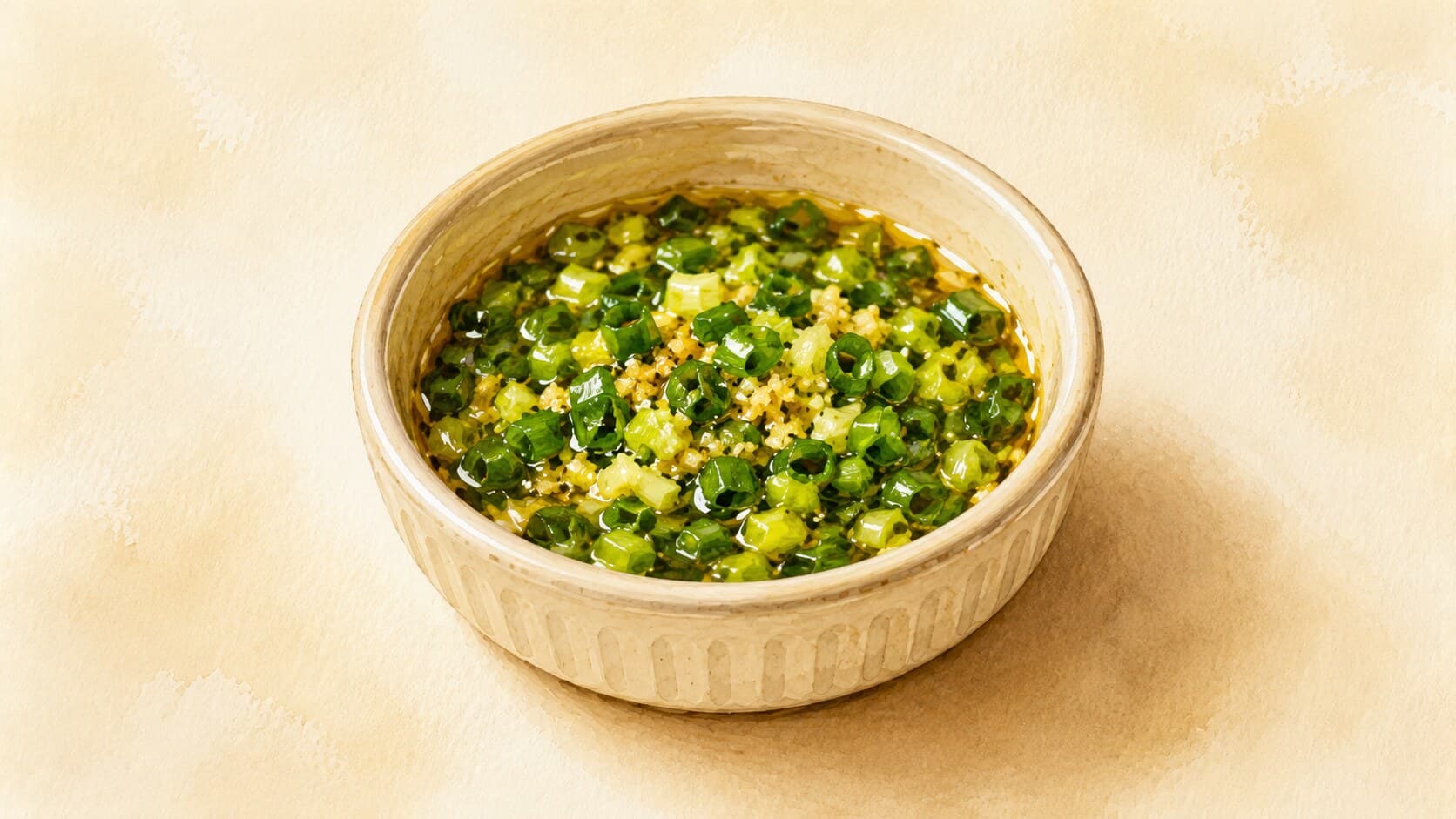
Ingredients
- 100 g fresh ginger, finely minced
- 100 g scallions, finely chopped
- 100 ml vegetable oil
- 1 tsp salt
- 1 tbsp soy sauce
- 1 tsp sesame oil
Steps
In a small pan, heat the vegetable oil over medium heat (about 160°C) until shimmering, but not smoking.
Add the minced ginger and sauté for 1-2 minutes until fragrant, stirring constantly to prevent burning.
Remove the pan from heat and stir in the chopped scallions, salt, soy sauce, and sesame oil, mixing well.
Let the sauce cool to room temperature before serving to allow the flavors to meld.
Why this works
Ginger Scallion Sauce is a vibrant combination of fresh ingredients that enhances many dishes. The technique of heating the oil allows the ginger to release its oils and flavor quickly, which is then infused into the scallions. This method also ensures that the rawness of the ginger is tempered, creating a balanced sauce. If the oil is too hot, it can scorch the ginger, leading to a bitter sauce; if this happens, simply reduce the heat or add a bit more fresh scallions to dilute the bitterness. The salt in the sauce helps to extract moisture from the scallions, intensifying their flavor while also providing a necessary contrast to the ginger's sharpness. Allowing the sauce to cool allows the ingredients to meld together, ensuring a harmonious blend of flavors. This sauce is versatile and can be served over grilled meats, stir-fries, or as a dip.
Common mistakes
Burning the ginger with oil that is too hot.
Target: Oil that shimmers and gives off a faint heat haze but is not yet smoking — roughly 150–170°C (300–340°F). When you drop a single piece of ginger in, it should sizzle steadily, not violently spit.
Why it matters: Ginger's aromatic compounds (gingerols and their cooked cousins, shogaols) are heat-sensitive — at moderate heat they bloom (release aroma into hot oil), but past the smoke point of the oil they break down into harsh, burnt-bitter notes. A pan that smokes is already past the sauce.
What to do: Heat the oil over medium, then test with one piece of ginger before adding the rest. If it sizzles aggressively or turns dark within seconds, pull the pan off the heat for 30 seconds before continuing.
Coarse, fibrous mince that never softens.
Target: Fresh ginger peeled and finely minced (or grated on a microplane), almost paste-like. Scallions sliced thin from both white and green parts.
Why it matters: A large chunk of ginger keeps its woody fibers no matter how long you bloom it. Fine cuts give more surface area for the oil to extract aroma, and the finished sauce coats food rather than studding it with stringy pieces.
What to do: Take a minute longer with the knife (or use a microplane — grating tool that reduces ginger to a fine pulp). Slice scallions on a slight diagonal for a thinner cut.
Treating it as long-shelf-life pantry sauce.
Target: Ginger scallion sauce is best the day it is made and within 2–3 days when refrigerated in a clean, sealed jar. It is at its finest within a few hours of cooling.
Why it matters: This sauce contains raw or only briefly bloomed aromatics in oil — exactly the storage conditions associated with risk if held at room temperature for long periods. Refrigeration (≤4°C / 40°F) is the safety baseline; freshness is also a flavor baseline because the scallion's green note fades fast.
What to do: Cool to room temperature within an hour, transfer to a clean glass jar, refrigerate immediately, and use within a few days. Do not leave at room temperature. Make small batches.
Skipping salt at the right moment.
Target: Add salt to the chopped scallions just before the hot oil hits them, not at the very end.
Why it matters: Salt on scallions performs a tiny osmosis (the movement of water across a cell wall toward the side with more salt) that draws moisture out and softens them just enough for the hot oil to bloom their aroma. Salt added at the end sits on top instead of working into the sauce.
What to do: Place sliced scallions in the bowl with the salt and a splash of soy sauce ready. Pour the hot oil-ginger mixture directly over them so everything blooms together.
What to look for
- Oil ready for the ginger: shimmering surface, faint haze, no smoke. A tossed-in scallion ring sizzles brightly but does not blacken.
- Ginger in oil, after 30–60 seconds: the pieces are pale gold, the aroma turns from sharp-raw to round and floral. If it darkens to brown, pull the pan immediately.
- Hot oil over scallions: a loud, brief sizzle, the green scallion turns a deeper jade, and the sauce smells immediately of cooked allium and ginger.
- Cooled sauce: the oil is pale gold to amber, the solids settle slightly, and the smell is clean — green, ginger-bright, savory. Any sour or stale note means it is past its window — discard and remake.
A note on history
Ginger scallion sauce — jeung yung (薑蓉) in Cantonese — is a classic Cantonese condiment built on two of the "mother" aromatics of southern Chinese cooking, ginger and scallion (China Sichuan Food). It is most strongly identified with Hong Kong's siu mei (Cantonese roast-meat shops), where it is the canonical dipping sauce for bak chit gai, the Cantonese white-cut (poached) chicken (The Hong Kong Cookery). The technique — pouring hot oil over raw aromatics to "bloom" them — is a small but central piece of Cantonese flavor logic, and the sauce travels easily beyond chicken to poached fish, plain rice, steamed vegetables, and noodles (Made With Lau).
Get the essays in your inbox — free
Weekly notes on flavor, fermentation, and food history — the writing behind the Atlas of Flavor. No spam; unsubscribe anytime.