
Fricassée de Poulet
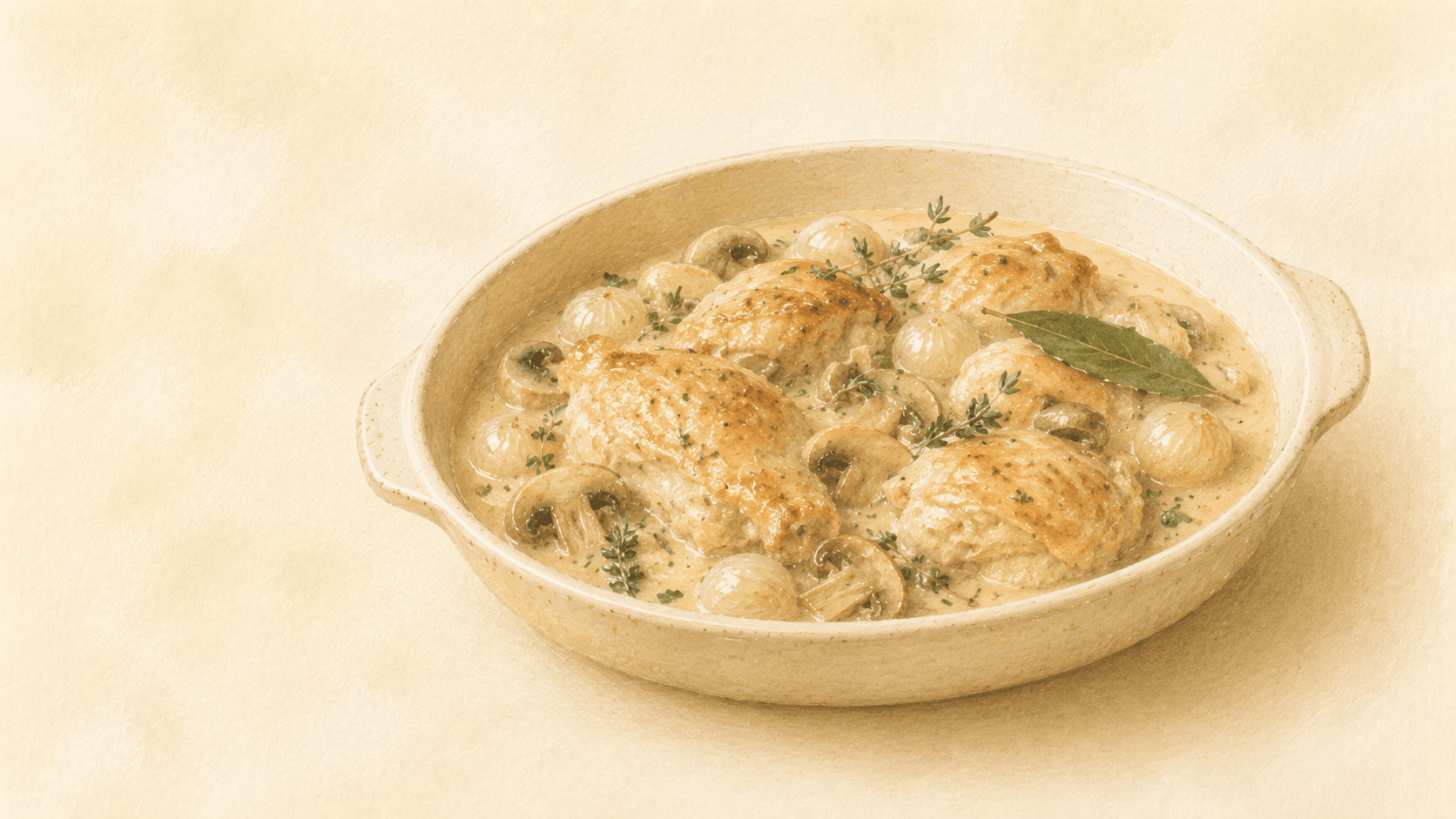
Chicken pieces browned lightly, then finished in a white sauce made from the cooking juices, cream, and sometimes mushrooms and pearl onions. Fricassée sits between a sauté and a braise — the chicken is not fully submerged, and the sauce is built from the pan, not from a separate stock reduction.
Contents (7 sections)▾
Ingredients
- 1.2–1.5 kg chicken, cut into pieces (legs, thighs, breast halves)
- 200 g button or cremini mushrooms — quartered
- 150 g pearl onions — blanched and peeled
- 30 g unsalted butter
- 1 tbsp neutral oil
- 200 ml dry white wine
- 200 ml chicken stock
- 200 ml heavy cream
- 2 egg yolks (for liaison — optional but traditional)
- Salt, white pepper
- Fresh thyme and bay leaf
- Fresh flat-leaf parsley — to finish
Steps
Season the chicken pieces with salt and white pepper. Heat the butter and oil in a wide, heavy-bottomed pan over medium heat. Brown the chicken pieces lightly on all sides — the goal is pale gold, not deep brown. This is a white fricassee; heavy caramelization would darken the finished sauce. Remove the chicken to a plate. This step develops a thin layer of Maillard-browned fond on the pan bottom, which is an important flavor base for the sauce.
In the same pan, sauté the pearl onions for 3–4 minutes until they begin to color. Add the mushrooms and cook until softened, about 4 minutes. Season lightly.
Deglaze the pan with the white wine, scraping up any browned bits from the bottom. Add the chicken stock and the thyme and bay leaf. Return the chicken pieces to the pan in a single layer. The liquid should come about halfway up the chicken — not submerging it. Bring to a gentle simmer, cover, and braise over medium-low heat for 25–30 minutes until the chicken is cooked through.
Remove the chicken pieces to a plate. Strain the cooking liquid through a fine sieve into a clean saucepan, pressing on the solids to extract flavor. Reserve the mushrooms and pearl onions. Reduce the strained liquid over medium heat by about one-third. Add the cream and return to a simmer. Reduce again until the sauce coats a spoon.
If using the egg yolk liaison: whisk the 2 egg yolks with a small amount of the hot cream in a separate bowl to temper them. Pour this mixture back into the sauce in a thin stream while stirring constantly. Do not allow the sauce to boil after adding the liaison — this will curdle the yolks. The liaison thickens the sauce and adds richness and a slight golden color. Return the chicken, mushrooms, and pearl onions to the sauce. Heat gently. Finish with chopped flat-leaf parsley.
Why this works
Fricassée (a French method of gently browning meat then simmering it in a creamy sauce built from the pan juices) occupies a precise position in the French classification of chicken preparations, and understanding that position clarifies the technique. It is distinct from blanquette (which is poached, not browned), coq au vin (which uses red wine and produces a dark sauce), and a simple sauté (which finishes with a quick pan sauce rather than a full braising stage).
The light browning step — the one that defines fricassée as a category — is deliberately restrained. The objective is a pale gold on the skin, not the deep caramelization of a roast. This produces a thin but significant layer of Maillard-browned fond on the pan bottom: complex amino acid-sugar reaction products that dissolve into the braising liquid during the deglazing step (pouring liquid into the hot pan to dissolve the browned residue stuck to the bottom) and give the finished white sauce a depth that it would lack if the chicken had been poached from raw. The white appearance of the sauce is not an indication of simplicity.
The egg yolk liaison is the classical thickening agent for fricassée and for blanquette de veau. It differs from a flour roux in two ways: it does not add starchiness or opacity; and it thickens through protein coagulation rather than starch gelatinization. When egg yolks are tempered into hot cream and added to a hot sauce below boiling point, the yolk proteins begin to denature and form a continuous network that increases the sauce's viscosity. The sauce must not boil after the liaison is added — at or above boiling point, the yolks coagulate fully, break from the sauce, and produce visible lumps. The temperature window is between approximately 70–82°C.
Pearl onions and mushrooms are the classic garnish for fricassée, and their inclusion is not merely traditional — both provide a textural counterpoint to the soft chicken and the smooth sauce. The mushrooms' glutamate content also reinforces the umami of the sauce.
Common mistakes
Over-browning the chicken.
Target: Pale gold on all surfaces — NOT deep brown.
Why it matters: Deep brown produces a sauce too dark for white fricassee and adds bitter caramelized notes. The white sauce character is the dish's defining feature.
What to do: Medium heat. Brief sear. Pull when pale gold.
Workarounds:
- Over-browned → accept "brown fricassee" — different but defensible dish (called "fricassée brune" in some regions).
Not reducing before adding cream.
Target: Reduce braising liquid by 1/3 before adding cream. Then reduce again briefly.
Why it matters: Cream added to unreduced liquid produces thin, watery sauce. Reduction concentrates flavor first, allowing cream to enrich without diluting.
What to do: Remove chicken. Reduce sauce. Add cream. Reduce again.
Workarounds:
- For body without long reduction, finish with a bit more cream + a knob of cold butter at the end.
Boiling after adding liaison.
Target: Egg yolk + cream liaison added at the end, sauce kept BELOW simmering thereafter.
Why it matters: The single most common failure. Boiling after the liaison breaks it — yolks scramble, sauce becomes lumpy.
What to do: Off-heat. Temper liaison with a ladle of hot sauce. Return to barely warm. Whisk gently.
Workarounds:
- Liaison curdled? Strain immediately — may rescue with gentle re-warming and additional cream.
Wrong cream.
Target: Heavy cream (35%+ fat) — NOT half-and-half, NOT low-fat versions.
Why it matters: Lower-fat cream produces thinner sauce, won't reduce correctly. The dish's silky character depends on 35%+ fat.
What to do: Use heavy cream. Real crème fraîche works equally well.
Workarounds:
- For shortcut, use a 50/50 mix of heavy cream + crème fraîche — extra body.
Wrong mushroom treatment.
Target: Mushrooms sautéed separately in butter until golden, added to the sauce at the end.
Why it matters: Mushrooms in fricassée provide textural contrast. Cooked with the chicken from the start, they release water that dilutes the sauce.
What to do: Sauté mushrooms separately. Add to the finished sauce just before serving.
Workarounds:
- For deeper flavor, use a mix of cultivated white + wild (chanterelles, morels) mushrooms.
What to look for
- After initial browning: chicken is pale gold on all surfaces. Pan has a thin, golden fond.
- After braising: the thickest part reads 74°C / 165°F on a food thermometer. Colour and juices vary and are not the safety test, so probe rather than judging by pink.
- Sauce before liaison: ivory, lightly coating a spoon.
- After liaison addition: slightly richer color, noticeably thicker consistency. Should coat a spoon without the sauce running immediately.
- Temperature management: sauce should be steaming without boiling. The surface should ripple, not bubble.
Chef's view
Fricassée is the entry point to understanding the French white sauce family — blanquette, velouté, and their derivatives. The egg yolk liaison specifically is a technique that does not appear in most other culinary traditions. Mastering it — tempering carefully, adding in a thin stream, maintaining temperature below boiling — gives access to a range of classic sauces that otherwise seem arbitrary. The physical principle (protein-network thickening below the coagulation point) is the same in each.
The dish is naturally suited to accompaniment with steamed rice, buttered egg noodles, or simply with crusty bread to take up the sauce. The cream sauce makes it relatively forgiving as a party dish: it can be held at a very low heat for 30–40 minutes without significant degradation, provided the sauce is never allowed to boil after the liaison is added.
Chef Test Notes
Tested with and without the egg yolk liaison. Without liaison, the sauce was lighter and less complex. The liaison adds noticeable richness and a slight velvety quality. Neither is wrong — the version without liaison is a reasonable shortcut.
Tested braising time: 20 minutes and 30 minutes. At 20 minutes, breast pieces were cooked through but thigh pieces needed more time. At 30 minutes, all pieces were fully cooked with no loss of moisture for the thigh. Breast pieces were slightly drier at 30 minutes — if using a whole chicken, consider removing the breast 5 minutes before the thighs.
Tested liaison temperature management: added at 85°C (just below simmering), at 90°C (simmering), and at 100°C (boiling). At 85°C, the liaison incorporated smoothly. At 90°C, it worked but with small flecks visible. At 100°C, the yolks curdled immediately.
Related glossary terms
- Liaison — the egg yolk-cream thickening method used at the end of this dish
- Fond — the caramelized pan deposits that flavor the sauce base
- Reduction — the evaporative concentration that builds the sauce
- Maillard reaction — the browning reaction from the initial chicken sear
Get the essays in your inbox — free
Weekly notes on flavor, fermentation, and food history — the writing behind the Atlas of Flavor. No spam; unsubscribe anytime.